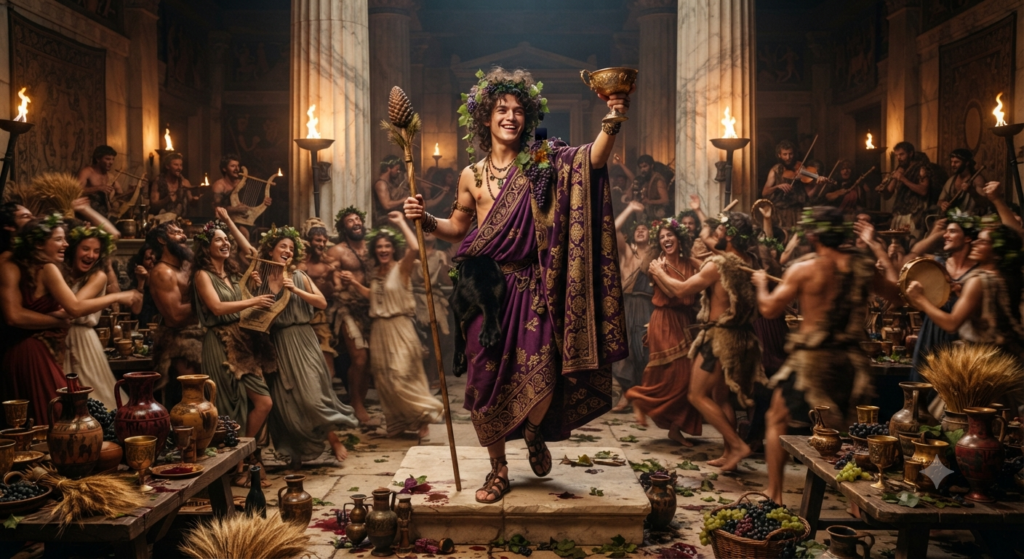
When people ask whether there was a Greek god associated with beer, the answer is not straightforward. Greek religion did not elevate beer to the same sacred status it gave wine, and there is no major Olympian whose office was beer in the way Dionysus is tied to the vine. Yet Greek texts do mention barley drinks, foreign brews, and local customs that stand beside the better-known world of wine.
Was there a Greek god of beer at all?
There is no widely attested Greek god whose central role was beer. In the surviving mythological tradition, no deity matches beer as directly as Dionysus matches wine, or Demeter matches grain. Greek religion was organized around many divine powers, but beer never became a dominant cult beverage in the Aegean world, and that absence matters. When Greeks spoke of beer-like drinks, they usually treated them as regional, foreign, or practical rather than as the focus of a major divine cult.
That does not mean the Greeks ignored fermented barley drinks altogether. Rather, beer remained outside the main symbolic center of Greek myth. If one asks, “Is there a Greek god associated with beer?” the safest answer is that there is no clear beer god in the classical canon. At most, one can speak of deities indirectly linked to brewing through grain, harvest, or drunken revelry, but not of a universally recognized divine patron of beer.
Dionysus, wine, and the limits of the sources
Dionysus is the obvious figure to mention, because he governs wine, ecstasy, theater, and the loosening of ordinary boundaries. Yet the sources consistently present him as the god of the vine and its wine, not of beer. Hesiod, Homeric material, and later mythographers associate him with grape cultivation, grapes, and the intoxication of wine. That distinction is important: the Greek religious imagination placed the vine at the center of Dionysian worship, not the barley brew used elsewhere in the ancient world.
The limits of the sources are just as revealing as what they contain. Greek authors wrote plenty about wine because wine was culturally central, but they almost never assign beer to Dionysus in any explicit way. Where barley drinks appear, they are usually named separately and treated as something different. Even if a modern reader wants to extend Dionysus’s domain to all fermented intoxication, the ancient evidence does not fully support that move. Greek religion was flexible, but it was also precise in its drink vocabulary.
Beer in ancient Greece and its foreign roots
Beer was known in the ancient Mediterranean long before or alongside Greek wine culture, but it was often associated with Egypt, Thrace, and other non-Greek regions. Greeks were aware that other peoples drank brewed grain beverages, yet they tended to regard those customs as foreign. In Greek eyes, beer belonged more naturally to lands where barley was common and vine culture less dominant. This helped keep beer from becoming a defining Greek ritual drink.
Classical authors sometimes refer to these drinks with a sense of cultural distance. The Greeks did not need beer to explain their own religious festivals, symposia, or myths because wine already filled that role. As a result, beer remained peripheral in Greek literature, even though the broader ancient world knew it well. The absence of a beer-centered god is therefore not an accident of survival alone; it reflects a real hierarchy of drinks in Greek civilization.
Zythos in Greek texts and everyday drinking
The Greek term most often connected with beer is zythos, a word usually understood as referring to Egyptian-style beer or a beer-like barley drink. When Greek writers mention zythos, they are generally not describing a standard Greek beverage, but a drink associated with other peoples. The term itself shows that the Greeks had a name for beer, yet one marked by cultural difference rather than domestic familiarity. It appears in texts as an object of observation more than devotion.
In everyday life, that meant beer was not woven into the ordinary religious and social habits of most Greek city-states. Wine, diluted with water, dominated the symposium and the libation bowl; beer did not. Still, the presence of zythos in Greek vocabulary proves that the drink was known and could be discussed without mystery. What it lacks, however, is a corresponding pan-Hellenic deity. The Greeks recognized the beverage, but they did not mythologize it in the way they mythologized wine.
Egyptian beer gods compared with Greek deities
Egypt offers a useful contrast, because beer there was deeply embedded in both daily life and sacred thought. Deities such as Tenenet and Hathor were connected, in different ways, with beer, festivity, and intoxication. Egyptian myth and ritual granted fermented grain drinks a religious visibility that Greek religion generally did not. In that world, beer could belong to the sphere of divine nourishment and celebration.
Greek religion had no exact equivalent. Demeter presided over grain and fertility, but not specifically over brewing. Dionysus ruled intoxication and ritual ecstasy, but through the vine. This difference shows how each culture shaped its gods around its own agricultural and social priorities. Where Egyptians found sacred meaning in beer, Greeks found it in wine. The comparison is helpful because it makes the Greek omission easier to understand: the lack of a beer god was part of a larger cultural pattern, not a gap in the mythology alone.
Why barley drink stayed outside Olympian cult
Barley drink stayed outside Olympian cult largely because Greek ritual life already had a powerful alcoholic center in wine. Wine was suited to sacrifice, libation, symposium, and mythic symbolism in a way beer never became. It could be mixed, poured, offered, and dramatized with ease. Beer, by contrast, had no comparable ritual vocabulary in mainstream Greek religion, at least not in the surviving evidence.
Agriculture also mattered. The Greek landscape favored vine cultivation in many regions, and wine became tied to identity, exchange, and ceremonial life. Barley was indispensable as food, but brewing it into a sacred drink never displaced the prestige of wine. Even where beer was known, it remained too closely associated with foreign practice to become central to the Olympian order. Greek cult generally elevated the drinks that reinforced Greek self-understanding, and beer did not occupy that place.
Ritual drink, symposium, and the place of wine
The symposium was one of the strongest reasons wine dominated Greek culture. It was not simply a drinking party, but a structured social and intellectual ritual in which wine was diluted, served, and discussed under rules that reflected civic identity. Greek poets, philosophers, and dramatists all treated wine as a medium for truth, frenzy, memory, and social order. This made wine far more than a beverage; it became a mythic and cultural instrument.
Beer had no equivalent institution in Greek elite culture. It did not anchor philosophy, lyric poetry, or sacrificial practice in the same way. When Greeks thought of ritual drink, they thought first of wine offered to gods and shared among humans. Dionysus’s presence in this sphere was so complete that beer had little room to acquire divine stature. The symposium, in effect, sealed wine’s place at the center of Greek religious and literary imagination.
Local cults and minor figures linked to brewing
The classical record does not give us a major Greek brewing god, but it does preserve the kind of local variation that often appears in Greek religion. Some places had smaller cults, epithets, or regional traditions that could connect deities with grain, nourishment, or festive intoxication in broad terms. These are not the same as a formal beer god, but they do show how flexible Greek religious thought could be at the margins.
Because the evidence is thin, caution is essential. Later speculation sometimes tries to assign brewing functions to minor gods or nymphs, but unless the sources explicitly say so, such identifications remain conjectural. Pausanias, for example, is invaluable for local cult detail, yet he does not reveal a Greek counterpart to a beer patron on the scale of Dionysus. What survives is suggestion rather than certainty: a religious world rich in local custom, but not one that seems to have centered brewing as a divine craft.
Mythic feasts where beer appears in the background
Greek myth is full of feasts, sacrifices, and banquets, but beer rarely appears in the foreground. The banquet scenes in Homer, for instance, are structured around wine, meat, and honor. Even when the stories involve abundance and foreign luxury, wine remains the drink that carries ritual weight. Beer may be present only implicitly, as part of the wider ancient world beyond Greece.
That background presence is still significant. Mythic feasting tells us what a culture chose to highlight. The Greeks made wine a marker of civilization and divine favor, while beer stayed mostly out of the frame. When drinking appears in myth, it usually signals hospitality, social bonds, or the dangerous edge of intoxication through wine. Beer does not receive that same narrative symbolism, which is one more reason there is no clear Greek beer deity in the stories that have come down to us.
What classical authors actually say about beer
Classical authors speak of beer sparingly, and when they do, they rarely praise it in religious terms. Herodotus, for example, notes foreign customs, including Egyptian drinking habits, and Greek writers after him continue to treat barley beer as something other peoples consume. Athenaeus preserves a great deal of culinary and drinking lore, yet even there beer appears more as an ethnographic curiosity than as a sacred beverage. The textual pattern is consistent across sources: beer is known, but not central.
That is why the scholarly consensus remains cautious. There is no strong classical evidence for a Greek god of beer, and no major mythological tradition around one. Greek religion honored grain through Demeter, intoxication through Dionysus, and local life through countless lesser powers, but beer itself did not become divine in the Hellenic imagination. The sources point in one direction: the Greeks knew beer was out there, yet they reserved their myths, rituals, and gods for wine.
So, is there a Greek god associated with beer? Not in any clear or classical sense. The Greeks knew barley drinks and sometimes described them, but beer never took the religious role that wine held in their world. In Greek mythology and cult, the vine belonged to Dionysus, the harvest to Demeter, and beer remained on the edge of the tradition, recognized but not enthroned.

Orin Vale has spent the better part of two decades tracing the threads that connect the world’s oldest stories — from the halls of Asgard to the banks of the Nile, from Olympus to the jungles of the Maya. What began as a childhood fascination with flood myths and trickster gods grew into years of independent study across comparative mythology and ancient religion, always chasing the same question: what did these stories mean to the people who first told them? Orin writes for readers who want more than trivia — the ones looking for the beliefs, fears, and truths that myths were built to carry.