Omphalos
Introduction

The omphalos is one of the most famous sacred objects in ancient Greek religion and mythology. Most often translated as “navel” or “center”, the term refers both to a physical cult object and to the broader idea of a world center, a point believed to connect heaven, earth, and divine authority. In Greek tradition, the omphalos at Delphi became especially important as a symbol of Apollo’s sanctuary and as a marker of the site many Greeks regarded as the center of the world.
The omphalos matters to the study of antiquity because it sits at the intersection of myth, ritual, politics, and geography. It appears in religious practice, in literary sources, in sanctuary architecture, and in later philosophical and symbolic interpretations. The object also reflects how ancient peoples used sacred geography to explain divine presence and human order.
Origin and Meaning
The Greek word ὀμφαλός (omphalós) means “navel”. By extension, it can mean the center or midpoint of something. In ancient religious usage, the term came to designate a sacred stone or marker associated with the center of the world.
The most famous omphalos was linked to Delphi in central Greece. Ancient writers and later interpreters treated it as a symbolic center of the inhabited world, the oikoumene. The concept was not limited to one city or sanctuary, however. In Greek thought, “navel” could also imply a place where the earth was especially open to divine communication.
The precise historical origin of the Delphi omphalos is not fully known. Ancient sources preserve mythological explanations, while archaeology reveals cult objects and monuments but not always a single definitive ritual beginning. As with many Greek sacred objects, its significance developed through a combination of local cult practice, Panhellenic prestige, and mythic storytelling.
Historical Context
The omphalos belongs to the religious world of ancient Greece, especially the sanctuary of Apollo at Delphi, which became one of the most important Panhellenic religious centers. Delphi was visited by city-states, rulers, envoys, and private individuals seeking oracles, divine legitimacy, and guidance.
In the Greek imagination, Delphi was not just a shrine. It was a place where:
- Apollo’s will was revealed through the Pythia, the priestess who delivered oracular responses.
- Sacred authority was tied to geography, ritual, and myth.
- The sanctuary occupied a central position in Greek collective memory and diplomacy.
The omphalos stood at the heart of this religious environment. It expressed the idea that Delphi was a cosmic midpoint and a place of contact between the human and divine worlds. At the same time, it likely functioned as a cult monument within a complex sanctuary landscape filled with altars, treasuries, statues, and votive offerings.
Different traditions developed around the object. Some accounts connected it to Zeus and the original order of the universe; others emphasized Apollo’s conquest of Delphi and the replacement of earlier divine powers, especially Python. Because ancient religion was layered and local, the omphalos cannot be reduced to a single story.
Main Characteristics
The omphalos is usually described as a stone object, often conical or rounded, sometimes covered with carved or sculpted patterns. The most famous surviving example is associated with Delphi and is displayed in modern archaeological contexts as a representation of the ancient cult object.
Common identifying features
- Stone construction
- Rounded or egg-like form
- Decorative carved net pattern in some artistic representations
- Association with sacred center or world axis
- Placement in a sanctuary, especially Delphi
Ancient images often depict the omphalos with a woolen fillet or sacred band wrapped around it. This detail appears in artistic and literary traditions and emphasizes its ritual status. The object is sometimes shown with a more abstract ornamental covering rather than as a plain stone.
It is important to note that the surviving archaeological material and the literary descriptions do not always match perfectly. The “omphalos” known from modern displays may reflect later reconstructions based on ancient references and surviving examples, rather than one universally fixed ancient form.
Family and Genealogy
As a sacred object, the omphalos does not have a conventional family genealogy in the way gods and heroes do. However, myth and ritual sometimes assign it relational significance within divine narratives.
Mythic relationships
- Zeus is sometimes associated with the original idea of the omphalos as the center of the world.
- Apollo is the primary god connected with the Delphi omphalos, since the sanctuary was dedicated to him.
- Python, the serpent or dragon defeated by Apollo in many versions of the Delphic myth, belongs to the sanctuary’s earlier mythical layer.
- In some traditions, earth goddess elements are implied, especially through the sanctity of the site itself.
Symbolic kinship
The omphalos can also be understood as related to:
- Oracular authority
- Sacred geography
- The “axis” or center of the world
- Foundational myths of sanctuary ownership
In this sense, its “genealogy” is not biological but cultural and ritual. It derives meaning from its placement within a network of divine relationships and mythic succession.
Symbols
The omphalos carries strong symbolic meaning in Greek religion and later interpretation.
Key symbols associated with the omphalos
| Symbol | Meaning |
|---|---|
| Navel | Center, origin, connection to life |
| Stone | Stability, permanence, sacred presence |
| Woolen fillet | Ritual consecration, sanctity |
| Net pattern | Sacred covering, cosmic order in artistic representations |
| Central placement | World midpoint, divine authority |
The most important symbolic idea is centrality. The omphalos signified not merely a location, but a cosmic and religious center. It could therefore represent:
- the center of the inhabited world,
- the point of communication with Apollo,
- the legitimate locus of prophecy,
- and the ordered structure of the universe.
In art and literature, the object’s rounded shape also evokes the human navel, reinforcing the idea of a site from which life and orientation radiate.
Sacred Animals
The omphalos itself is not usually associated with a large group of sacred animals in the way some gods are. However, the broader Delphic context brings it into contact with several significant animals.
Animals connected with the Delphic tradition
- Serpent or dragon: especially Python, the chthonic creature associated with the pre-Apollonian sanctuary.
- Dolphin: important in Apollo’s broader mythology, especially in the story of how he brought Cretan priests to Delphi in the Homeric Hymn to Apollo.
- Crows or ravens: sometimes associated with Apollo in Greek tradition, though not uniquely with the omphalos.
- Lions and other animals may appear in sanctuary art, but they are not central to omphalos symbolism.
The serpent is the most significant animal in relation to the Delphic sacred landscape. It represents the older, earth-linked power that Apollo displaces or transforms in myth. The dolphin, by contrast, belongs more to Apollo’s maritime and directional roles, which complement Delphi’s wider religious importance.
Sacred Plants
No plant is uniquely and universally tied to the omphalos in the way that laurel is tied to Apollo more broadly, but plants are still relevant to the Delphic sanctuary.
Important plants in the Delphic setting
- Laurel (daphne): sacred to Apollo and especially important at Delphi.
- Bay leaves: used in ritual contexts linked to Apollo and prophecy.
- Olivetree and other Mediterranean sacred flora: present in Greek ritual landscapes, though not specifically omphalos-related.
The strongest plant association is with laurel, which symbolized Apollo, purification, and prophetic power. Because Delphi was Apollo’s sanctuary, laurel acquired indirect relevance to the omphalos as part of the god’s cult environment.
Sacred Places
The omphalos is most famously associated with Delphi, but its symbolic meaning extends to sacred centers more broadly.
Delphi
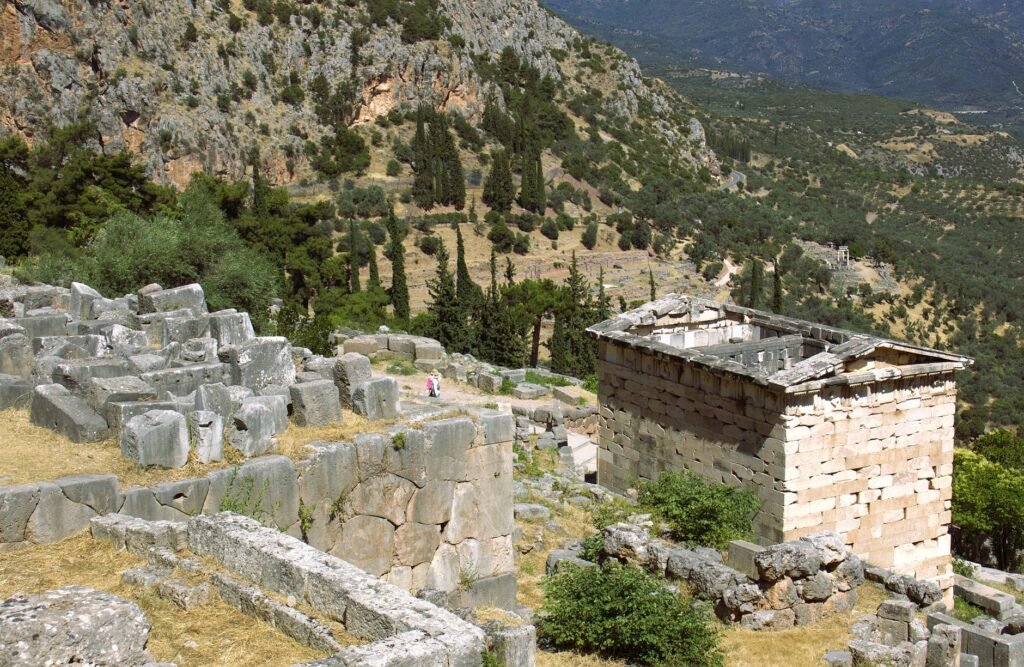
Delphi was the principal sanctuary of Apollo and the best-known home of the omphalos. Ancient Greeks regarded it as a place of extraordinary religious importance. The site included:
- the Temple of Apollo
- the altar
- the theater
- the stadium
- treasuries from various Greek cities
- votive monuments
- the sacred route leading through the sanctuary
The omphalos was connected to the temple’s interior cult life and to Delphi’s claim to be the center of the world.
Other places
While Delphi is primary, the omphalos concept also appears in broader discussions of sacred centers and world axes. Some later writers use “omphalos” more generally to describe important central places or monuments. However, these are interpretive extensions rather than equally prominent cult sites.
Powers and Attributes
Unlike a god, the omphalos does not possess powers in the supernatural sense. Its “attributes” are symbolic and ritual rather than personal.
Main functions and meanings
- Marks sacred center
- Establishes divine presence
- Signals prophetic authority
- Connects mythic origin with ritual location
- Represents cosmic order
- Legitimizes the sanctuary of Apollo
In a religious sense, the omphalos helped define Delphi as a place where human beings could seek answers from Apollo. In a broader cultural sense, it represented the Greek tendency to visualize order through sacred geography.
The object’s power lay in meaning, not physical action. It was powerful because it embodied a shared belief that the world had a center and that Delphi occupied it.
Main Myths
Several myths and legendary traditions are associated with the omphalos, especially through its connection to Delphi and Apollo.
Zeus and the center of the world
One widespread tradition held that Zeus released two eagles from opposite ends of the world, and they met at Delphi. This meeting marked the site as the center, or omphalos, of the earth. Different versions of this story are attributed in ancient traditions, and while the exact earliest source is debated, the myth became closely tied to Delphic centrality.
Apollo and Python
The most famous Delphic myth concerns Apollo’s arrival at Delphi and his defeat of Python, the serpent guardian of the earlier sanctuary. In many versions, Apollo kills Python and takes over the site, establishing his oracle. The omphalos belongs to this new order and symbolizes Apollo’s legitimate possession of the sanctuary.
The Homeric Hymn to Apollo
The Homeric Hymn to Apollo is crucial for Delphic myth. It describes Apollo’s search for a place to establish his cult and oracle. Although the omphalos is not always the main focus, the hymn helps frame Delphi as a chosen sacred location and supports later traditions that identify it as central.
The return of order
In a symbolic reading, the omphalos mythically expresses the transition from chaos or local chthonic power to ordered Olympian religion. Apollo’s sanctuary does not simply occupy a place on a map; it imposes a sacred structure on the world.
Relationship with Other Mythological Figures
The omphalos is not a deity, but it is deeply connected to several major mythological figures.
Apollo
Apollo is the figure most closely associated with the omphalos. As god of prophecy, music, purification, and ordered divine speech, he is the natural patron of a symbol marking the center of sacred communication.
Zeus
Zeus appears in traditions about the world’s center and cosmic order. The meeting of eagles at Delphi is a particularly important example of Zeus-linked symbolism.
Python
Python represents the older, pre-Apollonian power of the site. The omphalos’s Delphic meaning is strengthened by the contrast between Apollo’s new cult and Python’s defeat.
The Pythia
The priestess of Delphi, known as the Pythia, is indirectly related to the omphalos through the oracle. Her role made the sanctuary’s center active and authoritative.
Dionysus
Delphi also had strong connections with Dionysus, especially in seasonal or ritual interpretations of the sanctuary. While not directly tied to the omphalos in the same way as Apollo, Dionysian presence reminds us that Delphi’s cult life was layered and complex.
Worship and Cult
The omphalos was part of the ritual life of Delphi and the wider Greek sanctuary system.
Ritual context
The object likely functioned as a cult marker and possibly as a focus for ritual attention. Ancient sources and later interpretations suggest that it was treated with reverence and may have been wrapped in sacred wool or adorned for ceremonial purposes.
Types of devotion connected to Delphi
- Consultation of the oracle
- Offerings and dedications
- Sacrifices to Apollo
- Purification rituals
- Participation in Panhellenic festivals
The omphalos itself was not worshiped as a god, but it participated in sacred practice as a powerful symbol of Delphi’s authority. Visitors to the sanctuary encountered a religious landscape where the omphalos helped define the site’s spiritual identity.
Festivals and gatherings
Delphi hosted major games and festivals, especially the Pythian Games, which reinforced the sanctuary’s international prestige. Although the omphalos was not the festival itself, it belonged to the sacred environment that made Delphi a focal point of Greek religious life.
Ancient Sources
The omphalos is mentioned or implied in several ancient sources, though references vary in detail.
Important classical sources
- Pausanias, Description of Greece: provides valuable descriptions of Greek sanctuaries and local traditions, including Delphi.
- Pindar: offers poetic references to Delphi and its sacred authority.
- The Homeric Hymn to Apollo: foundational for Delphic mythology.
- Aeschylus, Euripides, and other tragedians: allude to Delphi, Apollo, and prophetic authority.
- Strabo: discusses geography and sacred centers.
- Apollodorus: useful for mythological summaries, including Delphic traditions.
- Plutarch: especially significant because he was associated with Delphi and wrote about its religious life.
Literary value and limitations
Ancient texts do not always agree on the exact role, appearance, or origin of the omphalos. Some authors treat it as a factual cult object; others emphasize its mythic significance. Modern interpretation therefore depends on reading literary, archaeological, and historical evidence together.
Roman Equivalent
There is no exact Roman equivalent to the omphalos as a single sacred object with the same cultural function. However, Roman religion and literature adopted Greek ideas about sacred centers and world symbolism.
Romans identified and revered important sanctuaries, and they also borrowed the Delphic reputation for prophecy and divine authority. In this sense, the omphalos influenced Roman cultural imagination, but it was not directly replaced by one fixed Roman counterpart.
The closest Roman parallels are:
- Sacred boundary markers
- Cult centers of major gods
- Symbolic “center” sites in imperial ideology
- Imported Delphic imagery in Roman art and literature
Roman authors who wrote about Greece preserved the omphalos as part of the classical cultural heritage.
Influence on Modern Culture
The omphalos has remained influential in modern scholarship, art, and symbolic language.
In scholarship and philosophy
The term “omphalos” is often used metaphorically to mean a center of power, knowledge, or civilization. It appears in studies of religion, archaeology, classics, and comparative mythology.
In literature and art
Modern writers and artists sometimes use the omphalos as a symbol of:
- origin,
- centrality,
- prophecy,
- sacred geography,
- and the search for meaning.
The Delphi omphalos frequently appears in museum contexts, books about ancient Greece, and visual reconstructions of classical religion.
In popular culture
The concept of an “omphalos” or world center appears in:
- fantasy fiction,
- historical novels,
- role-playing games,
- television stories involving ancient mysteries,
- and artworks inspired by Greek antiquity.
Even when the term is not used directly, the idea of a sacred center or world navel remains a powerful narrative device.
Curiosities
- The word omphalos is the source of the modern term “omphaloskepsis”, meaning contemplation of one’s navel; in intellectual history, it can also refer humorously or critically to self-absorbed thought.
- Delphi was not the only place in the ancient world to claim centrality, but it became the most famous Greek “center of the world.”
- The omphalos is both a specific cult object and a symbolic concept, which makes it especially important in religious history.
- Some artistic depictions of the omphalos show a net-like covering, but scholars do not agree on how literal every representation is.
- Ancient Greeks often connected sacred geography with political legitimacy; Delphi’s centrality had religious and diplomatic implications.
- The omphalos is sometimes interpreted as representing the axis mundi, a universal symbol found in many cultures, though the Greek version has its own specific history.
- Plutarch’s association with Delphi gives his writings a special value for understanding later Greek views of the sanctuary.
Frequently Asked Questions
What is an omphalos?
An omphalos is a sacred object, usually a stone, that symbolized the center or navel of the world in ancient Greek religion. The most famous omphalos was at Delphi.
Why was Delphi called the center of the world?
According to a Greek myth, Zeus released two eagles from opposite ends of the earth, and they met at Delphi. This marked the site as the world’s center.
Was the omphalos worshiped as a god?
No. The omphalos was a sacred object, not a deity. It was revered because of what it represented: the center of the world and Apollo’s prophetic sanctuary.
What did the omphalos look like?
Ancient and later depictions describe it as a rounded or conical stone, sometimes decorated or covered with a woven or net-like pattern and wrapped with sacred fillets.
Which god is most closely linked to the omphalos?
Apollo is the god most closely associated with the omphalos, especially through the sanctuary and oracle at Delphi.
Is there a Roman version of the omphalos?
There is no direct Roman equivalent. However, Roman religion and literature adopted Greek ideas of sacred centers and Delphi’s symbolic importance.
Where can the omphalos be seen today?
The best-known omphalos is associated with the archaeological and museum presentation of Delphi. Modern displays and reconstructions help visitors understand its ancient religious significance.
Conclusion
The omphalos is one of the most enduring symbols of ancient Greek religion because it expresses a fundamental human idea: the search for a center. At Delphi, this idea became sacred, political, and mythological at once. The omphalos stood for Apollo’s authority, the legitimacy of prophecy, and the conviction that the world had an ordered focal point.
Its importance lies not only in the object itself, but also in the cultural system around it: the oracle, the sanctuary, the myths of Zeus and Apollo, and the broader Greek fascination with sacred geography. Through ancient texts, archaeology, and later interpretation, the omphalos continues to serve as a powerful reminder of how the Greeks understood the relationship between place, divinity, and cosmic order.

Orin Vale has spent the better part of two decades tracing the threads that connect the world’s oldest stories — from the halls of Asgard to the banks of the Nile, from Olympus to the jungles of the Maya. What began as a childhood fascination with flood myths and trickster gods grew into years of independent study across comparative mythology and ancient religion, always chasing the same question: what did these stories mean to the people who first told them? Orin writes for readers who want more than trivia — the ones looking for the beliefs, fears, and truths that myths were built to carry.