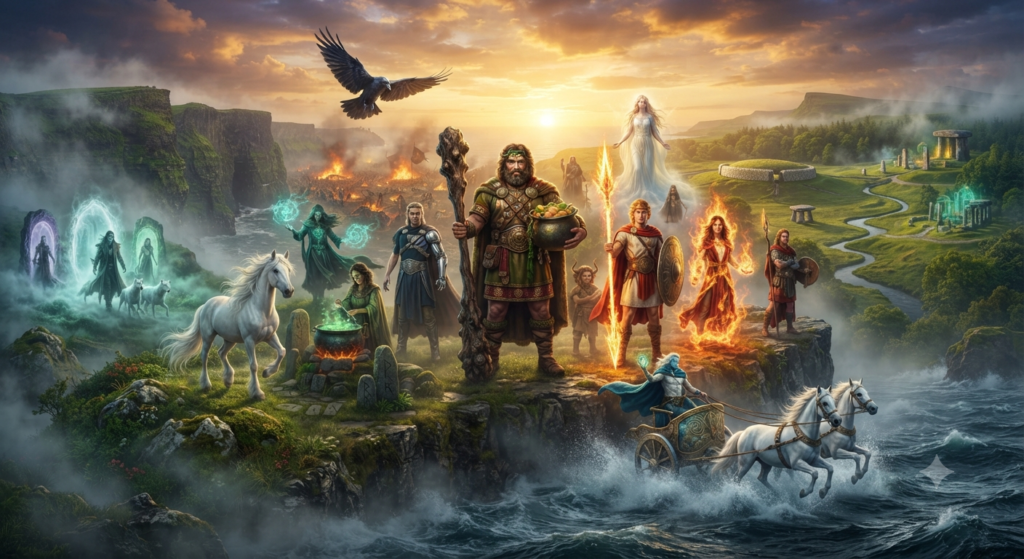
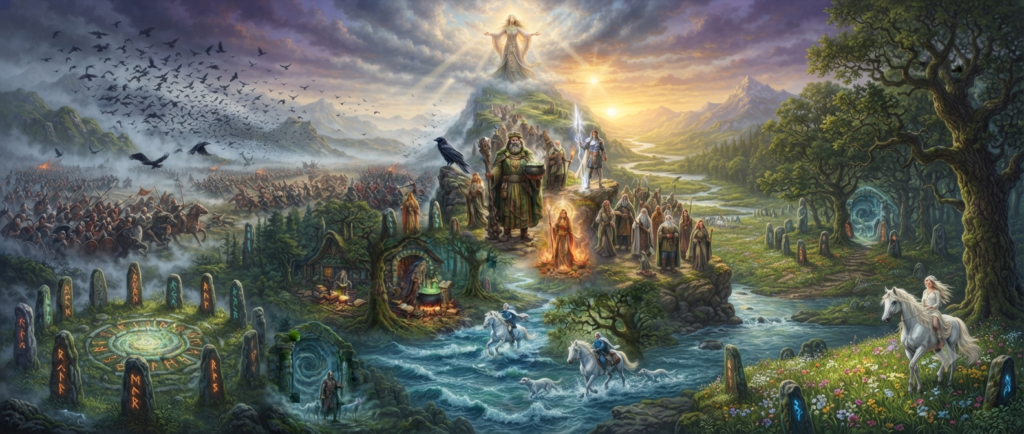
Celtic mythology survives not as a single unified system but as a family of related regional traditions, chiefly the Irish mythology of the Tuatha Dé Danann and the Welsh mythology preserved in the Mabinogion. This guide brings together the essential gods and goddesses of the Celtic world, from the fatherly Dagda to the shapeshifting magicians of Wales.
The Tuatha Dé Danann: Founders and Rulers
Dagda
The Dagda, whose name means “the good god,” ruled as a father figure among the Tuatha Dé Danann, wielding a magical cauldron that never emptied and a club capable of both killing and reviving with opposite ends.
Nuada
Nuada, first king of the Tuatha Dé Danann, lost his arm in battle and was fitted with a magical silver replacement, later reclaiming his throne after a period of forced abdication due to his imperfection.
Danu
Danu is regarded as the ancestral mother goddess of the Tuatha Dé Danann, “the people of Danu,” though ancient sources say little about her directly beyond her foundational role in Irish mythological genealogy.
Ériu
Ériu, one of three sister goddesses of sovereignty, gave her name to Ireland itself, embodying the land’s spiritual authority granted to whichever king proved worthy of ruling it.
War, Fate, and Sovereignty
Morrigan
The Morrigan was a powerful goddess of war, fate, and sovereignty, often appearing as a crow over battlefields to foretell death, and closely associated with the related war goddesses Badb and Macha.
Badb
Badb, whose name means “crow” or “scald-crow,” was a goddess of war and death closely linked to the Morrigan, her shrieking cry believed to signal impending slaughter on the battlefield.
Macha
Forced to race against the king’s horses while heavily pregnant, Macha cursed the men of Ulster with recurring labor pains at moments of crisis, a myth explaining the origin of the “Curse of Ulster” found in later Irish sagas.
Donn
Donn was regarded as a god of the dead and ancestor of the Irish people, believed to dwell on a rocky island off the southwest coast of Ireland where souls gathered after death.
Skill, Craft, and Knowledge
Lugh
Lugh was celebrated as a master of every skill and art, leading the Tuatha Dé Danann to victory against the Fomorians and later honored through the harvest festival of Lughnasadh.
Brigid
Brigid presided over poetry, healing, and smithcraft, and her sacred flame was tended continuously by her devotees, a tradition later absorbed into the Christian veneration of Saint Brigid of Kildare.
Ogma
Ogma, celebrated for his eloquence and strength, was credited in Irish tradition with inventing the Ogham alphabet, Ireland’s earliest known writing system carved into standing stones.
Goibniu
Goibniu was the master smith of the Tuatha Dé Danann, forging weapons swiftly and skillfully for the gods, and hosting a legendary feast whose ale was said to grant immortality to those who drank it.
Dian Cecht
Dian Cecht served as the great physician of the Tuatha Dé Danann, crafting Nuada’s silver arm and maintaining a magical healing well capable of restoring wounded warriors to the battlefield.
Airmid
Airmid, daughter of the healer Dian Cecht, was celebrated as a goddess of herbalism, said to have catalogued every healing herb in Ireland upon a cloak before her jealous father scattered them in anger.
Love, Beauty, and the Otherworld
Aengus
Aengus was a youthful god of love and desire, dwelling in the mound of Brú na Bóinne, whose myths often involve dream visions, transformation, and pursuit of an otherworldly beloved.
Manannán mac Lir
Manannán mac Lir ruled the sea and guarded the boundary to the Otherworld, said to ride his chariot across the waves as though upon solid land, with the Isle of Man traditionally named in his honor.
Cliodhna
Cliodhna was celebrated as a goddess of beauty and the Otherworld, later remembered in Irish folklore as a fairy queen associated with the sea and the enchanting song of her three magical birds.
Boann
Boann was the goddess of the River Boyne, said to have formed the river itself after approaching a forbidden sacred well, her story tying Ireland’s landscape directly to divine origin.
Flidais
Flidais governed wild animals, forests, and cattle, associated with abundance and untamed nature, and traditionally linked to a magical herd that provided endless milk.
Etain
Etain’s myth involves repeated transformation and rebirth, from a radiant woman into a butterfly and eventually reborn as a mortal, in one of Irish mythology’s most elaborate tales of love and jealousy.
The Welsh Pantheon
Rhiannon
Rhiannon, a horse goddess of Welsh mythology, endured a period of unjust punishment after being falsely accused of harming her son, her story preserved in the medieval Welsh tales of the Mabinogion.
Arawn
Arawn ruled Annwn, the Welsh Otherworld, and famously exchanged places with the mortal king Pwyll for a year, testing loyalty and honor in one of the Mabinogion’s central tales.
Cerridwen
Cerridwen brewed a cauldron of inspiration and knowledge intended for her son, but when the potion’s power was accidentally gained by a servant boy instead, a shapeshifting chase led to his eventual rebirth as the poet Taliesin.
Lleu Llaw Gyffes
Lleu Llaw Gyffes, whose name means “the fair one with the skillful hand,” was a Welsh god of many talents closely paralleling the Irish Lugh, his myths marked by his mother’s curses and his eventual triumph over betrayal.
Gwydion
Gwydion was a powerful magician and shapeshifter in Welsh mythology, renowned for his cunning illusions and his role in raising and protecting his nephew Lleu Llaw Gyffes.
Arianrhod
Arianrhod, associated with the stars and sky, dwelled in her tower Caer Arianrhod, her complicated relationship with her son Lleu Llaw Gyffes forming a central thread of Welsh mythological tradition.
Bran the Blessed
Bran the Blessed, a giant king of Britain, led a tragic war against Ireland to avenge his sister Branwen, and his severed head was said to continue speaking prophetically for years after his death.
Branwen
Branwen, sister of Bran the Blessed, was married to the Irish king Matholwch but suffered cruel mistreatment, her secret message carried by a trained starling ultimately sparking a devastating war between Britain and Ireland.
Understanding the Celtic Pantheon
How Many Celtic Gods Are There
Celtic mythology includes dozens of named deities across Irish, Welsh, and continental traditions, though the exact number is uncertain due to regional variation and the fragmentary survival of ancient sources.
Tuatha Dé Danann vs. Fomorians
The Tuatha Dé Danann, Ireland’s principal divine race, were locked in recurring conflict with the Fomorians, chaotic and often monstrous beings associated with the sea and destruction, most famously at the Battles of Mag Tuired.
Irish vs. Welsh Celtic Mythology
While both belong to the broader Celtic mythological family, Irish mythology centers on the Tuatha Dé Danann preserved in medieval Irish sagas, while Welsh mythology centers on a distinct pantheon preserved primarily in the Mabinogion.
Difference Between Celtic Gods and Celtic Heroes
Celtic gods like the Tuatha Dé Danann possessed inherent divine power and immortality, while figures like the hero Cú Chulainn, though semi-divine and superhumanly skilled, remained fundamentally mortal warriors within the sagas.
Is the Morrigan One Goddess or Three?
Ancient sources vary on whether the Morrigan was a single goddess or a triad alongside Badb and Macha (sometimes Nemain instead), reflecting the fluid, overlapping nature of Celtic war goddess traditions across different texts.
Who Is the Chief God in Celtic Mythology?
Unlike the clear hierarchies of Greek or Norse mythology, Celtic tradition has no single undisputed ruler of the gods, though the Dagda is often regarded as a paternal chief figure among the Tuatha Dé Danann.
Frequently Asked Questions
What is the most important source for Celtic mythology?
Medieval Irish manuscripts like the Book of Invasions and the Ulster Cycle, alongside the Welsh Mabinogion, preserve most of what survives of Celtic mythology, all recorded centuries after Christianization.
Why is Celtic mythology less standardized than Greek or Norse mythology?
Celtic mythology developed across many independent regional cultures without a shared written tradition until medieval Christian scribes began recording oral stories, resulting in significant regional variation.
Are the Tuatha Dé Danann considered gods or fairies?
Originally worshipped as gods, the Tuatha Dé Danann were later reimagined in folklore as the Aos Sí, or fairy folk, after Ireland’s Christianization diminished their overt divine status.
What is the Otherworld in Celtic mythology?
The Otherworld was a supernatural realm existing alongside the mortal world, reachable through mounds, islands, or mist, and associated with beauty, timelessness, and figures like Manannán mac Lir and Arawn.
Did the Celts worship the same gods across all regions?
No — Celtic religious practice varied significantly by region and tribe, with continental Gaulish deities, Irish deities, and Welsh deities showing both overlapping themes and distinct local characteristics.
How did Roman writers describe Celtic gods?
Roman writers like Julius Caesar often equated continental Celtic gods with their own Roman deities, though this practice likely obscured much of the genuine complexity of native Celtic religious belief.
What role did druids play in Celtic religion?
Druids served as priests, judges, and keepers of oral tradition in Celtic society, though because they left no written records themselves, most detailed knowledge of their practices comes from outside or later sources.
Do Celtic gods still influence modern culture?
Yes — Celtic mythological figures and themes continue to inspire modern literature, fantasy fiction, and neopagan spiritual movements, particularly through figures like the Morrigan, Brigid, and the Tuatha Dé Danann.

Orin Vale has spent the better part of two decades tracing the threads that connect the world’s oldest stories — from the halls of Asgard to the banks of the Nile, from Olympus to the jungles of the Maya. What began as a childhood fascination with flood myths and trickster gods grew into years of independent study across comparative mythology and ancient religion, always chasing the same question: what did these stories mean to the people who first told them? Orin writes for readers who want more than trivia — the ones looking for the beliefs, fears, and truths that myths were built to carry.