Introduction
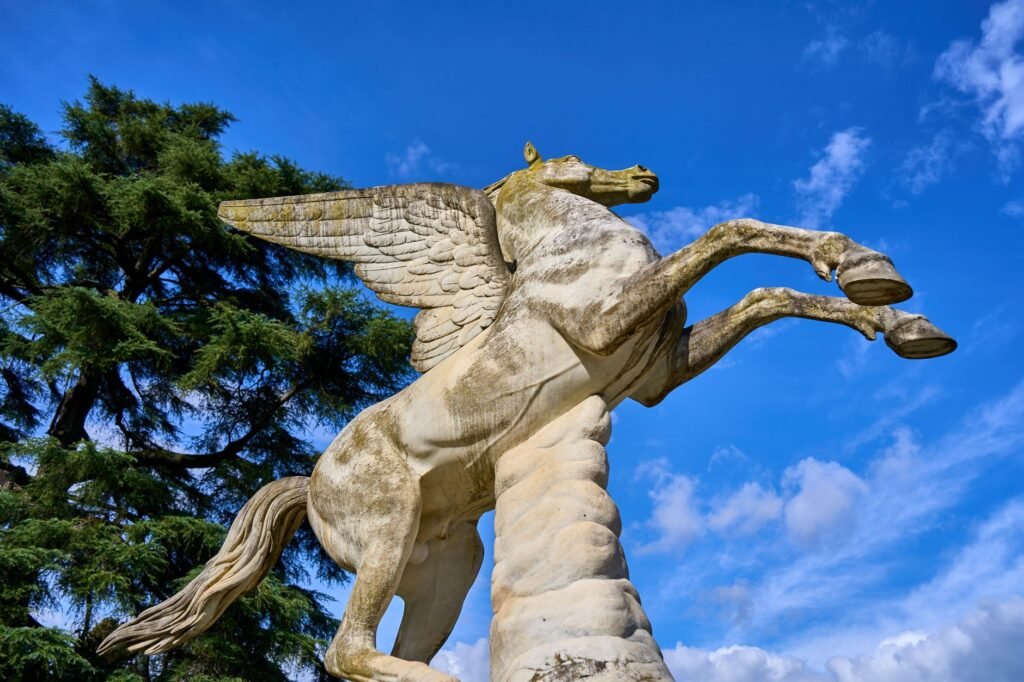
Pegasus is one of the most enduring figures in Greek mythology: a winged horse associated with divine inspiration, heroic quests, and the boundary between the mortal and immortal worlds. Unlike many mythical creatures, Pegasus is not merely a monster or an emblem of chaos. He is often presented as a noble, untamed, and beneficent being, linked to poetry, the Muses, and the spring of poetic inspiration. His image has remained powerful for more than two millennia, appearing in ancient literature, visual art, heraldry, modern branding, and popular culture.
In Greek myth, Pegasus is best known for his connection with the hero Bellerophon and for his role in the slaying of the monster Chimera. He also became associated with the constellations and with Mount Helicon, where his hoof is said to have created the spring Hippocrene. As a symbol, Pegasus stands for imagination, freedom, transcendence, and the soaring power of artistic creation.
Origin and Meaning
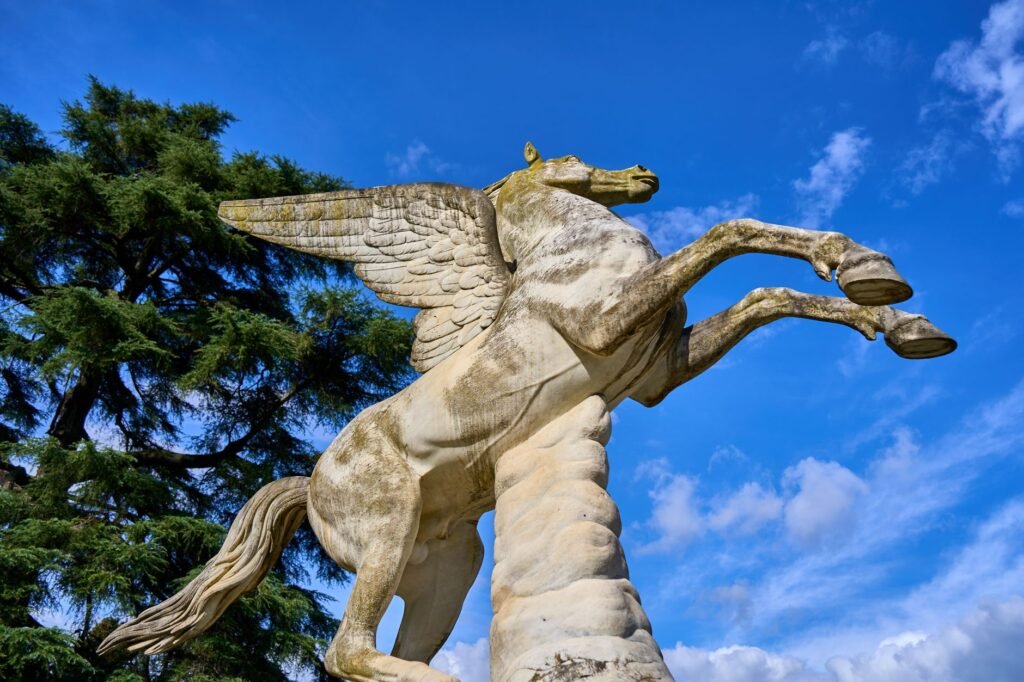
The name Pegasus comes from the Greek Pégasos (Πήγασος). Ancient etymology already connected the name with the Greek word pēgē, meaning “spring” or “well,” reflecting the tradition that the horse sprang forth near a spring or that he created a spring with a hoof strike. This explanation is traditional and widely repeated in ancient sources and later scholarship, though the exact linguistic origin of the name is not certain.
Pegasus belongs to the family of Greek mythic beings that combine animal form with divine significance. He is generally described as a horse with wings, but unlike the hybrid monsters of many mythologies, Pegasus is not part-human or part-bird; he is a pure horse transformed by extraordinary attributes. His birth is extraordinary and directly tied to the myth of Medusa.
Historical Context
Pegasus emerged within the religious and literary culture of ancient Greece, where horses were highly valued in aristocratic, military, and ritual contexts. The horse itself was a symbol of prestige, speed, and martial power. Adding wings to a horse created an image that combined earthly strength with celestial motion.
Greek mythology often used animals to express divine qualities. Pegasus is associated with several important mythic themes:
- the birth of heroes from violent or miraculous events,
- the intervention of gods in heroic narratives,
- the origin of sacred springs,
- the elevation of poetry and inspiration,
- and the tension between human ambition and divine limits.
Pegasus also appears in the context of the heroic age, especially in stories about Bellerophon, a mortal hero who attempts an almost impossible feat and later suffers for overreaching. The horse’s presence in these stories reflects a broader Greek concern with sophrosyne—restraint, moderation, and respect for the gods.
In later antiquity and beyond, Pegasus became a general emblem of artistic inspiration. Poets and scholars treated him less as a local mythic creature and more as a universal symbol of the creative imagination.
Main Characteristics
Pegasus is typically described as a magnificent white or pale horse with wings. Ancient sources do not always specify his color, but later tradition often imagines him as white, reinforcing associations with purity, divinity, and light.
Identifying features
- Wings: His most distinctive feature, enabling flight.
- Horse form: Entirely equine, unlike centaurs or other hybrids.
- Divine birth: He is not a natural horse but a miraculous being.
- Connection to springs: He is associated with the creation of sacred waters.
- Association with the gods: Especially Athena, Zeus, and the Muses in different traditions.
Pegasus is neither malevolent nor feral in the way many mythological beasts are. He is powerful, difficult to capture, and independent, but he is not depicted as destructive by nature. His wildness is more a sign of divine untamability than of evil.
Family and Genealogy
Pegasus has a remarkable genealogy, though ancient sources vary in emphasis.
Parentage
The most common tradition says that Pegasus was born from the blood of Medusa when she was beheaded by Perseus. In some versions, he and his brother Chrysaor emerged from Medusa’s neck or body at the moment of her death.
Medusa herself is the daughter of the sea deities Phorcys and Ceto in Hesiod’s Theogony, though not all later sources dwell on this lineage in the same way.
Siblings and offspring
Different traditions attribute different relationships to Pegasus:
- Chrysaor is often presented as his brother, also born from Medusa’s blood.
- Pegasus is sometimes said to have fathered the flying horse Arion in later traditions, though accounts vary and this is not a universally attested myth.
- In some later mythological genealogies, Pegasus is linked to broader lines of horse-divinities and heroic offspring, but these are often local or late traditions rather than pan-Hellenic consensus.
Relationships with humans and gods
Pegasus is most closely linked with:
- Bellerophon, the mortal hero who rides him;
- Athena, who helps Bellerophon acquire the horse in some versions;
- Poseidon, who is sometimes called the father or controller of horses and is associated with Pegasus through equine divine power;
- Zeus, who later uses Pegasus in service to the gods.
Symbols
Pegasus carries a range of symbolic meanings in ancient and modern contexts.
| Symbol | Meaning |
|---|---|
| Wings | Freedom, transcendence, divine speed |
| Horse body | Strength, nobility, power, vitality |
| White color | Purity, inspiration, celestial association |
| Spring or fountain | Poetic inspiration, sacred vitality |
| Sky/constellations | Immortality, cosmic order, divine favor |
Pegasus also became a symbol of:
- poetry and literature,
- artistic inspiration,
- heroic aspiration,
- knowledge and intellectual ascent,
- the bridge between earth and heaven.
Sacred Animals
Pegasus is himself a sacred or semi-sacred animal in myth, but he is especially connected with horses more generally.
Horses
Horses in ancient Greek culture were highly significant. They were associated with:
- aristocratic status,
- chariot warfare,
- athletic competition,
- funerary display,
- and divine beings such as Poseidon and Helios.
Pegasus represents the idealized, elevated horse: not merely useful or powerful, but endowed with supernatural grace.
Birds and the sky
Although not a bird, Pegasus shares symbolic territory with birds through flight. He belongs to the mythic imagination of the sky, elevation, and liberation from earthly limits. This has made him a visual and literary counterpart to creatures that ascend toward the heavens.
Sacred Plants
No specific sacred plant is universally and consistently associated with Pegasus in the ancient sources. However, plants enter the tradition indirectly through his connection to sacred springs and the Muses.
Laurel and poetic culture
Because Pegasus became associated with poetry, he is often culturally linked with laurel, the plant of Apollo and poets. This is more a matter of symbolic tradition than a fixed ancient cult association.
Flowers and inspiration
Later literary and artistic traditions connect Pegasus with flowers, muses, and idyllic landscapes, especially because of Hippocrene, the spring created by his hoof. These associations reinforce his role as a source of poetic nourishment rather than as a deity tied to a specific cult plant.
Sacred Places
Pegasus is connected with several important locations in Greek myth.
Mount Helicon
Mount Helicon in Boeotia is one of the most important places associated with Pegasus. According to tradition, his hoof struck the mountain and created Hippocrene, the “horse spring,” a fountain sacred to the Muses and to poetic inspiration.
Hippocrene
Hippocrene became a central symbol in later literature. It represented the source of poetic creativity and was often invoked by poets seeking inspiration.
Corinth
Pegasus is strongly associated with Corinth because of the Bellerophon cycle. In the hero’s story, the horse becomes central to his attempt to conquer the Chimera and to his rise and fall as a hero. The city’s mythic landscape is linked to Bellerophon’s exploits.
Olympus
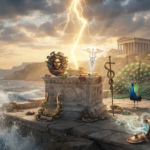
In some traditions, Pegasus ultimately serves Zeus on Olympus, carrying the thunderbolts for the king of the gods. This placement in the divine realm completes Pegasus’s movement from monster-born creature to celestial servant.
The sky and the constellation
Pegasus also occupies the heavens as a constellation, a later but significant form of mythic geography. This celestial placement made the horse part of both astronomy and mythic imagination.
Powers and Attributes
Pegasus is not a god in the strict sense, but he possesses extraordinary powers.
Main powers
- Flight: His defining power and the source of his fame.
- Exceptional speed: He moves between earth, sky, and divine realms.
- Service to the gods: In some traditions he carries Zeus’s thunderbolts.
- Creation of springs: His hoof strike produces sacred water.
- Aid to heroes: He enables Bellerophon’s victory over the Chimera.
Pegasus’s powers place him between creature and instrument of divine will. He is powerful, but not autonomous in the way major deities are. His abilities often serve higher purposes, whether heroic or cosmic.
Main Myths
Birth from Medusa
The most famous myth of Pegasus concerns his birth. When Perseus beheads Medusa, Pegasus and Chrysaor spring from her blood. Ancient sources differ in the details of their emergence, but the essential image is one of miraculous birth from death and violence.
This origin is important because it makes Pegasus both monstrous and beautiful in ancestry. He is born from a Gorgon, yet he is not monstrous himself. The myth transforms horror into wonder.
Bellerophon and the Chimera
Pegasus’s best-known story is his relationship with Bellerophon. The hero, seeking to tame the winged horse, is sometimes said to have received help from Athena, who provided a golden bridle. Using this, Bellerophon captured Pegasus near the spring Peirene or in a related Corinthian setting, depending on the tradition.
With Pegasus, Bellerophon defeated the Chimera, a fire-breathing monster usually described as having parts of a lion, goat, and serpent. Pegasus allowed Bellerophon to attack the Chimera from the air, avoiding its deadly breath and fires.
This myth has several layers of meaning:
- the triumph of strategy over brute force,
- the necessity of divine aid in heroic success,
- and the danger of excessive pride.
The fall of Bellerophon
After his triumphs, Bellerophon reportedly became arrogant and tried to ride Pegasus to Olympus. In response, Zeus sent a gadfly or other divine disturbance, causing Pegasus to throw Bellerophon down. Bellerophon fell into misery and obscurity, while Pegasus continued upward to divine service.
This episode is among the clearest moral lessons in Greek myth: heroic success does not justify hubris.
Pegasus and Hippocrene
Another well-known myth explains the creation of the spring Hippocrene. Pegasus struck Mount Helicon with his hoof, producing the fountain sacred to the Muses. This story made Pegasus a patron figure of poets and artists. The spring became a metaphor for inspiration itself.
Service to Zeus
In some later traditions, Pegasus is employed by Zeus to carry thunder and lightning. This role places Pegasus in the divine machinery of the cosmos and emphasizes his elevation after the Bellerophon episode.
Relationship with Other Mythological Figures
Perseus
Pegasus’s birth is tied to Perseus, who kills Medusa. Although Perseus does not usually ride Pegasus in the central myths, he is crucial to Pegasus’s origin.
Medusa
Medusa is Pegasus’s mother in the most widespread account. This connection gives Pegasus a dramatic and paradoxical birth from a figure associated with terror and transformation.
Bellerophon
Bellerophon is Pegasus’s most important mortal companion. Their story defines Pegasus as a hero’s mount and as a symbol of successful but limited ambition.
Athena
Athena is sometimes described as helping Bellerophon obtain Pegasus by giving him the golden bridle. Her role links Pegasus with wisdom, discipline, and heroic control.
Zeus
Zeus is associated with Pegasus in the later tradition where the horse carries thunderbolts. Zeus also symbolizes the limits beyond which even heroic success cannot pass.
The Muses
Pegasus’s connection to Hippocrene makes him one of the best-known mythic companions of the Muses. This relationship shifted his image from heroic mount to source of artistic inspiration.
Poseidon
Since horses are often linked to Poseidon, some traditions connect Pegasus with him as well. However, the exact nature of this relationship varies by source and should not be oversimplified.
Worship and Cult
Pegasus was not a major object of formal worship in the way that Zeus, Athena, or Apollo were. There is no well-documented independent cult of Pegasus in the mainstream ancient evidence. Instead, he appears within myth, poetry, art, and the symbolic landscape of Greek religion.
Ritual and cultural use
Pegasus was honored indirectly through:
- poetic invocation,
- depictions in art,
- and associations with the Muses and sacred springs.
Literary veneration
Later poets often invoked Pegasus metaphorically as a source of inspiration. This literary “cult” became more important than any formal religious practice.
Regional traditions
Local myths, especially in Boeotia and Corinth, preserved specific ties to Pegasus’s exploits and sacred locations. These traditions likely reinforced local identity and sacred geography.
Ancient Sources
Pegasus is mentioned by many classical authors, though different sources emphasize different aspects of the myth.
| Author | Work | Contribution |
|---|---|---|
| Hesiod | Theogony | Birth from Medusa and Chrysaor |
| Homer | Iliad and Odyssey | Indirect mythic context; Pegasus is not central, but the heroic age atmosphere is relevant |
| Pindar | Odes | Poetic and inspirational associations |
| Apollodorus | Bibliotheca | Concise retelling of Pegasus, Bellerophon, and the Chimera |
| Pausanias | Description of Greece | Local traditions and sacred sites, including Hippocrene |
| Ovid | Metamorphoses | Roman literary retellings of related myths |
| Hyginus | Fabulae | Compact mythographic summaries |
| Strabo | Geography | Geographical and local mythic references |
Notes on source variation
Ancient accounts are not identical. Some emphasize Pegasus’s birth; others focus on Bellerophon; still others on the spring at Helicon or the celestial constellation. This variation is typical of Greek myth, which existed as a network of traditions rather than a single fixed narrative.
Roman Equivalent
Pegasus does not have a precise Roman equivalent in the sense of a direct substitute deity. The Romans adopted the Greek Pegasus largely without replacement, preserving the Greek name and mythic identity.
In Roman literature, Pegasus appears within Greek-derived mythological frameworks, especially in authors such as Ovid and Hyginus. The Romans absorbed Pegasus into their literary and symbolic culture, where he continued to represent poetic inspiration and heroic elevation.
Influence on Modern Culture
Pegasus has had an enormous afterlife in modern culture. He is one of the most recognizable mythological creatures in the world.
Literature
Pegasus appears in:
- poetry as a metaphor for inspiration,
- fantasy literature as a noble winged horse,
- children’s literature and retellings of Greek myth,
- and scholarly or allegorical writing about imagination.
Art
Artists have long depicted Pegasus in:
- classical vase painting,
- Renaissance and Baroque art,
- neoclassical sculpture,
- modern illustration,
- and decorative arts.
His image often emphasizes motion, grace, and lightness.
Cinema and television
Pegasus appears in films and television adaptations of Greek myths, often in scenes involving Bellerophon or broader fantasy settings. Modern adaptations may adjust his appearance or role, but the central idea of the flying horse remains stable.
Games
Pegasus is common in:
- role-playing games,
- fantasy video games,
- card games,
- and tabletop mythology-inspired settings.
He is frequently used as a mount, a guardian creature, or a symbol of high-level magical power.
Branding and logos
Because of his associations with speed, freedom, and aspiration, Pegasus has been widely used in commercial logos and corporate identities. This modern use often relies on the creature’s symbolic power more than on any specific mythological detail.
Curiosities
- Pegasus is among the few major mythological creatures whose name has become a common symbol for artistic imagination.
- The spring Hippocrene made Pegasus especially important to poets, who saw inspiration as something that could be “drunk” from a sacred source.
- In some artistic traditions, Pegasus is shown without a rider to emphasize independence and majesty.
- The story of Bellerophon is often used as a warning about pride after success.
- Pegasus’s birth from Medusa links beauty and terror in a single mythic image.
- The constellation Pegasus is visible in the night sky and helped preserve the myth in astronomical tradition.
- Modern audiences often imagine Pegasus as wholly benevolent, but ancient myth presents him mainly as powerful and liminal, not as a simplified “good” creature.
Frequently Asked Questions
1. Is Pegasus a god or a horse?
Pegasus is a mythological winged horse, not a god. However, he has divine associations and sometimes serves the gods, especially Zeus.
2. Who were Pegasus’s parents?
The most common tradition says Pegasus was born from Medusa’s blood when she was killed by Perseus. Some versions also link him to Poseidon’s horse lineage, but Medusa is the standard mythic mother.
3. What is Pegasus famous for?
Pegasus is best known for helping Bellerophon defeat the Chimera and for creating the spring Hippocrene on Mount Helicon.
4. Why is Pegasus associated with poetry?
Because his hoof was said to create Hippocrene, a spring sacred to the Muses. In later tradition, this made Pegasus a symbol of poetic inspiration.
5. Did Pegasus really carry Zeus’s thunderbolts?
Some ancient and later traditions say so, but this is not the only or earliest role attributed to him. It is one of several mythic functions assigned to Pegasus.
6. What does Pegasus symbolize today?
Pegasus commonly symbolizes freedom, imagination, inspiration, nobility, and the power to rise above ordinary limits.
7. Is Pegasus mentioned in ancient Greek literature?
Yes. He appears in major mythographic and poetic sources such as Hesiod, Apollodorus, Pindar, Pausanias, and later Roman authors.
8. Is Pegasus always white in ancient art?
Not always. The white Pegasus is a common later image, but ancient sources do not consistently specify his color.
Conclusion
Pegasus occupies a unique place in world mythology. Born from the blood of Medusa, he became a figure of flight, inspiration, and divine service. His stories connect the violent and the beautiful, the heroic and the poetic, the earthly and the celestial. Through his role in the myths of Bellerophon, the Chimera, and Hippocrene, Pegasus came to represent both human aspiration and its limits.
His legacy has proved remarkably durable. In antiquity, he stood at the crossroads of myth, religion, and poetry; in modern culture, he remains a powerful symbol of imagination and transcendence. Pegasus endures because he expresses a timeless desire: to rise beyond the ground, beyond fear, and beyond ordinary life toward something higher.

Orin Vale has spent the better part of two decades tracing the threads that connect the world’s oldest stories — from the halls of Asgard to the banks of the Nile, from Olympus to the jungles of the Maya. What began as a childhood fascination with flood myths and trickster gods grew into years of independent study across comparative mythology and ancient religion, always chasing the same question: what did these stories mean to the people who first told them? Orin writes for readers who want more than trivia — the ones looking for the beliefs, fears, and truths that myths were built to carry.