Introduction
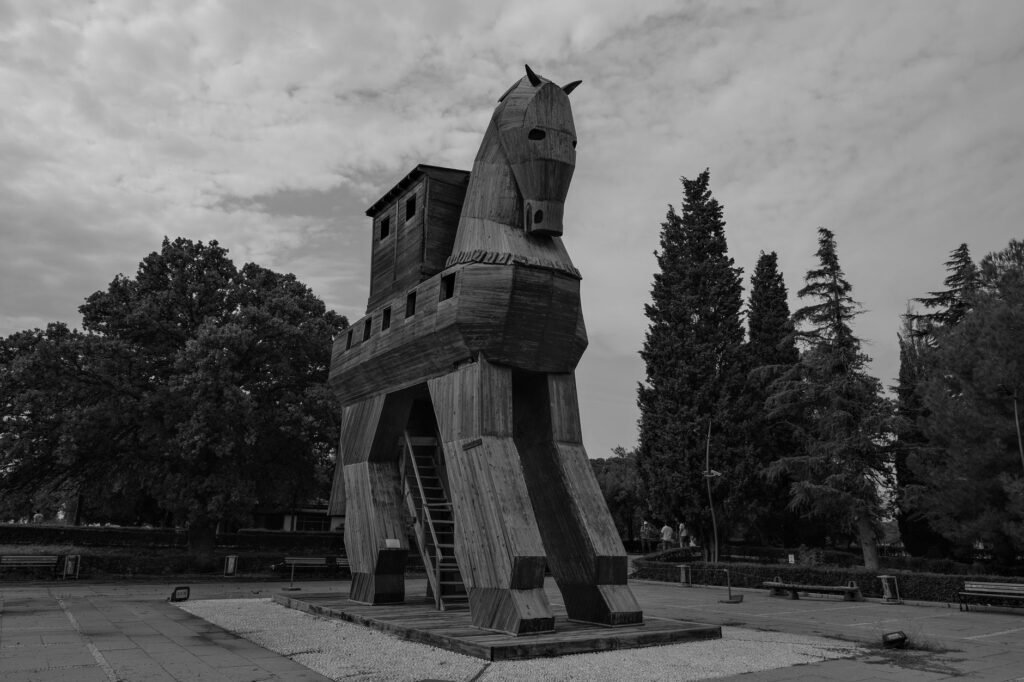
The Trojan Horse is one of the most famous episodes in Greek mythology and one of the most enduring symbols in world culture. In the traditional account, the Greeks built a giant wooden horse, hid armed men inside it, and left it outside the city of Troy as a deceptive offering. The Trojans brought the horse into their city, believing it to be a victory gift, and at night the hidden warriors emerged, opened the gates, and helped the Greek army capture Troy.
The story is important not only as a mythic narrative but also as a cultural metaphor for deception, hidden danger, and strategic cunning. The phrase “Trojan horse” is now widely used in politics, literature, security, and computing to describe anything that appears harmless but conceals a threat. Although the episode belongs to myth rather than verifiable history, it has had an extraordinary influence on Western imagination.
Origin and Meaning
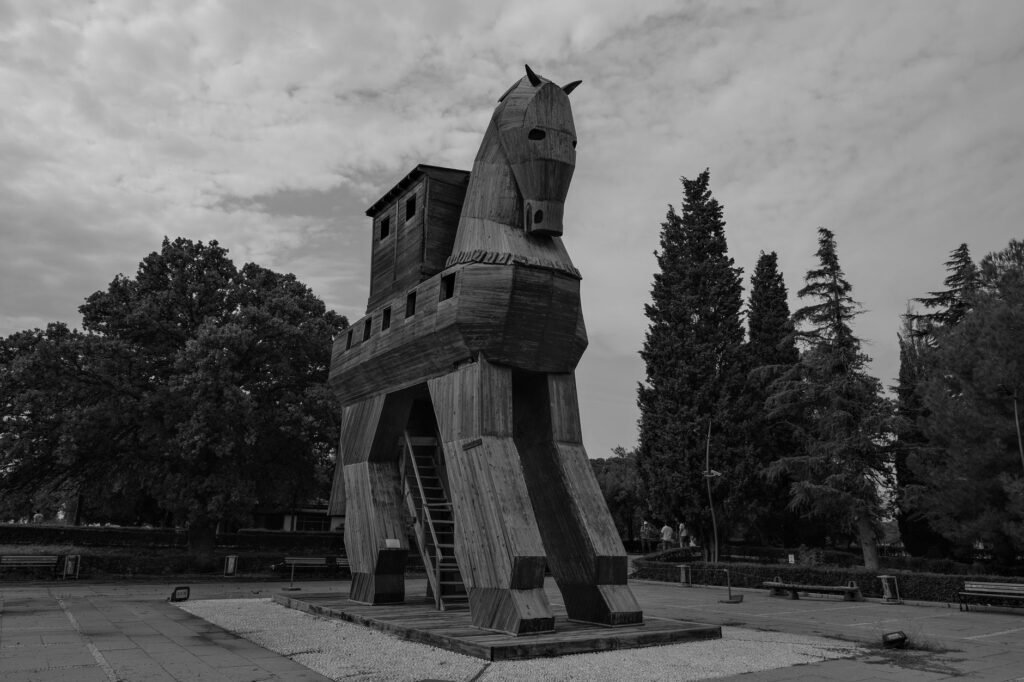
The expression Trojan Horse comes from the city of Troy and the Greek and Latin traditions describing the wooden horse used in the city’s fall. In ancient Greek, the horse is generally referred to as the dóru híppon or simply the horse of Troy, while Latin authors used phrases such as equus Troianus.
The meaning of the term has evolved far beyond its mythological origin. In modern usage, a “Trojan horse” usually means:
- a deceptive object or plan that conceals harmful intent
- a person or thing that gains access by appearing trustworthy
- in computing, a malicious program disguised as legitimate software
The mythic origin is literary and legendary. No archaeological evidence confirms the literal existence of a giant wooden horse. Some scholars have proposed alternative interpretations, such as the horse being a battering ram, a siege machine, or a symbolic image. Others argue that the story may preserve a memory of a real stratagem later transformed into myth.
Historical Context
The Trojan Horse belongs to the broader cycle of stories about the Trojan War, the legendary conflict between the Greeks and the city of Troy. The war occupies a central place in ancient Greek tradition and is most famously associated with Homer’s Iliad, although the horse itself does not appear in that poem.
The Trojan War tradition
In myth, the war began after the abduction or elopement of Helen, wife of Menelaus of Sparta, by Paris of Troy. Greek kings and heroes gathered under Agamemnon to recover Helen and avenge the insult. The war lasted ten years and involved gods, heroes, and shifting alliances.
The horse episode belongs to the war’s final stage. After years of stalemate, the Greeks devised a plan that bypassed Troy’s walls and defenses. The city fell not through open battle but through deception and infiltration.
Cultural setting
The story reflects several values central to ancient Greek culture:
- admiration for intelligence and cunning as well as brute strength
- awareness of the dangers of hubris, trust, and misjudgment
- interest in the tension between appearance and reality
- fascination with siege warfare and heroic deception
The horse also reflects the storytelling traditions of epic poetry, where memorable, dramatic, and morally charged episodes were preserved and elaborated by later poets and dramatists.
Main Characteristics
The Trojan Horse is defined by several distinctive features.
Physical and narrative characteristics
- It is a large wooden horse
- It contains armed Greek warriors hidden inside
- It is presented as a gift or offering
- It is accepted into Troy by the Trojans
- It enables the Greeks to enter the city and destroy it
Symbolic characteristics
The horse is not merely an object in the story; it functions as a symbol of:
- deception
- hidden force
- strategic intelligence
- vulnerability caused by misplaced trust
Literary characteristics
The episode is notable for:
- dramatic irony, since the audience often knows the danger before the characters do
- tension between divine will and human agency
- moral ambiguity, because the Greeks win through cunning rather than honorable combat
Family and Genealogy
As a mythic object, the Trojan Horse does not have a genealogy in the ordinary sense. However, ancient sources attribute its construction and planning to specific figures from the Greek heroic world.
Associated builders and planners
Different traditions name different individuals:
- Epeius is often credited as the builder of the horse
- Odysseus is commonly identified as the strategist behind the scheme
- Athena is sometimes associated with the plan because of her patronage of wisdom and craft
- Diomedes, Menelaus, and other Greek heroes are sometimes said to have been among the hidden warriors
Related figures in the story
The horse is connected to several important figures from the Trojan cycle:
- Priam, king of Troy
- Hector, Troy’s chief defender, already dead before the city falls
- Helen, whose fate is central to the war’s cause
- Sinon, the Greek who persuades the Trojans to accept the horse in some versions
- Laocoön, the Trojan priest who warns against the horse in Virgil’s account
Because the myth was told in multiple versions, details vary. Ancient sources do not always agree on how the horse was built, who suggested it, or exactly which heroes were inside.
Symbols
The Trojan Horse is among the most symbolically rich objects in classical tradition.
Common symbols associated with it
| Symbol | Meaning |
|---|---|
| Horse | Power, mobility, martial strength, but also danger when misunderstood |
| Wood | Artificial construction, concealment, a human-made trap |
| Closed container | Hidden intent, secrecy, surprise |
| Gift | False generosity, deceptive hospitality |
| Night | Secrecy, the moment of revelation and attack |
Interpretive meanings
The horse has been read as a symbol of:
- strategic deception
- the fragility of security
- the danger of accepting appearances at face value
- the failure of foresight
- the triumph of intelligence over force
In a broader cultural sense, it represents the idea that destruction can enter a city, institution, or mind disguised as a blessing.
Sacred Animals
Strictly speaking, the Trojan Horse is not a sacred object in a religious cult and does not belong to the category of divine animals. However, horses are highly significant in Greek and Mediterranean culture.
The horse in Greek tradition
Horses were associated with:
- warfare and aristocratic status
- speed and travel
- heroic prestige
- divine figures such as Poseidon, who was linked in some traditions with horses
- Athena, in her role as patron of skill and craft
Symbolic significance in the myth
In the Trojan Horse story, the animal form matters because it makes the object plausible as a monumental gift and gives the deception mythic weight. The horse is both:
- a noble emblem of martial culture
- a disguise for hidden invaders
This dual role strengthens the story’s irony.
Sacred Plants
No plant is specifically and consistently associated with the Trojan Horse in ancient sources. Unlike deities or heroes connected to olive, laurel, ivy, or oak symbolism, the horse episode does not have a standard botanical cultic association.
That said, certain plants are indirectly relevant in Greek epic and ritual settings:
- oak and other trees are often associated with divine signs or the making of wooden objects
- olive can symbolize wisdom and peace, especially in relation to Athena
- laurel appears widely in Greek religious and poetic symbolism
Any plant association with the Trojan Horse is therefore literary or interpretive rather than traditional or cultic.
Sacred Places
The Trojan Horse is connected primarily with Troy and the surrounding landscape of the Troad in northwestern Anatolia, near the modern Dardanelles region.
Troy
Troy, also called Ilion in Greek tradition, is the central location of the myth. The horse was brought within its walls, where it became the instrument of the city’s destruction.
Other related places
| Place | Significance |
|---|---|
| Troy / Ilion | Main city where the horse was accepted and the Greeks entered |
| Achaean camp | Greek encampment outside the city walls |
| Mount Ida | Nearby mountain associated with Trojan landscape and divine activity |
| Hellespont / Dardanelles | Maritime setting of the broader Trojan War tradition |
In later antiquity, the region of Troy became a site of literary memory and occasional pilgrimage. Ancient visitors and authors often linked the landscape to Homeric tradition.
Powers and Attributes
Because the Trojan Horse is an object rather than a deity, it does not possess powers in the supernatural sense. Its “power” lies in its function within the myth.
Principal attributes
- deception: it disguises intent
- concealment: warriors remain hidden inside
- mobility by implication: the horse can be moved into the city
- psychological manipulation: it exploits Trojan expectations
- destructive efficiency: it bypasses a long siege
Mythic role
The Trojan Horse symbolizes the power of:
- cleverness over direct combat
- planning over improvisation
- infiltration over assault
Its enduring fame comes from this combination of simplicity and effectiveness. The horse is not a magical object, but a brilliant instrument of stratagem.
Main Myths
The story of the Trojan Horse appears most fully in later epic and literary retellings rather than in Homer’s Iliad.
The basic myth
After years of warfare, the Greeks pretend to abandon the siege and sail away. In reality, they leave behind a massive wooden horse. One account says it is dedicated to Athena as an offering. The Trojans debate whether to destroy it or bring it into the city. Despite warnings, they accept it. At night, Greek warriors hidden inside emerge, signal the waiting Greek fleet or army, and open the gates of Troy. The city is then sacked.
Important variants
Ancient sources differ in several respects:
Who conceived the plan?
Odysseus is most often credited, but other versions emphasize divine help or the craftsmanship of Epeius.Why was the horse built?
Some traditions present it as an offering to Athena; others stress its role as a trick to enter the city.How did the Trojans react?
The priest Laocoön warns against the horse in Virgil’s Aeneid, but in other versions the decisive warning comes from Cassandra, whose prophecies are not believed.Who was inside?
Lists vary, but several major Greek heroes may be included depending on the source.
Laocoön and the serpents
In Virgil’s Aeneid, Laocoön famously warns, “I fear the Greeks even when they bring gifts.” He and his sons are then killed by serpents, which the Trojans interpret as a sign that the horse is sacred and must not be harmed. This episode powerfully intensifies the tragic irony of the myth.
The horse as literary climax
The horse is the final device that ends the Trojan War in most retellings. It combines:
- suspense
- irony
- catastrophe
- the collapse of civic trust
For this reason, it became one of the most memorable images in classical literature.
Relationship with Other Mythological Figures
The Trojan Horse is tied to many figures from the Trojan cycle.
Odysseus
Odysseus is the figure most frequently associated with the strategy. He represents intelligence, adaptability, and cunning. In later tradition, the horse becomes one of his signature achievements.
Athena
Athena is linked to wisdom, planning, and technical skill. Some versions connect the horse with her as a dedication or under her inspiration. Her presence reinforces the idea that intelligence is a kind of divine power.
Epeius
Epeius, sometimes described as a craftsman or boxer, is credited with physically constructing the horse. His role emphasizes craftsmanship and practical skill.
Sinon
Sinon is a deceptive Greek figure who persuades the Trojans to accept the horse in Virgil’s account. He is crucial in many later retellings because he serves as the human face of the deception.
Laocoön and Cassandra
Both are warning figures whose advice is ignored. Their relationship to the horse is central to the myth’s tragic dimension:
- Laocoön offers rational caution
- Cassandra offers prophetic truth
- both are dismissed or punished
Priam and the Trojans
Priam, as king, embodies the vulnerability of Troy’s leadership. The acceptance of the horse suggests a tragic breakdown in judgment at the highest level of the city.
Worship and Cult
The Trojan Horse was not the focus of a religious cult, and there is no evidence of worship, temple rituals, or festivals dedicated to it as an independent sacred object.
However, the horse appears in a broader religious and ritualized literary context.
Possible ritual associations
- Offerings to Athena in some versions frame the horse as a votive object
- the story reflects the importance of divine favor and omens
- ritual interpretation of signs plays a major role, especially in the Laocoön episode
Literary rather than cultic significance
The Trojan Horse belongs to the world of epic storytelling, not formal worship. Its cultural power comes from literature, performance, and later artistic adaptation rather than from a cult centered on veneration.
Ancient Sources
The Trojan Horse is known mainly from later ancient authors. Since the original Homeric epics do not present the episode in full, the story survives through summaries, references, and retellings.
Major ancient sources
| Author | Work | Relevance |
|---|---|---|
| Homer | Odyssey | Mentions the horse indirectly; Odysseus’ role is remembered |
| Virgil | Aeneid | Most famous detailed literary account in Latin |
| Apollodorus | Bibliotheca | Concise mythographic summary |
| Pausanias | Description of Greece | Preserves traditions and local knowledge |
| Quintus Smyrnaeus | Posthomerica | Epic continuation covering the fall of Troy |
| Euripides | Various fragments and plays | Trojan aftermath and associated traditions |
| Homeric scholia and later commentators | Scholarly traditions | Preserve variant details |
Homeric tradition
In the Odyssey, the horse is mentioned as a feat associated with Odysseus and as part of the memories of the Trojan War. The full narrative is not given there, but the reference shows that the story was already well known in the epic tradition.
Virgil’s version
Virgil’s Aeneid, especially Book 2, is the most influential ancient treatment of the horse. It provides dramatic speeches, emotional detail, and a powerful account of Troy’s destruction as seen through the eyes of the Trojan survivor Aeneas.
Mythographic and historical retellings
Later mythographers such as Apollodorus summarize the event more tersely, while Quintus Smyrnaeus offers an extended epic continuation. These texts help preserve the diversity of ancient versions.
Roman Equivalent
There is no true Roman equivalent to the Trojan Horse as a separate mythological figure. Instead, Rome adopted and transformed the story through its literary tradition.
Roman adaptation
The most important Roman treatment is Virgil’s Aeneid, in which the Trojan Horse becomes part of Rome’s foundational myth indirectly. Aeneas escapes Troy, eventually leading to the ancestry of the Romans in Virgil’s epic imagination.
Roman perspective
For Roman readers, the horse served several functions:
- it connected Roman origins to Trojan suffering and survival
- it illustrated the consequences of deception and war
- it provided a dramatic explanation for Troy’s fall and Aeneas’s departure
Thus, the horse was not simply borrowed by Rome; it became part of the ideological and literary bridge between Troy and Roman identity.
Influence on Modern Culture
The Trojan Horse has become one of the most recognizable images in global culture.
In language and politics
The phrase “Trojan horse” is used to describe:
- covert political influence
- disguised threats in diplomacy
- hidden agendas in organizations
- infiltration tactics in debate or propaganda
In computing and cybersecurity
A Trojan horse in computer security is malware that appears legitimate but performs harmful actions once installed. This usage is directly inspired by the myth and is now standard technical vocabulary.
In literature and film
The story has appeared in:
- retellings of the Trojan War
- historical novels
- fantasy fiction
- children’s adaptations of Greek myths
- films and television productions based on classical legend
In art and popular imagination
The horse is frequently depicted in:
- paintings of the fall of Troy
- sculpture and illustration
- educational materials about mythology
- museum and heritage exhibitions
Its image is often used to represent deception, strategic intelligence, or hidden danger in logos, cartoons, and editorial graphics.
Curiosities
- The Trojan Horse is one of the few ancient mythic objects whose name has become a universal metaphor.
- The story is not fully told in Homer’s Iliad; it becomes clearer in later works.
- Virgil’s account strongly shaped how later Europe imagined the episode.
- The warning phrase “I fear the Greeks even when they bring gifts” is among the most cited lines associated with the myth, though it comes from Virgil, not Homer.
- Some scholars have suggested the horse may reflect a real siege device or a symbolic ritual, but this remains speculative.
- The horse’s fame is due partly to its dramatic structure: a gift, a mistake, hidden enemies, and a city’s downfall.
- The episode is one of the oldest and most influential examples of a “deceptive container” story type in world literature.
Frequently Asked Questions
1. Was the Trojan Horse real?
There is no confirmed historical evidence that a literal giant wooden horse existed. The story belongs to Greek myth and epic tradition, though it may preserve a memory of an actual stratagem or siege event.
2. Who built the Trojan Horse?
Ancient sources commonly credit Epeius with building it, while Odysseus is usually credited with planning the deception. Different traditions vary.
3. Why did the Trojans bring the horse into the city?
In the myth, they believed it was a gift or offering, possibly to Athena. Some versions stress that omens and conflicting advice influenced their decision.
4. Who warned the Trojans not to trust the horse?
The most famous warning comes from Laocoön in Virgil’s Aeneid. Cassandra also warns against it in some traditions, but her prophecies are not believed.
5. Why is the Trojan Horse still famous today?
It remains famous because it is a powerful symbol of deception and hidden danger. The story is easy to remember, visually striking, and morally dramatic.
6. What does “Trojan horse” mean in modern language?
It usually means something that looks harmless or useful but secretly contains danger, fraud, or malicious intent.
7. Is the Trojan Horse mentioned in Homer?
Homer refers to the horse in the Odyssey, but the full story is not narrated there. Later authors provide the best-known detailed versions.
Conclusion
The Trojan Horse is one of the most influential myths of the ancient world. Originating in the Trojan War tradition, it combines deception, craftsmanship, strategic intelligence, and tragic irony in a single unforgettable image. Although its historicity is uncertain, its cultural meaning is undeniable.
From ancient epic and Roman literature to modern cybersecurity and everyday speech, the Trojan Horse has remained a lasting metaphor for hidden danger disguised as a gift. Its power lies in the simplicity of the image and the depth of its symbolism: what seems harmless may conceal the means of destruction.

Orin Vale has spent the better part of two decades tracing the threads that connect the world’s oldest stories — from the halls of Asgard to the banks of the Nile, from Olympus to the jungles of the Maya. What began as a childhood fascination with flood myths and trickster gods grew into years of independent study across comparative mythology and ancient religion, always chasing the same question: what did these stories mean to the people who first told them? Orin writes for readers who want more than trivia — the ones looking for the beliefs, fears, and truths that myths were built to carry.