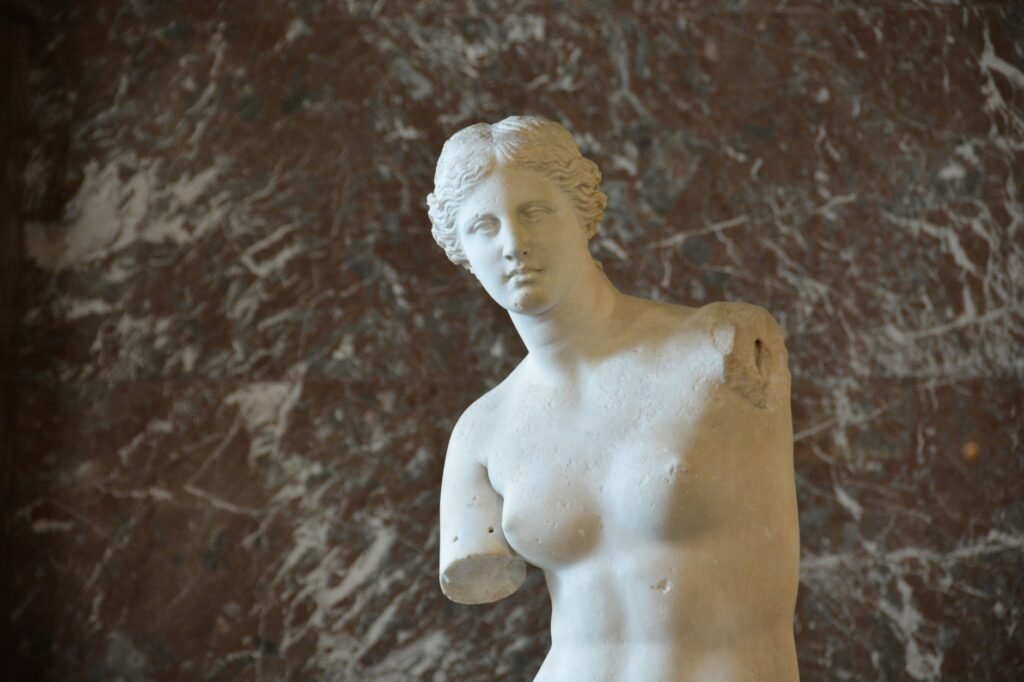
Girdle of Aphrodite
The Girdle of Aphrodite is one of the most famous magical objects in Greek mythology. Also known as the Cestus of Aphrodite or Kestos Himas in Greek, it was said to be a wondrous belt or sash that possessed the power to inspire irresistible attraction, charm, and erotic desire. In ancient literature, the girdle appears as a symbol of the goddess’s authority over love, seduction, beauty, and the complex power of desire.
Although the girdle is not as widely featured as Aphrodite herself, it is important because it concentrates many of the goddess’s essential qualities into a single object. It also played a key role in one of the best-known scenes of the Iliad, where Hera borrows it to enchant Zeus. For that reason, the Girdle of Aphrodite occupies a significant place in mythology, ancient symbolism, and later literary and artistic traditions.
Origin and Meaning
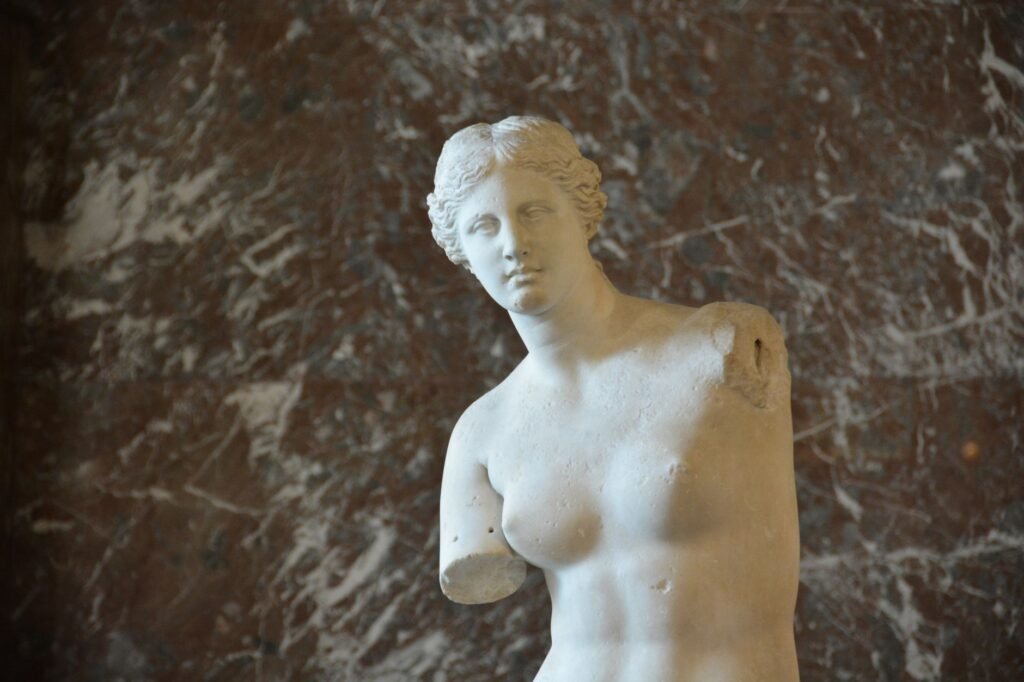
The Greek term most often connected with the object is κέστος ἱμάς (kestos himas), meaning roughly “embroidered belt” or “patterned girdle.” The Latin equivalent, cestus, became the standard term in later Roman and English usage. The word refers to a girdle, sash, or belt worn around the waist.
In mythological context, the girdle is not an ordinary accessory. It is described as an enchanted object associated with Aphrodite’s beauty and persuasive power. Ancient authors do not always provide the same physical description, but the girdle is consistently treated as a potent emblem of sexual allure and divine charm.
The historical origin of the girdle as a mythic attribute is difficult to trace with precision. It clearly belongs to the archaic and classical Greek imagination, but the surviving evidence comes primarily from literary sources rather than from archaeological finds. Different traditions emphasize different aspects:
- as a symbol of adornment and feminine beauty
- as a magical weapon of seduction
- as a divine token belonging to Aphrodite alone
- as an object that can be lent to another goddess for a specific purpose
Historical Context
Aphrodite was one of the major Olympian deities in the Greek world, associated with love, sexual attraction, fertility, beauty, and the force of desire that could unite or disrupt both mortals and gods. Her worship varied widely across the Greek-speaking world, from civic cults to more intimate domestic and private expressions of devotion.
In this context, the girdle reflects ancient ideas about kosmos—order, adornment, and the arranging of the body as a meaningful act. In Greek culture, belts and girdles were not merely practical items. They could signal status, gender, age, ritual purity, or readiness for marriage and sexuality. A goddess’s girdle therefore had strong symbolic value.
The Girdle of Aphrodite also appears in a broader mythic environment where divine objects often hold supernatural power. Such objects include Hermes’ sandals, Athena’s aegis, and various weapons or garments imbued with divine force. In Aphrodite’s case, the girdle represents not physical strength but the ability to influence emotion, desire, and persuasion.
Ancient audiences would have understood the girdle as part of a worldview in which beauty and desire were powerful forces. Love was not seen only as a private feeling; it could shape politics, dynastic success, warfare, and the fate of cities.
Main Characteristics
The Girdle of Aphrodite is usually described as a magical belt or sash worn around the goddess’s waist. Its most important characteristic is its ability to make the wearer irresistibly desirable.
Common attributes associated with the girdle
- Charm and seduction: It grants or intensifies attraction.
- Erotic power: It awakens desire in others.
- Persuasion: It can influence hearts and minds.
- Divine glamour: It enhances beauty and radiance.
- Transferability: In at least one major myth, it can be lent to another goddess.
Because ancient sources are limited, the exact appearance of the girdle is not fixed. It is sometimes imagined as richly decorated, embroidered, or adorned in a luxurious manner, but the texts do not preserve a single authoritative visual description.
The object is also distinctive because it differs from many other divine emblems. A weapon symbolizes force; a crown symbolizes sovereignty; the girdle symbolizes erotic authority. This makes it one of the clearest physical embodiments of Aphrodite’s domain.
Family and Genealogy
The Girdle of Aphrodite is not a person and therefore has no family in the usual sense. However, it is closely tied to Aphrodite’s divine identity and to the mythology of her cult.
Aphrodite’s parentage in ancient tradition
Ancient sources offer more than one account of Aphrodite’s origins:
- Hesiod’s Theogony presents Aphrodite as born from the sea foam after Uranus was overthrown.
- Homeric tradition often treats her as the daughter of Zeus and Dione.
These differing genealogies matter because they affect how ancient audiences may have understood her girdle. In Hesiodic tradition, the belt belongs to a goddess born from primordial cosmic events, reinforcing its aura of ancient, elemental power. In Homeric tradition, it remains a divine attribute linked to one of the Olympians.
Relationships and mythic associations
The girdle is most famously involved with:
- Hera, who borrows it
- Zeus, who is affected by its power
- Aphrodite, its rightful owner
- Sleep and Poseidon indirectly, in the wider plot of the Iliad episode in which Hera’s deception unfolds
The object does not have descendants, but it is part of a family of divine artifacts in mythic literature.
Symbols
The Girdle of Aphrodite is itself a symbol, but it is linked with several related images and ideas.
Major symbolic meanings
| Symbolic aspect | Meaning |
|---|---|
| Girdle or belt | Erotic power, bodily adornment, feminine charm |
| Embroidery or ornament | Beauty, luxury, refinement |
| Waist/waistband | Sexuality, marriageability, bodily form |
| Transfer of the girdle | The contagious or shareable nature of charm |
| Divine possession | Authority over love and desire |
Related symbolic associations
- Flowers and perfume: often connected with Aphrodite’s sphere of beauty
- Mirrors: symbols of self-regard and allure
- Doves: associated with the goddess and her softness
- Shells and seashells: linked to her birth from the sea in some traditions
The girdle’s symbolic value lies in its ability to transform the wearer. It does not merely decorate; it changes social and emotional perception.
Sacred Animals
The Girdle of Aphrodite is not itself an animal-associated cult object, but it belongs to the wider symbolic world of Aphrodite, who was commonly linked with several animals.
Animals associated with Aphrodite
- Doves: the most common sacred animal of Aphrodite, symbolizing gentleness, love, and fertility
- Sparrows: also connected with desire and affectionate energy
- Swans: associated with beauty and grace in later tradition
- Goats and hares: in some local or artistic contexts, linked with sexuality and fertility
The girdle shares the qualities associated with these animals, especially the dove: softness, attraction, and the power to draw others near. Ancient texts do not explicitly connect the girdle to a sacred animal of its own, so any such association would be interpretive rather than canonical.
Sacred Plants
No specific plant is universally or securely tied to the Girdle of Aphrodite alone. However, Aphrodite in broader mythology is associated with several plants, especially those connected with beauty, fertility, and love.
Plants linked to Aphrodite
- Roses: later a major flower of love and beauty
- Myrtle: strongly associated with Aphrodite in Greek and Roman tradition
- Apple: a traditional symbol of love, beauty, and courtship
- Anemone: linked in later mythic and poetic traditions
- Violet: associated with fragrance and delicate beauty in Greek poetry
These plants reflect the same conceptual world as the girdle. They represent charm, fragrance, fertility, and the seductive power of the goddess. The belt itself is not botanical, but it belongs to a cluster of symbols through which Aphrodite’s influence was expressed.
Sacred Places
There are no known sacred places dedicated specifically to the Girdle of Aphrodite as an independent cult object. Its significance is literary and mythological rather than archaeological. However, it is tied to the sacred geography of Aphrodite’s cult more generally.
Important places associated with Aphrodite
- Cythera: an island strongly linked with Aphrodite’s worship
- Cyprus: especially important in Aphrodite’s mythic and cultic identity
- Paphos: one of her major cult centers in Cyprus
- Corinth: famous in antiquity for cults of Aphrodite
- Cyrene and other Mediterranean sites: where forms of her worship appear
The girdle’s most famous narrative setting is the Olympian and divine sphere rather than any specific sanctuary. In the Iliad, it appears in the context of divine activity on Olympus. This makes it a celestial rather than local sacred object.
Powers and Attributes
The central power of the Girdle of Aphrodite is the ability to inspire desire and irresistible attraction. It is closely connected with the goddess’s role as a force that can bind gods and mortals alike.
Powers traditionally associated with the girdle
- Attraction: it increases personal magnetism
- Erotic enchantment: it induces longing and passion
- Persuasion: it aids in gaining consent or compliance
- Glamour: it heightens beauty and presence
- Deception by beauty: it can be used strategically, even in misleading ways
In mythic terms, the girdle does not act on its own independently of divine will. It is an instrument of Aphrodite’s power. This distinction is important: the object is not a free-standing magical talisman in the modern sense, but a divine attribute that externalizes the goddess’s influence.
Main Myths
The most important myth involving the Girdle of Aphrodite is found in Homer’s Iliad.
Hera borrows the girdle in the Iliad
In Book 14 of the Iliad, Hera wishes to distract Zeus so that the Greeks can gain advantage in the Trojan War. To do this, she seeks help from Aphrodite. Hera asks to borrow Aphrodite’s girdle, because it contains within it the powers of love and seduction.
Aphrodite grants the request, and the girdle is described as holding several qualities, including:
- love
- desire
- seductive speech
- persuasion
- the ability to charm even wise minds
Hera then uses the girdle as part of an elaborate deception. She adorns herself, makes herself irresistible, and approaches Zeus. The result is that Zeus is overwhelmed by desire, falls asleep after their union, and is temporarily removed from the conflict.
This episode is important for several reasons:
- It reveals the girdle as a concentrated form of Aphrodite’s power.
- It shows that even Hera, queen of the gods, depends on Aphrodite’s charm.
- It demonstrates the ancient belief that erotic influence could determine political and military outcomes.
- It presents the girdle not merely as jewelry but as a divine instrument of agency.
Other mythic references
The girdle is not central to many other surviving myths, but later traditions and artistic interpretations often refer to it when discussing Aphrodite’s power over attraction and beauty. In some retellings, it is called the “cestus of Venus,” especially in Roman and post-classical literature.
Relationship with Other Mythological Figures
The Girdle of Aphrodite is most directly connected with Aphrodite herself, but its mythic role involves several other deities and figures.
Hera
Hera is the most important secondary figure associated with the girdle. Her borrowing of it in the Iliad is a striking example of divine cooperation and cunning. Hera’s use of the girdle shows that erotic power can be instrumentalized for political ends.
Zeus
Zeus is affected by the girdle’s power when Hera uses it. The episode underscores the idea that even the king of the gods is not immune to desire.
Ares and Hephaestus
Aphrodite’s wider mythic world includes Ares and Hephaestus. While the girdle is not directly tied to their stories in surviving major sources, these relationships reinforce Aphrodite’s association with passion, marriage tensions, and the instability of desire.
Mortals and heroes
The girdle’s symbolic function extends to mortals, since Aphrodite’s influence often affects human love, courtship, and social order. The object can be understood as a mythic model for the invisible power of attraction in human life.
Worship and Cult
There is no evidence that the Girdle of Aphrodite was worshipped as an independent cult object in the way that a sacred relic might be. Instead, it belongs to Aphrodite’s mythic iconography and may have influenced how worshippers imagined her power.
Aphrodite’s cultic associations
Aphrodite was honored through:
- offerings of incense, flowers, perfumes, and libations
- dedications of mirrors, jewelry, and adornments
- rituals connected with marriage, fertility, and beauty
- local festivals and civic celebrations in various regions
Possible cultic meaning of the girdle
The girdle can be understood as a mythological expression of the kinds of values present in Aphrodite’s worship:
- bodily adornment
- attraction and marital success
- fertility and sexual union
- the controlled power of beauty
Because ancient religion did not always separate myth, symbol, and ritual in modern ways, the girdle may have resonated with actual forms of dress, adornment, and votive practice, even without direct evidence of formal cult use.
Ancient Sources
Several ancient sources are important for understanding the Girdle of Aphrodite.
Key sources
Homer, Iliad 14
The most famous account of the girdle, especially the scene where Hera borrows it.Hesiod, Theogony
Important for Aphrodite’s divine status and origin, though not for the girdle specifically.Later Homeric scholarship and commentary traditions
These help clarify the meaning of the girdle in Homeric context.Apollodorus, Library
Useful for broader mythographic background on Aphrodite and divine relationships.Ovid, Metamorphoses and other Roman authors
These often treat Aphrodite as Venus and preserve related imagery of beauty, allure, and divine adornment.
What the sources show
The sources do not provide a large independent dossier on the girdle. Instead, they show that it functioned as a recognized mythic sign of Aphrodite’s power. The Homeric passage is especially valuable because it explicitly lists the forces contained in the object.
Roman Equivalent
The Roman equivalent of Aphrodite is Venus. In Roman literature, the Girdle of Aphrodite is usually referred to as the cestus of Venus.
Roman authors inherited and adapted Greek mythology, and Venus retained the core associations of love, beauty, and attraction. The girdle remained a potent symbol in Latin poetry, where it could represent seductive power and the ability to move hearts.
In Roman culture, Venus was also linked with:
- fertility
- victory in a broad symbolic sense
- ancestry and dynastic legitimacy, especially in connection with the Julian line in later Roman ideology
The girdle, as a Venusian emblem, fits well within Roman poetic and artistic language about ornament, desire, and persuasive beauty.
Influence on Modern Culture
The Girdle of Aphrodite has influenced later literature, art, and popular representations of classical mythology, even when not named directly.
Areas of influence
- Literature: The girdle appears in retellings of Greek myth and in poetic discussions of seductive power.
- Visual art: Artists depicting Aphrodite or Venus often emphasize adornment, belts, sashes, and luxurious drapery.
- Theater and opera: Classical allusions to the girdle can appear as symbols of charm or erotic manipulation.
- Modern fiction and fantasy: Magical belts or sashes inspired by mythological objects often echo the same concept of transformative allure.
- Scholarship: The girdle remains of interest in studies of gender, power, ornament, and ancient conceptions of beauty.
Modern readers often interpret the girdle as a metaphor for the social and psychological force of attractiveness. It can also be discussed in terms of the relationship between femininity and power in ancient culture.
Curiosities
- The Girdle of Aphrodite is one of the rare mythic objects whose power is explicitly connected to seduction rather than combat.
- In the Iliad, the object is so powerful that it can be borrowed by Hera, showing that divine charisma can be transferred.
- The girdle is often treated as an emblem of persuasion, not just physical beauty.
- Ancient sources do not give a consistent visual description, which leaves room for artistic interpretation.
- The object illustrates how Greeks imagined love as a force that could be as consequential as war.
- The girdle’s role in Homer is one of the clearest examples of divine adornment as agency.
- In later tradition, the term “cestus” sometimes became more generalized, and can appear in contexts not strictly limited to Aphrodite.
Frequently Asked Questions
What is the Girdle of Aphrodite?
The Girdle of Aphrodite is a magical belt or sash in Greek mythology associated with the goddess Aphrodite. It was believed to confer irresistible charm, desire, and seduction.
Where does the Girdle of Aphrodite appear in ancient literature?
Its most famous appearance is in Homer’s Iliad, Book 14, where Hera borrows it to enchant Zeus.
What powers did the girdle have?
It was said to contain powers of love, desire, seductive speech, and persuasion. Ancient sources emphasize its ability to make the wearer irresistible.
Is the Girdle of Aphrodite the same as the Cestus of Venus?
Yes. In Roman tradition, Aphrodite became Venus, and the girdle is commonly called the cestus of Venus.
Was the girdle a real religious object?
There is no evidence that it was a real cult relic. It is best understood as a mythological and symbolic object associated with Aphrodite’s divine power.
Why was Hera interested in the girdle?
In the Iliad, Hera borrows the girdle so she can distract Zeus and help the Greek side in the Trojan War.
Does the girdle appear in many myths?
No, it is not central to many surviving myths. Its fame comes mainly from Homer and from later references to Aphrodite’s power.
What does the girdle symbolize?
It symbolizes beauty, erotic attraction, feminine authority, and the persuasive force of love.
Conclusion
The Girdle of Aphrodite is a compact but powerful symbol in Greek mythology. More than a decorative accessory, it represents the goddess’s dominion over love, attraction, and the invisible forces that shape human and divine relationships. Its most famous literary appearance in the Iliad reveals how the ancient Greeks imagined desire as a force with real consequences in politics, war, and the lives of gods.
Because the object is associated with both beauty and power, it remains an enduring image in the study of classical mythology. The girdle shows that Aphrodite’s influence was never merely ornamental. In myth, as in cultural memory, it is a sign that charm can be transformative, and that beauty itself may carry authority.

Orin Vale has spent the better part of two decades tracing the threads that connect the world’s oldest stories — from the halls of Asgard to the banks of the Nile, from Olympus to the jungles of the Maya. What began as a childhood fascination with flood myths and trickster gods grew into years of independent study across comparative mythology and ancient religion, always chasing the same question: what did these stories mean to the people who first told them? Orin writes for readers who want more than trivia — the ones looking for the beliefs, fears, and truths that myths were built to carry.