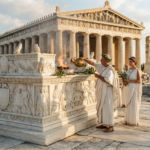
When readers ask what the Greek words for hope are, the shortest answer is ἐλπίς (elpis), the principal ancient Greek noun for hope, expectation, or anticipation. In Greek literature, however, the idea is richer than a single English equivalent. Ancient authors used related forms and neighboring terms to express hope as a feeling, an expectation of good, a confident waiting, or sometimes a mere forecast of what may come. The word’s meaning shifts with context, and in myth and poetry it can sound noble, fragile, or even troubling.
Hope in Greek: Elpis and its meaning
The central Greek word for hope is ἐλπίς (elpis). In classical usage, it can mean hope, expectation, or anticipation, and it does not always carry the same positive tone that “hope” often has in modern English. A person may hope for good fortune, but one may also expect trouble; Greek writers could use elpis for either direction depending on the passage. Its verbal family includes ἐλπίζω (elpizō), “to hope” or “to expect,” which shows how closely the noun is tied to the idea of looking ahead.
Greek thought often treats hope as something bound to uncertainty. It is not simply optimism, but a mental stance toward what has not yet arrived. That is why elpis can appear beside words for fear, expectation, and waiting. In myth and philosophy alike, it can be a blessing, a deception, or a necessary part of mortal life.
Elpis in Homer and early Greek poetry
In Homer, elpis appears less as a formal moral idea than as a practical act of expectation. The epic world is full of men and women who anticipate victory, return, ruin, or rescue, and elpis belongs to that horizon of uncertainty. Homeric Greek does not always present hope as a pure virtue; often it is simply the human habit of anticipating what may happen next. That makes the word flexible, rooted in lived experience rather than abstract doctrine.
Early Greek poetry uses the term in a similarly open way. The poets of the archaic period move easily between hope and expectation, and elpis can be shaped by circumstance rather than moral judgment. In these texts, hope is not detached from danger. It stands beside labor, fate, and the limits of human knowledge, reflecting a world in which mortals can only foresee so much.
How Hesiod presents Elpis in myth
Hesiod gives elpis one of its most famous mythic settings in the story of Pandora. In the Works and Days, after Pandora opens the jar, all the evils fly out among humankind, while elpis remains inside. The passage has inspired centuries of interpretation because Hesiod does not state in a simple, final way whether hope is preserved as a good or trapped as a deprivation. The Greek allows more than one reading, and scholars continue to debate whether hope remains with humanity or is withheld from it.
This ambiguity is part of Hesiod’s power. He presents human life as burdened by toil, sickness, and loss, yet not wholly stripped of expectation. If elpis remains in the jar, it may mean that hope is guarded from the world’s evils; if it is confined, it may mean that mortals are left without its comfort. Hesiod’s text does not flatten that tension, and the result is one of the most famous and unsettling uses of hope in ancient literature.
Elpis as a goddess or a personified force
In Greek tradition, Elpis can be personified, though she is not among the major Olympian deities. Greek religion often gives shape to abstractions—such as Victory, Memory, or Strife—and Elpis belongs to this broader pattern of personified forces. In art and later literary imagination, she may appear as a figure rather than only a noun, representing the human tendency to look toward an unknown future.
Still, it is important not to overstate her cultic role. Unlike Aphrodite or Athena, Elpis was not a widely attested major goddess with a large mythic cycle. She functions more as an embodiment of a concept than as an independent divine personality. That said, personification mattered deeply in Greek culture, and even an abstract force could carry religious and poetic weight.
Pandora’s jar and the fate of hope
The famous vessel associated with Pandora is often called a “box” in later tradition, but in Hesiod it is a jar or storage vessel, the pithos. When Pandora opens it, the contents escape into the human world. Hope’s place in this scene remains the key interpretive problem. Some readers take the survival of elpis in the jar to mean that hope is a final mercy left for mortals; others see it as one more withheld power, inaccessible just when humanity needs it most.
The myth’s force lies in that uncertainty. Greek sources do not force a single, tidy lesson. Instead, Pandora’s jar dramatizes the double edge of anticipation: hope can sustain people through suffering, yet it can also delay acceptance of what is real. In that sense, the myth reflects a very Greek understanding of human vulnerability, where desire for the future is inseparable from fear of disappointment.
Greek words for hope in later usage
In later Greek, elpis remains the standard and most important word for hope. It continues through Hellenistic, Roman-era, and Byzantine usage, where it may mean expectation, confidence, or hope in a more explicitly favorable sense. The word survives across centuries because it is broad enough to hold both emotional and practical meanings.
The verb elpizō also remains common, and related expressions can describe hoping for something, expecting something, or relying on a future outcome. In Christian Greek, elpis acquires especially strong associations with hope as trust in divine promise, though the word itself is older than Christianity and already well established in classical literature. This continuity is one reason it remains the natural answer to the question of Greek words for hope.
Euelpis and other hope-related Greek terms
One notable related term is εὔελπις (euelpis), meaning “hopeful,” “of good hope,” or “confident.” It combines the prefix eu- (“good”) with elpis, and it often suggests a favorable expectation rather than hope in a vague sense. A person described as euelpis is not merely wishing; they are well disposed toward the future. In historical and literary Greek, such compounds help refine the basic idea of hope into shades of confidence, goodwill, and anticipation.
Other related terms belong to the same semantic field, including words for expectation and confidence depending on context. Greek often distinguishes between emotional hope and rational expectation only by usage rather than by sharply separate vocabulary. That flexibility is one reason ancient texts can feel so precise: a writer can indicate whether a character hopes, expects, fears, or presumes without changing the deeper forward-looking structure of the sentence.
Hope, expectation, and expectation in Greek
Greek elpis can overlap with the idea of expectation in a way that English sometimes separates more strongly. A soldier may “hope” to survive, but the Greek may frame that as an expectation shaped by circumstances, omens, or judgment. The same word can therefore describe a modest hope, a serious prediction, or even an anxious anticipation. Context does the work of interpretation.
This overlap matters in reading ancient texts. When translators render elpis simply as “hope,” they may smooth out a broader sense of expectancy; when they render it as “expectation,” they may lose its emotional warmth. Greek allows both, and often both are present at once. The result is a concept that feels less sentimental and more existential, tied to the uncertainty of mortal life.
Elpis in philosophy and everyday speech
Greek philosophers sometimes treat hope with suspicion, especially when it blinds people to reality or encourages false confidence. Yet they also recognize its human necessity. In ethical and philosophical writing, elpis can be linked to desire, fear, memory, and judgment, revealing how deeply future-oriented thought is woven into the mind. The ancient Greeks rarely reduce hope to a simple virtue; they see it as a force that can guide or mislead.
In everyday speech, the word would have been far more ordinary. People hoped for safe travel, a good harvest, a favorable verdict, or a son’s return from war. This practical use anchors the grand mythic and philosophical meanings. Hope was not only a subject for poets and thinkers; it was part of ordinary human survival.
Translating hope from ancient Greek sources
Translating elpis is never entirely straightforward. In one passage it may mean hope, in another expectation, and in another a more neutral anticipation. Translators must decide whether the surrounding context leans toward confidence, uncertainty, or fear, and that choice shapes the reader’s understanding of the text. This is especially true in Hesiod, where the question of whether hope remains in Pandora’s jar depends partly on how one reads the Greek.
For that reason, the best translation is often contextual rather than fixed. Ancient Greek does not offer one rigid “word for hope” that always equals the English term in every sense. It offers elpis, elpizō, and related forms, along with compounds like euelpis, each carrying the weight of expectation, trust, or anticipation. Taken together, they show that the Greek language understood hope as something both ordinary and profound, a human looking toward what cannot yet be seen.
The Greek word most often used for hope is elpis, but the full picture is broader than a dictionary entry. In Homer, Hesiod, later poetry, and philosophical writing, hope can mean desire for the future, expectation of what will come, or a fragile confidence held by mortals facing uncertainty. It is a small word with a long shadow, moving from myth into daily speech and from ancient literature into later religious and cultural language.

Orin Vale has spent the better part of two decades tracing the threads that connect the world’s oldest stories — from the halls of Asgard to the banks of the Nile, from Olympus to the jungles of the Maya. What began as a childhood fascination with flood myths and trickster gods grew into years of independent study across comparative mythology and ancient religion, always chasing the same question: what did these stories mean to the people who first told them? Orin writes for readers who want more than trivia — the ones looking for the beliefs, fears, and truths that myths were built to carry.