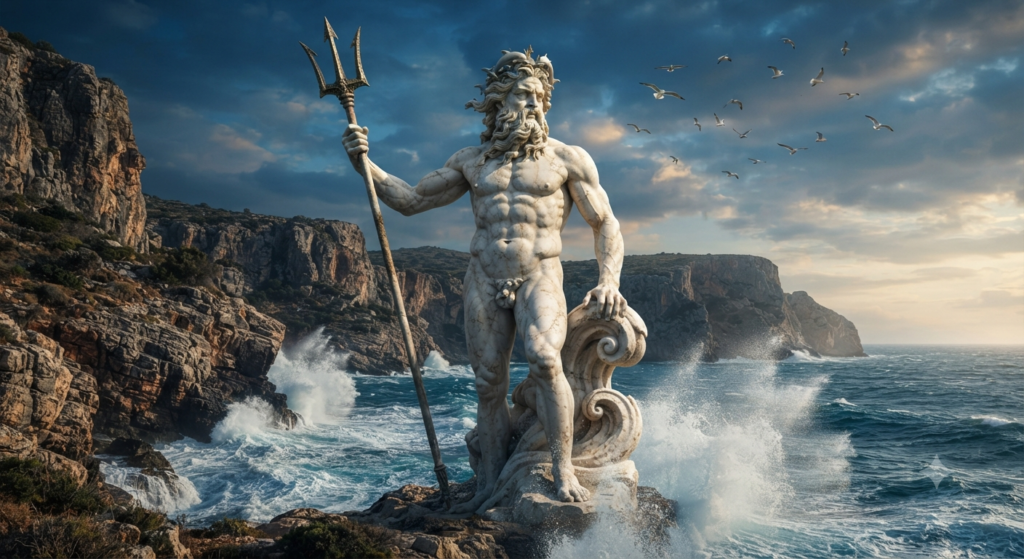
A Greek statue of Poseidon usually presents the sea god as a powerful, mature, bearded figure, built on the scale of a hero or king rather than a delicate deity. In classical art he is most often identified by the trident, and by a commanding body that suggests control over the sea, earthquakes, and the deep forces of nature. Greek sculptors did not all imagine him in exactly the same way, but they consistently gave him an image of authority, strength, and restless motion.
Poseidon in Greek Art and Temple Sculpture
Poseidon, the Olympian god of the sea, earthquakes, and horses, appears frequently in Greek sculpture, especially in sanctuaries near the coast or in regions closely tied to seafaring. In temple settings, he was often shown as a divine protector whose image could be read at a glance: a mature male, usually armed with a trident, standing in a dignified but forceful pose. Ancient worshippers did not see these statues as mere decoration; they were visible signs of a god whose power touched harbors, storms, and the stability of the earth itself.
Greek artists adapted Poseidon’s image to the needs of the cult site. A temple statue might show him in full grandeur, while smaller votive reliefs could reduce him to the essential marks of identity, especially the trident and beard. In major sanctuaries, his figure was sometimes paired with scenes of horses, dolphins, or maritime symbols, reflecting the wide reach of his divine sphere as described in Homer and later sources.
The Bearded God of Sea and Earthquakes
One of the most consistent features of a Greek Poseidon statue is the beard. He is rarely shown as a youthful god; instead, he appears as an older, solemn male with a heavy beard and thick hair, a form that aligns him with Zeus and Hades as one of the elder Olympian powers. This aged appearance conveys authority and endurance, suitable for a god who rules immense natural forces rather than a specific human domain.
His expression is often severe or controlled rather than openly emotional. In surviving sculpture and vase painting, Poseidon’s face tends to carry the gravity of a ruler, with a strong brow and a calm but penetrating gaze. That solemnity suits his mythic character in sources such as Homer, where he is frequently active, forceful, and capable of violent response when offended.
Trident, Crown, and Other Divine Attributes
The trident is the most familiar attribute of Poseidon and the clearest clue to a statue’s identity. In Greek art, it may be held upright like a scepter, angled as if ready for action, or paired with a raised arm in a gesture of command. The weapon functions not only as a practical sign of sea power but also as a symbol of division, striking, and dominion over water and earth.
Other attributes also appear, though less consistently. Some depictions include a wreath or crown, especially in contexts that emphasize divine honor. Horses and dolphins can accompany him, and in certain artworks he may be linked to a chariot drawn by sea creatures, an image that reflects his broad maritime kingship. These additions are not universal, but they reinforce the same idea: Poseidon is a god of movement, force, and mastery over unstable elements.
Muscular Stance in Marble and Bronze Forms
Poseidon is usually shown with a muscular build, close to the heroic body ideal of Greek sculpture. His shoulders are broad, his torso firm, and his limbs defined, suggesting the physical energy needed to hurl the trident or stand against the powers of the sea. Even when he is not in motion, his body often seems ready for it, with a stance that implies latent action rather than rest.
Bronze statues were especially well suited to this image. Bronze allowed sculptors to create extended arms, dramatic balance, and fine details that marble could not always support in the same way. A famous example of this style is the so-called Artemision figure, often identified as Zeus but argued by many scholars to be Poseidon because of the preserved arm position and the likely trident. Whether Zeus or Poseidon, it shows the kind of dynamic, authoritative body Greek artists favored for a chief god.
Poseidon Statues in Classical and Hellenistic Styles
In the Classical period, Poseidon was usually represented with restraint, symmetry, and idealized strength. His body might be balanced in a calm contrapposto stance, with a controlled face and a clear silhouette. Even when he is portrayed as powerful, the overall effect is disciplined and noble rather than theatrical. Greek sculptors of the fifth and fourth centuries BCE tended to seek clarity and proportion above dramatic excess.
Hellenistic art, by contrast, often introduced greater movement and expressive force. Poseidon statues from this later world can seem more dramatic, with twisting poses, wind-swept hair, and a stronger sense of the body in action. The god remains recognizably the same, but the emotional energy is heightened. This shift reflects broader changes in Greek artistic taste, where divine figures increasingly appear as vivid presences rather than purely ideal forms.
Facial Features Seen in Surviving Greek Figures
The face of Poseidon is typically mature, with a broad forehead, deep-set eyes, and a thick beard framing the mouth and jaw. Sculptors often gave him a stern or contemplative look, avoiding the softness associated with younger gods such as Apollo. His features aim to communicate age, wisdom, and the capacity for overwhelming power.
In surviving heads and reliefs, the hair is usually abundant and wavy, sometimes falling in heavy locks around the temples and neck. This style mirrors the movement of water without depicting it directly. The result is a face that feels elemental: not merely human, but a divine concentration of the sea’s depth and unpredictability.
Drapery, Nudity, and the God’s Heroic Pose
Poseidon can appear either draped or nearly nude, depending on the period and artistic purpose. In many Greek images, a simple himation or cloak is thrown over one shoulder or wrapped around the lower body, leaving the chest exposed. This partial drapery marks him as dignified and godlike, while also emphasizing the anatomy beneath it. In other works, especially heroic or athletic depictions, he is fully nude, following the Greek idealized male body.
The pose is often heroic even when the clothing is minimal. One arm may support the trident, the other may be relaxed or extended in a sign of command. The body is shown as balanced but powerful, a visual counterpart to the god’s rule over the sea. Greek art rarely makes him appear passive; even in stillness, the figure suggests strength held in reserve.
Common Materials Used for Poseidon Images
Marble and bronze were the most important materials for Poseidon statues. Marble allowed for elaborate temple images, detailed beards, and a polished surface that suited formal sacred display. Bronze, however, was especially valued for dynamic compositions and for the fine rendering of muscles, hair, and outstretched arms. Because bronze is easier to balance in dramatic positions, it often supported more adventurous artistic designs.
Terracotta, relief carving, and painted pottery also carried his image, though on a smaller scale. These media were used for votive offerings, domestic devotion, or narrative scenes in mythological art. In every case, the artist relied on a recognizable set of signs: mature face, powerful frame, and the trident above all else. The material changed, but the divine identity remained stable.
Famous Ancient Depictions of the Sea God
Among the most discussed ancient images is the bronze figure from Cape Artemision, often debated as either Zeus or Poseidon. If identified as Poseidon, it would show him in the act of throwing the trident, a dramatic expression of divine force. The debate itself is important, since it shows how closely Greek gods could share visual language in art: Zeus and Poseidon both appear as powerful bearded rulers with extended arms and commanding bodies.
Another major reference point is the sculptural tradition surrounding sanctuaries such as those at Corinth and the Isthmus, where Poseidon’s cult was especially strong. Pausanias describes sacred places and cult images that helped shape how later viewers imagined the god. Even when specific statues are lost, ancient testimony and surviving fragments make it clear that Poseidon was often portrayed as a majestic elder deity rather than a monstrous sea creature or a mere maritime symbol.
How Greek Artists Differed from Roman Neptune
Greek Poseidon and Roman Neptune are closely related, but Greek artists generally emphasized a more severe and heroic image. Poseidon in Greek art is often rooted in the aristocratic male ideal of the polis: bearded, muscular, and restrained, with the trident as his defining mark. The emphasis falls on divine authority and elemental power, not on decorative abundance.
Roman Neptune could become more theatrical and ornamental, especially in later imperial art. He is sometimes shown with richer marine associations, more elaborate sea imagery, or a softer, more decorative style. Greek art, by contrast, tends to keep Poseidon closer to the language of heroic sculpture. Even when the figure is grand and majestic, he remains a stern ruler of the deep, shaped by the classical Greek love of measure, force, and proportion.
A Greek statue of Poseidon therefore looks less like a monster of the ocean than like an enduring king of its hidden power. His beard, trident, muscular frame, and solemn expression all work together to present a god who commands water, storms, and the shaking earth. Across marble, bronze, and relief, Greek artists gave him a form that is calm on the surface but charged with the force of the sea beneath it.

Orin Vale has spent the better part of two decades tracing the threads that connect the world’s oldest stories — from the halls of Asgard to the banks of the Nile, from Olympus to the jungles of the Maya. What began as a childhood fascination with flood myths and trickster gods grew into years of independent study across comparative mythology and ancient religion, always chasing the same question: what did these stories mean to the people who first told them? Orin writes for readers who want more than trivia — the ones looking for the beliefs, fears, and truths that myths were built to carry.