Athena gave the Athenians the olive tree, a gift that Greek tradition remembered as both practical and sacred. In the founding myth of Athens, this was not merely a useful plant but the sign of Athena’s protection, chosen over Poseidon’s rival offering when the gods or the first kings of the land judged who should preside over the city. The story survives in several ancient versions, and while the details vary, the heart of the tradition remains stable: Athena’s gift linked the city to wisdom, fertility, trade, and peace.
Athena and the city that chose her patronage
Athena is the Olympian goddess of wisdom, strategic war, crafts, and civic order, and Athens became the city most closely associated with her name. Ancient tradition held that the city was not simply “named after” her in a casual sense; rather, it came under her patronage after a divine contest. That relationship shaped Athenian identity for centuries, from state ritual to temple sculpture, and the Acropolis became the visible center of that devotion.
The Athenians regarded Athena not only as a goddess of battle but as a guardian of the polis itself. Her presence signified intelligence guided toward civic stability, rather than raw force alone. This is why her most famous gift to the city was not a weapon or a display of conquest, but a living tree that promised sustenance, continuity, and economic life.
The contest with Poseidon for Athens
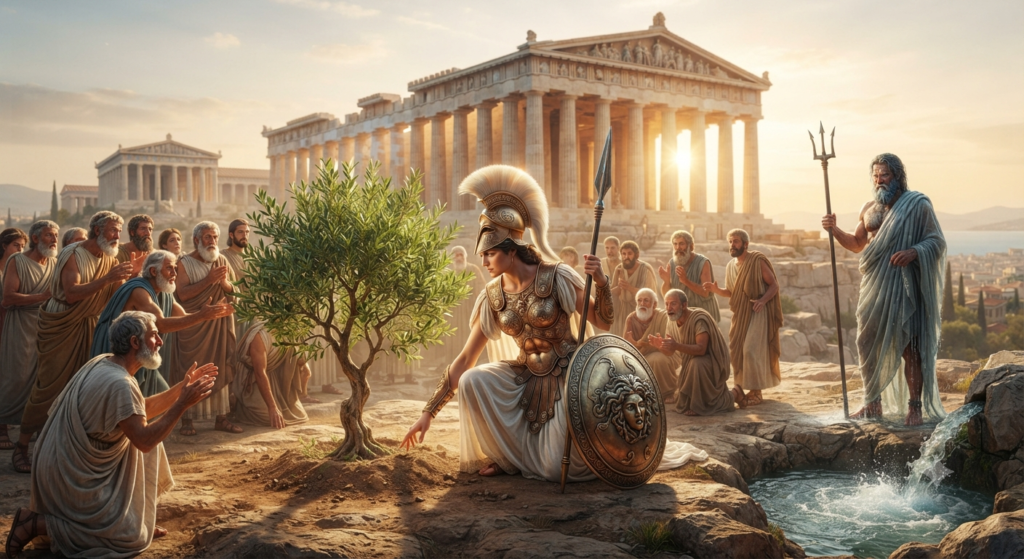
The best-known version of the myth tells of a contest between Athena and Poseidon for the patronage of the city. Poseidon struck the ground with his trident and produced a salt spring or a sea-water source, while Athena offered the olive tree. The people, or in some versions the first king, judged the goddess’s gift to be more valuable, and Athena became the city’s divine protector.
Different ancient authors preserve different details of the same basic story. Some emphasize the rivalry as a dispute before the gods, others as a decision involving the early inhabitants of the land. In every version, however, the contest explains why Athens bears a name tied to Athena and why the olive became so deeply woven into the city’s religious and civic imagination.
Olive tree gift and its sacred meaning
The olive tree given by Athena was not an ordinary plant. In mythic terms it sprang from the earth on the Acropolis, marking the goddess’s favor and her claim to the city. Olive trees were precious in the ancient Mediterranean world because they yielded oil, wood, and fruit, making them central to daily life, ritual, and commerce.
The sacred meaning of the olive extended far beyond utility. It symbolized endurance, since olive trees live long and can survive harsh conditions, and it represented a form of blessing that was peaceful rather than destructive. For Athenians, Athena’s gift suggested a city whose greatness would rest on cultivation, skill, and orderly prosperity.
How the Athenians judged the divine rivals
In the myth, the judgment between Athena and Poseidon often appears as a collective decision, though the exact judges vary by source. Some traditions place the choice in the hands of the first inhabitants, while others imagine an assembly of gods or a royal arbiter. What matters is that the contest is not resolved by force, but by evaluation of which gift would best serve the community.
That theme aligns closely with Athenian self-image. The city celebrated debate, civic procedure, and measured judgment, and the myth retroactively gives those values a divine origin. Athena wins not because she is more aggressive than Poseidon, but because her gift is better suited to human flourishing and organized life.
Cecrops and the earliest account of the vote
One of the oldest figures connected to the story is Cecrops, the mythical first king of Athens. In some accounts he is the one who oversees the contest and accepts the judgment that grants the city to Athena. Later tradition also associates him with the earliest ordering of the Attic people, giving the myth a founding figure who bridges the divine and human realms.
The vote or judgment attributed to Cecrops is not presented as a democratic election in the modern sense, but as a legendary way of explaining civic legitimacy. By placing the decision in the age of the first king, the myth ties the goddess’s gift to the origin of Athens itself. Cecrops thus becomes a witness to the moment when the city chose wisdom, usefulness, and divine protection under Athena’s name.
The Acropolis, salt spring, and other signs
The Acropolis was the setting for the contest in many versions, and its sacred landscape preserved the memory of what happened there. Pausanias describes visible remains associated with the myth, including the marks of Poseidon’s trident and the sacred olive tree of Athena. Such details show how myth and place were intertwined in Athenian religious memory.
The salt spring or briny water struck by Poseidon also mattered, even if it was less immediately useful than the olive. It represented the sea power and stormy force over which Poseidon presided, and some traditions imply that the Athenians recognized the value of both gifts. Still, Athena’s offering was the one that best matched the city’s needs, and the landscape of the Acropolis became a living monument to that choice.
Why Athena’s olive branch became a symbol
Athena’s olive branch became a symbol because it condensed several meanings into one image. It stood for victory without devastation, prosperity without excess, and wisdom expressed through practical benefit. In later Greek and Roman art, the olive branch could also signal peace, making it one of the most enduring emblems associated with the goddess.
For Athens, the symbol was especially powerful because it joined divine myth to everyday life. Olive oil was essential in cooking, lighting, athletics, ritual anointing, and trade, so the goddess’s gift touched nearly every sphere of society. The branch of Athena therefore came to represent not only the city’s patron deity, but the ideal of civilized abundance rooted in disciplined care.
Agrarian wealth, peace, and civic prosperity
The olive tree also reflected the economic logic of ancient Attica. Unlike a purely martial symbol, it promised harvests, oil production, and long-term agrarian wealth, all of which supported the city’s stability. The myth imagines Athena as a giver whose power is expressed through growth and continuity rather than spectacle alone.
Peace is part of that prosperity. Although Athena is a war goddess, she is not chiefly a goddess of chaos or rage; she governs strategy, reason, and ordered defense. The olive tree fits that aspect of her character, suggesting a city that could defend itself while still valuing agriculture, trade, and the preservation of civic life.
Ancient sources on the founding myth of Athens
The contest between Athena and Poseidon appears in several ancient sources, though not always with the same emphasis. Apollodorus gives a concise account in the Bibliotheca, while Pausanias offers a more topographical and ritual perspective. Ovid also retells the story in the Metamorphoses, adapting Greek material for a Roman audience, and later authors preserve related local traditions.
Because these accounts differ, the myth should be understood as a family of related versions rather than a single fixed narrative. Some sources focus on the divine dispute, some on the choice of the first king, and others on the sacred remains visible in Athens. Yet all agree on the essential point: Athena won the city by giving the Athenians the olive tree, a gift remembered as the mark of her enduring favor.
The lasting legacy of Athena’s gift to Athens
Athena’s gift to Athens endured as a foundation story, a religious symbol, and a civic ideal. The olive tree linked the city to the goddess in a way that was both mythic and material, reflecting the ancient belief that divine favor could be seen in the landscape itself. Even after the myth became part of literary tradition, it continued to shape how Athens understood its own identity.
In broader cultural memory, the story explains why Athena remains associated with wisdom, measured strength, and productive peace. The Athenians did not receive a weapon from their patron goddess, but a living emblem of nourishment and resilience. That is the deepest answer to the question: Athena gave the Athenians the olive tree, and with it the promise of a city built to endure.

Orin Vale has spent the better part of two decades tracing the threads that connect the world’s oldest stories — from the halls of Asgard to the banks of the Nile, from Olympus to the jungles of the Maya. What began as a childhood fascination with flood myths and trickster gods grew into years of independent study across comparative mythology and ancient religion, always chasing the same question: what did these stories mean to the people who first told them? Orin writes for readers who want more than trivia — the ones looking for the beliefs, fears, and truths that myths were built to carry.