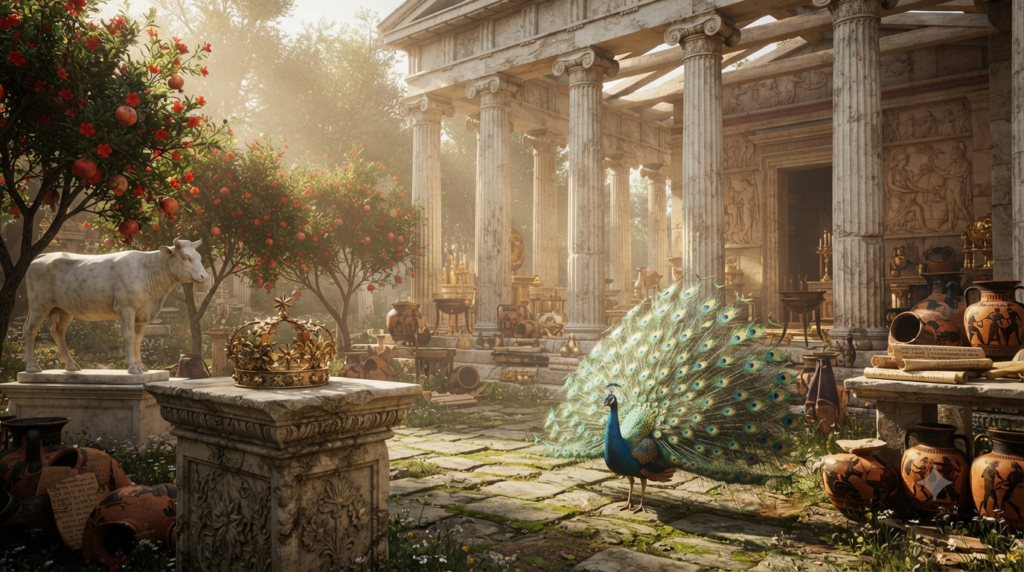
Anyone asking what is Hera’s symbol most often arrives at the peacock, the emblem most widely recognized as representing the queen of the Greek gods throughout both ancient art and modern popular culture. Yet Hera’s symbolism extends well beyond this single, iconic bird, encompassing the pomegranate, the diadem, the cow, and even the cuckoo, each reflecting a different facet of her broader mythological identity as goddess of marriage, fertility, and royal authority. Understanding what is Hera’s symbol requires examining each of these emblems individually, since together they reveal a considerably richer picture of her significance than any single symbol alone could fully convey.
The Peacock — Hera’s Most Iconic Symbol
The peacock stands as the most immediately recognized answer to what is Hera’s symbol, an association rooted specifically in the myth of Argus Panoptes, a hundred-eyed giant whom Hera had placed to watch over Io, one of Zeus’s mortal lovers, transformed into a heifer to escape detection.
Following Argus’s death, Hera transferred his hundred eyes onto the tail feathers of the peacock, creating the bird’s distinctive, eye-like plumage pattern and establishing a direct, memorable mythological origin story relevant to what is Hera’s symbol and its specific connection to this particular animal.
This origin imbues the peacock with symbolism extending beyond simple beauty, representing vigilance and watchfulness specifically, alongside the more general association with regal splendor and status that made the peacock a fitting emblem for a goddess holding the position of queen among the Olympian gods.
This combination of narrative origin and symbolic meaning explains why the peacock remains the clearest, most consistent answer to what is Hera’s symbol, appearing repeatedly throughout ancient Greek art and continuing to represent her identity within modern discussions of Greek mythology today.
The Pomegranate — Fertility and Marriage
The pomegranate represents another significant answer to what is Hera’s symbol, closely connected to her role as goddess of marriage and fertility, reflecting the fruit’s broader ancient symbolic association with abundance, continuity, and the successful union central to marital and familial life.
This connection between the pomegranate and marriage reinforces Hera’s specific mythological domain, distinguishing this particular symbol from the more narratively driven peacock by connecting directly to her core divine function rather than to a single specific mythological episode or story.
The pomegranate’s numerous seeds further reinforced ancient symbolic associations with fertility and family continuity, making it a particularly fitting emblem relevant to what is Hera’s symbol given her established role overseeing marriage and the broader continuation of family lines throughout ancient Greek religious and cultural life.
This fertility-focused symbolism adds essential depth to what is Hera’s symbol, demonstrating that her iconography extended beyond simple visual recognition into meaningful representation of her actual divine responsibilities within the broader structure of ancient Greek religious practice and belief.
The Diadem and Crown — Symbols of Royal Authority
The diadem and crown represent Hera’s specific status as queen of the gods, providing a direct, unambiguous visual marker relevant to what is Hera’s symbol regarding her royal authority alongside Zeus within the broader Olympian hierarchy.
Unlike the more narratively rich peacock or the domain-specific pomegranate, the diadem functions primarily as a straightforward marker of royal status, immediately communicating Hera’s elevated position without requiring familiarity with any specific underlying mythological narrative or story.
This distinction proves useful when considering what is Hera’s symbol comprehensively, since the diadem represents a more universally understood symbol of authority, comparable to crowns used to denote royalty across numerous different cultures, rather than relying on Greek-specific mythological knowledge for its meaning to register.
Recognizing the diadem’s role alongside the peacock and pomegranate provides a more complete picture of what is Hera’s symbol, illustrating how her iconography combined both narratively rich, story-driven emblems and more universally recognizable markers of royal status and authority.
The Cow — An Older Sacred Association
Homer specifically used the epithet “boôpis,” generally translated as “cow-eyed” or “ox-eyed,” when describing Hera, establishing an important, somewhat older answer to what is Hera’s symbol connected to this particular animal within ancient Greek literary and religious tradition.
This association with cattle likely reflects older, pre-classical religious traditions connecting Hera to fertility and motherhood, suggesting that her cow-related symbolism predates some of her more commonly recognized later iconography, including her connection to the peacock specifically.
This older layer of symbolism adds valuable historical depth to what is Hera’s symbol, demonstrating that her iconographic tradition developed and evolved across different periods of ancient Greek religious history rather than remaining static from the earliest recorded references through to later classical artistic representation.
Understanding this cow-related epithet enriches what is Hera’s symbol considerably, revealing meaningful historical layers within her broader iconographic tradition that extend beyond the more immediately recognized symbols commonly associated with her in later Greek and Roman artistic representation.
The Cuckoo — A Symbol Tied to Courtship
The cuckoo holds a specific place relevant to what is Hera’s symbol through its connection to the myth describing how Zeus transformed himself into this particular bird specifically to approach and win Hera’s affection, ultimately leading to their eventual marriage within Greek mythological tradition.
This origin story ties the cuckoo directly to the beginning of Hera and Zeus’s relationship, providing a symbol connected specifically to courtship and marital origin rather than to her broader ongoing divine authority or responsibilities as queen of the gods and goddess of marriage more generally.
This narrative connection distinguishes the cuckoo from Hera’s other symbols, offering a more specific, story-focused emblem relevant to what is Hera’s symbol that commemorates a particular mythological moment rather than representing an ongoing, general aspect of her broader divine identity and function.
Including the cuckoo within a complete answer to what is Hera’s symbol ensures accurate representation of the full range of emblems documented within ancient sources, avoiding an incomplete picture limited exclusively to her more commonly recognized peacock and pomegranate associations alone.
Why These Symbols Matter
Together, these varied symbols reveal that what is Hera’s symbol resists reduction to a single emblem, instead reflecting multiple distinct facets of her broader mythological identity, including royal authority, marital fidelity, fertility, vigilance, and the specific origin of her relationship with Zeus.
Each symbol serves a genuinely distinct representational function, from the diadem’s straightforward marker of royal status to the peacock’s narratively rich connection to vigilance and the pomegranate’s direct link to her core domain overseeing marriage and fertility throughout ancient Greek religious tradition.
Recognizing this full range of symbolism significantly enriches what is Hera’s symbol as a broader question, demonstrating that her iconographic tradition developed considerable depth and nuance across the many centuries during which she remained a central figure within ancient Greek religious and artistic practice.
This comprehensive understanding reinforces why what is Hera’s symbol deserves a genuinely complete answer rather than a simplified response limited to the peacock alone, ensuring appropriate recognition of her rich, multifaceted iconographic tradition throughout Greek mythology.
FAQ — Quick Answers About Hera’s Symbols
What is Hera’s symbol?
Hera’s most iconic symbol is the peacock, though she is also associated with the pomegranate, the diadem, the cow, and the cuckoo.
Why is the peacock associated with Hera?
The peacock is associated with Hera because she placed the hundred eyes of the slain giant Argus onto its tail feathers.
What does the pomegranate represent for Hera?
The pomegranate represents fertility and marriage, directly connecting to Hera’s role as goddess overseeing these domains.
Why is Hera called “cow-eyed” by Homer?
Homer’s epithet “boôpis,” meaning cow-eyed, likely reflects older religious traditions connecting Hera to fertility and motherhood.
What is the significance of the cuckoo in Hera’s mythology?
The cuckoo relates to the myth in which Zeus transformed into this bird specifically to win Hera’s affection before their marriage.
Conclusion
Anyone who sets out to answer what is Hera’s symbol discovers a rich collection of emblems extending well beyond the peacock alone, including the pomegranate, diadem, cow, and cuckoo, each representing a distinct facet of her broader mythological identity as queen of the Greek gods.
From the peacock’s narrative connection to vigilance to the pomegranate’s direct link to fertility and marriage, these symbols collectively reveal a goddess whose iconographic tradition developed genuine depth and complexity across many centuries of ancient Greek religious and artistic practice.
Ultimately, what is Hera’s symbol finds its fullest answer not in any single emblem, but in appreciating how these varied symbols together represent the many dimensions of her significant role within Greek mythology and religious tradition.

Orin Vale has spent the better part of two decades tracing the threads that connect the world’s oldest stories — from the halls of Asgard to the banks of the Nile, from Olympus to the jungles of the Maya. What began as a childhood fascination with flood myths and trickster gods grew into years of independent study across comparative mythology and ancient religion, always chasing the same question: what did these stories mean to the people who first told them? Orin writes for readers who want more than trivia — the ones looking for the beliefs, fears, and truths that myths were built to carry.