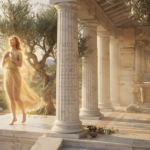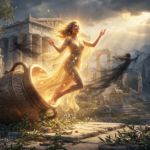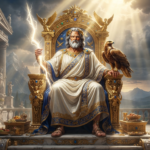
Harmonia in Greek mythology is the goddess of concord, balance, and fitting order, a figure whose very name evokes harmony among people and among the powers of the cosmos. She is not among the most prominently worshipped Olympians, yet her story is deeply rooted in Greek ideas about marriage, civic peace, and the fragile beauty of arrangement after conflict. In myth, Harmonia is best known as the wife of Cadmus, founder of Thebes, and as the figure associated with the famous Necklace of Harmonia, a gift whose beauty concealed a lasting curse.
Harmonia in Greek Myth: the Goddess of Concord
Harmonia personifies the Greek ideal of harmonia, the right joining of different parts into a stable whole. In early Greek thought, this could mean political concord, marital union, musical proportion, or cosmic balance. She belongs to the divine language of order rather than to the sphere of conquest or violence, which makes her one of the more subtle deities in the mythic tradition. Unlike a goddess with a large cycle of surviving stories, Harmonia is known mainly through her role in genealogies and in the Theban myths surrounding Cadmus.
Her presence in myth is therefore symbolic as much as narrative. Greek authors used her name and her marriage to express the idea that a city, a household, or even the world itself depends on proper alignment. Yet the myths around her are rarely simple celebrations of peace. The most famous things attached to her name are not blessings but dangerous gifts, and this tension between order and disaster lies at the heart of her legend.
Parentage and Divine Family of Harmonia
Ancient sources do not give a single, uniform account of Harmonia’s parentage. The best-known tradition, found in sources such as Hesiod, makes her the daughter of Ares and Aphrodite, the union of war and love. That ancestry is deeply meaningful: she is born from forces that seem opposed, and her own nature becomes the reconciliation of tension into form. Other traditions preserve different genealogies, but the Ares-Aphrodite version became the dominant one in Greek literary memory.
Her divine family also places her within the network of the major Olympian gods. As the child of Aphrodite, she is linked to beauty, attraction, and desire; as the child of Ares, she stands near conflict, bloodshed, and force. This mixed heritage is important for understanding her mythic function. Harmonia is not innocent in the sense of being untouched by danger; rather, she is the composed result of powers that are not naturally at peace. In that way, she embodies a distinctly Greek idea: harmony is not the absence of opposing energies, but their measured joining.
Cadmus, Harmonia, and Theban Royal Marriage
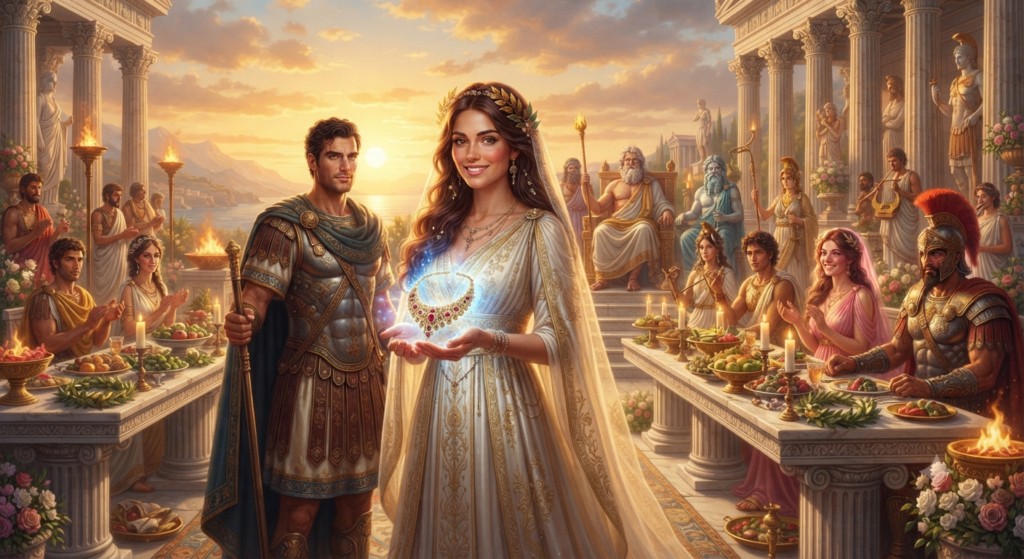
Harmonia’s central myth concerns her marriage to Cadmus, the Phoenician founder of Thebes. Cadmus had followed the quest for his sister Europa and, after various wanderings, came into contact with the forces that would lead to the founding of the city. In Greek tradition, his marriage to Harmonia marks the formal union between a mortal culture-founder and a divine bride. The wedding is often treated as a great mythical event, attended by gods and celebrated with extraordinary gifts.
Their marriage is remembered as a royal and civilizing union, but it also belongs to Thebes’ deeply troubled history. Cadmus and Harmonia became the ancestral figures for a line of Theban rulers whose family would suffer repeated tragedies. The marriage itself may appear blessed, yet the curse that shadows the house of Cadmus is already present in the background of the myth. In this sense, Harmonia is not only a goddess of concord; she is also a witness to the instability that follows even the most radiant divine-human union.
The Necklace of Harmonia and Its Curse
The most famous object associated with Harmonia is the Necklace of Harmonia, sometimes called the Necklace of Eriphyle in later stories because of the way it passed into other hands. Different ancient authors preserve different versions of its origin. In one tradition, it was a wedding gift made by Hephaestus and given to Harmonia at her marriage; in another, other gods or divine artisans are involved in the gifting. However it began, the necklace was renowned for its beauty and for the ruin that followed its possession.
The object’s curse unfolds across generations. It passes from Harmonia to her descendants and eventually becomes bound up with betrayal, greed, and death in Theban and Argive myth. Most notably, it is associated with Eriphyle, who is induced to betray her husband Amphiaraus, which leads to catastrophe. Greek myth often treats splendid objects as morally double-edged, and the Necklace of Harmonia is a classic example: a thing of immense beauty becomes an instrument through which fate works destruction.
Harmonia’s Wedding Gifts in Later Myth
Later myth and literary tradition expanded the list of Harmonia’s wedding gifts. Alongside the necklace, the bracelet or robe associated with her marriage is sometimes mentioned, depending on the source and the tradition being followed. These gifts were not random ornaments; they symbolized the magnificence of a divine wedding and the dangerous power lodged in objects touched by the gods. Greek myth often returns to this theme, where crafted things carry blessing and ruin at once.
Some versions emphasize Hephaestus as the artisan behind the necklace, while others speak more generally of divine gifts bestowed at the wedding feast. The uncertainty itself is telling. Ancient myth was not always interested in fixed canon; it preserved prestige, local memory, and poetic variation. What remained constant was the idea that Harmonia’s bridal gifts were extraordinary and fateful, linking beauty with inherited suffering across generations of mortal kings and queens.
Sources for Harmonia in Hesiod and Apollodorus
Hesiod is among the earliest surviving authors to place Harmonia within the genealogy of the gods, especially through the tradition that names her as the daughter of Ares and Aphrodite. This short but influential detail helped establish the divine logic of her identity. Later mythographers, including Apollodorus, preserve the broader story of Cadmus and Harmonia, giving readers the sequence of events that connects the marriage to Theban legend and to the famous cursed necklace.
Apollodorus is especially valuable because he summarizes versions that may otherwise be scattered across poets, tragedians, and local traditions. His account reflects the way ancient mythography organized legendary material into coherent narratives. At the same time, the sources do not all agree on every detail, and that is important to note. Harmonia is one of those figures whose story survives in fragments: a genealogy here, a wedding there, a cursed object in another writer. Her myth is assembled from these pieces rather than preserved as a single continuous tale.
Harmonia’s Link to Aphrodite and Ares
Harmonia’s parentage links her inseparably to Aphrodite and Ares, two of the most potent and disruptive divine forces in Greek mythology. Aphrodite represents desire, attraction, fertility, and beauty, while Ares embodies battle, bloodshed, and violent conflict. From their union is born a goddess whose name suggests the successful joining of opposites. This makes Harmonia more than a decorative figure in the divine family tree; she is the child of reconciliation between powers that are usually at odds.
This linkage also helps explain why her story is not purely serene. Greek myth often imagines beauty as inseparable from danger, especially when it arises from divine unions. Harmonia’s identity therefore reflects a broader mythic pattern: order is precious because chaos is always near. She stands at the point where love and war meet, and where the outcome can become either stable marriage or inherited disaster.
The Banquet of the Gods and Sacred Order
The wedding of Cadmus and Harmonia is often imagined as a banquet attended by the gods, a scene of extraordinary splendor. Such divine feasting in Greek myth is rarely mere decoration. A banquet among the gods reflects sacred order, rightful placement, and the temporary suspension of ordinary human limits. In that setting, marriage becomes more than a private union; it becomes a public and cosmic event, witnessed by divine powers and folded into the structure of the world.
Harmonia’s role in this setting underscores her significance as a goddess of fitting arrangement. The wedding feast represents the ideal of kosmos, an ordered beauty in which every element has its place. Yet the myth does not let the image remain wholly perfect. Even in the presence of divine witnesses, the gifts carried away from the banquet become tied to future suffering. Greek myth often places order and ruin side by side, and Harmonia’s wedding is one of the clearest examples of that pattern.
Harmonia in Theban Legend and Her Legacy
In Theban legend, Harmonia becomes part of the long and sorrowful dynasty descending from Cadmus and her own children. The house of Thebes is marked by repeated disasters, from later royal conflicts to the tragic careers of descendants such as Semele and Agave in the broader family line. Harmonia herself is not the cause of these tragedies, but her marriage anchors the lineage in which they unfold. She is remembered less as an active heroine than as a divine matriarch whose legacy is inseparable from the city’s fate.
Later traditions sometimes imagine Cadmus and Harmonia transformed at the end of their lives, an ending that reflects the mythic tendency to remove major founders from ordinary mortal history. Their story then closes not with simple death but with a final crossing into another mode of being. Through this ending, Harmonia remains tied to Thebes as both origin and afterlife of the royal house, a presence whose meaning extends beyond any single episode.
Why Harmonia Matters in Greek Mythology
Harmonia matters because she gives a name and a divine face to one of the most important Greek ideas: that order is beautiful, but also fragile. She is not a goddess of spectacle or conquest, yet her myth touches marriage, civic foundation, dynastic fate, and the dangerous power of sacred gifts. Through her, Greek mythology expresses the hope that different forces can be joined without breaking apart, even while acknowledging how often that hope fails.
In the figure of Harmonia, Greek myth preserves a profound paradox. She is the goddess of concord, yet the stories attached to her are shadowed by inherited curse and the instability of human and divine arrangements. That tension is what gives her myth lasting force. Harmonia endures as a reminder that balance is never accidental in Greek thought; it must be made, honored, and constantly defended against the forces that would tear it apart.

Orin Vale has spent the better part of two decades tracing the threads that connect the world’s oldest stories — from the halls of Asgard to the banks of the Nile, from Olympus to the jungles of the Maya. What began as a childhood fascination with flood myths and trickster gods grew into years of independent study across comparative mythology and ancient religion, always chasing the same question: what did these stories mean to the people who first told them? Orin writes for readers who want more than trivia — the ones looking for the beliefs, fears, and truths that myths were built to carry.