In the vast and enduring tapestry of Greek mythology, few objects are as legendary as the Golden Fleece, and few quests as celebrated as that of Jason and the Argonauts. What is the myth of the golden ram (Chrysomallos) and the Golden Fleece? It is a sprawling epic that begins with a divine act of rescue, continues through a perilous voyage to the edge of the known world, and culminates in a tale of love, betrayal, and the pursuit of kingship. At its heart is Chrysomallos, the fabulous, winged ram with a fleece of gold, sent by the cloud nymph Nephele to save her children from a sacrificial death . This ram’s gleaming pelt would eventually become the most coveted treasure in the Greek world, a symbol of authority and legitimacy that launched a thousand ships and brought together the greatest heroes of an age . This article will explore the complete myth, from the miraculous birth of the golden ram to its tragic aftermath, examining the historical and cultural significance of this foundational Greek legend.
The Birth of the Golden Ram
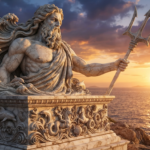
The story of the Golden Fleece begins not with a mortal king, but with a divine transformation born of love and deception. According to the Roman mythographer Hyginus, the golden ram, known as Chrysomallos, was the offspring of the sea god Poseidon and a beautiful maiden named Theophane . Theophane, the daughter of Bisaltes, was so attractive that she was besieged by a multitude of suitors. To protect her from them, Poseidon carried her away to the island of Crumissa .
There, in a display of divine cunning to further conceal his prize, Poseidon transformed Theophane into a ewe and himself into a ram. He also changed all the island’s inhabitants into various cattle to complete the illusion. When Theophane’s persistent suitors arrived and found no humans, only herds of animals, they began slaughtering the cattle for food. Poseidon, seeing that the transformed citizens of Crumissa were being destroyed, retaliated by changing the suitors into wolves . In this strange and pastoral setting, the god, in his ram form, lay with Theophane in her ewe form, and from this union was born the extraordinary Chrysomallos—the golden-fleeced ram . This unique parentage established Chrysomallos as a creature of immense divine power, a being whose very existence was a marvel of the gods. He was not merely a magical animal but a direct descendant of the Olympian king of the sea.
The Rescue of Phrixus and Helle
The golden ram’s divine purpose was to intervene in a tragedy brewing in the mortal realm of Boeotia. The story begins with Athamas, a king of Boeotia (and founder of Halos in Thessaly), who took the cloud-nymph Nephele as his first wife . Together they had two children: a boy named Phrixus and a girl named Helle. However, Athamas later abandoned Nephele and married Ino, the daughter of Cadmus . Ino, as stepmothers often are in Greek myth, was consumed with jealousy. She despised her stepchildren and saw them as obstacles to her own children’s inheritance .
To rid herself of Phrixus and Helle, Ino devised a cruel and elaborate plot. She manipulated the city’s grain supply, roasting the seeds so that they would not germinate, which caused a devastating famine . When the desperate citizens consulted an oracle for a solution, Ino bribed the messengers who were sent to return with a false answer. The corrupted envoys declared that the famine would only end if Athamas sacrificed his son, Phrixus, to the gods . (In some versions of the myth, Helle was to be sacrificed alongside her brother) .
Athamas, believing the oracle, prepared to sacrifice his son. But at the critical moment, Nephele, the children’s divine mother who had ascended to the sky, intervened. She sent the golden-fleeced ram, Chrysomallos, to rescue her children . The children climbed onto the back of the magical, flying ram, and it carried them away from their father and their wicked stepmother, soaring high over the land and the sea . The ram was said to have even spoken to Phrixus, giving him encouragement during their perilous journey .
However, the flight was not without tragedy. As they flew over the strait that separates Europe and Asia, Helle lost her grip or grew dizzy and fell from the ram’s back, plunging into the sea below . She drowned in the waters, and the strait was thereafter named the Hellespont, meaning “the sea of Helle,” in her memory (this is the modern-day Dardanelles) . Phrixus, however, survived the journey and was carried all the way to the kingdom of Colchis, a land on the far eastern shore of the Black Sea .
The Sacrifice and the Fleece
Phrixus arrived safely in Colchis, where he was welcomed by King Aeëtes, a son of the sun god Helios . The king treated him with kindness and eventually gave him his daughter, Chalciope, in marriage . In gratitude for his deliverance, Phrixus sacrificed the golden ram to the gods. According to some sources, he specifically offered it to Zeus Phyxius, the god of fugitives and escape ; in others, the sacrifice was to Poseidon, essentially returning the ram to its divine father . Following the sacrifice, the ram was placed among the stars, becoming the constellation Aries .
Phrixus then took the precious, shimmering fleece of the ram and presented it as a gift to King Aeëtes. Alternatively, it was Aeëtes himself who placed it in a sacred location . The king hung the Golden Fleece on an oak tree in a grove that was consecrated to Ares, the god of war . He then set a massive, sleepless dragon, known as the Colchian Dragon, to guard it . It is said that a prophecy had foretold that Aeëtes would lose his kingdom if he ever lost the fleece, thus making its protection a matter of his very survival .
Jason and the Argonauts
Many generations passed, and the Golden Fleece remained in Colchis, a symbol of hidden power and kingship. The story then shifts to Thessaly, where a king named Pelias had usurped the throne of Iolcus from his brother Aeson . Aeson’s son, Jason, was spirited away as an infant and raised by the wise centaur Chiron on Mount Pelion . When Jason reached adulthood, he returned to Iolcus to reclaim his rightful throne . Pelias, wary of the young hero, consulted an oracle and was warned to beware of a man wearing only one sandal . As fate would have it, Jason arrived in the city having lost one of his sandals while helping an old woman cross a river (the woman was the goddess Hera in disguise, who was testing his character) .
Recognizing Jason as the “one-sandaled man” from the prophecy, Pelias was terrified but clever. He devised a plan to send Jason on what he believed would be a fatal mission. He demanded that Jason retrieve the Golden Fleece from Colchis and bring it back to Iolcus . If he succeeded, Pelias promised to surrender the throne. Jason, eager to prove his worth, accepted the impossible quest .
To accomplish this task, Jason gathered a band of the greatest heroes in Greece. This crew, known as the Argonauts (meaning “sailors of the Argo”), included many of the most famous names in Greek mythology: Heracles (Hercules), the Dioscuri twins Castor and Polydeuces (Pollux), the singer Orpheus, the hunter Meleager, and the winged sons of Boreas, Zetes and Calais . Under the guidance of the goddess Athena, they built a magnificent ship named the Argo, which could carry fifty oarsmen and was fitted with a speaking timber from the sacred oak of Zeus at Dodona .
The Voyage and the Trials
The voyage of the Argonauts to Colchis was an epic adventure in its own right, filled with danger, encounters with strange peoples, and heroic feats. They landed on the island of Lemnos, which was inhabited only by women who had murdered their husbands, and stayed there for some time . They were welcomed by King Cyzicus of the Doliones, but after departing, a storm forced them back to the same shore, where they were attacked in the night by the Doliones, who did not recognize them. In the ensuing battle, Jason was forced to kill the king . They also encountered the boxer King Amycus of the Bebryces, who forced all strangers to fight him. The Argonaut Polydeuces accepted the challenge and killed him .
One of the most crucial stops was in Thrace, where they encountered the blind seer Phineus. He was tormented by the Harpies, winged monsters who stole his food and fouled what they did not take. Phineus agreed to help the Argonauts find the correct route to Colchis if they would free him from the Harpies. The winged sons of Boreas, Zetes and Calais, chased away the Harpies, and in gratitude, Phineus revealed the path and gave them advice on navigating the treacherous Clashing Rocks, or Symplegades .
These rocks were two massive cliffs that would smash together and crush any ship trying to pass through the narrow strait. Following Phineus’s advice, Jason sent a dove ahead of the ship. As the rocks crashed together, they clipped the dove’s tail feathers, but the bird survived. The rocks then recoiled, giving Jason just enough time to row the Argo through with all his might. Athena herself held one rock back, ensuring the ship’s safe passage. From that moment on, the Clashing Rocks became forever fixed, no longer a threat to sailors . After many more adventures, the Argo finally arrived at the kingdom of Colchis .
The Labors of Jason and Medea’s Magic
Jason, accompanied by some of his crew, approached King Aeëtes and formally requested the Golden Fleece . The king, however, was not willing to simply hand over his most prized possession. He set Jason three seemingly impossible tasks to complete if he wanted to claim the fleece .
First, Jason had to yoke a pair of fire-breathing, bronze-hoofed bulls and use them to plow a field sacred to Ares. Second, he had to sow the teeth of a dragon into the plowed field. These teeth, once planted, would sprout into a crop of fully armed, hostile warriors. Third, he had to defeat these warrior-spawn and then kill the sleepless dragon that guarded the Golden Fleece .
At this critical moment, Jason received unexpected assistance. Aeëtes’s daughter, the sorceress Medea, fell deeply in love with Jason, thanks to the intervention of the gods Eros and Athena . She struck a deal: she would help him succeed in his labors if he would marry her and take her away from Colchis . Jason swore an oath to do so, and Medea provided the help he desperately needed.
Medea, a powerful and skilled witch, gave Jason a magic ointment that would protect him from the bulls’ fire and make him invulnerable for a day . Protected by this salve, Jason successfully yoked the bulls and plowed the field. He then sowed the dragon’s teeth, and as the warriors began to sprout from the ground, Medea advised him to throw a heavy stone into their midst. Confused and unable to discern the source of the attack, the newly-sprung warriors turned on each other in a violent frenzy and fought to the death, leaving Jason unharmed . The final task was to overcome the guardian serpent. Medea used her knowledge of magical herbs to create a potent sleeping potion and sprinkled it on the dragon’s eyes, putting the creature into a deep slumber . Jason then seized the Golden Fleece from the sacred oak .
The Flight and Tragic Aftermath
Having obtained the fleece, Jason, Medea, and the Argonauts fled Colchis in the night. To delay her father’s pursuit, Medea committed a horrific act: she killed her brother, Apsyrtus, dismembered his body, and threw the pieces into the sea. Aeëtes, forced to stop and gather the remains of his son, was unable to catch the fleeing ship . After a long and eventful voyage home, Jason and the Argonauts finally returned to Iolcos with the Golden Fleece. The epic quest was complete, and Jason gave the fleece to King Pelias .
However, Pelias proved treacherous and refused to give up the throne. His reign continued, and he even conspired to kill Jason’s father, Aeson . Medea, once again, intervened. She devised a cunning and cruel plot. She demonstrated her magical powers to Pelias’s daughters by restoring an old ram to youth by cutting it up and boiling it in a magical cauldron . She convinced them that she could perform the same rejuvenation on their aging father. Believing her, they cut Pelias into pieces and boiled him in the cauldron, but the potion was a trick, and Pelias was killed .
Despite this, Jason never became king of Iolcos. The throne was given to Pelias’s son, Akastos, and Jason and Medea were driven into exile . They settled in Corinth, where they lived for ten years and had sons. But Jason’s story ends tragically. He eventually abandoned Medea to marry Glauke, the daughter of the king of Corinth. Enraged by his betrayal, Medea sent Glauke a poisoned robe and crown that burned her to death. She then murdered her own children by Jason and fled to Athens in a dragon-drawn chariot . Jason, alone and desolate, died years later when a rotting beam from his beloved ship, the Argo, fell on him .
Frequently Asked Questions About What is the myth of the golden ram (Chrysomallos) and the Golden Fleece?
What is the Golden Fleece in Greek mythology?
The Golden Fleece is the fleece of the golden-woolled, winged ram Chrysomallos. It was a symbol of authority and kingship. The fleece was kept in Colchis, where it was guarded by a sleepless dragon until it was stolen by Jason and the Argonauts .
Who was Chrysomallos and how was he born?
Chrysomallos was the golden-fleeced, winged ram. According to Roman myth, he was the son of the sea god Poseidon and a nymph named Theophane. Poseidon transformed himself into a ram and Theophane into a ewe, and their union produced the magical ram .
Who sent the golden ram to save Phrixus and Helle?
The cloud nymph Nephele sent the golden ram to rescue her children, Phrixus and Helle, from being sacrificed by their father, Athamas, due to the schemes of their wicked stepmother, Ino .
What happened to Helle during the flight on the ram?
During the flight, Helle fell from the back of the ram into the sea and drowned. The strait where she fell was named the Hellespont (modern Dardanelles) in her memory .
What were the three tasks Jason had to perform to get the Golden Fleece?
King Aeëtes demanded that Jason: 1) yoke fire-breathing bulls and plow a field, 2) sow dragon’s teeth in the field, and 3) defeat the warriors who rose from the teeth and slay the sleepless dragon guarding the fleece .
How did Medea help Jason obtain the Golden Fleece?
Medea, a powerful sorceress and daughter of King Aeëtes, fell in love with Jason. She gave him a protective ointment against the fire-breathing bulls, advised him to throw a stone to make the sown warriors fight each other, and put the guardian dragon to sleep with a magic potion .
What is the historical origin of the Golden Fleece myth?
Some scholars believe the myth reflects a real practice of washing gold from streams using sheep fleeces, which was common in the region of Colchis (modern Georgia) in ancient times. Gold flecks would get caught in the wool, giving the fleece a golden appearance .
What does the Golden Fleece symbolize?
The Golden Fleece is most commonly interpreted as a symbol of royalty, authority, and legitimate kingship. It represented the divine right to rule, which is why Jason had to retrieve it to claim his throne .
Conclusion
The myth of the golden ram, Chrysomallos, and the Golden Fleece is a cornerstone of Greek mythology, a story that weaves together themes of divine intervention, betrayal, heroism, and tragic love. From the miraculous birth of the ram to its heroic sacrifice and the epic, generation-spanning quest to reclaim its fleece, the narrative embodies the essence of the Greek heroic age. It brought together the greatest heroes of an era, pitted them against the forces of nature and magic, and explored the fundamental human desire for legitimacy and power. The legacy of this myth endures, not only in the stars of the Aries constellation but also in the very concept of a noble quest for an unattainable treasure, forever reminding us of the power and peril of ambition.

Orin Vale has spent the better part of two decades tracing the threads that connect the world’s oldest stories — from the halls of Asgard to the banks of the Nile, from Olympus to the jungles of the Maya. What began as a childhood fascination with flood myths and trickster gods grew into years of independent study across comparative mythology and ancient religion, always chasing the same question: what did these stories mean to the people who first told them? Orin writes for readers who want more than trivia — the ones looking for the beliefs, fears, and truths that myths were built to carry.