Hecate’s night refers to the dark, threshold-bound time associated with Hecate, the Greek goddess of crossroads, ghosts, the moon, and the spaces between worlds. In Greek religion, it was not a single fixed festival everywhere, but a set of devotional and ritual ideas tied to the dark moon, the last day of the lunar month, and offerings made at places of transition. Its significance lies in this sense of liminality: Hecate’s night marked a moment when the ordinary order of home, city, and daylight gave way to forces that were unseen, uncertain, and sacred.
Hecate’s night in Greek myth and ritual practice
In Greek myth, Hecate appears as a powerful goddess who stands at the edges of many divine domains. In Hesiod’s Theogony, she is honored above all by Zeus and granted wide influence over earth, sea, and sky, which already sets her apart from goddesses tied to one narrow sphere. Later Greek tradition especially associated her with thresholds, paths, and nocturnal presence, and this is the background against which Hecate’s night became meaningful.
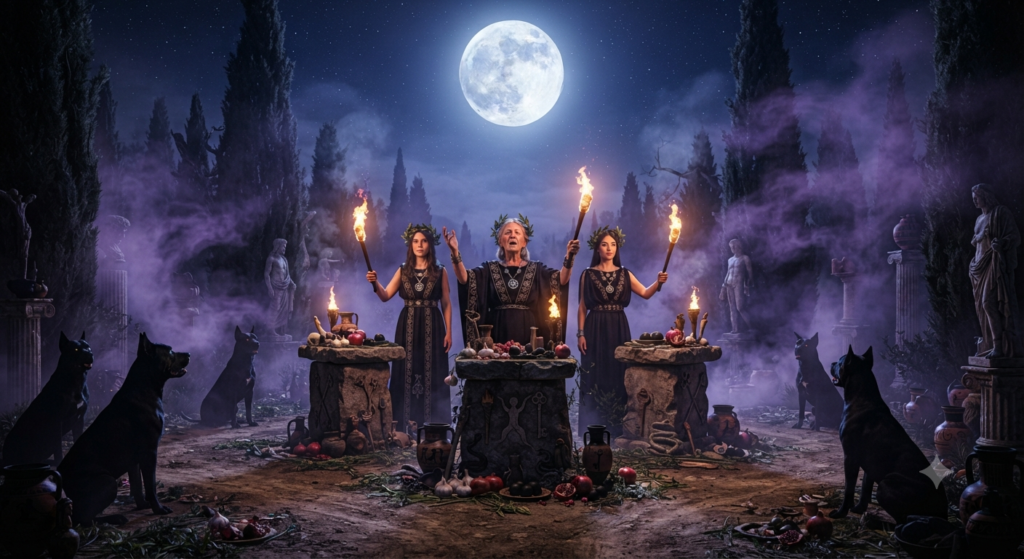
Ritual practice reflected that association. The last day of the lunar month, when the moon was dark or nearly dark, was commonly marked by offerings to Hecate, often at crossroads or outside the house. These observances are best understood not as a single universal ceremony, but as a widespread pattern in Greek religious life: a time when people sought to honor a goddess linked to the unstable boundary between safety and exposure, purity and danger.
The goddess Hecate and her liminal powers
Hecate’s greatest significance in Greek religion is her liminality. She belongs to neither the bright certainty of Olympus nor the full darkness of the underworld alone. Instead, she moves among borders: road junctions, doorways, shorelines, the meeting point of mortal and divine. That is why later sources often depict her as a torch-bearing figure, illuminating what would otherwise remain hidden.
This liminal power also explains why she could be both protective and unsettling. Hecate was invoked to guard against evil forces, yet she was also connected with ghosts, wandering souls, and the uncanny presences that gather at night. Her authority lay precisely in this in-between condition. Hecate’s night was sacred because it belonged to a goddess who could travel where ordinary human certainty breaks down.
Why the dark moon marked sacred thresholds
The dark moon held strong symbolic weight in Greek calendrical religion. As one lunar month ended and another had not yet begun, time itself seemed suspended. The sky offered no full moon to order the night, and the community entered a brief interval of uncertainty before renewal. Such moments naturally invited rites of purification, protection, and appeasement.
Hecate’s night fit this rhythm because she was a goddess of transitions. The last night of the month became a sacred threshold, a pause between endings and beginnings. In that interval, people acknowledged the vulnerability of households and travelers, as well as the invisible powers thought to move more freely when the moon was absent.
Torchlight, crossroads, and the edge of the world
Torches are among the most persistent images associated with Hecate. In myth and cult, they suggest guidance through darkness, but also the frightening clarity that reveals what normally remains concealed. A torch is not the sun; it does not banish all shadow. It creates a small protected circle of visibility, which suits a goddess worshiped at the borders of the known world.
Crossroads were equally important. A three-way junction was not just a place on a road; it symbolized choice, uncertainty, and the meeting of multiple directions. Greek worship placed offerings there because crossroads belonged to no single household or civic center. In that sense, they were the edge of the world in miniature, and Hecate’s night made that edge ritually visible.
Hecate’s night in household protection rites
Hecate was not only a goddess of eerie spaces outside the home. She was also called upon to protect the household itself. Greek domestic religion often treated the home as a guarded sphere, vulnerable to pollution, bad luck, and harmful spirits. On the dark moon, offerings to Hecate could help secure that boundary.
This protective role is important because it shows that Hecate’s night was not simply about fear. It was also about maintaining order through respectful acknowledgment of danger. By honoring Hecate, a household recognized the powers beyond its walls and asked that they remain at a distance. Her night, then, was a ritual negotiation between domestic peace and the uncertain world outside.
Offerings left at the crossroads for the goddess
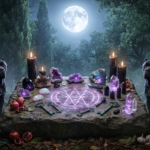
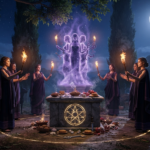
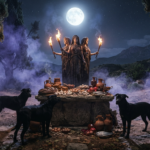
Ancient sources and later testimony describe offerings left for Hecate at crossroads, especially food such as cakes, eggs, fish, garlic, honey, and leftovers from the meal. These were sometimes known collectively as Hecate’s suppers or meals set out in her honor. The precise contents varied by time and place, and scholars caution against treating every later description as equally ancient, but the practice itself is well established.
The act of leaving food at a crossroads carried symbolic force. The offering was placed where routes met and where no private owner could claim the space. It was a gift surrendered to the goddess of boundaries, and perhaps also to the wandering beings under her care. Hecate’s night was therefore marked not by grand public sacrifice alone, but by intimate, practical acts of reverence performed at the meeting point of paths.
The connection between night, ghosts, and omens
Night in Greek religion was often a time when the dead felt nearer. Hecate’s associations with ghosts and restless spirits reflect this broader cultural pattern. The darkness of the lunar month, when the moon was absent, heightened the sense that the world was open to presences beyond human sight. Hecate, who moved among these presences, became a natural figure through whom people interpreted strange signs.
Omens, dreams, and uncanny noises could all be understood within this atmosphere. Hecate’s night gave a ritual frame to experiences that might otherwise seem random or terrifying. By naming the darkness and addressing the goddess associated with it, people turned uncertainty into a known religious condition, one that could be approached with caution and prayer.
Hecate as guide between the living and the dead
Hecate’s role as a guide is central to her meaning. She is often imagined as a companion or escort at the boundary between life and death, not as the ruler of death itself. In literary and religious tradition, she appears near chthonic powers, near graves, and near the wandering dead, yet she remains distinct from Hades and Persephone. Her task is movement, not possession.
This makes Hecate’s night especially significant in funerary and memorial contexts. The dark moon and the liminal goddess together express a worldview in which death is not simply an end but a passage through unseen thresholds. Hecate offers orientation where there is no stable road, and that is why she could be invoked when the living wished to honor or ward off the dead.
Lunar darkness and the meaning of sacred silence
The silence of the dark moon mattered as much as its darkness. Without the brilliance of the full moon, night became quieter, more inward, and more susceptible to reflection. In Greek religious life, moments of reduced visibility often invited restraint, purification, and attentiveness. Hecate’s night carried this mood of sacred silence, in which speech and action were measured.
That silence was not empty. It was filled with expectation, with the sense that something powerful existed just beyond perception. The goddess of crossroads and thresholds presided over this interval because she embodied what cannot be fully seen or spoken. Her night gave form to the sacred pause before renewal, a pause that could feel ominous, protective, or both at once.
Legacy of Hecate’s night in later tradition
Hecate’s night endured well beyond archaic and classical Greece. Hellenistic, Roman, and later literary traditions preserved her as a figure of torches, crossroads, magic, and moonlit power. Roman authors and later magical texts expanded these associations, though often in ways that blend religion, literature, and later occult imagination. The goddess remained one of the strongest symbols of nocturnal threshold power in the ancient Mediterranean.
In modern reception, Hecate’s night continues to fascinate because it condenses several enduring themes: the fear of darkness, the need for protection, the reverence owed to transitions, and the sacredness of what lies outside ordinary control. Her presence at the edge of the month and at the edge of the road still speaks to a deeply human experience, the knowledge that every ending carries a hidden beginning.
The significance of Hecate’s night lies in its power to name a boundary. It was the dark interval when Greeks acknowledged the fragility of the home, the uncertainty of roads, the nearness of spirits, and the need for divine protection. Through Hecate, darkness was not simply feared; it was ritually addressed, giving shape to what lay between one state and another.
That is why Hecate’s night remains important in the study of Greek mythology and religion. It reveals how the ancient Greeks understood sacred time, how they met danger with offering, and how they gave a goddess of thresholds her rightful place at the edge of the visible world.

Orin Vale has spent the better part of two decades tracing the threads that connect the world’s oldest stories — from the halls of Asgard to the banks of the Nile, from Olympus to the jungles of the Maya. What began as a childhood fascination with flood myths and trickster gods grew into years of independent study across comparative mythology and ancient religion, always chasing the same question: what did these stories mean to the people who first told them? Orin writes for readers who want more than trivia — the ones looking for the beliefs, fears, and truths that myths were built to carry.