In Greek mythology, the stars are rarely explained as simple lights placed in the sky. They are more often the end point of a story: a beloved figure preserved after death, a hunter lifted beyond human reach, a maiden set among the constellations, or a divine being whose radiance became visible to mortals. These star myths reveal how the Greeks imagined the heavens as a living archive of memory, loss, and transformation. Some traditions speak of specific constellations, while others describe the stars in broader terms as divine or primordial creations. Together, they show that the origin of the stars was not a single tale but a network of sacred narratives, many of them preserved by Hesiod, Homer, Apollodorus, Ovid, and later mythographers.
Greek Star Myths in Ancient Sky Lore
Greek star myths usually begin with a transformation. A person, animal, or divine presence is changed into a fixed light in the sky, often as a reward, memorial, or sign of divine power. The stars are not generally treated as natural objects in the modern sense; rather, they belong to the mythic order, where heaven and earth are connected by metamorphosis. In this way, constellations became landmarks of story as much as of astronomy.
The Greeks also distinguished between the stars as a collective and particular stars or groups with named identities. Homer and Hesiod already assume a sky crowded with meaningful forms, while later writers such as Apollodorus and Ovid preserve fuller explanatory myths. These stories do not always explain the literal first appearance of all stars, but they do explain why certain stars are there, and why they bear the shapes and names humans recognize.
How the Pleiades Became a Star Cluster
The Pleiades are among the most famous star myths in Greek tradition. In most versions, they are the seven daughters of Atlas and the sea-nymph Pleione: Maia, Electra, Taygete, Alcyone, Celaeno, Sterope, and Merope. Classical authors differ slightly on their fate, but the central pattern is consistent: the sisters are placed among the stars, usually as a group associated with both beauty and pursuit. Their celestial form gave rise to one of the most important markers in ancient seasonal and agricultural time.
Their story also contains a shadow of loss. In some accounts, one sister, often Merope, dimmed or hid her brilliance because she married a mortal, Sisyphus, or because of shame tied to the fall of Troy in later genealogical traditions. This difference in brightness became part of the mythic explanation for why the Pleiades appear unevenly visible. Their star cluster is therefore not only a family in the sky, but a register of divine ascent and mortal entanglement.
Orion, Artemis, and the Hunter’s Fate
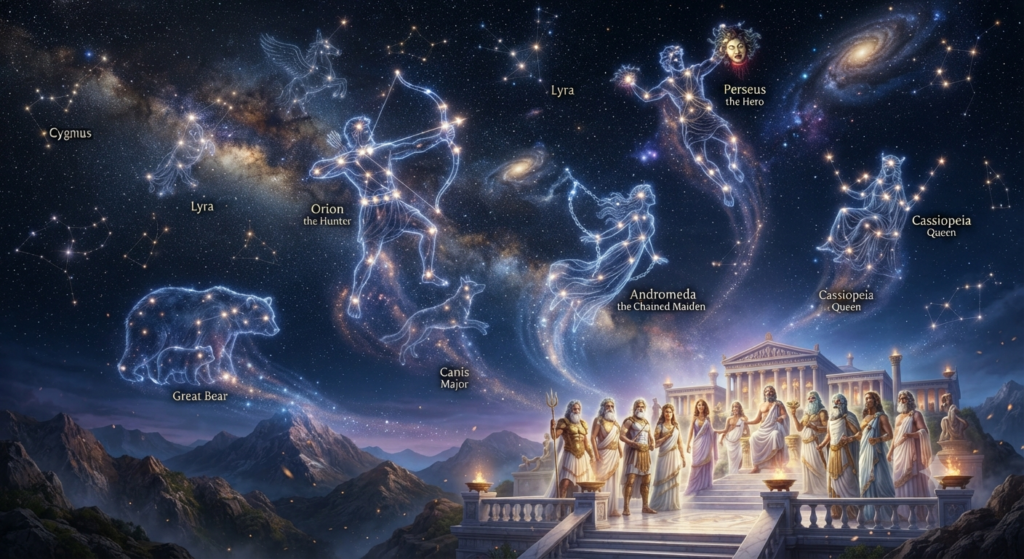
Orion’s celestial origin is tied to several conflicting myths, each preserved by different ancient sources. In Homer, he appears as a mighty hunter in the underworld; in later traditions, he is placed among the stars after death. The reason for his death varies: some tell of a scorpion sent against him, others of Apollo’s interference, and still others of divine punishment for his arrogance or violence. What remains stable is that Orion’s great figure was translated into the night sky, where he still appears as a hunter pursued by the Scorpion.
Artemis is central in some versions, though not always as the direct cause of his death. Certain myths link Orion and Artemis as companions in the hunt, while others make him a threat to her chastity or independence. Because the traditions are not uniform, it is best not to force a single narrative. What the star myth explains is the constellational drama itself: Orion, his dog, and the Scorpion are arranged in a way that recalls pursuit, danger, and the limits set upon human ambition.
Callisto’s Transformation into a Constellation
Callisto’s story is one of the most enduring Greek transformation myths connected to the sky. A companion of Artemis, Callisto was turned into a bear in many versions after becoming involved with Zeus, though the details vary according to source. Hera’s jealousy or wrath often follows, and the transformation becomes a mode of preservation and punishment at once. Later, Callisto is placed among the stars as the Great Bear, or in some traditions as the constellation Ursa Major.
Her son Arcas plays an important role in the mythic logic. In some accounts, he is nearly responsible for killing the bear before Zeus intervenes and sets both mother and son in the heavens. This dual translation into constellations explains not only the presence of the Great Bear but also the close relationship between Ursa Major and Ursa Minor in the sky. The myth gives celestial shape to kinship, danger, and the strange mercy of divine intervention.
Astraeus and the Birth of the Stars
Among the more cosmological Greek figures is Astraeus, a Titan associated with dusk and the stars. In Hesiodic genealogy, he belongs to the line of divine beings that generate atmospheric and celestial powers, and later tradition makes him the father of the stars and the winds through his union with Eos, the dawn. This is one of the few myths that speaks more directly to the origin of the stars as a category rather than merely to individual constellations.
Astraeus does not dominate popular narrative in the way Orion or the Pleiades do, but he is important for understanding Greek mythic cosmology. He embodies the threshold between day and night, the time when stars appear. In that sense, the birth of the stars is linked not to a dramatic event but to an ordered divine succession. The Greeks often imagined the heavens as genealogical, and Astraeus stands at the point where sky, wind, and starlight begin to take shape.
Aphrodite and the Star of Dawn
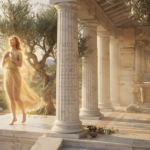
Aphrodite is associated in Greek and Roman tradition with the brilliant star visible before sunrise, often called the morning star or dawn star. In Greek thought, this is linked to the planet Venus rather than to a fixed star in the modern sense, but mythic language often blurs that distinction. As the bright herald of morning, the star becomes an emblem of Aphrodite’s beauty, power, and generative presence.
This association is especially prominent in later poetic and religious traditions, where the morning star signals desire, renewal, and divine radiance. Ancient observers knew it was a celestial body with a pattern distinct from the fixed stars, yet mythically it belonged to the same symbolic sky. Aphrodite’s star is therefore less an origin story than a transformation of astronomical brightness into divine identity, one of the clearest examples of how the Greeks read meaning into the heavens.
Metamorphosis, Grief, and Celestial Light
Many star myths are really grief myths. A figure is lost, mourned, or endangered, and the sky becomes a place of continuation after earthly life. This is true not only of heroes and hunters but also of children, maidens, and animals whose stories end in transformation. The celestial realm preserves what the world below cannot. In these narratives, light is never purely decorative; it is a form of remembrance.
Metamorphosis also reflects divine control over fate. The gods can save, punish, conceal, or immortalize by changing a mortal body into a star. The result is often ambiguous: elevation and loss occur together. This tension gives Greek star myths their distinctive emotional force. The heavens do not erase suffering; they fix it in radiant form, making the stars visible reminders of what has been changed forever.
Homeric and Hesiodic Views of Star Origins
Homer and Hesiod offer different but complementary ways of thinking about the stars. Homer uses the night sky richly and poetically, with stars serving as navigational and symbolic features, but he rarely gives formal origin myths for them. Hesiod, especially in the Theogony and related works, is more interested in genealogy and cosmic order, showing how divine powers generate one another. Together, they establish the framework later mythographers would elaborate.
Neither poet presents a full, systematic account of how every star came to be. Instead, they place stars within the fabric of a world already governed by divine ancestry and cosmic cycles. Later Greek tradition filled in these gaps with stories of ascent, punishment, and memorialization. The result is a mythic sky that is less a product of scientific explanation than of poetic inheritance, where starlight belongs to the same order as thunder, dawn, and death.
Constellaions in Ovid and Roman Tradition
In Roman literature, especially Ovid’s Metamorphoses, the stars become central evidence of transformation. Ovid gathers older Greek material and reshapes it into a vast poem of change, where many figures end by entering the heavens. His treatment of constellations is particularly influential because it links mythic narrative with visible astronomy in a literary form that later readers found definitive. Even when the stories are Greek in origin, Ovid’s Latin retelling often became the version most widely known.
Roman tradition also absorbed and adapted Greek star myths into a broader imperial imagination. The heavens became a place where memory, lineage, and divine favor could be displayed. Ovid is especially important for Callisto and other transformed beings, but his work also reflects a more general Roman interest in cataloguing the sky through story. The misspelling in the heading aside, constellations in Roman myth are rarely neutral; they are monuments of change.
Cross-Cultural Parallels in Star Myths
Greek star myths share features with traditions from many other cultures: the dead or transformed entering the sky, the stars marking seasonal knowledge, and celestial bodies carrying the memory of human life. In Mesopotamian, Egyptian, Chinese, and Indigenous traditions as well, the heavens often preserve stories of divine order, cosmic struggle, or ancestral presence. The Greek imagination is distinctive, but not isolated.
What makes the Greek material especially influential is the way it combines poetic beauty with genealogical logic. The stars are not just lights; they are kin, victims, hunters, lovers, and gods made visible. That same pattern appears elsewhere in world mythology, though in different forms and with different theological meanings. Across cultures, star myths answer the same deep human question: why does the night sky seem alive with names, figures, and memory?
Greek star myths explain the origin of the stars less as a single creation event than as a series of transformations into celestial form. Some stars are descendants of divine beings, some are transformed mortals, and some are linked to dawn, dusk, and the cosmic rhythms that frame human life. Taken together, these stories show how the ancient Greeks read the sky as a sacred landscape, where grief, power, and remembrance became light.

Orin Vale has spent the better part of two decades tracing the threads that connect the world’s oldest stories — from the halls of Asgard to the banks of the Nile, from Olympus to the jungles of the Maya. What began as a childhood fascination with flood myths and trickster gods grew into years of independent study across comparative mythology and ancient religion, always chasing the same question: what did these stories mean to the people who first told them? Orin writes for readers who want more than trivia — the ones looking for the beliefs, fears, and truths that myths were built to carry.