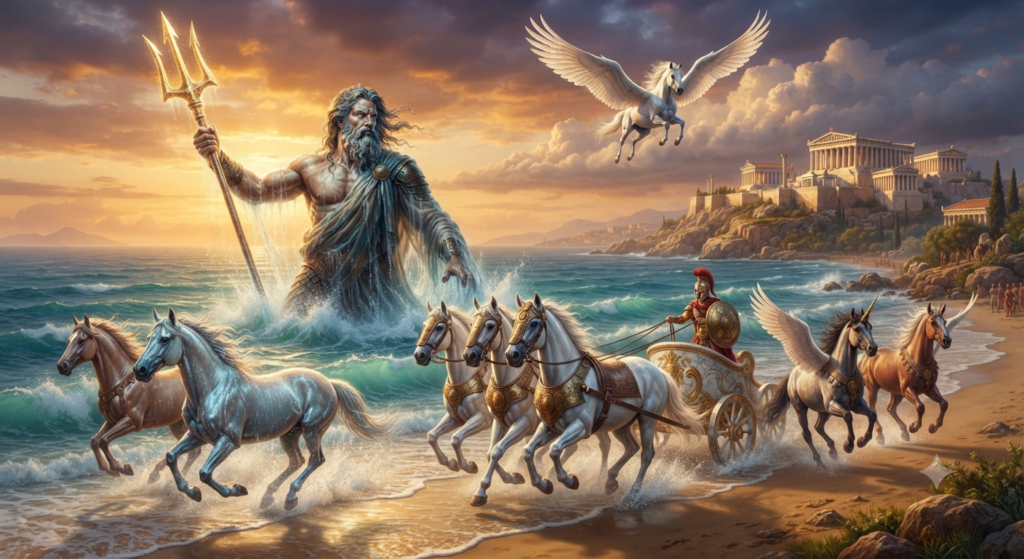
In Greek mythology, horses are far more than animals of burden or speed. They stand at the crossing point between the divine and the mortal world: born from gods, harnessed by heroes, linked to prophecy, sacrifice, warfare, and the untamed powers of the sea and sky. In the surviving poems and myths of Homer, Hesiod, Apollodorus, Ovid, and later writers, horses appear as sacred gifts, miraculous births, and symbols of rank and force, reflecting how deeply the ancient Greeks admired them.
Horses as Sacred Symbols in Greek Myth
Horses in Greek mythology often signal divine favor, noble status, and overwhelming power. They are associated with kings, gods, and heroic lineages, and their presence frequently marks a scene as elevated beyond ordinary life. In epic poetry, horse teams draw chariots of gods and heroes alike, while fine horses are among the greatest prizes a mortal can possess. Their beauty and strength made them natural symbols of prestige in a culture that admired aristocratic warfare and elite competition.
At the same time, horses also carried religious meaning. In several Greek traditions, they were connected with chthonic forces, sea deities, and solar imagery, depending on the local cult and mythic setting. The same animal could represent ordered speed in a chariot or untamed power in the wild, which gave the horse a flexible but potent symbolic life in Greek thought. This duality helps explain why horses appear so often at moments of divine intervention, heroic testing, and ritual exchange.
Poseidon and the Birth of the First Horse
One of the most famous myths about horses concerns Poseidon, who was called Hippios, “of horses,” in some local cults. Ancient tradition gives several versions of the first horse’s origin, but a common strand makes Poseidon the creator or father of horses. In one widely known account, he fashioned the first horse from sea foam or brought horses forth through his own generative power, showing his unusual command over both the sea and the speed of these animals. The exact details vary from source to source, as Greek myth often does.
Poseidon’s connection to horses is especially striking because he is better known today as a sea god. For the Greeks, however, his power was broader and more elemental. He could shake the earth, stir the sea, and animate the force of the horse, an animal whose wild energy seemed to mirror divine violence. This association made him central to horse cults and to myths in which equine power emerges from the sea’s ancient, unfathomable depth.
Divine Chariots and the Power of Speed
Horses are the engine of divine movement in Greek myth. The chariots of gods in Homeric epic are drawn by immortal horses that flash across heaven, the sea, or the battlefield with unnatural speed. Helios, the sun god in later tradition, is famously linked with his solar chariot, while deities such as Hera, Athena, and Ares also appear in chariots at different points in the tradition. These vehicles are not mere decoration; they express the reach and authority of divine beings moving through the world.
Speed itself becomes a form of power. A horse can carry a god into a moment before mortal eyes can fully grasp it, and this rapid movement mirrors the suddenness of fate and battle. In epic scenes, horses are trained, named, and described with care, emphasizing their almost personal role in the action. Their swiftness makes them ideal companions for gods and heroes who act on a scale beyond ordinary human time.
Horse-Born Heroes in Epic Greek Tales
Greek myth sometimes links heroes to horses in ways that suggest special birth or destiny. The most famous example is not a human born from a horse, but a hero whose life is deeply tied to horse culture: Achilles, often associated with exceptional horses, especially the immortal pair Xanthus and Balius given by Poseidon. These horses embody heroic excellence and the strange mingling of divine gift and mortal fate. When Xanthus speaks in Homer’s Iliad, the moment is unforgettable, showing that horses can become almost prophetic beings in their own right.
Other heroic traditions place horsemen at the center of their identities. The Dioscuri, Castor and Polydeuces, were celebrated as protectors of sailors and horsemen, and Castor in particular was linked with horsemanship. In myth and cult alike, the mounted or chariot-driving hero often stands for aristocratic discipline, martial skill, and closeness to the gods. Horses do not merely accompany such figures; they help define their stature.
Centaurs and the Wild Side of Equine Myth
Centaurs reveal the untamed, unsettling side of equine imagery in Greek mythology. These beings, part human and part horse, inhabit the boundary between civilization and animal force. In many stories they are violent, impulsive, and difficult to govern, though not all are monstrous. Chiron, the most famous centaur, is an exception: wise, civilized, and skilled in medicine, hunting, and instruction. His difference from the other centaurs makes the contrast between noble and savage nature especially clear.
The centaur myths suggest that horses could symbolize both human mastery and the fear of losing it. A centaur is what happens when that boundary collapses. Greek artists and poets often used centaurs to dramatize conflict between order and chaos, especially in tales involving weddings, battles, and the struggle to civilize the wild. Through them, the horse becomes a figure not only of strength but of unruly excess.
Pegasus and the Skybound Horse Traditions
Pegasus is the most famous horse in Greek myth, and one of the most enduring. According to the traditional account preserved by Hesiod and later writers, he sprang from the blood of Medusa after Perseus beheaded her. Born from a violent act, Pegasus nevertheless becomes a creature of elevation and grace, later associated with Bellerophon and the defeat of the Chimera. His story captures the Greek habit of turning catastrophe into marvel.
Pegasus also rises beyond the earth in a literal sense. Later myth links him with the heavens, where he is transformed into a constellation. That final ascent gives him a special place among mythic horses: he is not only a companion in heroic adventure, but also a bridge between earth and sky. In Greek tradition, the horse can therefore represent divine inspiration, aerial travel, and the possibility of transcendence.
Horse Sacrifice, Ritual, and Ancient Worship
Horses were rare and valuable animals, which made them especially significant in ritual contexts. Greek sources and local traditions preserve evidence of horse sacrifice in certain cults and ceremonies, though this practice was not universal across the Greek world. Where it occurred, it could be tied to chthonic powers, heroic dead, or particular divine figures such as Poseidon. The sacrificial horse often carried strong symbolic weight because of its cost and prestige.
Ancient worship also linked horses with votive offerings and local festivals. In some places, equine imagery appeared in processions, temple dedications, and ceremonial competitions. Pausanias and other ancient authors record regional customs that show how varied Greek religion could be from city to city. Horses were not simply practical creatures; in sacred settings they could embody wealth, speed, and the dangerous beauty of divine power.
Horses in War, Sport, and Homeric Society
In Homeric society, horses are inseparable from war and aristocratic competition. Chariot warfare and horse breeding signal status, while the care of horses marks the elite household. The Iliad repeatedly pauses to describe teams, harnesses, and the emotional bond between warrior and steed. A hero’s horses are not incidental possessions; they are part of his identity, his honor, and sometimes his grief.
Outside battle, horses also belong to athletic and social prestige. Chariot racing became one of the great events of the Panhellenic games, and victory in such contests brought immense fame. The Greeks understood horse ownership as a sign of wealth and political influence, which is why horses so often appear in myths about kings, warriors, and noble houses. In this world, to command horses was to command movement, visibility, and power.
Mortals, Omens, and Horses in Greek Legend
Greek mythology and legend often use horses as omens or signs of hidden truth. A horse’s behavior might reveal divine favor, warn of danger, or mark a heroic turning point. Because horses were associated with gods and prophecy, their appearance in a story could carry weight beyond the immediate scene. This is especially true in narratives where divine horses respond to fate or where a miraculous horse reveals what mortals cannot yet understand.
Mortals, too, could be judged by their relationship to horses. A skillful horseman might reflect discipline and nobility, while a poor one could symbolize disorder or the failure to live up to heroic standards. Greek legend is full of such contrasts, and the horse often serves as the medium through which they are expressed. Whether as a gift, a warning, or a test, the horse continually bridges human ambition and divine design.
The Horse’s Lasting Place in Hellenic Lore
Horses endure in Greek mythology because they hold together so many of its central ideas: power, beauty, danger, prestige, sacrifice, and transcendence. They can belong to Poseidon, carry gods across the sky, accompany heroes in war, and emerge as monstrous hybrids or radiant miracles. Few animals in Greek tradition are given such a wide symbolic range, and none are more closely tied to the imagination of nobility and force.
That lasting presence explains why horses remain one of the most recognizable figures in Hellenic lore. From Pegasus to the divine chariot, from centaur myths to heroic epics, they give shape to the Greeks’ understanding of motion and mastery. In their speed and vulnerability, their usefulness and mystery, horses became a lasting emblem of the mythic world itself.
Greek mythology does not treat horses as background creatures. They are sacred, dangerous, beautiful, and often deeply meaningful, appearing wherever divine power touches mortal life. Whether born from a god, driven by a hero, or transformed into a sign in the heavens, the horse remains one of the clearest symbols of how the Greeks imagined force made visible.

Orin Vale has spent the better part of two decades tracing the threads that connect the world’s oldest stories — from the halls of Asgard to the banks of the Nile, from Olympus to the jungles of the Maya. What began as a childhood fascination with flood myths and trickster gods grew into years of independent study across comparative mythology and ancient religion, always chasing the same question: what did these stories mean to the people who first told them? Orin writes for readers who want more than trivia — the ones looking for the beliefs, fears, and truths that myths were built to carry.