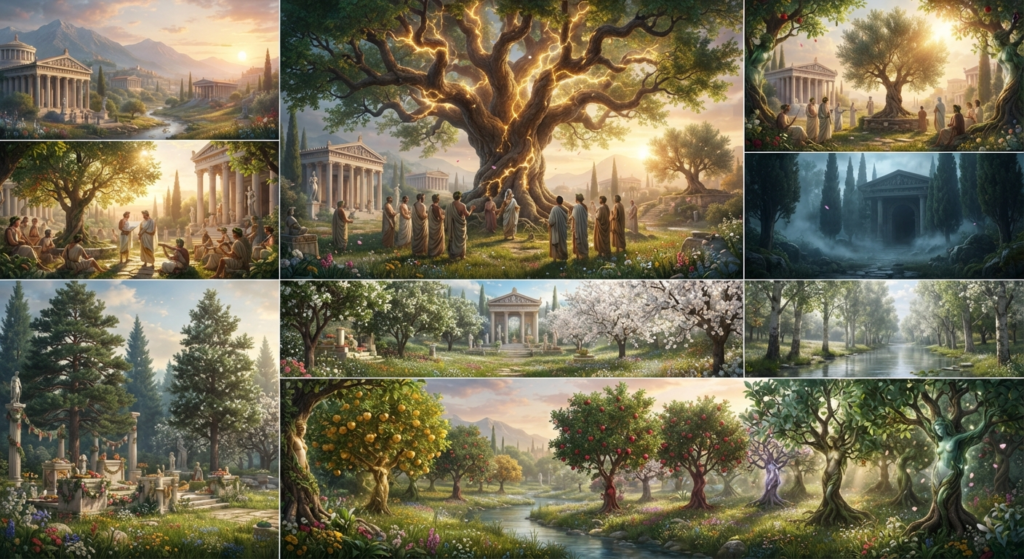
In the ancient Greek world, the natural landscape was not merely a backdrop for human activity but a living tapestry woven with divine presence. Trees, in particular, held profound significance, serving as sacred symbols, dwelling places for spirits, and tangible connections to the gods. To understand what trees were sacred in Greek mythology is to explore a rich ecological and spiritual system where the divine and the natural world were inseparably intertwined. For the Greeks, trees were more than just sources of wood, fruit, or shade; they were embodiments of divine will, sites of prophecy, and the very bodies of nymphs. This comprehensive guide delves into the sacred groves, metamorphosis myths, and cultic practices that defined the veneration of trees, revealing why specific species—from the mighty oak to the humble almond—were held in such high esteem. We will explore the mythological origins, the deities they were associated with, and the enduring legacy of these sacred botanical entities in the ancient world and beyond.
Origins and Historical Background of Tree Veneration
Pre-Hellenic Roots and the Cult of Nature
The veneration of trees in Greek mythology has deep roots that extend back to the pre-Hellenic period, reflecting a primal human reverence for the life-giving and mysterious forces of nature. In ancient Greece, trees were viewed as animate beings, inhabited by spirits or souls; they were not simply objects but subjects of religious awe . This belief was so fundamental that the ancient Greek word for oak, drys, was also the general word for tree, demonstrating the primacy of this species in their conception of arboreal life . This animistic worldview held that trees housed some kind of ‘soul’ and were the haunts of nymphs, spirits of the woods and mountains .
The earliest sanctuaries of the gods were not built temples but sacred groves (alsos), natural spaces where the divine presence was felt most keenly . These groves were often enclosed and considered inviolable. To cut down a tree within a sacred grove was a grave act of sacrilege, punishable by the gods. This deep-seated reverence for trees as temples or bodies of intelligent divinities is a recurrent theme in ancient literature. The Roman historian Pliny noted that the ancients adored trees because they looked upon them as the temples of some divinity . This belief was not limited to the Greeks but was shared by many ancient cultures, suggesting a common human impulse to sacralize the natural world.
The Evolution from Animism to Anthropomorphic Deities
Over time, these animistic beliefs evolved into more structured mythology. The spirits inhabiting trees became personified as nymphs, specifically the Dryads and Hamadryads . The Dryads, who were often associated with oaks, were nymphs whose life force was irrevocably bound up with that of a particular tree . At their birth, a symbiotic plant would spring up from the earth, and when they died, it would wither away. The premature felling of the tree brought about the death of the nymph . This concept established a direct and fatal link between the human-like deity and the natural world. Ovid recounts a story of an impious profaner who, while striking an oak with an axe, heard the tree declare that a nymph lodged within and that her death would not go unpunished . Similarly, another account mentions a mother transformed into a tree, begging her son never to touch any trees, as they were the bodies of nymphs . This powerful belief system ensured the protection of sacred trees and groves through fear of divine retribution.
The Major Sacred Trees and Their Divine Associations
The gods of the Greek pantheon each had their own favored trees, often linked to their myths, attributes, or domains. This association was so strong that a deity’s presence could be identified through their sacred flora. The following are some of the most significant examples of what trees were sacred in Greek mythology, highlighting their primary divine connections.
The Oak of Zeus
The oak tree was without question the most sacred tree in the Greek world, dedicated to Zeus, the king of the gods . The oak’s strength, longevity, and towering presence made it a fitting symbol for the supreme deity. It was not merely a symbol, however; it was also a direct conduit for Zeus’s will. The most famous sacred oak was located at Dodona, in northwestern Greece. Here, the oracle of Zeus was delivered through the rustling of the leaves of a sacred oak . Priests and priestesses would interpret the sounds of the wind in the branches, providing divine guidance to those who consulted the oracle. The oak at Dodona was one of the most respected oracles in the ancient world, second only to Delphi, and solidified the oak’s status as a tree of immense prophetic power. The oak also appears in other myths, such as the story of the Golden Fleece, which was nailed to the branches of an oak tree in the sacred grove of Ares at Colchis and guarded by a dragon .
The Olive Tree of Athena
The olive tree was the sacred tree of Athena, the goddess of wisdom, strategic warfare, and crafts . Its profound importance to Athenian culture and religion is exemplified by the myth of the contest between Athena and Poseidon for the patronage of the city of Athens. According to the myth, Poseidon struck the ground with his trident and produced a saltwater spring, while Athena caused the first olive tree to spring forth from the rock of the Acropolis . The gods judged Athena’s gift—which provided wood, oil for food and light, and a valuable trade commodity—to be far more beneficial for mankind, and she was awarded the city. The most sacred olive tree in Athens grew in her sanctuary on the Acropolis, and the fate of the city was believed to depend upon its survival . Olive oil was a staple of Greek life, used in cooking, lamps, and as a skin lotion, making the tree an indispensable symbol of prosperity and civilization.
The Laurel of Apollo
The laurel tree (also known as the bay tree) was sacred to Apollo, the god of music, poetry, prophecy, and healing . The laurel’s connection to Apollo is beautifully explained in the myth of Daphne. In this famous story, Apollo, struck by Eros’s arrow, fell madly in love with the nymph Daphne. She, however, was struck by a leaden arrow and despised him. As Apollo pursued her, Daphne called out to her father, a river god, for help. He transformed her into a laurel tree just as Apollo was about to catch her . Apollo, heartbroken but still loving her, made the laurel his sacred tree. He declared that its leaves would never wither and would be used to crown victors in athletic games, poets, and heroes. The laurel also had apotropaic and purifying properties and was a symbol of victory and honor .
The Cypress of the Underworld
The cypress tree, with its dark, evergreen foliage, was associated with the god of the dead, Hades, and was a symbol of mourning and the underworld. Its connection to the realm of the dead is rooted in the tragic myth of Cyparissus, a young boy beloved by Apollo . Cyparissus accidentally killed a beloved pet deer and was so overwhelmed with grief that he wished to mourn forever. Apollo, moved by his sorrow, transformed him into a cypress tree. The tree’s tall, slender form and its permanent, deep green color came to represent the enduring nature of grief and the eternal realm of the dead. Cypress trees were commonly planted around tombs and in cemeteries, serving as a living memorial and a link to the underworld.
The Pine of Attis and Cybele
The pine tree was sacred to Cybele, the great Mother Goddess, and her consort Attis . The myth explaining this association is one of death, castration, and rebirth. According to one version, the hermaphroditic being Agdistis (a form of Cybele) was castrated, and an almond tree grew from the blood or severed genitals . Later, Attis was born from this almond tree. Attis grew to become a beautiful man, and Agdistis/Cybele fell in love with him. When Attis was to marry another, the goddess drove him mad, causing him to castrate himself. He bled to death, and a pine tree grew from his blood. In other versions, Attis was born directly from the almond or pine . The pine tree, with its conical shape and evergreen needles, became a central symbol in the Cybele-Attis cult, representing self-sacrifice, mourning, and the promise of rebirth. This myth underscores how plants and trees could be central to the mythology and ritual of major cults.
The Myrtle and Myrrh of Aphrodite
The myrtle tree was sacred to Aphrodite, the goddess of love, beauty, and desire . The myrtle’s fragrant leaves and beautiful white flowers made it an appropriate symbol for the goddess of love. It was frequently used in wedding rituals; brides would wear myrtle garlands and bathe in myrtle-scented water before their marriage . This association stems from the myth of Myrrha (or Smyrna), a princess who was transformed into a myrtle tree . The story of Myrrha is particularly dark, as she was cursed by Aphrodite to fall in love with her own father. After a fraught and tragic series of events, she fled his wrath and the gods transformed her into a myrtle tree. From her trunk, a boy was born—Adonis, who would become Aphrodite’s mortal lover. While the myrrh tree, which produces the fragrant resin, is also linked to Aphrodite through a very similar myth, the myrtle was more directly associated with love and the wedding ceremony.
The Poplar and the Underworld
The white poplar was another tree associated with the underworld, specifically with Hades. According to myth, Leuke, a nymph and daughter of Oceanus, was abducted by Hades (Pluto) and transformed into a white poplar tree . Like the cypress, the poplar was a tree of mourning and was often planted in cemeteries. Heracles, on his journey to the underworld, was said to have worn a crown of white poplar, further cementing its connection to the realm of the dead and the world of heroes.
The Linden (Lime) Tree
The linden or lime tree was sacred to Aphrodite , though its mythology is also linked to the themes of transformation and reward. One myth tells of Philyra, a nymph who was loved by the Titan Cronus. When their affair was discovered, Cronus turned into a horse and fled, and Philyra gave birth to the centaur Chiron. Ashamed, she begged Zeus to change her form, and he transformed her into a linden tree . In another tale, the linden is associated with the pious couple Baucis and Philemon. For their hospitality to Zeus and Hermes in disguise, the gods spared them from a great flood and, at their death, transformed them into a pair of entwined trees: Baucis a linden, and Philemon an oak . This myth highlights the reward of piety and the sanctity of the tree as a final, blessed form.
The Lotus Tree
The lotus tree (a species of date plum) was sacred to the god Priapus, a rustic fertility god . The most famous myth associated with the lotus tree is that of Lotis, a nymph who was transformed into a lotus tree to escape Priapus’s unwanted advances . The lotus tree is also famous for its role in the story of the Lotophagi, or Lotus-Eaters, a tribe encountered by Odysseus in the Odyssey. The honey-sweet fruit of the lotus caused those who ate it to lose all desire to return home, making it a symbol of seductive oblivion .
Other Notable Trees and Plants
Beyond the major trees, a wide variety of other species held sacred significance through their associations with metamorphosis myths, deities, and rituals. Exploring these further enriches our understanding of what trees were sacred in Greek mythology.
The Almond Tree
The almond tree was revered for being the first tree to flower in late winter or very early spring, symbolizing rebirth and undying hope . This remarkable characteristic led to its association with the tragic love story of Phyllis and Demophon. According to the myth, Phyllis, daughter of the Thracian king, waited for her lover Demophon to return from Athens, but he was delayed. She died of grief and was transformed into an almond tree. When Demophon finally returned, he found the tree withered and barren. He wrapped his arms around it, and his tears and embrace caused it to miraculously blossom with white flowers . This myth explains the almond tree’s early bloom as a symbol of undying love. The almond is also linked to the myth of Agdistis and Attis, where it grew from the blood of the castrated Agdistis, leading to Attis’s birth .
The Mulberry Tree
The mulberry tree is most famously known from the tragic love story of Pyramus and Thisbe. The two ill-fated Babylonian lovers agreed to meet beneath a white-berried mulberry tree. When Pyramus found Thisbe’s bloody shawl and believed she was dead, he killed himself. Thisbe, finding her dead lover, also committed suicide. Their mingled blood soaked into the earth and turned the white berries of the mulberry tree a deep black-red, a color they have retained ever since . This myth, which inspired Shakespeare’s Romeo and Juliet, links the mulberry to themes of tragic love and sacrifice.
The Pomegranate Tree
The pomegranate tree is not always considered a tree in the same sense as an oak or an olive, but its significance in Greek mythology is immense. Its fruit is directly tied to the myth of Persephone. Hades offered Persephone a pomegranate seed in the underworld. Because she ate it, she was bound to return to the underworld for a portion of each year, creating the seasons . The pomegranate thus became a symbol of marriage, fertility, and the indissoluble bond between the underworld and the upper world.
The Apple Tree
The golden apple tree is a central motif in the Judgement of Paris, the event that indirectly sparked the Trojan War. Eris, the goddess of discord, threw a golden apple inscribed “to the fairest” among the goddesses Hera, Athena, and Aphrodite, leading to a divine beauty contest with disastrous consequences . The apple tree, and especially the golden apple, became a symbol of beauty, discord, and temptation.
The Fig and Walnut
Both the fig and walnut are mentioned in the context of hamadryad nymphs, whose life force was tied to a specific tree. The hamadryads associated with these trees were the Hamadryas Balanos (for the acorn) and likely similarly specific nymphs for the fig and walnut . This further reinforces the belief that each tree had a distinct spirit that dwelt within it.
Ancient Sources and Artistic Representations
Our understanding of what trees were sacred in Greek mythology comes from a variety of ancient sources, including epic poetry, hymns, historical accounts, and mythological compendiums. Homer mentions the oracular oak of Zeus at Dodona in the Iliad, establishing it as a site of divine communication . Herodotus, in his Histories, recounts the fate of Athens’ sacred olive tree, which survived a Persian attack, demonstrating its perceived importance to the city’s fate . Pausanias, the Greek traveler and geographer, provides invaluable descriptions of sacred sites and the trees associated with them, such as the monk’s pepper tree of Hera on Samos and the myth of Attis and the almond .
The poets Ovid, Apollodorus, and Hyginus are essential sources for the many metamorphosis myths, where humans and nymphs are transformed into trees . Ovid’s Metamorphoses is a particularly rich text, containing the stories of Daphne and the laurel, Myrrha and the myrtle, Baucis and Philemon, Pyramus and Thisbe, and Cyparissus. The Homeric Hymns also preserve sacred traditions, such as the birth of Apollo on Delos, where the goddess Leto clung to a palm tree .
In art, sacred trees were often depicted in the background of mythological scenes or as attributes of the gods. For example, Athena is frequently shown with an olive branch, Apollo with a laurel wreath, and Aphrodite with myrtle. These depictions served as visual shorthand, reminding viewers of the divine associations and the mythological narratives that gave these trees their sacred status.
Cultural Influence and Modern Legacy
The reverence for sacred trees in Greek mythology has had a lasting impact on Western culture. The concept of the sacred grove has influenced the design of parks, gardens, and even the idea of the “haunted” forest. The various trees and their associated myths continue to be referenced in literature, art, and popular culture. The laurel wreath remains a symbol of victory and honor, used in academic ceremonies. The myrtle is still associated with love and marriage. The allegory of the lotus-eaters persists as a warning against hedonistic oblivion.
The Greek mythological framework also provides a rich vocabulary for discussing nature and our relationship with it. The dryads and hamadryads serve as potent symbols of the vital connection between humanity and the natural world, reminding us of the need for conservation and respect for our environment. The sacred trees of Greece are not just relics of an ancient past; they are living symbols that continue to inspire and inform our cultural imagination.
Frequently Asked Questions About What trees were sacred in Greek mythology?
Which tree was most sacred to Zeus?
The oak tree was the most sacred tree to Zeus. The god delivered his oracles through the rustling of the leaves of the sacred oak at Dodona, making it one of the most important prophetic sites in the ancient Greek world .
What tree is sacred to Athena?
The olive tree was sacred to Athena. In her contest with Poseidon for Athens, Athena created the first olive tree, and it became a symbol of the city’s prosperity and a central object of veneration on the Acropolis .
What tree is associated with Apollo?
The laurel tree (or bay tree) was sacred to Apollo. This association comes from the myth of Daphne, who was transformed into a laurel tree to escape Apollo’s pursuit .
What are the trees connected to Hades and the underworld?
The cypress and the white poplar were both associated with Hades and the realm of the dead. The cypress is linked to the myth of Cyparissus, and the poplar is linked to the abduction of the nymph Leuke . Both were symbols of mourning and used in funerary practices.
What tree was sacred to Aphrodite?
The myrtle tree was sacred to Aphrodite, the goddess of love. It was used in wedding ceremonies, and its connection to the goddess is explained by the myth of the princess Myrrha, who was transformed into a myrtle tree .
What is the significance of the almond tree in Greek myth?
The almond tree is associated with the myth of Phyllis and Demophon. Phyllis died of grief and was transformed into an almond tree, which remained barren until her lover returned, causing it to miraculously blossom—explaining why it is the first tree to bloom in spring .
What tree is associated with the goddess Cybele?
The pine tree was sacred to Cybele and her consort Attis. The myth involves Attis’s death and rebirth, and the pine tree symbolized his sacrifice, as well as the mourning and renewal central to her cult .
What are Dryads and Hamadryads?
Dryads and Hamadryads were nymphs whose lives were bound to trees. The Dryads were often associated with oaks, and they would die if their tree was destroyed. The Hamadryads were a type of dryad whose life was specifically tied to a single tree .
Conclusion
To ask what trees were sacred in Greek mythology is to open a door to a world where the divine was immanent in nature. The Greeks did not simply see trees as resources or mere objects of beauty; they saw them as sacred entities, inhabited by spirits, and intimately connected to the lives and attributes of their gods. The oak, the olive, the laurel, the cypress, the pine, and the myrtle were not just plants but powerful symbols of divine power, love, sorrow, and renewal. Through a rich tapestry of myths, cultic practices, and oracular traditions, these trees became the silent witnesses to a worldview that respected and revered the natural world as a vital manifestation of the sacred. This veneration has left an indelible mark on Western culture, reminding us of the profound and ancient link between the human spirit and the enduring majesty of the natural world.

Orin Vale has spent the better part of two decades tracing the threads that connect the world’s oldest stories — from the halls of Asgard to the banks of the Nile, from Olympus to the jungles of the Maya. What began as a childhood fascination with flood myths and trickster gods grew into years of independent study across comparative mythology and ancient religion, always chasing the same question: what did these stories mean to the people who first told them? Orin writes for readers who want more than trivia — the ones looking for the beliefs, fears, and truths that myths were built to carry.