Anyone asking where is Hades should first note that this question typically refers to the underworld realm itself rather than the god who rules it, since Hades functioned both as the name of this significant Greek deity and as a common term for the realm he governed. Within Greek mythology, the answer to where is Hades points consistently downward, situating this realm beneath the earth, accessed through specific rivers and legendary physical entrances that ancient Greeks believed connected the world of the living to this significant, separate cosmic domain. Understanding where is Hades requires examining both its general cosmological position and the specific geographic locations ancient sources associated with entry into this significant underworld realm.
Hades’s Place in Greek Cosmology
Within the broader structure of Greek cosmology, where is Hades receives a consistent answer: beneath the earth, forming a distinct cosmic realm separate from the sky governed by Zeus and the sea governed by Poseidon, following their shared division of authority after the Titanomachy.
This positioning beneath the earth reflects Greek mythology’s broader three-part cosmic structure, in which where is Hades specifically corresponds to the underworld component of this larger system, distinguishing it clearly from the celestial and maritime domains ruled by Hades’s Olympian brothers.
Rather than representing a literal, geographically mappable location in the modern sense, where is Hades within ancient Greek belief functioned as a genuinely separate cosmic realm, understood as existing beneath the visible world while remaining largely inaccessible and mysterious to the living under ordinary circumstances.
Understanding this cosmological positioning provides essential context for where is Hades, establishing the underworld’s fundamental place within the broader three-part division of cosmic authority that structured ancient Greek understanding of the universe following the significant Titanomachy.
The Rivers of the Underworld
The River Styx represents one of the most significant geographic features relevant to where is Hades, functioning as the river by which the gods themselves swore their most binding, sacred oaths, reinforcing its exceptional significance within the broader underworld landscape.
The River Acheron frequently appears in connection with where is Hades as well, often associated specifically with the crossing undertaken by souls entering the underworld, reflecting its significant role within the broader mythological geography ancient Greeks associated with this particular realm.
Additional rivers, including Lethe, associated with forgetfulness, and Phlegethon, associated with fire, further populate the mythological landscape relevant to where is Hades, each carrying specific symbolic significance within the broader geographic structure ancient sources attributed to this particular underworld realm.
This network of significant rivers reinforces that where is Hades involved a genuinely detailed, symbolically rich mythological geography rather than a simple, undifferentiated location, providing ancient Greeks with a considerably more textured understanding of this significant realm’s internal structure.
Legendary Entrances to the Underworld
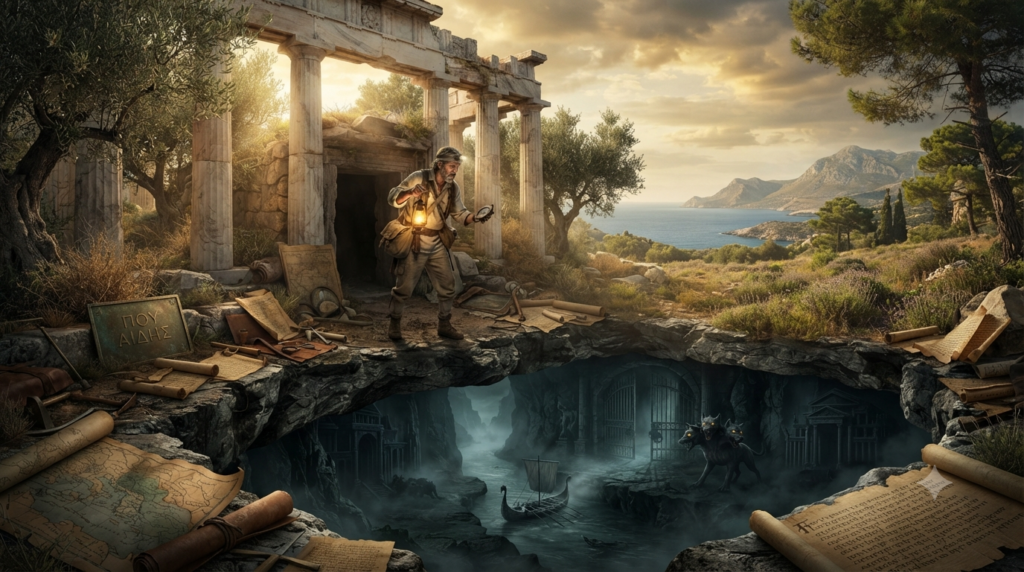
Cape Tainaron, located in southern Greece, represents the most frequently cited legendary entrance relevant to where is Hades, believed by ancient Greeks to provide a specific, physical point of access connecting the world of the living directly to this significant underworld realm.
Other locations, including the region of Avernus in Italy, later became associated with underworld entrances as well, particularly within broader Greco-Roman literary and religious tradition, expanding the geographic scope relevant to where is Hades beyond mainland Greece specifically into the broader ancient Mediterranean world.
These legendary entrances served an important symbolic function relevant to where is Hades, providing specific, tangible points of contact between the living world and this otherwise inaccessible underworld realm, reinforcing ancient belief that passage between these two significant cosmic domains remained genuinely possible under certain circumstances.
Recognizing these specific legendary entrances adds meaningful geographic texture to where is Hades, demonstrating that ancient Greek belief connected this cosmic realm to actual, named physical locations rather than treating it as an entirely abstract or inaccessible concept disconnected from the living world.
Is the Underworld a Literal Place?
Ancient Greek religious belief generally treated where is Hades as a genuine, feared, and respected cosmic reality, with the underworld’s existence taken seriously within actual ancient Greek religious practice rather than being understood as purely symbolic or metaphorical during the period of active worship.
Modern engagement with where is Hades, by contrast, typically approaches this question through a more symbolic or purely cosmological lens, examining the underworld’s significance within Greek mythological structure without requiring literal belief in its physical existence beneath the earth.
This distinction between genuine ancient religious belief and modern symbolic or academic engagement reflects a broader pattern relevant to how contemporary audiences approach historical mythological traditions generally, treating where is Hades as meaningful cultural and religious history rather than active contemporary belief for most readers today.
Recognizing this distinction provides important final context for where is Hades, confirming that this question can be meaningfully addressed both through genuine ancient religious understanding and through modern academic or symbolic engagement with Greek mythological cosmology and geography.
FAQ — Quick Answers About the Location of Hades
Where is Hades?
In Greek mythology, Hades is located beneath the earth, forming a separate underworld realm distinct from the sky and sea domains of Zeus and Poseidon.
What rivers are associated with the underworld?
The Styx and Acheron are the most significant rivers associated with Hades, along with Lethe and Phlegethon, each carrying distinct symbolic meaning.
Where did ancient Greeks believe you could enter Hades?
Cape Tainaron in southern Greece was the most commonly cited legendary entrance to the underworld in ancient Greek tradition.
Is Hades a real, literal place?
Ancient Greeks generally treated Hades as a genuine cosmic reality within their religious belief, though modern engagement typically approaches it symbolically.
Is Hades the same as the god’s name?
Yes, “Hades” refers to both the underworld realm itself and the god who rules over it within Greek mythology.
Conclusion
Anyone who sets out to answer where is Hades finds a realm consistently positioned beneath the earth within Greek cosmology, connected to the living world through significant rivers like the Styx and Acheron and legendary entrances such as Cape Tainaron in southern Greece.
Understanding this realm’s place within the broader three-part division of cosmic authority, alongside its detailed mythological geography, reveals a genuinely rich and symbolically significant underworld tradition central to ancient Greek religious and mythological understanding.
Ultimately, where is Hades finds its most complete answer in recognizing both its cosmological position beneath the earth and its genuine significance within ancient Greek religious belief, confirming this realm’s lasting importance throughout Greek mythological tradition.

Orin Vale has spent the better part of two decades tracing the threads that connect the world’s oldest stories — from the halls of Asgard to the banks of the Nile, from Olympus to the jungles of the Maya. What began as a childhood fascination with flood myths and trickster gods grew into years of independent study across comparative mythology and ancient religion, always chasing the same question: what did these stories mean to the people who first told them? Orin writes for readers who want more than trivia — the ones looking for the beliefs, fears, and truths that myths were built to carry.