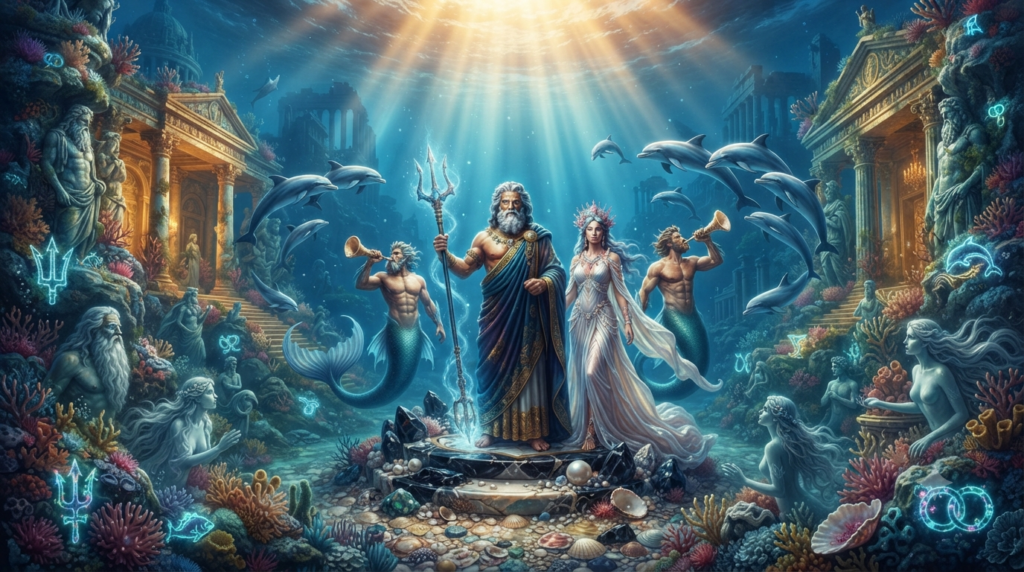
When people search for who are Poseidon’s friends, they are usually applying a modern lens to an ancient belief system that never quite worked that way. Greek mythology rarely frames the gods as having “friends” in the casual, mutual sense the word carries today. Divine relationships were instead built on family ties, marriage, political alliance among the Olympians, and the patronage a god chose to extend toward favored mortals. Understanding this distinction is essential before identifying who Poseidon’s closest relationships actually were.
Despite this difference in framework, Poseidon does have a consistent circle of figures who appear again and again at his side across myth and cult worship. His wife, his children, the sea deities who share his domain, his fellow Olympian brothers, and the mortal heroes he chose to favor all occupy a version of the role “friend” might describe in a human context. Examining each of these relationships reveals not just who stood closest to Poseidon, but what kind of god he was within his own divine household.
This distinction matters for anyone genuinely trying to answer who are Poseidon’s friends, since a search for camaraderie in the human sense will come up empty, while a search for loyalty, kinship, and favor reveals a surprisingly rich network around the god of the sea. Rather than a single best friend or tight social circle, Poseidon’s world is organized around concentric layers of family, allies, and chosen mortals.
What follows examines each of these relationships individually, from his wife Amphitrite to the mortal heroes he protected, building a complete picture of who occupied the closest positions to Poseidon within Greek mythology’s own logic of divine connection.
Understanding “Friendship” Among the Greek Gods
Before identifying specific figures, it helps to understand why the concept of friendship rarely appears in stories about the Olympians. Greek myth, as recorded by poets like Homer and Hesiod, organizes divine relationships primarily around genealogy and hierarchy rather than personal affection chosen freely between equals. A god’s closest relationships are almost always dictated by birth, marriage, or the political structure of Olympus itself.
This structural approach explains why questions like who are Poseidon’s friends require some reframing. The gods do form alliances, show favoritism, and occasionally display genuine affection, but these bonds are consistently described in terms of family loyalty, marital partnership, or protective patronage rather than as friendship between independent parties choosing one another freely. Zeus and Poseidon, for example, are always discussed as brothers first, never simply as friends.
Patronage represents the closest ancient equivalent to modern friendship within this system, particularly in how Poseidon relates to mortal heroes. When a god selects a human to protect, guide, or favor, the relationship carries emotional investment and loyalty that resembles friendship, even though the god-mortal power imbalance makes the term technically inaccurate. This dynamic appears repeatedly in Poseidon’s mythology and offers the most human-feeling version of connection available to him.
With this framework established, the figures who follow represent the closest approximations of friendship available within Poseidon’s mythology: his wife, his children, his extended sea family, his Olympian brothers, and his favored mortal heroes. Each relationship reveals a different facet of how the god of the sea connected with those around him.
Amphitrite: Wife and Closest Companion
Amphitrite stands as the figure closest to Poseidon in nearly every sense the ancient sources allow. As his wife and queen of the sea, she appears alongside him consistently in both literature and art, sharing his throne and his domain in a partnership that ancient audiences would have recognized as the deepest bond available to any Olympian. Unlike Zeus’s turbulent marriage to Hera, Poseidon and Amphitrite’s relationship is depicted with relatively little conflict.
Her origins as a Nereid, one of the fifty sea-nymph daughters of Nereus, connect her directly to the broader marine world Poseidon governs, making their union as much a joining of sea deities as a marriage of equals. Some versions of her myth describe Poseidon pursuing her with the help of a dolphin, who eventually persuades her to accept him, an image that later became a symbolic tribute to the animal in Poseidon’s own iconography.
Amphitrite’s role extends beyond companionship into shared authority over the sea itself, a distinction that separates her from the more passive divine spouses found elsewhere in Greek mythology. Ancient depictions frequently show her enthroned beside Poseidon, holding her own trident-like scepter, reinforcing that their bond functions as genuine partnership rather than simple subordination.
Because of this closeness, any honest answer to who are Poseidon’s friends must begin with Amphitrite, since no other figure in his mythology receives the same sustained presence at his side across so many centuries of storytelling and worship.
Triton: Son and Loyal Herald
Triton, the son of Poseidon and Amphitrite, occupies a uniquely close position within his father’s world as both offspring and functional herald of the sea. Described as half-man and half-fish, Triton carries a conch shell that he blows to calm or stir the waves at his father’s command, making him an active extension of Poseidon’s will rather than a passive family member.
This role as herald places Triton in constant proximity to Poseidon, present in scenes where the god’s authority over the sea needs to be announced or enforced. Ancient art frequently depicts Triton accompanying his father’s chariot processions, reinforcing the image of a son who serves not out of obligation alone but as a trusted extension of Poseidon’s power across the ocean.
The loyalty embedded in this relationship distinguishes it from many other parent-child dynamics among the Olympians, where rivalry or distance often characterizes the bond. Triton’s consistent, cooperative presence beside Poseidon throughout mythology suggests a relationship built on mutual purpose, with father and son functioning almost as partners in maintaining order across the sea.
Within any exploration of who are Poseidon’s friends, Triton represents the clearest example of a family bond that also carries the loyalty and closeness typically associated with friendship, making him one of the few figures who fits both categories simultaneously.
Nereus and the Nereids: The Extended Sea Family
Beyond his immediate household, Poseidon maintains a consistently peaceful relationship with Nereus, the elderly sea god known for his wisdom and truthfulness, and with Nereus’s fifty daughters, the Nereids. Unlike many of Poseidon’s other interactions across mythology, which often involve conflict or conquest, his relationship with this branch of the sea pantheon is marked by cooperation rather than tension.
Nereus himself, sometimes called the “Old Man of the Sea,” predates the Olympian generation and represents an older, gentler layer of divine authority over the ocean. Rather than competing with Poseidon for dominance, Nereus coexists peacefully within the same domain, a dynamic that stands in contrast to Poseidon’s more contentious relationships with rival gods elsewhere in myth.
The Nereids, including Amphitrite herself before her marriage, form a constant presence throughout Poseidon’s underwater court, frequently depicted attending him alongside dolphins, hippocamps, and other marine creatures in ancient art. Their collective presence reinforces the sense of a genuine sea community surrounding Poseidon, rather than a solitary god ruling in isolation.
This extended network illustrates that questions about who are Poseidon’s friends extend naturally into questions about his broader marine community, since Nereus and the Nereids function as a kind of extended family, offering companionship and cooperative coexistence within the same watery realm Poseidon commands.
Poseidon’s Ties to Zeus and Hades: Alliance, Not Friendship
Poseidon’s relationship with his brothers Zeus and Hades offers the clearest example of why the word “friendship” fits awkwardly onto Olympian relationships. After the defeat of their father Cronus, the three brothers divided the cosmos by lot, with Zeus receiving the sky, Hades the underworld, and Poseidon the sea. This division created a permanent structural alliance among them, but not necessarily personal warmth.
Ancient sources depict Poseidon as proud of his domain and occasionally resentful of Zeus’s overall authority as king of the gods, a tension that surfaces in stories where Poseidon challenges or resists Zeus’s decisions. This friction suggests a relationship closer to professional rivalry between powerful equals than to friendship as commonly understood, even as the brothers remain bound by necessity and shared origin.
With Hades, Poseidon’s interactions appear even less frequently in surviving mythology, largely because Hades himself rarely leaves the underworld to interact with his Olympian siblings. What relationship exists between them is defined almost entirely by their shared division of the cosmos rather than by personal closeness or recorded interaction.
For anyone researching who are Poseidon’s friends, the relationship with Zeus and Hades serves as an important clarifying contrast: these are alliances of necessity and family structure, not friendships built on personal affinity, reinforcing why Amphitrite, Triton, and the sea community represent far closer bonds than his fellow Olympian brothers.
Mortal Favorites: Heroes Poseidon Supported
Among mortals, Poseidon extends a form of loyalty and protection to select heroes and demigods that comes closest to resembling human friendship, even though the power imbalance between god and mortal keeps the relationship fundamentally one of patronage. Theseus, whom some traditions describe as Poseidon’s son, receives particular favor, including the god’s assistance in various trials throughout his heroic career.
Pelops similarly benefits from Poseidon’s direct favor, most notably when the god grants him a winged chariot to help him win the hand of Hippodamia in a dangerous race. This kind of active intervention distinguishes Poseidon’s mortal favorites from casual worshippers, showing a god willing to personally involve himself in a hero’s fate when sufficiently invested in their success.
These relationships typically began through lineage, prayer, or a mortal’s demonstrated worthiness in Poseidon’s eyes, rather than through anything resembling equal companionship. Once established, however, the god’s support in these cases often persisted across a hero’s entire mythological arc, suggesting a form of loyalty that, while not friendship in the strict sense, carried real emotional investment on Poseidon’s part.
When people ask who are Poseidon’s friends with mortals specifically in mind, these favored heroes represent the closest available answer, illustrating how patronage in Greek mythology could function as an emotionally significant relationship even without the mutuality that defines human friendship.
The Horse: Poseidon’s Signature Companion
No discussion of who are Poseidon’s friends would be complete without addressing his enduring association with horses, even though this relationship falls outside personal or family bonds entirely. Ancient tradition credits Poseidon with creating the horse itself, striking the earth to bring the animal into existence, an act that permanently linked him to horsemanship across Greek culture.
This connection appears throughout Poseidon’s iconography, with the god frequently depicted alongside horses or riding a chariot pulled by hippocamps, hybrid creatures combining horse and fish. The association extended into real-world worship, where Poseidon received cult titles like Hippios, meaning “of the horse,” reflecting his patronage over both the animal and those who depended on it.
While a horse cannot function as a friend in any literal sense, this symbolic companionship reveals something meaningful about how ancient worshippers understood Poseidon’s character: a god deeply tied not just to the sea, but to power, movement, and untamed natural force, expressed through his signature animal companion.
Understanding this relationship rounds out the full picture of who are Poseidon’s friends, since it demonstrates that his closest associations extend even into symbolic and animal companionship, reinforcing the god’s identity as ruler over forces both wild and vast.
What These Relationships Reveal About Poseidon’s Character
Taken together, Poseidon’s closest relationships paint a portrait of a god defined by loyalty within structured bonds rather than by open, freely chosen friendship. His marriage to Amphitrite, his partnership with his son Triton, his peaceful coexistence with Nereus and the Nereids, and his selective favor toward mortal heroes all reflect a consistent pattern: connection through family, domain, and chosen patronage.
This pattern distinguishes Poseidon from gods like Hermes or Dionysus, whose mythologies feature broader, more socially fluid relationships across both divine and mortal worlds. Poseidon’s world, by contrast, remains tightly organized around his household and his chosen favorites, reflecting the more insular, authority-driven character often attributed to him throughout ancient sources.
This insularity does not indicate coldness so much as a particular style of divine loyalty, one rooted in structure rather than spontaneity. The consistency of his relationship with Amphitrite, the active cooperation shown by Triton, and the sustained protection extended to mortals like Theseus all suggest a god capable of deep, lasting attachment within the relationships he does maintain.
Ultimately, the search for who are Poseidon’s friends reveals more about the nature of Greek divine relationships than it does about any single companionship, showing that for a god like Poseidon, loyalty was expressed through family, alliance, and patronage rather than through friendship as it is understood today.
Frequently Asked Questions
Did Poseidon have any real friends?
Not in the modern sense. His closest relationships were built through marriage, family, and patronage rather than mutual friendship between equals.
Who was Poseidon closest to?
Amphitrite, his wife, along with their son Triton, represent the figures most consistently present at his side throughout Greek mythology.
Was Poseidon friends with Zeus?
Their bond functioned as a fraternal alliance rooted in the division of the cosmos, marked by occasional rivalry rather than personal friendship.
Conclusion
Answering who are Poseidon’s friends ultimately means looking past the modern expectation of casual companionship and toward the family loyalty, marital partnership, and mortal patronage that structured his relationships instead. Amphitrite, Triton, Nereus and the Nereids, his Olympian brothers, and his favored heroes together reveal a god whose closest bonds were built not on friendship as we define it, but on the deeper, more structured loyalties that defined connection throughout Greek mythology.

Orin Vale has spent the better part of two decades tracing the threads that connect the world’s oldest stories — from the halls of Asgard to the banks of the Nile, from Olympus to the jungles of the Maya. What began as a childhood fascination with flood myths and trickster gods grew into years of independent study across comparative mythology and ancient religion, always chasing the same question: what did these stories mean to the people who first told them? Orin writes for readers who want more than trivia — the ones looking for the beliefs, fears, and truths that myths were built to carry.