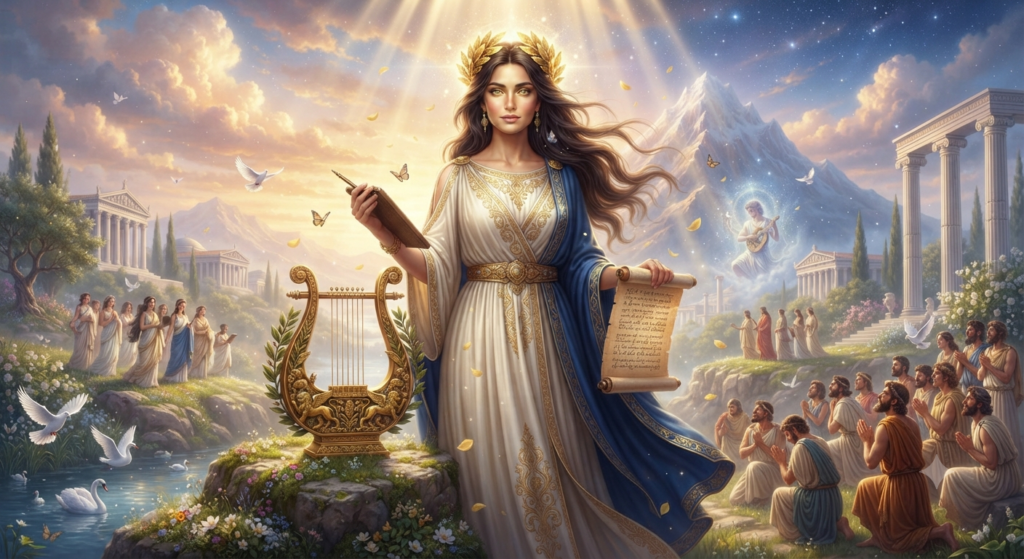
In the pantheon of Greek mythology, Calliope stands as the supreme embodiment of poetic inspiration and heroic song. Who is Calliope, the Muse of epic poetry? She is the eldest and most honored of the nine Muses, the goddesses who presided over the arts and sciences in ancient Greek religion . Her name, derived from the Greek words kallos (beauty) and ops (voice), meaning “beautiful-voiced,” reflects her role as the divine source of eloquence and heroic verse . As the patron of epic poetry, she was the celestial authority who inspired the greatest poets of antiquity and judged the standards by which their works were measured, holding a position of unmatched prestige among her divine sisters .
Origins and Genealogy
Calliope was born to Zeus, the king of the gods, and Mnemosyne, the Titaness of memory . According to Hesiod’s Theogony, Zeus lay with Mnemosyne for nine consecutive nights, and she gave birth to the nine Muses, with Calliope being the most important among them . Her siblings included Clio (history), Euterpe (music), Thalia (comedy), Melpomene (tragedy), Terpsichore (dancing), Erato (lyric poetry), Polymnia (sacred song), and Urania (astronomy) . This divine genealogy established the Muses as the ultimate arbiters of cultural and intellectual achievement, and Calliope’s primacy among them reflected the supreme status of epic poetry in the ancient Greek world .
Hesiod explicitly names Calliope as the most important Muse, noting that “she attends upon respected lords” . This designation as the “Chief of all Muses” was echoed by later poets, including Ovid, who reinforced her position as the leader of her divine sisters . Her role extended beyond mere inspiration to encompass the very definition of what constituted great epic poetry, making her the ultimate judge of heroic verse.
Mythological Role and the Contest with the Pierides
One of the most revealing myths about Calliope involves her defeat of the Pierides, nine mortal sisters who dared to challenge the Muses to a singing contest . According to Ovid’s Metamorphoses, the Pierides sang of the battle of the gods and giants, presenting the Olympian gods as subject to fear and temporary defeat . In response, Calliope sang of the rape of Persephone and Demeter’s search, a story that affirmed the power and order of the divine realm .
The nymph judges declared Calliope’s voice so moving that the Pierides were utterly vanquished. When the mortal sisters refused to accept their defeat and mocked the Muses, Calliope punished them by transforming them into magpies, their proud songs reduced to harsh squawks . This myth illustrates Calliope’s assertiveness and her role as a protector of the divine order of the arts, as well as the severe consequences of hubris against the gods .
Family and Famous Children
Calliope’s most celebrated mythological role was as the mother of Orpheus, the legendary musician whose lyre-playing could charm all living things and even move stones . In most accounts, Orpheus was fathered by either Apollo, the god of music, or King Oeagrus of Thrace . Calliope taught her son the verses for his singing, and his unparalleled musical talent was directly attributed to her divine influence .
She was also the mother of Linus, another renowned musician and eloquent public speaker, who was likewise fathered by Apollo or Oeagrus . Some sources further claim she bore Rhesus, a king of Thrace, to the river god Strymon , and the Corybantes, ecstatic worshippers of Cybele, to her father Zeus . According to some accounts, she was also the mother of the Sirens . Additionally, Calliope was called upon by Zeus to judge the dispute between Aphrodite and Persephone over the beautiful youth Adonis, demonstrating her role as a divine arbiter .
Depictions in Art and Literature
In ancient art, Calliope was typically depicted holding a writing tablet and a stylus, or occasionally a scroll, symbolizing her role as the recorder and inspirer of epic verse . This iconography is consistent across numerous classical representations, showing her seated or standing with these instruments, as if preparing to write the next great epic . On the François Vase, an Attic black-figure volute krater dating to around 570 BCE, she is portrayed playing the flute, reflecting an earlier period before the Muses’ domains were strictly defined .
Her literary legacy is equally impressive. The Roman poet Virgil famously invokes her in the opening of the Aeneid with the words, “Aid, O Calliope, the martial song!” . She is also called upon by Dante Alighieri in the Divine Comedy, who addresses her as the source of his poetic inspiration: “Here rise to life again, dead poetry! Let it, O holy Muses, for I am yours, And here Calliope, strike a higher key” . Homer himself was considered to have been directly inspired by Calliope to compose the Iliad and the Odyssey, and his greatness led to him being symbolically referred to as her son .
Frequently Asked Questions About Who is Calliope, the Muse of epic poetry?
What does the name Calliope mean?
The name Calliope comes from the Greek words kallos (“beautiful”) and ops (“voice”), meaning “beautiful-voiced.” This name reflects her role as the Muse of eloquence and epic poetry .
Who were the parents of Calliope?
Calliope was the daughter of Zeus, the king of the gods, and Mnemosyne, the Titaness of memory. According to Hesiod, Zeus lay with Mnemosyne for nine nights, and she gave birth to the nine Muses .
Who was the most famous child of Calliope?
The most famous child of Calliope was Orpheus, the legendary musician and poet whose lyre-playing could charm all living things. In some traditions, Orpheus’s father was Apollo, while in others it was the mortal King Oeagrus of Thrace .
What was the contest of the Pierides?
The Pierides were nine mortal sisters who challenged the Muses to a singing contest. Calliope’s voice was so powerful that the nymph judges declared her victorious. When the Pierides mocked the Muses, Calliope transformed them into magpies as punishment .
How was Calliope depicted in ancient Greek art?
Calliope was typically depicted holding a writing tablet and a stylus, or occasionally a scroll, emphasizing her role as the Muse of epic poetry. On the François Vase, however, she is shown playing the flute .
Did Calliope judge the dispute over Adonis?
Yes, Calliope was called upon by Zeus to judge the dispute between the goddesses Aphrodite and Persephone over the beautiful youth Adonis. She decided that Adonis would spend equal time with each goddess and some time alone .
Conclusion
Who is Calliope, the Muse of epic poetry? She is the immortal embodiment of poetic inspiration, the eldest and wisest of the nine Muses, and the divine patron of heroic song. Her legacy extends from the ancient world, where she inspired Homer, Virgil, and countless other poets, to the Renaissance and beyond, where her name continued to be invoked as the source of artistic greatness. More than a mere mythological figure, Calliope represents the profound human belief that the greatest works of art and literature are not solely products of human effort but are gifts from a higher, divine power. Her stories, from her role as the mother of Orpheus to her decisive victory over the Pierides, paint a portrait of a goddess who was both nurturing and fiercely protective of the arts, a figure whose “beautiful voice” continues to resonate through the ages as a symbol of the enduring power of poetry. Her influence as the chief Muse underscores the supreme value placed on epic storytelling in the ancient Greek world and reminds us of the enduring power of the written word.

Orin Vale has spent the better part of two decades tracing the threads that connect the world’s oldest stories — from the halls of Asgard to the banks of the Nile, from Olympus to the jungles of the Maya. What began as a childhood fascination with flood myths and trickster gods grew into years of independent study across comparative mythology and ancient religion, always chasing the same question: what did these stories mean to the people who first told them? Orin writes for readers who want more than trivia — the ones looking for the beliefs, fears, and truths that myths were built to carry.