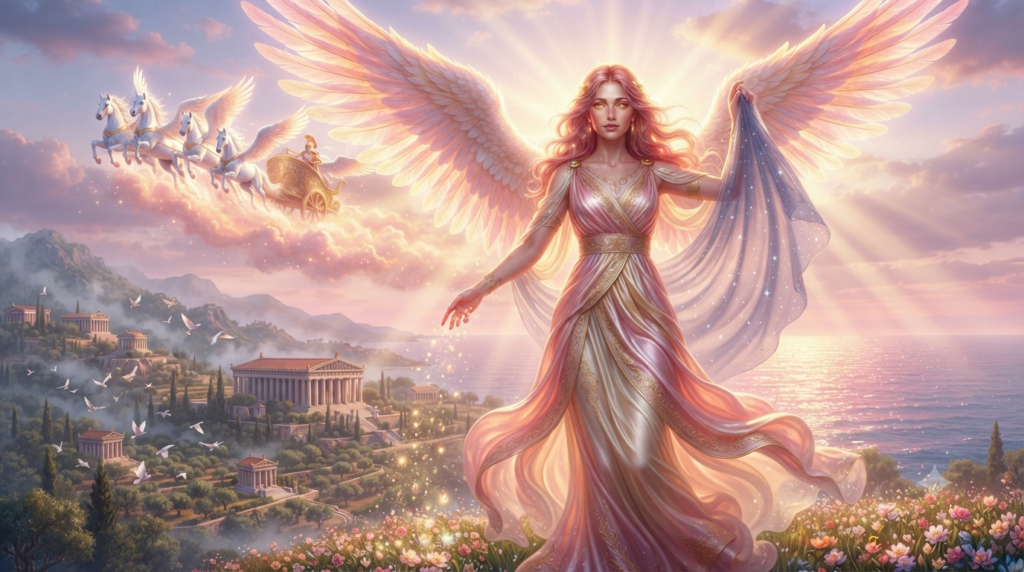
Anyone asking who is Eos, the Greek goddess of the dawn, is asking about one of the oldest and most consistently present figures in Greek mythology, even though she rarely receives the same attention as the Olympian gods who came after her generation. Eos belongs to the earlier order of Titan deities, embodying the daily transition from night into day, a role she performed with unwavering regularity across countless generations of Greek storytelling.
Unlike many mythological figures whose stories center on a single defining myth, Eos appears repeatedly throughout Greek literature specifically through her function rather than through dramatic personal narrative alone. Homer invokes her presence at the start of nearly every new day in both the Iliad and the Odyssey, using her arrival as a natural marker of time passing within these epic poems, a testament to how deeply embedded she was in the ancient Greek understanding of the natural world.
Beyond this functional role, Eos also carries a distinctly personal and often melancholic mythology of her own, particularly through a series of tragic love affairs with mortal men. These stories reveal a goddess whose divine power over the dawn coexists with genuine emotional vulnerability, adding depth to her character well beyond her role as a simple personification of morning light.
What follows examines Eos’s Titan origins, her defining appearance and epithets, her broader domain and family, and the recurring mythology of mortal love and loss that shapes her most memorable stories within Greek tradition.
Eos’s Origins: Daughter of the Titans
Eos belongs to the second generation of Titan deities, born as the daughter of Hyperion and Theia, both primordial gods closely associated with light and celestial radiance. This parentage firmly establishes Eos within a family unit specifically dedicated to governing the major sources of light visible in the ancient Greek sky, distinguishing her lineage from the later Olympian gods who eventually rose to prominence after the Titans’ fall from power.
Eos shared this specific celestial responsibility with two siblings, Helios, god of the sun, and Selene, goddess of the moon, together forming a trio responsible for governing the full cycle of light and darkness across each day and night. This sibling arrangement reflects a broader pattern common throughout early Greek cosmology, where closely related deities frequently divided related natural phenomena among themselves rather than each functioning entirely independently.
Unlike Zeus and his fellow Olympians, who overthrew the previous generation of Titans in a dramatic cosmic conflict, Eos and her siblings continued their assigned roles largely undisturbed by this broader power struggle, since their functions governing daily light and darkness remained essential regardless of which generation of gods held ultimate authority over the cosmos. This continuity helps explain why Eos persisted as a consistent presence throughout Greek mythology despite predating the more famous Olympian pantheon.
Understanding this Titan heritage provides essential context for who is Eos, the Greek goddess of the dawn, since her origins place her among the oldest functioning deities in Greek religious tradition, tasked with a responsibility so fundamental to daily existence that it transcended the political upheavals reshaping the rest of the Greek divine hierarchy.
The “Rosy-Fingered” Goddess: Appearance and Epithets
Homer’s epics repeatedly describe Eos through one particular epithet that has become permanently associated with her identity: “rosy-fingered dawn,” a phrase appearing throughout both the Iliad and the Odyssey to mark the arrival of each new morning. This vivid, poetic description captures the reddish-pink hues often visible in the sky at sunrise, translating a natural visual phenomenon directly into Eos’s divine characterization.
Ancient Greek art frequently depicted Eos as a winged goddess, emphasizing her ability to move swiftly across the sky each morning as she performed her daily duties. This winged imagery distinguished her visually from many other deities, reinforcing her specific connection to swift, continuous movement rather than the more static, enthroned depictions common among the major Olympian gods.
Additional artistic representations show Eos riding in a chariot drawn by horses, an image reinforcing her role in actively bringing about the transition from darkness to daylight through deliberate, purposeful movement across the heavens. Some depictions also portray her scattering dew across the earth as she travels, tying her directly to the physical, observable phenomenon of morning moisture appearing on plants and fields at daybreak.
This consistent visual and poetic identity helps answer who is Eos, the Greek goddess of the dawn, in concrete, sensory terms: a winged figure defined by rosy color, swift movement, and the physical transformation of the world from darkness into the fresh light and moisture of early morning.
What Is Eos the Goddess Of?
At the center of Eos’s divine identity lies her fundamental responsibility for the arrival of dawn itself, marking the daily transition from night into day across the ancient Greek world. This role positioned her as far more than a decorative or symbolic figure, since ancient Greeks relied on this predictable daily transition for agricultural planning, travel, and the basic organization of daily life.
Beyond simply representing the dawn symbolically, Eos held the specific functional task of opening the gates of heaven each morning, allowing her brother Helios to begin his own daily journey across the sky in his sun chariot. This cooperative arrangement between siblings illustrates how ancient Greek mythology often structured natural phenomena through interconnected divine responsibilities rather than isolated, independent domains.
This gatekeeping function gave Eos genuine cosmic importance despite her relatively limited presence in more dramatic mythological narratives compared to figures like Zeus or Athena. Without Eos fulfilling her role each morning, the entire daily cycle governing light across the ancient Greek world would have remained incomplete, underscoring how essential her seemingly modest responsibility actually was within the broader cosmic order.
This combination of practical function and symbolic significance offers a clear answer to who is Eos, the Greek goddess of the dawn: a deity whose power, though narrower in scope than the great Olympians, remained absolutely indispensable to the fundamental daily rhythm the ancient Greeks depended upon for their entire way of life.
Astraeus and Their Children: The Winds and Stars
Eos’s mythology extends beyond her own personal story through her union with the Titan Astraeus, god of the stars and dusk, a pairing that produced several significant offspring central to other aspects of Greek cosmology. This relationship connected Eos’s domain over morning light directly to the broader celestial family governing different aspects of the sky and atmosphere.
Among their most notable children were the Anemoi, the four directional wind gods: Boreas, god of the north wind; Notus, god of the south wind; Zephyrus, god of the west wind; and Eurus, god of the east wind. These wind deities appear throughout Greek mythology influencing weather, sea travel, and dramatic narrative moments, including their notable role in stirring the storm that endangers Odysseus during his journey home.
Eos and Astraeus were also credited as parents of Eosphorus, also known as Phosphorus, the personification of the morning star, an association that directly reinforced Eos’s own connection to the earliest hours of daylight. This offspring further ties Eos’s mythological family into the broader celestial imagery surrounding dawn, morning light, and the visible transition from night to day.
This extended family network adds meaningful depth to who is Eos, the Greek goddess of the dawn, revealing a goddess whose influence extended beyond her own daily task into a broader mythological lineage responsible for winds, stars, and the celestial phenomena most closely associated with the earliest hours of each new day.
Aphrodite’s Curse: Why Eos Kept Falling for Mortals
One of the most persistent patterns throughout Eos’s mythology involves her repeated romantic pursuit of mortal men, a tendency ancient sources trace back to a curse placed upon her by Aphrodite, goddess of love. According to this myth, Aphrodite discovered that Eos had been intimate with Ares, the god of war and Aphrodite’s own lover, prompting the offended goddess to curse Eos with perpetual, uncontrollable desire specifically for mortal men.
This curse fundamentally shaped the trajectory of Eos’s subsequent mythology, transforming her from a deity primarily defined by her cosmic function into a figure whose personal story became dominated by a repeating cycle of infatuation, pursuit, and eventual heartbreak. Each new mortal she fell for represented another instance of this divine punishment playing out across generations of Greek storytelling.
This mythological explanation reflects a broader pattern found throughout Greek mythology, in which curses and divine punishments frequently explain recurring behavioral patterns attributed to specific gods, providing narrative justification for otherwise unusual or repeated divine actions. Aphrodite’s curse gives Eos’s romantic mythology a coherent internal logic, connecting her many separate love stories into a single overarching narrative thread.
Understanding this curse proves essential to fully answering who is Eos, the Greek goddess of the dawn, since it explains why her personal mythology diverges so sharply from her stable, functional role governing daybreak, introducing genuine emotional turmoil into the story of a goddess otherwise defined by predictable, cosmic regularity.
The Tragedy of Tithonus
Among Eos’s mortal love affairs, her relationship with Tithonus stands as the most famous and emotionally devastating example of the consequences tied to her curse. After falling deeply in love with the mortal Tithonus, Eos approached Zeus directly, requesting that he grant her beloved immortality so that their relationship might continue indefinitely without the natural limitation of human mortality.
Zeus granted this specific request, but Eos’s petition contained a critical omission that would ultimately doom the relationship to profound tragedy: she had asked only for Tithonus’s immortality, neglecting to also request eternal youth alongside it. As a direct consequence of this oversight, Tithonus continued aging indefinitely even as his mortality was removed, eventually shriveling into an ancient, helpless state without ever being permitted the release of death.
This tragic outcome transformed what began as a passionate love story into one of Greek mythology’s most poignant meditations on the dangers of incomplete wishes and the fundamental incompatibility between mortal and immortal existence. Some versions of the myth describe Tithonus eventually being transformed into a cicada, his endless, aged existence reduced to a creature whose constant chirping echoes his perpetual, wordless suffering.
This story remains central to any complete answer regarding who is Eos, the Greek goddess of the dawn, illustrating the genuine emotional cost embedded within her recurring mortal love affairs and reinforcing the broader Greek mythological theme that even a goddess’s deepest love could not overcome the fundamental boundaries separating divine and mortal existence.
Cephalus and Orion: Other Mortal Loves
Beyond Tithonus, Eos pursued several other notable mortal figures throughout Greek mythology, each relationship reinforcing the same underlying pattern established by Aphrodite’s curse. Her pursuit of Cephalus, already married to Procris at the time of Eos’s advances, introduces additional complexity into her romantic mythology, since this particular affair directly disrupted an existing mortal marriage rather than involving an unattached partner.
Ancient sources describe Eos abducting Cephalus and attempting to win his affection despite his ongoing devotion to his wife, a storyline that eventually contributes to further tragic consequences within Cephalus and Procris’s own mythology once he returns to mortal life. This episode reinforces Eos’s characterization as a goddess whose desires, however genuine, frequently created disruption and eventual sorrow rather than lasting happiness.
Eos’s relationship with the hunter Orion represents another significant episode within this recurring pattern, with several ancient sources describing her affection for him before his eventual fate led to his transformation into a constellation, a transition often attributed to the goddess Artemis rather than Eos herself. This connection nonetheless reinforces Eos’s broader mythological association with mortal men whose stories intersect with the celestial realm she inhabits.
Considering these additional relationships alongside the Tithonus myth completes a fuller picture of who is Eos, the Greek goddess of the dawn, confirming a consistent mythological pattern in which her mortal love affairs, regardless of the specific partner involved, repeatedly end in complication, disruption, or genuine tragedy rather than lasting fulfillment.
Eos and Her Roman Counterpart: Aurora
When Roman mythology absorbed and reinterpreted Greek religious tradition, Eos found her direct equivalent in Aurora, the Roman goddess of the dawn, who inherited nearly all of Eos’s core attributes and mythological associations. This continuity reflects the broader pattern of interpretatio graeca, through which Roman writers systematically matched their own deities with corresponding Greek counterparts based on shared function and domain.
Aurora retained Eos’s fundamental role as the personification of daybreak, along with much of her visual imagery, including winged movement across the sky and association with the rosy coloration of early morning light. Roman poets frequently invoked Aurora using language strikingly similar to Homer’s original descriptions of Eos, demonstrating how thoroughly this specific mythological identity transferred between the two cultures with minimal alteration.
The mortal love stories associated with Eos, including her relationships with figures like Tithonus, similarly carried over into Roman literary tradition under Aurora’s name, preserving the same essential narrative structure even as the goddess’s name changed to fit Roman religious and linguistic conventions. This consistency further illustrates how completely Roman mythology absorbed this particular Greek deity rather than developing a substantially different independent tradition.
Recognizing this Roman continuation adds important context to who is Eos, the Greek goddess of the dawn, confirming that her mythology proved significant enough to survive largely intact across the transition from Greek to Roman religious tradition, securing her lasting cultural relevance under both her original Greek name and her Roman identity as Aurora.
Frequently Asked Questions
What is Eos the goddess of?
Eos is the Greek goddess of the dawn, responsible for opening the gates of heaven each morning to allow her brother Helios to begin his daily journey across the sky.
Who are Eos’s parents?
Eos is the daughter of the Titans Hyperion and Theia, making her sister to Helios, god of the sun, and Selene, goddess of the moon.
Why was Eos cursed by Aphrodite?
Aphrodite cursed Eos with perpetual desire for mortal men after discovering that Eos had been intimate with Ares, Aphrodite’s own lover.
Conclusion
Eos, the Greek goddess of the dawn, embodies one of the most fundamental and universally experienced cycles in human life, the daily transition from darkness into light, while also carrying one of Greek mythology’s most consistently melancholic personal narratives through her cursed love for mortal men. From her Titan origins alongside Helios and Selene to the enduring tragedy of Tithonus, Eos’s mythology reveals a goddess whose cosmic reliability coexists with genuine emotional vulnerability, securing her lasting place within Greek mythology despite standing outside the more famous circle of Olympian gods.

Orin Vale has spent the better part of two decades tracing the threads that connect the world’s oldest stories — from the halls of Asgard to the banks of the Nile, from Olympus to the jungles of the Maya. What began as a childhood fascination with flood myths and trickster gods grew into years of independent study across comparative mythology and ancient religion, always chasing the same question: what did these stories mean to the people who first told them? Orin writes for readers who want more than trivia — the ones looking for the beliefs, fears, and truths that myths were built to carry.