In the vast and intricate pantheon of Greek mythology, where gods and goddesses embody the full spectrum of human experience, Geras stands as a figure of profound and universal significance. Who is Geras, the Greek god of old age? He is the divine personification of aging and the inevitable decay that accompanies the passage of time. As the son of Nyx, the goddess of night, Geras was a daimon, a spirit who represented a fundamental aspect of mortal existence. Unlike the youthful, athletic gods of Olympus, Geras was depicted as a shriveled, bent old man, a powerful and unsettling symbol of the frailty and decline that awaits all living things, his presence a constant reminder of the ephemeral nature of youth and vitality.
Origins and Family
Geras was born of the primordial goddess Nyx, the personification of night, a figure of immense power who could inspire fear even in the heart of Zeus himself. Nyx was known for giving birth to a brood of abstract spirits, many of whom represented the darker, more difficult aspects of human existence. Geras’s siblings included Thanatos (Death), Hypnos (Sleep), Nemesis (Divine Retribution), Eris (Strife), and the Moirai (the Fates). This lineage placed Geras among the fundamental forces of the cosmos, concepts that were not merely descriptive but governed the laws of nature and the fate of mortals and gods alike.
The sibling relationship between Geras and Thanatos is particularly significant. They represent two successive stages of the mortal journey: old age inevitably precedes death. Their mother, Nyx, gave birth to them in her cave, a symbolic birthplace that underscores the connection between the darkness of night and the ending of life. This genealogy established that Geras was not a temporary condition but an integral part of the cosmic order.
Appearance and Iconography
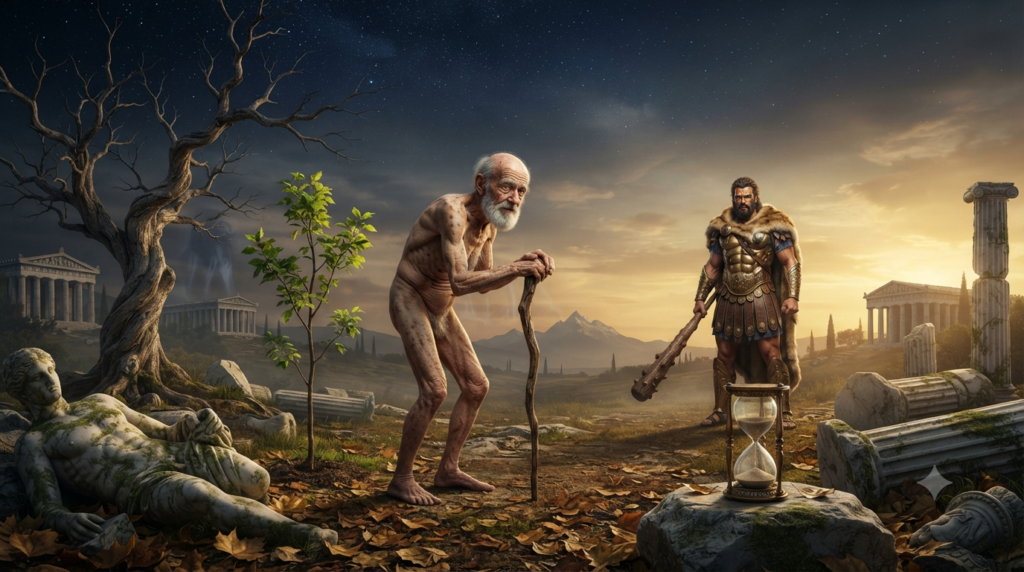
The artistic depictions of Geras are among the most striking and poignant in all of Greek mythology. He is almost universally portrayed as a tiny, shriveled, and bent old man, whose physical appearance reflects the hardships and decline that accompany old age. He is often shown leaning on a staff for support, his body withered and weak. In some vase paintings, he is depicted with sagging breasts and a balding head, his entire form a testament to the ravages of time. His name, which is the Greek word for “old age,” is often inscribed on his figure in ancient pottery, making his identity unambiguous.
One of the most famous depictions of Geras is on a red-figure vase from Athens, dating to around 480 BC, which shows him facing Heracles. This scene is rich with allegorical meaning, as Geras is seen fleeing from the youthful hero. The symbolism of the scene is unmistakable: even the greatest of heroes cannot ultimately escape the effects of time, and no amount of strength can permanently vanquish old age. In some representations, Geras is also shown in the presence of Aphrodite, reminding viewers of the inevitable loss of beauty and sexual allure that comes with age.
Mythological Role
Geras does not have a significant role in the traditional heroic narratives or epic cycles of Greek mythology. He is not a character who shapes events through dramatic actions or schemes. Instead, his role is more profound: he is the personification of an inescapable reality. He represents the final stage of life, the slow decay of the body and the eventual loss of strength. His presence in mythology serves as a stark reminder to mortals of their limitations. The constant fear of Geras, the anxiety about losing one’s youth and vigor, is a theme that appears throughout Greek literature.
In many myths, the pursuit of immortality or eternal youth is a recurring theme, and Geras stands as the immovable obstacle to such aspirations. The story of Tithonus, who was granted immortality by Eos but not eternal youth, is a powerful cautionary tale against trying to circumvent the natural order represented by Geras. The old age that Tithonus experienced was a worse fate than death itself, demonstrating the horrors that Geras embodies. Thus, Geras serves as an essential reminder to mortals of their place in the world and the futility of trying to escape their fate.
The Heracles Myth
The most famous mythological episode involving Geras is his confrontation with the hero Heracles. On a well-known black-figure amphora and a red-figure hydria, the hero is depicted pursuing or fighting the aged spirit. The allegorical meaning of this scene is profound: Heracles, the symbol of ultimate strength and youthful virility, engages in a futile battle against the personification of old age. No matter how powerful the hero, he cannot defeat the inexorable passage of time.
This myth serves as a powerful reminder that even the greatest heroes are subject to the same natural laws as ordinary mortals. Heracles’s struggle against Geras is ultimately a losing battle. In some depictions, Geras is shown fleeing or being physically overcome, but the very fact that he exists and will return underscores the cyclical nature of life. The scene is a testament to the Greek understanding of mortality: youth and strength are temporary, and old age is an inevitable fate that awaits everyone.
Philosophical and Cultural Significance
In the philosophical traditions of ancient Greece, Geras was often discussed in the context of the human condition. The Roman poet Horace wrote of the Geras that “no one is without defect; no one lacks his own Geras,” meaning that all people will eventually face the trials of old age. Greek philosophers like Plato and Aristotle reflected on the nature of aging and its effects on the human psyche and the body, often using the concept of Geras as a lens for discussing virtue, wisdom, and the good life.
Culturally, Geras served as a powerful symbol of the brevity of life. His image was a common motif in art, literature, and everyday life, serving as a memento mori—a reminder of mortality. In the Hellenistic period, he was often depicted in scenes of the pompa, or the procession of the gods, reminding the viewer of the transient nature of power and beauty. The symbolic presence of Geras in such contexts was a call to appreciate the present moment and to pursue virtue and honor while one still possessed the strength to do so.
Frequently Asked Questions About Who is Geras, the Greek god of old age?
Who were the parents of Geras?
Geras was the son of Nyx, the primordial goddess of the night. He did not have a father, as Nyx gave birth to him parthenogenetically, without male involvement.
Who were the siblings of Geras?
Geras had numerous siblings, all of whom were personifications of abstract concepts. His siblings included Thanatos (Death), Hypnos (Sleep), Nemesis (Retribution), Eris (Strife), and the Moirai (the Fates).
How was Geras depicted in ancient Greek art?
Geras was typically depicted as a tiny, shriveled, and bent old man, leaning on a staff. He is often shown with sagging breasts and a balding head, emphasizing his physical weakness and decay.
Did Geras have any myths where he played a significant role?
Geras is not a major character in epic myths but appears in a famous scene where he is pursued by Heracles. This allegorical scene shows that even the greatest hero cannot defeat the aging process.
What is the connection between Geras and the hero Heracles?
In one famous artistic depiction, Heracles is shown trying to beat Geras with his club. The myth highlights that strength and heroism cannot overcome the effects of time and aging.
What is the Roman equivalent of Geras?
The Roman equivalent of Geras is the deity Senectus, the god of old age. Like Geras, Senectus personified the frailty and decline that accompanies the end of life.
Conclusion
Who is Geras, the Greek god of old age? He is the enigmatic and powerful spirit who personifies the inevitable decline that awaits all living beings. As the son of Nyx, he is a fundamental force of the cosmos, a reminder of the ephemeral nature of youth and vitality. His depictions in ancient art, as a tiny, bent, and shriveled old man, are striking and poignant, serving as a constant memento mori. Although he plays no major role in epic tales, his presence is felt everywhere in Greek mythology, from the cautionary tale of Tithonus to his futile battle with Heracles. Geras represents the essential truth that time is the ultimate conqueror, and he remains a powerful symbol of the grace and wisdom that can be found in accepting the inevitable passage of life.

Orin Vale has spent the better part of two decades tracing the threads that connect the world’s oldest stories — from the halls of Asgard to the banks of the Nile, from Olympus to the jungles of the Maya. What began as a childhood fascination with flood myths and trickster gods grew into years of independent study across comparative mythology and ancient religion, always chasing the same question: what did these stories mean to the people who first told them? Orin writes for readers who want more than trivia — the ones looking for the beliefs, fears, and truths that myths were built to carry.