Who Is Hermod in Norse Mythology?
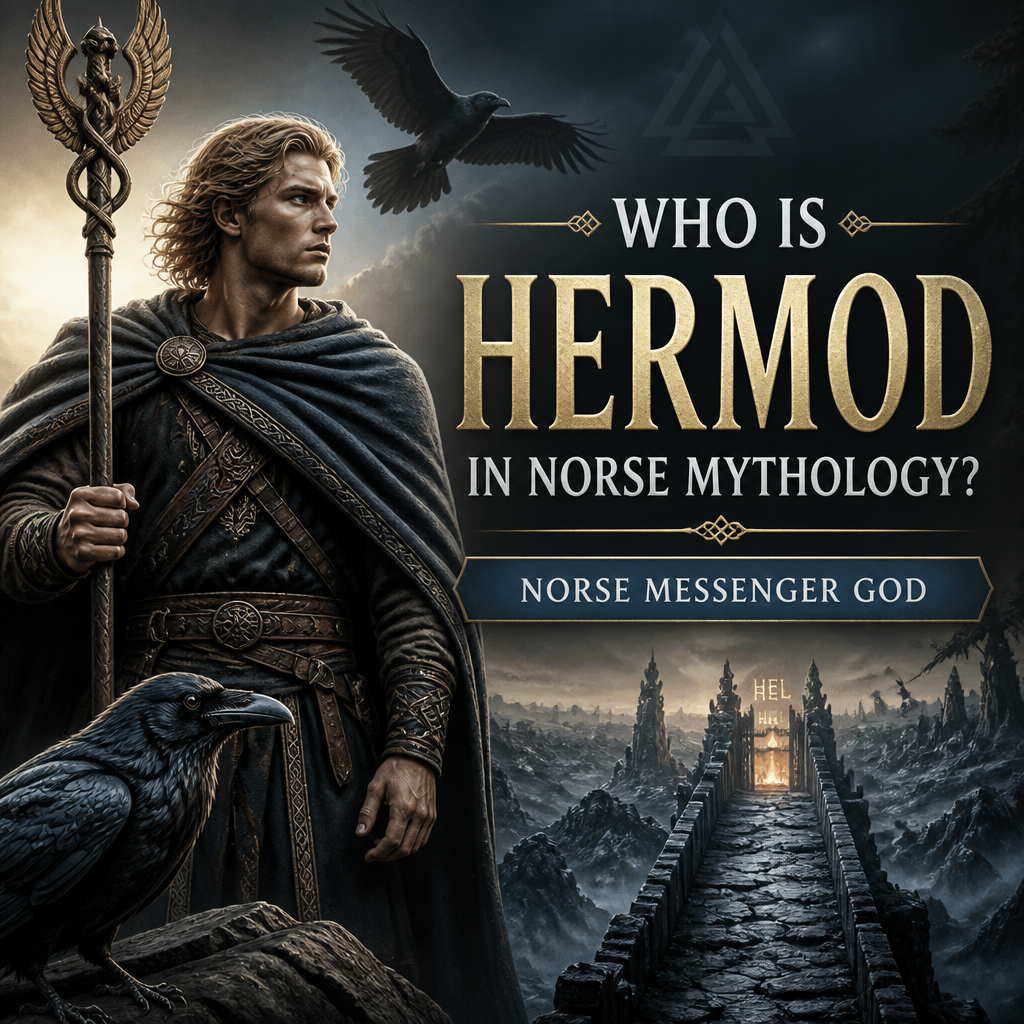
Hermod is a lesser-known but fascinating figure in Norse mythology. Often described as a brave messenger of the gods, he is best remembered for his journey to Hel, the gloomy realm of the dead, in an attempt to bring back the beloved god Balder. While Hermod does not appear as often as Odin, Thor, or Loki, his role in one of the most emotional Norse myths gives him lasting importance.
In Old Norse sources, Hermod is connected closely with Odin and the world of the Aesir gods. His story reveals themes of loyalty, courage, grief, and the limits of even divine power.
Hermod’s Place Among the Norse Gods
Hermod, sometimes written as Hermóðr, is usually associated with the Aesir, the main tribe of Norse gods. In later medieval sources, he is often described as a son of Odin, the All-Father. This connection makes him the brother of gods such as Thor and Balder, though the surviving myths do not give him as much attention as these more famous figures.
His name is commonly interpreted as meaning something like “war-spirit” or “courage in battle.” This fits his character well. Hermod is not mainly known as a warrior who slays giants or monsters. Instead, he shows bravery through a dangerous journey into the realm of the dead.
Hermod’s identity is somewhat complex because Norse mythology survives in scattered poems and stories written down after the Viking Age. Some references to Hermod may point to a heroic human figure, while others present him as a divine being. The most famous version of his story comes from Snorri Sturluson’s Prose Edda.
Hermod and the Death of Balder
To understand who Hermod is in Norse mythology, it is important to understand the death of Balder.
Balder was one of the most beloved gods. He was associated with beauty, goodness, and light. After Balder began having troubling dreams of his own death, the gods became afraid. His mother, Frigg, made nearly every thing in the world swear not to harm him. Because of this, the gods amused themselves by throwing weapons at Balder, watching them bounce away harmlessly.
However, Loki discovered that mistletoe had been overlooked. He tricked the blind god Hod into throwing a mistletoe dart at Balder. The dart struck Balder and killed him.
The gods were devastated. Balder’s death was not only a family tragedy but also a sign of the approaching doom of the gods: Ragnarok.
Hermod’s Journey to Hel
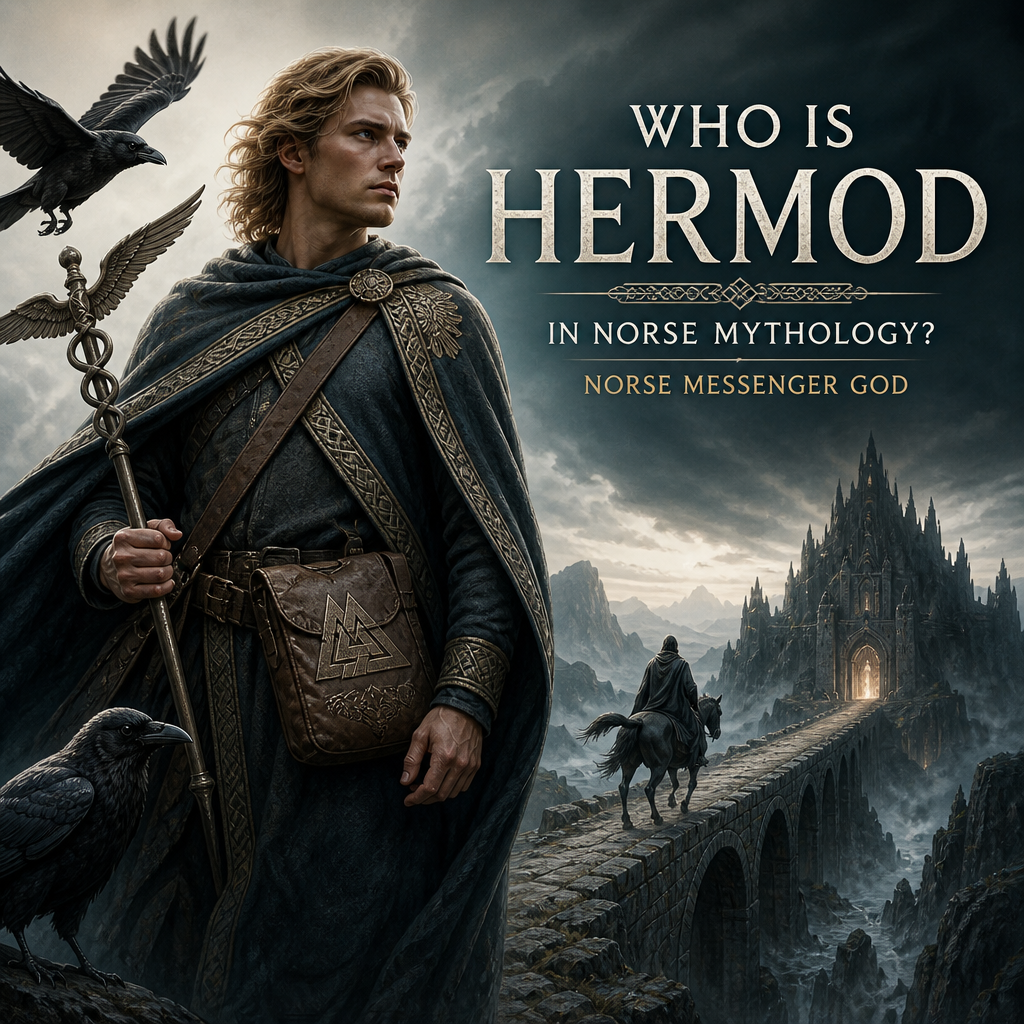
After Balder’s death, the gods searched for a way to bring him back. Frigg asked who among the Aesir would ride to Hel and offer a ransom for Balder’s return. Hermod volunteered.
This is the moment that defines Hermod’s role in Norse mythology. He mounted Sleipnir, Odin’s eight-legged horse, and rode for nine nights through dark valleys and deep places until he reached the river Gjoll and the bridge that led into Hel’s realm.
The bridge was guarded by the maiden Modgud, who noticed that Hermod did not look like the dead who normally crossed into Hel. Hermod explained that he was searching for Balder. Modgud told him that Balder had already crossed the bridge and continued northward toward Hel.
Hermod rode on until he reached the gates of Hel. There, Sleipnir leapt over the barrier, allowing Hermod to enter the realm of the dead.
The Meeting with Balder and Hel
Inside Hel’s hall, Hermod found Balder sitting in a place of honor. Balder’s wife, Nanna, who had died of grief after his death, was also there.
Hermod spent the night in Hel’s realm. In the morning, he begged Hel, the ruler of the dead, to let Balder return to Asgard. He explained that all beings mourned Balder and wanted him restored to life.
Hel agreed, but only on one condition: every living and dead thing in the world had to weep for Balder. If all things mourned him, he could return. If even one refused, he would remain in Hel.
Balder then gave Hermod gifts to carry back to the gods. These included the ring Draupnir, which Odin had placed on Balder’s funeral pyre. Nanna also sent gifts to Frigg and others.
Hermod returned to Asgard with the message. At first, it seemed as though Balder might be saved, because nearly everything in creation wept for him.
Why Balder Did Not Return
Unfortunately, not every being agreed to mourn. A giantess named Thokk refused to weep for Balder. Many versions of the myth suggest that Thokk was actually Loki in disguise.
Because of this refusal, Balder remained in Hel.
Hermod’s mission did not succeed in bringing Balder back, but it was not a failure of courage or loyalty. He did everything asked of him and went where few living beings could go. His journey showed the depth of the gods’ love for Balder and the harsh certainty of fate in Norse mythology.
What Hermod Represents
Hermod is not one of the loudest or most powerful gods, but he represents important values in Norse storytelling.
Courage
Hermod rides alone into Hel, a place associated with death, darkness, and finality. His courage is quiet but profound.
Loyalty
He undertakes the journey because Frigg and the gods are grieving. His actions show devotion to his family and community.
Hope
Hermod’s mission is driven by the hope that death can be reversed. Even though Balder remains in Hel, Hermod’s journey shows that the gods are willing to struggle against fate.
Acceptance of Fate
Norse mythology often emphasizes that some events cannot be avoided. Hermod’s story reminds us that bravery does not always guarantee victory.
Hermod in the Larger Norse Mythic World
Hermod’s journey is especially important because it connects several key parts of Norse cosmology: Asgard, the realm of the gods; Midgard, the world of humans; and Hel, the realm of many of the dead. His ride on Sleipnir also links him directly to Odin, whose horse can travel between worlds.
The myth also deepens the tragedy of Balder’s death. Without Hermod, readers would only see the gods grieving. Through Hermod’s mission, the story explores what they are willing to do in response to that grief.
Hermod is sometimes compared to messenger figures in other mythologies because he travels between worlds and carries words between gods, the dead, and supernatural beings. Yet he is not simply a messenger. He is a divine rider who crosses one of the most feared boundaries in Norse belief.
Why Hermod Still Matters
So, who is Hermod in Norse mythology? He is the brave son of Odin who rode to Hel in an attempt to rescue Balder. Though he did not succeed in overturning fate, his story remains one of the most moving episodes in the Norse mythic tradition.
Hermod matters because he shows that heroism is not always about battle. Sometimes it is about answering a call, facing darkness, and carrying hope into a place where hope seems impossible.

Orin Vale has spent the better part of two decades tracing the threads that connect the world’s oldest stories — from the halls of Asgard to the banks of the Nile, from Olympus to the jungles of the Maya. What began as a childhood fascination with flood myths and trickster gods grew into years of independent study across comparative mythology and ancient religion, always chasing the same question: what did these stories mean to the people who first told them? Orin writes for readers who want more than trivia — the ones looking for the beliefs, fears, and truths that myths were built to carry.