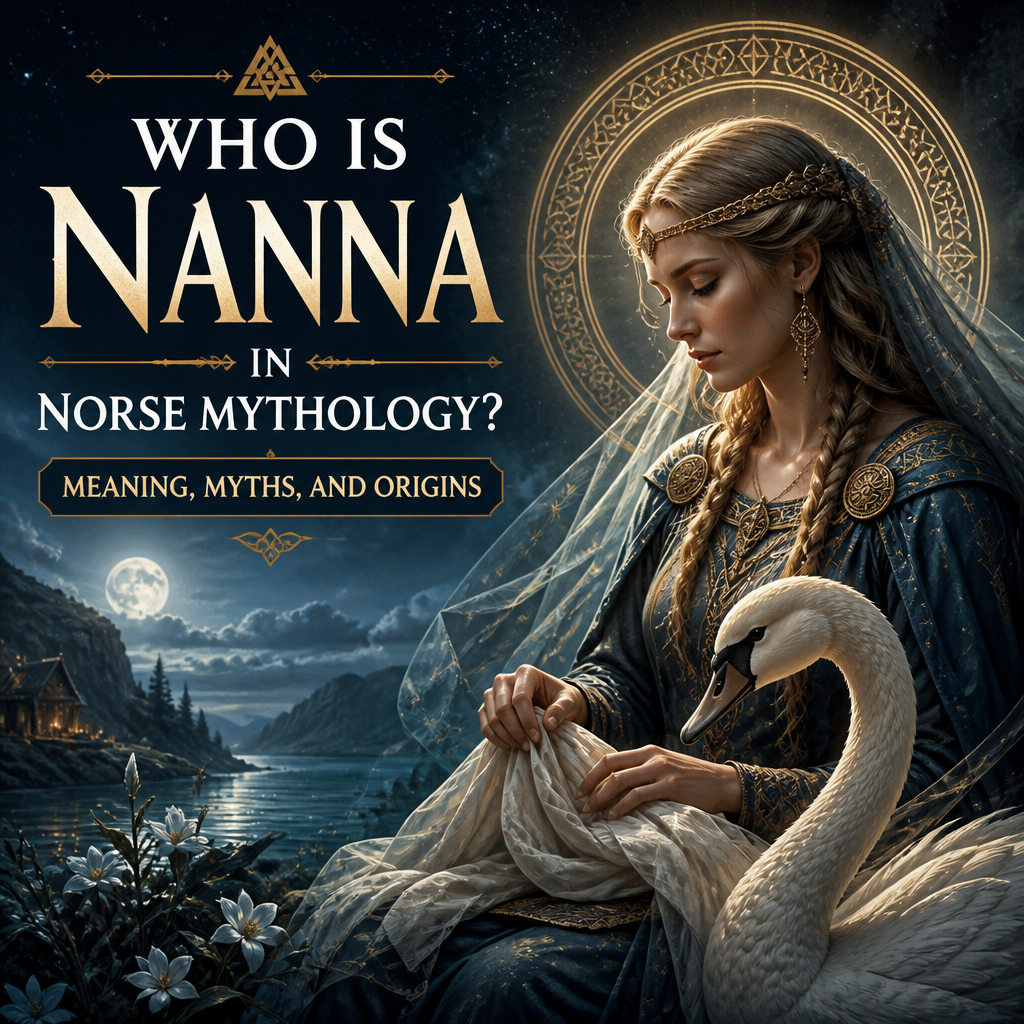
Who Is Nanna in Norse Mythology?
Nanna is one of the quieter figures in Norse mythology, but her story is deeply moving. She is best known as the wife of Baldr, the beloved god associated with beauty, light, and purity. While Nanna does not appear in as many myths as Odin, Thor, or Loki, her role in the story of Baldr’s death makes her an unforgettable part of the Norse mythological tradition.
When people ask, “who is Nanna in Norse mythology,” the answer often begins with her devotion. Nanna is remembered as a goddess connected with love, grief, loyalty, and the tragic consequences of fate. Her tale is brief, but it carries great emotional weight.
Nanna’s Family and Identity
In the most familiar accounts, Nanna is a goddess and the wife of Baldr, one of the sons of Odin and Frigg. She is also the mother of Forseti, a god associated with justice, peace, and wise judgment.
Nanna’s lineage varies depending on the source. In the Prose Edda, written by the Icelandic scholar Snorri Sturluson in the 13th century, she is called the daughter of Nep. Because Nep is not a well-known figure, his identity remains uncertain. This lack of detail is common in Norse mythology, where some gods and goddesses are mentioned only briefly.
Her main family connections are:
- Husband: Baldr, god of light, beauty, and goodness
- Son: Forseti, god of justice and reconciliation
- Father: Nep, a mysterious and little-known figure
Although Nanna’s background is not described in depth, her place in Baldr’s household gives her importance among the gods.
Nanna and Baldr
Nanna’s story is closely tied to Baldr. Baldr was loved by nearly all beings, and his death is one of the most famous tragedies in Norse mythology. According to the myth, Baldr began having dreams that predicted his death. His mother, Frigg, tried to protect him by asking almost everything in the world to swear not to harm him.
However, Frigg overlooked mistletoe, thinking it too small and harmless to matter. Loki discovered this weakness and tricked the blind god Höðr into throwing a dart or spear made of mistletoe at Baldr. The weapon struck Baldr and killed him.
Baldr’s death shocked the gods. It was not only the loss of a beloved deity but also a sign that Ragnarök, the end of the world in Norse myth, was drawing closer.
Nanna’s Death from Grief
Nanna’s most important moment comes after Baldr’s death. In the Prose Edda, she is overcome with grief at the sight of her husband’s body. Her sorrow is so intense that she dies of a broken heart.
The gods then place her body beside Baldr’s on his funeral ship, Hringhorni. The ship is set aflame and sent out to sea as part of Baldr’s funeral rites. This image of Nanna lying beside Baldr in death is one of the most powerful scenes in Norse mythology.
Her death emphasizes several themes:
- Devotion: Nanna’s bond with Baldr continues beyond death.
- Grief: Her sorrow shows the emotional depth of the gods.
- Fate: Even divine beings cannot escape destiny.
- Tragedy: Baldr’s death affects not only him but everyone who loves him.
Nanna’s passing makes Baldr’s funeral even more sorrowful and highlights the devastating impact of Loki’s betrayal.
Nanna in Hel
After their deaths, Baldr and Nanna go to Hel, the realm of the dead ruled by the goddess Hel. This does not mean they are dishonored. In Norse mythology, many who die outside battle go to Hel’s realm, while warriors may go to Valhalla or Fólkvangr.
Later, the god Hermóðr rides to Hel in an attempt to bring Baldr back. During this journey, he sees Baldr and Nanna seated together. Nanna sends gifts back to the gods, including a robe for Frigg and a ring for Fulla.
This detail shows that Nanna remains thoughtful and generous even in the underworld. Her presence beside Baldr also suggests that their bond continues after death.
Nanna in Different Sources
The most familiar version of Nanna’s story comes from Snorri Sturluson’s Prose Edda. However, other sources present her differently.
In the work of Saxo Grammaticus, a medieval Danish historian, Nanna appears in a more human-like and heroic setting rather than a purely divine one. In Saxo’s version, Nanna is involved in a rivalry between Balderus and Hotherus, figures based on Baldr and Höðr. This account differs greatly from the myth found in the Eddas.
These differences remind us that Norse mythology was not a single fixed tradition. Stories changed depending on region, storyteller, and time period.
What Does Nanna Represent?
Nanna is often associated with love, faithfulness, mourning, and emotional loyalty. She is not a warrior goddess, a ruler of worlds, or a trickster. Instead, her power is found in the human-like depth of her grief and devotion.
Her story reflects the Norse understanding of fate. Even the gods suffer, and even the most beautiful and beloved beings can be taken by death. Nanna’s grief is not portrayed as weakness. Rather, it shows the seriousness of loss in a world where destiny cannot easily be changed.
Why Nanna Matters
Nanna may not be one of the most famous Norse goddesses, but she plays an important role in one of the mythology’s central tragedies. Her death deepens the emotional impact of Baldr’s fate and gives the story a personal, intimate dimension.
To understand who Nanna is in Norse mythology, it helps to see her not as a minor background figure, but as a symbol of enduring love and sorrow. Through her, the myth of Baldr becomes more than a story about prophecy and death. It becomes a story about attachment, mourning, and the bonds that remain even in the realm of the dead.
Nanna’s presence is brief, but her memory lingers. In a mythology filled with battles, giants, gods, and cosmic destruction, she represents the quiet heartbreak at the center of divine tragedy.

Orin Vale has spent the better part of two decades tracing the threads that connect the world’s oldest stories — from the halls of Asgard to the banks of the Nile, from Olympus to the jungles of the Maya. What began as a childhood fascination with flood myths and trickster gods grew into years of independent study across comparative mythology and ancient religion, always chasing the same question: what did these stories mean to the people who first told them? Orin writes for readers who want more than trivia — the ones looking for the beliefs, fears, and truths that myths were built to carry.