Poseidon’s Trident
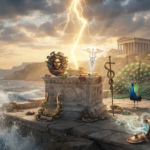
Poseidon’s Trident is one of the most recognizable symbols in Greek mythology. As the weapon of Poseidon, god of the sea, earthquakes, and horses, it appears in ancient literature, art, religious iconography, and modern popular culture. The trident is not merely a weapon of attack: in myth, it also represents divine authority over the sea and the forces hidden beneath it. Because Poseidon was one of the major Olympian gods, his trident became a lasting emblem of power, instability, and the unpredictable nature of the ocean.
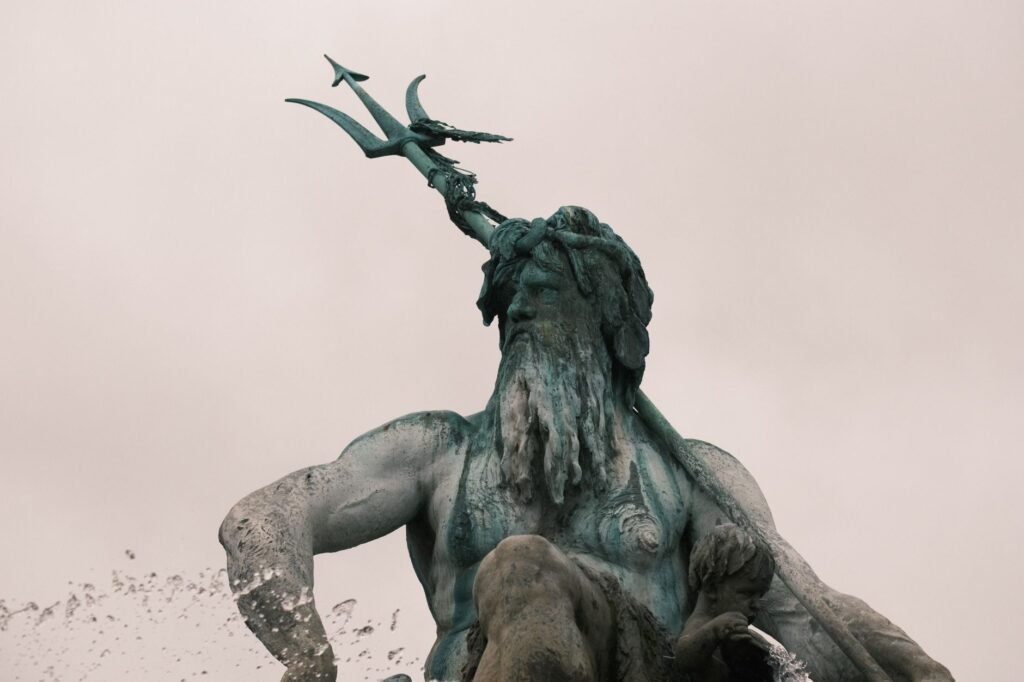
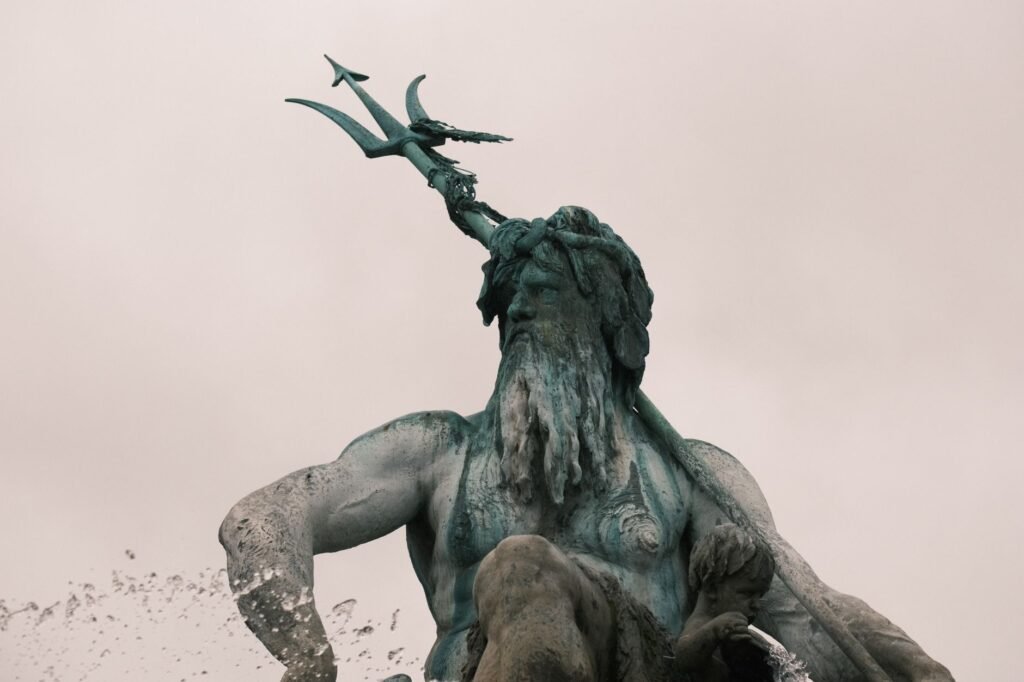
In classical and later tradition, the trident is strongly associated with Poseidon’s identity as a ruler of waters. It is often depicted as a spear with three prongs, a form that visually distinguishes it from ordinary weapons. Over time, the image of Poseidon’s trident has become a broad cultural symbol for marine power, nautical sovereignty, and mythic force.
Origin and Meaning
The English word trident comes from the Latin tridens or tridentis, meaning “three-toothed” or “three-pronged.” The term describes the weapon’s distinctive shape rather than a specific mythological origin. In Greek, Poseidon’s weapon is usually referred to as a three-pronged spear rather than by a single fixed ceremonial name.
The exact origin of the trident as a divine attribute is not fully recoverable from surviving sources. It is clear, however, that in Greek art and literature it became closely linked with Poseidon at an early date. The weapon likely drew on practical tools used by ancient peoples for fishing and possibly spearfishing, which may have contributed to its maritime associations. In mythology, this everyday implement is transformed into a divine instrument capable of stirring seas, splitting rocks, and creating fountains of water.
The symbolic meaning of the trident can be understood on several levels:
- Authority over the sea
- Control of earthquakes and subterranean forces
- Power to create or destroy
- Association with royal or godly sovereignty
Historical Context
Poseidon was among the principal gods of ancient Greece, worshipped throughout the Greek world. His cult was especially important in coastal regions, on islands, and in places where seafaring or horse breeding mattered. As a major deity, he required distinctive visual signs, and the trident became the most enduring of these.
In the ancient Mediterranean, the sea was both a route of trade and a source of danger. Storms, shipwrecks, and sudden changes in weather shaped daily life and economic survival. A god who could command the sea was therefore deeply significant. Poseidon’s trident symbolized that power in a way that sailors, traders, and communities could recognize.
The trident also reflects Poseidon’s broader role beyond seafaring. Ancient Greeks connected him with earthquakes, a relationship preserved in the epithets and myths that describe him as Earth-Shaker. This dual identity—lord of waters and controller of subterranean disturbances—helped make the trident a sign of elemental force, not simply a marine implement.
Main Characteristics
Poseidon’s Trident is usually depicted as a long shaft topped by three points. Artistic representations vary, but several features are common:
| Feature | Description | Symbolic significance |
|---|---|---|
| Three prongs | The head has three pointed tips | Power, precision, divine force |
| Long shaft | Resembles a spear or staff | Authority, distance, control |
| Marine association | Often shown with sea creatures or waves | Dominion over the ocean |
| Dynamic use | Poseidon may hold, raise, or strike with it | Action, command, punishment |
In mythological imagery, the trident can produce dramatic effects. It may:
- Stir or calm the sea
- Split the ground
- Create springs or saltwater sources
- Strike enemies or challenge other gods
The weapon is thus both symbolic and narrative. It identifies Poseidon, but it also acts as a story-moving instrument.
Family and Genealogy
Poseidon is a son of the Titans Cronus and Rhea, and brother to Zeus, Hades, Hera, Demeter, and Hestia. Like many Greek gods, Poseidon has a complex family network. The trident itself does not have a separate genealogy, but it belongs within Poseidon’s divine identity and authority.
Poseidon’s marital and family relationships vary across sources. His principal wife in many traditions is Amphitrite, a sea goddess and one of the Nereids. He is also credited with numerous offspring by different partners, both divine and mortal. Some of these children are associated with the sea, while others are linked to horses, giants, or heroic lineages.
Because the trident is central to Poseidon’s role, it is often present in stories involving his offspring or rivals. In this sense, it is part of the divine “family portrait” of Poseidon as a father, ruler, and enforcer.
Symbols
Poseidon’s trident is the primary symbol associated with him, but it is not the only one. Ancient and later traditions often connect him with other signs and emblems that reinforce his domain.
Common symbols linked to Poseidon
- Trident: the best-known emblem of his power
- Horse: linked to his role as creator or patron of horses
- Dolphin: associated with the sea and benevolent maritime power
- Bull: sometimes connected to strength, sacrifice, and storm imagery
- Wave or sea foam: visual shorthand for his marine rule
The trident’s symbolic importance lies in its ability to combine several ideas at once. It is a weapon, a staff of office, and a ritual sign. In later artistic traditions, it often functions as a visual abbreviation for Poseidon himself.
Sacred Animals
Poseidon is associated with several animals, each reflecting a different aspect of his character.
| Animal | Meaning |
|---|---|
| Horse | Speed, power, and Poseidon’s link with equestrian mastery |
| Dolphin | Marine life, guidance, and the sea’s abundance |
| Bull | Strength, sacrifice, and primal force |
| Sea creatures in general | Domain over marine life and the oceanic world |
The horse
The horse is especially important. Poseidon was sometimes called Hippios, a title linked to horses. In some traditions, he is even credited with creating the first horse. This connection may seem surprising, but it fits the god’s reputation for force, speed, and sudden movement.
The dolphin
The dolphin appears frequently in Greek art as a friendly marine symbol. It reflects Poseidon’s life-giving and navigational aspects, not only his destructive powers.
The bull
The bull is a powerful image of raw energy and storm-like force. In some myths, bull imagery intensifies Poseidon’s connection to fertility, sacrifice, and danger.
Sacred Plants
No single plant is universally and exclusively sacred to Poseidon in the way that the olive is sacred to Athena. Still, certain plants and trees appear in his cultic and mythological environments.
Commonly associated plants
- Pine: often linked with the sea, coastal landscapes, and the broader sacred ecology of Poseidon’s worship
- Reeds and coastal vegetation: associated with wetlands, shorelines, and watery domains
- Sea plants and algae: not sacred in a formal sense, but part of the symbolic marine environment
Because surviving sources emphasize animals, locations, and ritual practices more than plants, this aspect of Poseidon’s symbolism is less clearly defined. Where ancient evidence is limited, it is best to say that plants connected with the seashore and coast are culturally relevant rather than formally sacred in all traditions.
Sacred Places
Poseidon was worshipped widely, but several places were especially significant in his cult and mythology.
Important sites associated with Poseidon
| Place | Significance |
|---|---|
| Cape Sounion | Famous sanctuary of Poseidon in Attica |
| Isthmia | Major cult site near the Isthmus of Corinth; home of the Isthmian Games |
| On the sea and coast | Natural sphere of Poseidon’s worship |
| Earthquake-prone regions | Areas where his “Earth-Shaker” aspect was especially meaningful |
Cape Sounion
Cape Sounion in Attica housed an important sanctuary of Poseidon overlooking the sea. Its dramatic coastal setting matched the god’s maritime identity. The site remains one of the most famous ancient places connected with him.
Isthmia
Near Corinth, the sanctuary of Poseidon at Isthmia became the center of the Isthmian Games, one of the major Panhellenic athletic festivals. This association shows that Poseidon was not only a sea god but also a deity of public religious life and competition.
Coastal sanctuaries
Many smaller sanctuaries and local shrines stood near harbors, capes, and islands. Since sailors depended on Poseidon’s favor, his worship was naturally tied to the geography of travel and commerce.
Powers and Attributes
Poseidon’s trident signifies the god’s range of powers. He was not a one-dimensional sea deity, but a major Olympian whose influence extended across several domains.
Main powers associated with Poseidon
- Ruler of the sea
- Controller of storms and waves
- Earthquakes and subterranean shocks
- Creation of springs and water sources
- Patronage of horses
- Role in navigation and maritime safety
- Punitive force against those who offend him
The trident is often the means by which these powers become visible in myth. When Poseidon strikes the earth or sea with it, the world changes. In this sense, the trident is less a decorative accessory than a symbol of cosmic intervention.
Main Myths
Poseidon’s trident appears in a number of major Greek myths, though the details differ depending on the source.
The contest for Athens
One of the best-known myths involving Poseidon is his contest with Athena for the patronage of Athens. In many versions, Poseidon struck the ground or rock with his trident, producing either a saltwater spring, a horse, or both. Athena offered the olive tree, which the Athenians judged more useful. Athena won, and the city was named after her.
Different ancient sources preserve different versions of the contest. Some emphasize the saltwater spring; others highlight the horse; still others include both gifts.
The punishment of Odysseus
In Homer’s Odyssey, Poseidon becomes the chief divine opponent of Odysseus because of the blinding of Polyphemus, Poseidon’s son. While the trident is not always present in the same direct way as in visual art, it remains the emblem of the god whose wrath causes storms and prolonged suffering at sea.
The creation of springs
Several myths attribute water sources to Poseidon’s trident. In these stories, he strikes the earth and water emerges. These narratives reinforce his role as a god of both oceanic and subterranean waters.
The challenge to other gods
Poseidon sometimes uses the trident in conflict with other deities or heroes. Whether battling giants, opposing city patrons, or asserting his rights, the weapon represents divine force and legitimacy.
Relationship with Other Mythological Figures
Poseidon’s trident is often central to his interactions with gods and mortals.
Zeus
Poseidon is Zeus’s brother and one of the three great sons of Cronus who divided the cosmos after overthrowing the Titans. Zeus rules the sky, Poseidon the sea, and Hades the underworld. The trident therefore marks Poseidon’s portion of divine authority.
Athena
Poseidon’s rivalry with Athena is famous, especially in the contest over Athens. The trident is the instrument of his claim, and Athena’s victory underscores the political and cultural importance of wisdom over raw force in the city’s mythic self-image.
Amphitrite
As Poseidon’s consort in many traditions, Amphitrite belongs to the marine world that the trident symbolizes. Their relationship reinforces Poseidon’s status as a sea sovereign.
Nereids, sea gods, and sea monsters
Poseidon interacts with a wide marine population: Nereids, Triton, dolphins, sea nymphs, and monsters. The trident becomes a sign of his superiority over this watery realm.
Heroes
Heroic figures often encounter Poseidon’s power indirectly through storms, voyages, or divine punishment. In some myths, he also assists or obstructs heroes according to his interests.
Worship and Cult
Poseidon was worshipped through sacrifices, festivals, prayers, and local rituals, especially in maritime communities.
Forms of worship
- Animal sacrifice, especially in coastal or pan-Hellenic contexts
- Prayers for safe sailing
- Offerings at sanctuaries near the sea
- Games and competitions in his honor
- Local rites seeking protection from earthquakes or storms
The Isthmian Games were among the most important festivals associated with Poseidon. Held near Corinth, they combined athletic competition with religious celebration. Their existence demonstrates the wide civic relevance of the god.
In ritual contexts, the trident may not have been used as a literal liturgical object in every case. Rather, it functioned as the defining emblem of the god honored by the rite. Ancient worship centered on Poseidon’s favor, not on the weapon as an independent sacred artifact.
Ancient Sources
Several classical authors preserve important references to Poseidon and his trident.
Homer
In the Iliad and the Odyssey, Poseidon appears as a powerful god who controls the sea and opposes or assists mortals according to divine motives. Homer is essential for understanding Poseidon’s character, even when the trident is more implicit than descriptive.
Hesiod
Hesiod’s Theogony provides the genealogical framework for the Olympian gods, including Poseidon’s parentage and place among the ruling deities.
Apollodorus
The Bibliotheca attributed to Apollodorus collects many myths, including the contest for Athens and other Poseidon-related traditions.
Pausanias
Pausanias’s Description of Greece is valuable for local cults, sanctuaries, and regional traditions connected with Poseidon.
Ovid
In Roman literary adaptation, Ovid presents Neptune and related marine imagery in works such as the Metamorphoses. These accounts help show how Poseidon’s Greek identity was transformed in later literature.
Other sources
- Pindar: important for athletic and religious contexts, including the Isthmian Games
- Hyginus: provides mythographic summaries, though sometimes in compressed form
- Later mythographers and artists: help trace the persistence of the trident in visual culture
Roman Equivalent
The Roman equivalent of Poseidon is Neptune. In Roman religion, Neptune was initially associated more broadly with fresh water and later became identified with the sea under Greek influence. The trident remained Neptune’s defining symbol in Roman art and literature.
Although Roman and Greek traditions overlap heavily, they are not entirely identical. Neptune’s cult developed within Roman religious structures, while Poseidon belonged to Greek myth and worship. Still, in modern usage the trident is often treated as interchangeable between Poseidon and Neptune, especially in art and popular culture.
Influence on Modern Culture
Poseidon’s trident has had a major influence on modern culture because it is visually simple, instantly recognizable, and rich in symbolic meaning.
Literature and art
Modern writers and artists often use the trident to represent:
- the sea
- power over nature
- ancient mythology
- divine kingship
Painters, sculptors, and illustrators frequently show Poseidon or Neptune holding the trident as a shorthand for maritime authority.
Cinema and television
The trident appears in films and television productions based on Greek mythology, fantasy, or adventure themes. It is often used in ways that emphasize spectacle and power rather than strict historical accuracy.
Games and comics
In video games, comics, and graphic novels, Poseidon’s trident may function as:
- a magical weapon
- a symbol of oceanic control
- a quest object
- a character’s signature item
Public symbolism
The trident is also used in logos, maritime emblems, sports branding, and civic imagery. In such contexts, it often suggests strength, sea connection, and authority.
Curiosities
- The trident is one of the few mythological weapons instantly recognizable across many cultures, even beyond Greek studies.
- Poseidon’s trident is often treated as if it were unique, but the general idea of a three-pronged implement also has practical roots in fishing and hunting tools.
- Some ancient myths attribute the first horse to Poseidon, linking the sea god to one of the most land-based and aristocratic animals in antiquity.
- The trident’s three points have inspired symbolic interpretations, but ancient sources do not consistently explain why the weapon has three prongs.
- In some later traditions, the trident becomes almost more famous than Poseidon himself, especially in visual art.
- The weapon’s association with earthquakes shows how ancient myth linked marine and geological forces within one divine figure.
Frequently Asked Questions
What is Poseidon’s Trident?
Poseidon’s Trident is the three-pronged weapon associated with Poseidon, the Greek god of the sea, earthquakes, and horses. It symbolizes his power over water and the forces of nature.
Why does Poseidon have a trident?
Ancient tradition presents the trident as Poseidon’s identifying weapon and emblem of authority. It reflects his dominion over the sea and related elemental forces.
What could Poseidon do with his trident?
In myth, Poseidon could use the trident to stir the sea, create springs, strike the earth, and punish enemies. It functions as both a weapon and a divine tool.
Is Poseidon’s trident the same as Neptune’s trident?
Yes, in Roman tradition Neptune is the counterpart of Poseidon, and the trident is also his main symbol. The two figures are closely linked, though their cults developed in different cultural settings.
What does the trident symbolize?
It symbolizes control of the sea, divine power, earthquakes, authority, and the unpredictable energy of the natural world.
Where was Poseidon especially worshipped?
Poseidon was widely worshipped throughout the Greek world, especially in coastal regions and at major sanctuaries such as Cape Sounion and Isthmia.
Is the trident mentioned in ancient texts?
Yes. While descriptions vary, Poseidon and his power are found throughout ancient Greek and Roman literature, including Homer, Hesiod, Apollodorus, Pausanias, and Ovid.
Conclusion
Poseidon’s Trident is far more than a mythological weapon. It is a durable symbol of divine authority, oceanic power, and the ancient Greek imagination of nature’s force. Rooted in the religious life of the Greek world and preserved in classical literature and art, the trident came to embody the identity of Poseidon himself. Its image has endured for centuries because it is both simple and profound: a three-pronged sign of mastery over the sea, the earth, and the unstable powers that lay beneath them.
From ancient sanctuaries and epic poetry to modern films and logos, Poseidon’s Trident remains one of the most powerful visual emblems inherited from classical mythology.

Orin Vale has spent the better part of two decades tracing the threads that connect the world’s oldest stories — from the halls of Asgard to the banks of the Nile, from Olympus to the jungles of the Maya. What began as a childhood fascination with flood myths and trickster gods grew into years of independent study across comparative mythology and ancient religion, always chasing the same question: what did these stories mean to the people who first told them? Orin writes for readers who want more than trivia — the ones looking for the beliefs, fears, and truths that myths were built to carry.