Aegis
Introduction
The aegis is one of the most recognizable objects in Greek mythology: a powerful divine shield, cloak, or breastplate associated above all with Zeus and Athena. In ancient literature, the aegis functions both as a weapon of intimidation and as a symbol of divine authority, protection, and terror. Its exact appearance varies across sources, but it is consistently portrayed as an awe-inspiring supernatural object that inspires fear in enemies and signals the presence of a major god.
The aegis has had a long cultural afterlife. In modern languages, the word “aegis” commonly means protection, sponsorship, or authority under which something is carried out. Its enduring importance comes from its dual nature: it is at once a mythological object, a symbol of sovereignty, and a literary emblem of divine power.
Origin and Meaning
The Greek word aigis (αἰγίς) has been traditionally connected to aix (αἴξ), meaning “goat,” which has encouraged the widespread interpretation of the aegis as a goat-skin cloak or shield. This etymology is ancient, but the exact origin of the term remains uncertain. Some scholars have proposed that the word may predate Greek or belong to an older Mediterranean substrate, though no single explanation is universally accepted.
In classical usage, the aegis is not merely a protective hide. It is a sacred and terrifying divine object, often linked with storm, lightning, and martial power. Ancient authors sometimes describe it as a shield, sometimes as a fringed goatskin garment, and sometimes as an attribute suspended over the chest or carried in battle. The variability of the descriptions suggests that the aegis may have evolved from an earlier ritual object or symbolic animal skin into a more abstract sign of divine force.
Historical Context
The aegis belongs to the religious and mythological world of ancient Greece, where gods were understood as active powers capable of intervening in war, weather, and civic life. The earliest literary references appear in Homer, where the aegis is a formidable object associated especially with Zeus, but also with Athena. In epic poetry, divine weapons and insignia were not decorative details; they marked the presence of a god’s will in the world.
In the broader ancient Mediterranean context, animal skins and fringed protective garments were common ritual and military symbols. A goatskin would have been immediately recognizable in a pastoral society, while its association with divine terror elevated it beyond ordinary material culture. The aegis may have been understood as a sacred form of protective equipment used in ritual or represented in art to indicate divine authority.
In Greek religion, Athena’s role as a war goddess and protector of cities made the aegis particularly important. It connected her to defense, strategic warfare, and the intimidation of enemies, distinguishing her from gods of raw violence. Zeus, as king of the gods, used the aegis to manifest sovereign power and thunderous command. The object therefore reflects the central Greek concern with order, hierarchy, and sanctioned force.
Main Characteristics
The aegis is best known for the following characteristics:
- Divine protection: It shields the bearer and those under its power.
- Terrifying force: It causes panic, confusion, and flight among enemies.
- Association with supreme authority: It belongs to Zeus and Athena in particular.
- Visual distinctiveness: Ancient descriptions often include fringes, tassels, or serpentine ornament.
- Connection to storm and battle: It is linked to thunder, lightning, and martial dominance.
Appearance in Ancient Sources
The appearance of the aegis is not fixed. Different traditions describe it as:
| Source tradition | Description |
|---|---|
| Homeric epic | A powerful shield or garment associated with Zeus and Athena |
| Later mythographic and artistic traditions | A goatskin cloak or breastplate with fringe |
| Iconography | A decorated garment or shield often marked by the head of Medusa |
| Poetic and religious language | A supernatural sign of divine wrath and protection |
One common later feature is the Gorgon head or gorgoneion placed on the aegis, especially in depictions of Athena. This adds a further layer of apotropaic power, since the monstrous face was believed to avert evil and terrorize opponents.
Family and Genealogy
As an object, the aegis does not have a standard genealogy in the way a deity does. However, its mythological associations place it within the family sphere of the Olympian gods.
Associated Divine Figures
- Zeus: In Homer, Zeus often wields or controls the aegis as a sign of supreme authority.
- Athena: The aegis is especially associated with Athena in later Greek tradition and art.
- Pallas: In some traditions, Athena is said to have inherited, received, or incorporated the aegis after the death of Pallas, though accounts differ and the details are not uniform.
- Medusa: The gorgoneion on Athena’s aegis is linked to Medusa, whose severed head is a source of protective terror.
Origin Traditions
Ancient sources do not agree on the aegis’s ultimate origin. Some accounts connect it directly with Zeus as an emblem of kingship and storm power. Others associate it with Athena after the defeat of a monstrous adversary or after the acquisition of a divine protective object. In some later interpretations, the aegis is imagined as fashioned from the hide of a sacred or slain creature, but this is not described uniformly across the tradition.
Because of these differences, it is best understood as a mythological attribute with multiple explanatory traditions rather than a figure with a fixed family tree.
Symbols
The aegis is associated with a number of symbolic elements, many of which became important in art and later literature.
Key Symbols
- Goat skin: Possibly the most famous symbolic interpretation, connected to the etymology of the word.
- Fringe or tassels: Often described as a striking ornamental edge.
- Gorgon head: Especially in Athena’s later iconography, the aegis may display Medusa’s head.
- Shield or breastplate: Represents defense, authority, and battle readiness.
- Lightning and storm imagery: Especially in connection with Zeus.
- Serpents: Sometimes associated with the Gorgon and with chthonic protective power.
Symbolic Meaning
The aegis symbolized:
- divine sanction
- protection under authority
- fear as a weapon
- legitimacy in war
- the boundary between mortal vulnerability and divine invincibility
In political and cultural terms, the aegis also came to mean protection granted by a powerful patron. That figurative meaning survives strongly in modern English.
Sacred Animals
The animal most strongly linked to the aegis is the goat, mainly because of the word’s traditional etymology and possible association with goatskin.
Goat
The goat has many symbolic meanings in the ancient world:
- fertility and vitality
- rustic abundance
- ritual sacrifice
- toughness and endurance
- connection to protective hides and shields
If the aegis originally referred to a goatskin garment, the animal would have contributed both material and symbolic value. Goats were common in Greek life, making the object at once familiar and transformed by divine significance.
Serpent
Although not an animal “of the aegis” in the same direct way, serpents often accompany its imagery through the Gorgon tradition. The serpent in Greek symbolism can represent danger, renewal, and chthonic power. When present on the aegis or associated with it, it intensifies the object’s apotropaic and terrifying quality.
Sacred Plants
No plant is universally and directly tied to the aegis in the way that the olive is tied to Athena or the laurel to Apollo. However, certain plants appear in broader symbolic contexts around the goddess and her cult.
Olive
Athena’s strongest plant association is the olive tree. While not a symbol of the aegis itself, it belongs to Athena’s wider sphere as a goddess of civilized prosperity, craft, and protection. The olive conveys peace, endurance, and civic life, balancing the more fearsome aspects of the aegis.
Willow and Laurel in Broader Greek Symbolism
In some Greek ritual and literary settings, plants such as laurel and willow may appear in protective or sacred contexts, but they are not standard aegis symbols. It is important to distinguish between Athena’s broader religious associations and the specific iconography of the aegis.
Sacred Places
The aegis is not tied to one single sanctuary, but it is closely associated with major centers of Athena and Zeus worship across the Greek world.
Athens
Athena’s chief city, Athens, is the most important cultural center for understanding the aegis. In Athenian art and religion, Athena often appears armored and bearing the aegis as a sign of civic protection and divine guardianship.
The Acropolis
The Acropolis, especially the precincts dedicated to Athena, was a major setting for the goddess’s cult and iconography. While no single temple is uniquely “the temple of the aegis,” the object is deeply embedded in the sacred visual culture of Athens.
Olympus
As an attribute of Zeus, the aegis belongs symbolically to Mount Olympus, the seat of the Olympian gods in Greek imagination. There it functions as part of Zeus’s cosmic authority.
Panhellenic Sanctuaries
In broader Greek art and literature, the aegis appears in contexts connected with panhellenic sanctuaries and cults of Athena and Zeus, though it is the deity, not the object alone, that receives worship.
Powers and Attributes
The aegis is not a deity and does not possess independent personality, but it has clearly defined mythic functions.
Primary Powers
- Protection: The bearer is shielded from harm.
- Terror: Enemies are struck with fear and disorientation.
- Legitimacy: It marks rightful divine authority.
- Military superiority: It helps ensure victory in battle.
- Theophany: It indicates the presence of a god in action.
Role in Myth and Symbolism
The aegis represents a paradox common in Greek religion: protection and destruction are closely linked. What safeguards one side may terrify the other. This makes the aegis especially suited to deities who govern order through force, such as Zeus and Athena.
In literary terms, the aegis often serves as a narrative device signaling that divine intervention is imminent. When a god shakes or displays the aegis, the scene shifts dramatically, and human resistance becomes futile.
Main Myths
The aegis appears in a number of myths, especially in epic and later mythological traditions.
Zeus and the Aegis in Homer
In the Iliad, Zeus is repeatedly described as wielding the aegis to instill fear and direct events in battle. The object is a sign of his control over the war at Troy and over the other gods. When he shakes the aegis, armies tremble and the battlefield changes course.
Athena and the Aegis
Athena is the deity most commonly represented with the aegis in later Greek art and literature. It underscores her role as a goddess of strategic war, wisdom, and protection of heroes and cities. In many later depictions, she carries the aegis on her chest or arm, often with the Gorgon head.
Perseus, Medusa, and the Gorgoneion Tradition
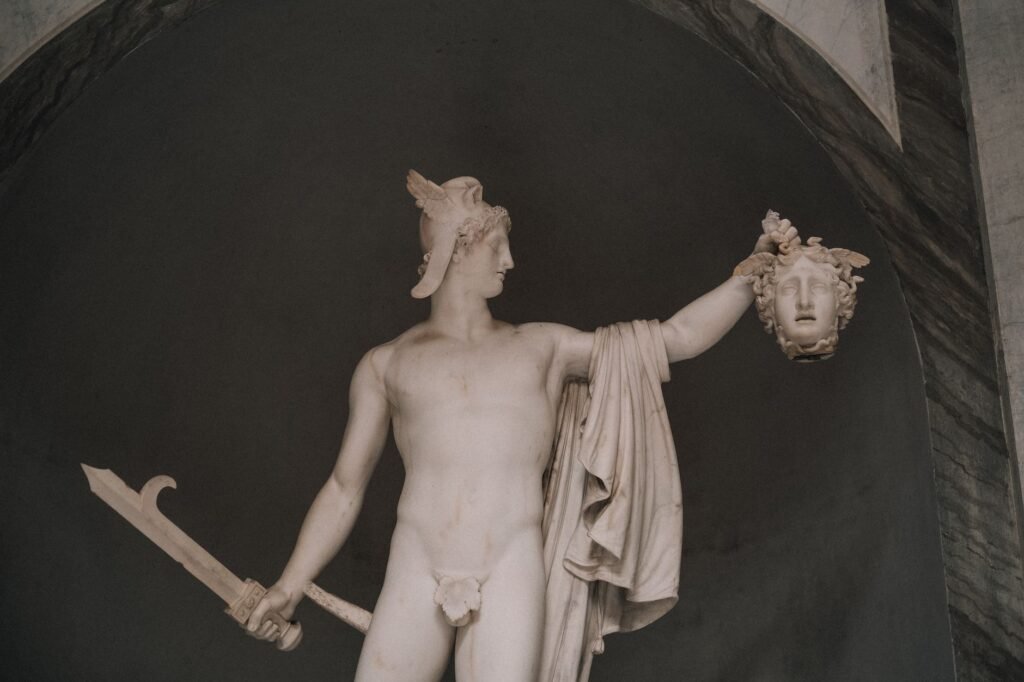
Although the precise chain of myth varies, the Gorgon head on Athena’s aegis is often connected to the myth of Perseus and Medusa. Perseus slays Medusa and later presents or transfers the Gorgon’s head into the protective sphere of Athena. Ancient sources and artistic traditions do not always narrate this in exactly the same way, but the connection between Medusa’s head and the aegis is a central part of later mythic symbolism.
Apollo and Aegis Imagery
In some poetic traditions, the aegis may appear in the wider language of divine intimidation and battle. However, Zeus and Athena remain its core bearers. Other gods may be described in terms of comparable radiance or power, but they are not standard owners of the aegis.
Relationship with Other Mythological Figures
The aegis illuminates the relationships among the major Olympian gods.
Zeus
For Zeus, the aegis expresses sovereignty. It is a tool of command, not merely defense. His use of it in epic reinforces his superiority over gods and mortals alike.
Athena
For Athena, the aegis reflects a distinct kind of warfare: disciplined, intelligent, and protective. She is not a goddess of reckless destruction but of strategic victory and civic order.
Hera
In some traditions and iconography, Hera may also appear in relation to divine regalia and protective symbols, but the aegis is not her primary attribute. The relationship is mainly indirect, through the broader family of Olympian authority.
Mortals and Heroes
Heroes such as Perseus, Heracles, and others may be affected by divine displays of the aegis, usually through inspiration, protection, or terror. The object marks the separation between mortal action and divine intervention.
Worship and Cult
There was no independent cult of the aegis itself. Instead, the object was part of the ritual and artistic representation of gods, especially Athena and Zeus.
Ritual Significance
The aegis may have been evoked in:
- prayers for protection
- battlefield invocations
- civic rites honoring Athena
- poetic hymns emphasizing divine power
Offerings and Symbolic Use
Ancient worship of Athena and Zeus included offerings, sacrifices, and dedications. While the aegis itself was not commonly offered as a distinct cult object, its imagery likely appeared on votive dedications, shields, and temple decorations. Its protective function made it suitable for public and military symbolism.
Festivals
Athena’s festivals, especially in Athens, would have reinforced the goddess’s role as protector of the city. The aegis as an icon of guardianship fits the ritual atmosphere of such celebrations, even though no major festival is named after it.
Ancient Sources
The aegis is well attested in classical literature and art. Important sources include:
Homer
In the Iliad and Odyssey, the aegis appears as a potent sign of Zeus’s and Athena’s power. Homer’s descriptions are among the earliest and most influential.
Hesiod
Hesiod’s works contribute to the broader mythic framework of the gods, though the aegis is less central than in Homer.
Apollodorus
The Bibliotheca preserves mythographic material that helps explain the relationships among Athena, Perseus, Medusa, and other figures relevant to aegis traditions.
Pausanias
Pausanias is important for understanding Greek cult, sanctuaries, and iconography. His Description of Greece provides valuable evidence for local traditions and temple imagery.
Ovid
In Roman-era literature, Ovid preserves mythic narratives related to Medusa, Perseus, and divine objects, helping trace the later development of Greek myths in Latin culture.
Visual and Archaeological Sources
Greek vase painting, sculpture, and later Roman art are also essential. They show how the aegis was imagined visually: as a decorated, fringed, and sometimes monstrous protective object.
Roman Equivalent
The aegis does not have a perfect Roman equivalent, because it is more of a Greek divine attribute than a separate Roman deity’s standard emblem. However, Roman culture adopted the term and the concept, especially in relation to Minerva, the Roman counterpart of Athena.
Minerva
Minerva often inherits Athena-like attributes in Roman art and literature, including the aegis in certain depictions. The object thus becomes part of the Roman visual and symbolic language of wisdom, war, and civic protection.
Roman Usage
In Roman and later European literature, “under the aegis of” came to mean protected by or supported by. This metaphorical use is one of the most durable legacies of classical mythology in modern English.
Influence on Modern Culture
The aegis has had a strong impact on modern language, literature, and popular culture.
Language and Politics
The phrase “under the aegis of” is widely used in formal English to mean under the protection, sponsorship, or guidance of an authority. It appears in diplomacy, scholarship, law, and organizational language.
Literature and Art
Writers often use the aegis as a metaphor for guardianship or legitimizing power. Artists and illustrators continue to depict Athena with the aegis as part of her classical iconography.
Film, Television, and Games
In modern fantasy and science fiction, “aegis” is frequently used as a name for:
- protective armor
- defense systems
- organizations that guard others
- magical shields or barriers
Video games, comics, and television often borrow the term because it instantly suggests protection and formidable power.
Branding and Institutions
The word is also common in the names of security firms, insurance companies, defense projects, and technological products. Its classical association with trust and protection makes it attractive in branding.
Curiosities
- The aegis is one of the few mythological objects whose meaning has entered everyday English in a major way.
- Ancient depictions sometimes make it difficult to distinguish whether the aegis is a shield, a garment, or a symbolic pelt.
- The Gorgon head on Athena’s aegis is an example of an apotropaic image, meaning one believed to ward off evil.
- In epic poetry, the mere shaking or display of the aegis can alter the outcome of a battle scene.
- The aegis may reflect very old ritual uses of animal skins in warrior or priestly contexts.
- Despite its fame, the aegis is not a god, hero, or monster, but an object whose symbolic force became larger than many divine characters.
- Its association with both Zeus and Athena shows how Greek myth can assign the same symbol to different divine functions.
Frequently Asked Questions
What is the aegis in Greek mythology?
The aegis is a divine shield or protective object associated mainly with Zeus and Athena. It symbolizes protection, authority, and terrifying power.
Why is it called the aegis?
The name is traditionally linked to the Greek word for “goat,” suggesting an original connection with goatskin. However, the exact etymology is uncertain.
Is the aegis a shield or a cloak?
Ancient sources describe it in different ways. It can appear as a shield, a breastplate, or a fringed cloak-like garment.
Why does Athena carry the aegis?
Athena carries the aegis as a sign of her role as protector of cities, strategic war goddess, and divine defender. It emphasizes her power to intimidate enemies and shield allies.
What is on the aegis in later art?
Many later depictions show the Gorgon head of Medusa on the aegis, especially in connection with Athena. This enhances its protective and terrifying qualities.
Does the aegis belong only to Athena?
No. In Homer, Zeus also possesses or uses the aegis. Athena is its most famous bearer in later Greek and Roman art.
What does “under the aegis of” mean today?
It means under the protection, sponsorship, or authority of someone or something. The phrase comes from the mythological idea of divine protection.
Is the aegis worshipped?
No separate cult was devoted to the aegis itself. Worship was directed to the gods associated with it, especially Zeus and Athena.
Conclusion
The aegis is one of the most enduring symbols of Greek mythology because it unites protection, sovereignty, and fear in a single divine emblem. Whether imagined as a shield, a cloak, or a sacred goatskin, it marked the presence of Zeus and Athena in myth, art, and ritual. Its imagery helped ancient audiences understand divine power as something both protective and overwhelming.
Across centuries, the aegis has continued to signify authority and guardianship. From classical epic to modern political language, it remains a powerful example of how mythological symbols can outlive the cultures that created them.

Orin Vale has spent the better part of two decades tracing the threads that connect the world’s oldest stories — from the halls of Asgard to the banks of the Nile, from Olympus to the jungles of the Maya. What began as a childhood fascination with flood myths and trickster gods grew into years of independent study across comparative mythology and ancient religion, always chasing the same question: what did these stories mean to the people who first told them? Orin writes for readers who want more than trivia — the ones looking for the beliefs, fears, and truths that myths were built to carry.