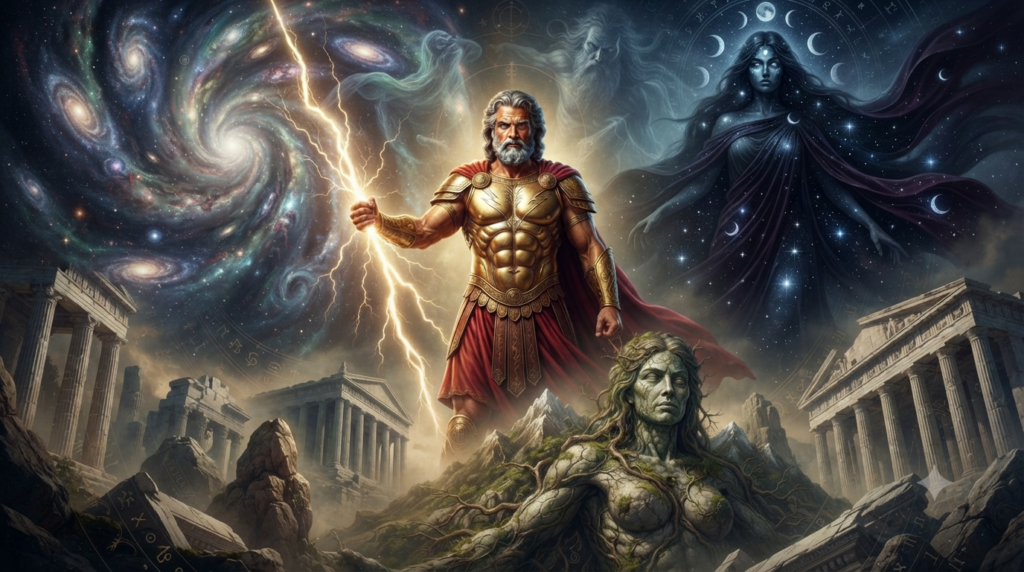
Anyone asking who is stronger than Zeus discovers that within Greek mythology itself, no single figure ever definitively defeated him, yet several forces came genuinely close or existed largely beyond his direct control, revealing meaningful limits to his otherwise dominant authority. Understanding who is stronger than Zeus requires distinguishing between figures who directly and seriously challenged him, cosmic forces that existed outside his conventional sphere of dominance, and the broader category of hypothetical cross-mythology comparisons that, while genuinely interesting, remain fundamentally different from documented mythological confrontation.
Typhon — The Closest Anyone Came to Defeating Zeus
Typhon represents the clearest, most direct answer to who is stronger than Zeus in terms of demonstrated combat threat, having been created specifically by Gaia to challenge his authority, with several ancient sources describing moments when Zeus appeared genuinely close to actual defeat during their dramatic confrontation.
This battle ultimately turned in Zeus’s favor only through decisive use of his thunderbolt, reinforcing that Typhon’s challenge represented the single most serious documented threat to Zeus’s supremacy found throughout Greek mythology, distinguishing this particular confrontation from any other adversary he faced.
This near-defeat remains the strongest evidence available when addressing who is stronger than Zeus, confirming that while Zeus ultimately prevailed, this victory was neither easy nor guaranteed, reflecting genuine vulnerability rather than effortless, predetermined triumph over this particular primordial adversary.
Understanding Typhon’s significance provides essential grounding for who is stronger than Zeus, establishing that even within his own decisive victory, Zeus faced authentic, serious danger unmatched by any other single documented confrontation throughout the broader scope of Greek mythology.
Forces Beyond Zeus’s Control
Nyx, the primordial goddess of Night, offers a genuinely different answer to who is stronger than Zeus, not through direct combat, but through existing in a category he deliberately avoided challenging, as documented specifically within Homer’s Iliad when Zeus restrained his own anger rather than risk offending her.
This restraint suggests that certain primordial forces, predating even the Titans, occupied a position that Zeus’s otherwise extensive authority did not comfortably extend to challenge directly, providing a meaningfully different category relevant to who is stronger than Zeus beyond simple combat capability alone.
Fate and the Moirai represent another significant consideration relevant to who is stronger than Zeus, since even the king of the gods generally operated within broader cosmic principles governing destiny that he did not fully or independently control, reflecting structural limits within the broader Greek cosmological hierarchy.
Recognizing these forces existing beyond Zeus’s conventional authority significantly enriches who is stronger than Zeus, demonstrating that strength and dominance within Greek mythology were not always measured through direct confrontation, but sometimes through simply existing outside another figure’s effective jurisdiction entirely.
Poseidon’s Attempted Rebellion
Poseidon stands apart from Zeus’s other Olympian relatives as the figure who actively attempted direct rebellion, joining Hera and Athena in a documented conspiracy to bind Zeus, providing relevant context for who is stronger than Zeus grounded in actual coordinated mythological challenge rather than pure speculation.
This conspiracy ultimately failed, requiring external intervention through Briareus, summoned by Thetis, to successfully free Zeus, reinforcing that even coordinated opposition from multiple significant Olympian gods proved insufficient to overturn his established authority when addressing who is stronger than Zeus.
This outcome provides important evidence relevant to who is stronger than Zeus, confirming that while genuine ambition and coordinated effort existed among certain Olympian gods, no such attempt succeeded in actually overturning his supreme position within the broader Olympian hierarchy.
This documented failed rebellion reinforces that within his own pantheon specifically, Zeus’s authority remained secure even when genuinely and seriously contested, distinguishing coordinated challenge from actual demonstrated superiority when addressing who is stronger than Zeus.
Within His Own Pantheon, Zeus Remains Undefeated
Considering Typhon’s near-defeat, Nyx’s primordial standing, and Poseidon’s failed conspiracy together, who is stronger than Zeus receives a consistent answer within Greek mythology specifically: no single figure or coordinated effort ever definitively and permanently overturned his established supreme authority.
This pattern distinguishes genuine challenge from actual defeat, confirming that while Zeus faced authentic danger and opposition across multiple significant mythological episodes, these challenges ultimately reinforced rather than overturned his position atop the Olympian hierarchy throughout Greek mythological tradition.
This consistent outcome across multiple separate mythological episodes provides the clearest overall answer to who is stronger than Zeus within his own specific mythological tradition, confirming genuine vulnerability without ever translating into documented, lasting defeat by any single figure or coalition.
Recognizing this pattern reinforces that who is stronger than Zeus, within Greek mythology specifically, ultimately finds no clear answer among individual gods or coordinated rebellions, despite several genuinely significant and well-documented challenges to his authority throughout numerous separate mythological narratives.
Cross-Mythology Comparisons — A Different Kind of Question
Beyond Greek mythology specifically, comparisons with figures like Odin from Norse mythology represent a genuinely different category relevant to who is stronger than Zeus, functioning as analytical exercises rather than references to any documented mythological confrontation between figures from entirely separate traditions.
These cross-mythology comparisons, while genuinely interesting and worth exploring on their own terms, cannot provide a definitive answer to who is stronger than Zeus in the same way documented intra-Greek confrontations like Typhon or Poseidon’s conspiracy can, since no actual ancient source describes any meeting between Zeus and figures from other mythological traditions.
Recognizing this important distinction ensures that who is stronger than Zeus receives an accurate, appropriately nuanced treatment, separating genuine documented mythological challenge within Greek tradition from legitimate but fundamentally different hypothetical comparison across entirely separate cultural and religious traditions.
This distinction reinforces that meaningfully addressing who is stronger than Zeus requires clarity regarding which specific type of comparison is actually being considered, whether documented challenge within his own mythology or broader, inherently speculative comparison across unrelated traditions.
So, Who Is Stronger Than Zeus?
Within Greek mythology specifically, who is stronger than Zeus finds no definitive answer among individual gods or documented coordinated efforts, confirming that he remained undefeated throughout the surviving mythological tradition despite facing genuinely serious challenges from figures like Typhon and Poseidon.
At the same time, forces like Nyx and Fate demonstrate that Zeus’s power, while extensive, was never portrayed as entirely unlimited, revealing meaningful boundaries that complicate any simplified image of absolute, unchallenged cosmic authority throughout Greek mythological tradition.
This combination of documented near-defeat, deliberate restraint before primordial forces, and failed rebellion collectively provides the most complete, accurate answer to who is stronger than Zeus, revealing genuine complexity rather than either simple invincibility or straightforward defeat by any single figure.
Ultimately, who is stronger than Zeus finds its most honest answer in recognizing this nuanced reality: undefeated by any individual challenger within his own mythology, yet genuinely limited by certain primordial forces and cosmic principles that existed meaningfully beyond even his considerable authority.
FAQ — Quick Answers About Who Might Be Stronger Than Zeus
Who is stronger than Zeus?
Within Greek mythology, no single figure ever definitively defeated Zeus, though Typhon came closest, and forces like Nyx and Fate existed beyond his direct control.
Did Typhon ever defeat Zeus?
No, Zeus ultimately defeated Typhon using his thunderbolt, though several sources describe him coming genuinely close to being overpowered.
Was Poseidon ever successful in challenging Zeus?
No, Poseidon’s conspiracy to bind Zeus ultimately failed after Thetis summoned Briareus to intervene and free him.
Is Zeus considered all-powerful in Greek mythology?
Not entirely; while extremely powerful, Zeus faced genuine limits, particularly regarding primordial forces like Nyx and broader Fate.
Can Zeus be compared to gods from other mythologies like Odin?
Yes, though these comparisons remain hypothetical, since no ancient source documents any actual meeting between Zeus and figures from other traditions.
Conclusion
Anyone who sets out to answer who is stronger than Zeus discovers that within Greek mythology itself, he remained undefeated by any single figure or coordinated challenge, despite facing genuine, well-documented danger from Typhon and Poseidon’s failed rebellion against his rule.
At the same time, his deliberate restraint before Nyx and the broader limits imposed by Fate reveal that his power, while extensive, was never portrayed as entirely absolute, adding genuine nuance to any complete answer regarding his true standing within Greek cosmology.
Ultimately, who is stronger than Zeus finds its most accurate answer not in a single named challenger, but in recognizing the meaningful, well-documented boundaries that existed even for the supreme ruler of the Greek pantheon throughout his extensive mythological tradition.

Orin Vale has spent the better part of two decades tracing the threads that connect the world’s oldest stories — from the halls of Asgard to the banks of the Nile, from Olympus to the jungles of the Maya. What began as a childhood fascination with flood myths and trickster gods grew into years of independent study across comparative mythology and ancient religion, always chasing the same question: what did these stories mean to the people who first told them? Orin writes for readers who want more than trivia — the ones looking for the beliefs, fears, and truths that myths were built to carry.