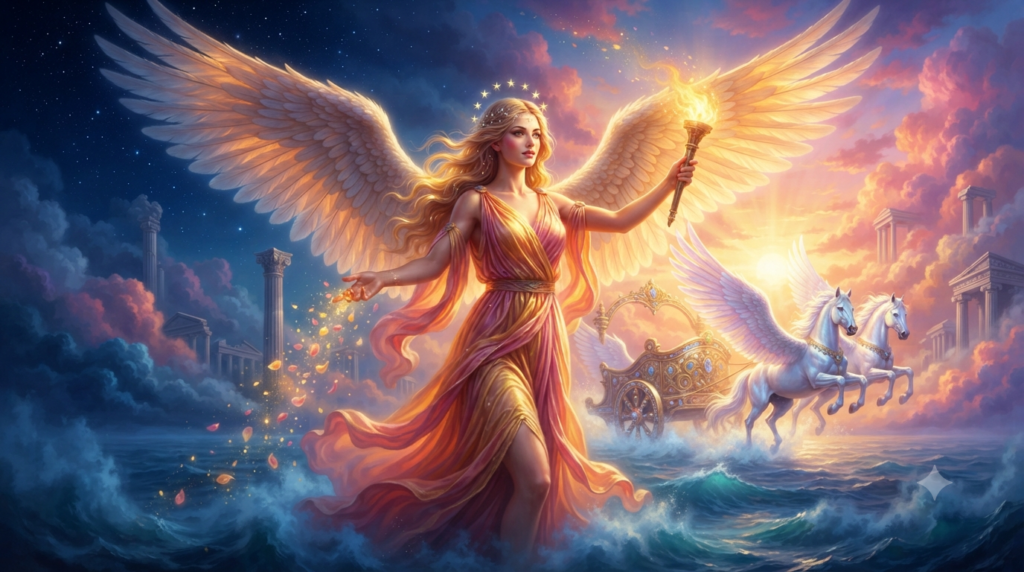
In the luminous realm of Greek and Roman mythology, few figures embody the beauty and promise of a new day as profoundly as the winged goddess of the dawn. Who is the winged figure associated with dawn in mythology? She is Eos, the radiant Greek goddess of the dawn, known to the Romans as Aurora, who each morning rises from her golden throne to herald the arrival of her brother Helios, the sun god . As the daughter of the Titans Hyperion and Theia, she was revered as the personification of the dawn, her very essence intertwined with the colors of the morning sky and the eternal cycle of light and darkness .
Origins and Genealogy
Eos was born into the highest echelons of the Greek divine hierarchy as a second-generation Titan. Her parents were Hyperion, the Titan god of heavenly light, and Theia, the Titaness of sight and the shining ether of the sky . Her siblings included Helios, the god of the sun, and Selene, the goddess of the moon, making her part of a divine trio that governed the celestial cycle of day and night . This genealogy firmly established her as a cosmic force of immense importance, as she was directly responsible for opening the gates of heaven each morning to allow her brother Helios to drive his golden chariot across the sky .
According to the Homeric tradition, Eos rises from her abode at the edge of the world, called Oceanus, the great river that encircled the earth . From there, she ascended into the heavens, her presence scattering the stars and painting the sky with the radiant hues of dawn. Her role was not merely passive but active, as she was the divine force that dispelled the darkness of night and prepared the world for the life-giving light of the sun .
Appearance and Iconography
The ancient poets and artists depicted Eos as a strikingly beautiful goddess, embodying the ideal of feminine grace and radiant youth. She was most famously described by Homer as “rosy-fingered” or “rosy-armed,” an epithet that captured the delicate pink and crimson colors that spread across the sky at dawn . She was also called “saffron-robed,” referencing the golden-orange hues of the morning light . Her garments were often depicted as flowing and luminous, reflecting the colors of the sky she personified.
In ancient Greek art, Eos was typically portrayed as a winged goddess, emphasizing her ability to ascend swiftly into the heavens . She was often shown riding a chariot drawn by winged horses, or in some depictions, her own wings were sufficient to carry her skyward . In numerous vase paintings and reliefs, she is seen pursuing her divine duties, scattering flowers in her path or holding a torch to illuminate the world . Her iconography frequently associates her with the colors of the dawn—pink, gold, and white—and she is often depicted as a youthful, ethereal figure, full of grace and vitality .
Mythological Role and Daily Cycle
The primary mythological function of Eos was to announce the arrival of the sun each day. She was the divine usher of the dawn, whose appearance marked the transition from night to day . According to Homeric tradition, Eos would leave her home on the river Oceanus at the start of each day, riding her chariot to the heavens to herald the approach of her brother Helios, who followed her with his blindingly bright sun chariot . This daily journey was not merely a poetic image but a sacred ritual that maintained the cosmic order .
However, Eos’s role was not limited to her morning duties. She was also responsible for the stars, which she would put to flight at dawn, and she was associated with the direction east, the place of sunrise . In later Greek thought, the dawn was seen as a time of renewal and hope, and Eos came to represent the possibility of new beginnings . In the Homeric epics, she is sometimes said to accompany her brother Helios throughout the whole day, not leaving him until sunset . Her presence in the sky was a comfort to mortals, a daily reminder that the darkness of night would always give way to the light of a new day.
The Mortal Loves of Eos
Despite her divine nature, Eos was best known in mythology for her passionate and often tragic loves for mortal men. The goddess was cursed by Aphrodite with an insatiable desire for mortal lovers as punishment for her affair with Ares, the god of war . This curse led to a series of dramatic abductions and romantic entanglements that have become some of the most enduring stories in Greek mythology .
Her most famous love was Tithonus, a handsome Trojan prince. Eos abducted him and, upon asking Zeus to grant him immortality, she failed to request eternal youth. As a result, Tithonus grew older and more decrepit, eventually being transformed by Eos into a cicada, his endless chirping a symbol of his eternal but terrible existence . Another famous lover was Orion, the great hunter, whom Eos abducted but later lost when he was killed by Artemis . She also had a romance with Cephalus, whom she also took as her lover, though this affair caused great sorrow and tragedy . These tales underscore the goddess’s intense emotional life and the sorrowful consequences that often attended her passions . By the Titan Astraeus, she was also the mother of the winds Zephyrus, Notus, and Boreas, and of Hesperus, the Evening Star, and the other stars .
Roman Equivalent: Aurora
In Roman mythology, Eos was known as Aurora, and her attributes and mythology were largely carried over from the Greek tradition . The Romans also depicted her as a winged goddess, often shown riding a chariot drawn by horses, dressed in red and yellow, sometimes with a sun-disk over her head and a halo of sunbeams around her brow, or with a torch in her right hand . Like Eos, Aurora opened the gates of the day and preceded the appearance of the sun chariot . The name “Aurora” has endured in the English language to describe the dawn and the spectacular natural light displays of the aurora borealis .
Frequently Asked Questions About Who is the winged figure associated with dawn in mythology?
Who is the Greek goddess of the dawn?
The Greek goddess of the dawn is Eos. She is the winged goddess who rises each morning from her home at the edge of the river Oceanus to herald the arrival of the sun .
What is the Roman name for Eos?
The Roman equivalent of Eos is Aurora . Like Eos, Aurora is the winged goddess of the dawn who precedes the rising of the sun .
Why is Eos depicted with wings?
Eos is depicted with wings in art and literature to symbolize her ability to ascend swiftly into the heavens each morning. Her wings represent her speed and her role as the divine messenger who announces the dawn .
What does “rosy-fingered” mean in reference to Eos?
The epithet “rosy-fingered” was famously used by Homer to describe Eos. It refers to the soft pink and red colors that appear in the sky at dawn, capturing the goddess’s beauty and her association with the colors of the morning light .
Who were the mortal lovers of Eos?
Eos was cursed by Aphrodite to desire mortal men, leading to numerous romantic relationships. Her most famous lovers included Tithonus, whom she turned into a cicada, Orion the hunter, and Cephalus .
What was the story of Eos and Tithonus?
Eos abducted Tithonus, a Trojan prince, and asked Zeus to grant him immortality. However, she forgot to ask for eternal youth. Tithonus grew older and more decrepit until Eos transformed him into a cicada, who chirps forever .
Conclusion
Who is the winged figure associated with dawn in mythology? She is Eos, the radiant embodiment of the morning, a figure whose daily journey across the heavens announced the arrival of light and the beginning of a new day . As the daughter of the Titans Hyperion and Theia, she was part of a divine family that governed the celestial cycle, and her role as the usher of the sun was essential to the cosmic order . However, her myth extends far beyond her duties, encompassing tales of tragic romance and divine punishment that highlight the complexities of the Greek divine imagination . Her curse by Aphrodite and her love for mortal men like Tithonus and Orion illustrate the themes of desire and loss that are central to the Greek worldview . Today, her name persists as a symbol of hope, renewal, and the relentless passage of time, reminding us that each dawn brings with it the promise of a new beginning and the eternal cycle of life and rebirth. Her image, with wings outstretched and torch in hand, remains one of the most iconic representations of the power and beauty of the morning light.

Orin Vale has spent the better part of two decades tracing the threads that connect the world’s oldest stories — from the halls of Asgard to the banks of the Nile, from Olympus to the jungles of the Maya. What began as a childhood fascination with flood myths and trickster gods grew into years of independent study across comparative mythology and ancient religion, always chasing the same question: what did these stories mean to the people who first told them? Orin writes for readers who want more than trivia — the ones looking for the beliefs, fears, and truths that myths were built to carry.