Who Is Vidar in Norse Mythology?
Vidar is one of the most powerful yet mysterious gods in Norse mythology. Known for his silence, strength, and role in avenging Odin, Vidar stands apart from many of the more famous Norse gods. While figures like Thor, Loki, and Odin appear in many stories, Vidar is mentioned less often—but his importance is enormous, especially in the events of Ragnarok.
So, who is Vidar in Norse mythology? He is a son of Odin, a god of vengeance, and one of the few deities destined to survive the end of the world.
Vidar’s Place Among the Norse Gods
Vidar belongs to the Aesir, the main tribe of Norse gods associated with power, war, kingship, and cosmic order. His father is Odin, the All-Father and ruler of Asgard. His mother is usually identified as the giantess Gridr, making Vidar part god and part giant, a common pattern in Norse myth.
Despite being Odin’s son, Vidar is not as talkative or active in the myths as some of his brothers. He is often described as quiet, patient, and immensely strong. In fact, some sources suggest he is nearly as strong as Thor.
Vidar is sometimes called “the silent god,” a title that reflects both his personality and his limited but powerful role in the surviving stories.
The Meaning of Vidar’s Name
The name Vidar is often interpreted as meaning something like “wide ruler” or “warrior of the forest,” though scholars debate the exact meaning. The Old Norse form of his name is Víðarr.
The first part of the name may be connected to words meaning “wide” or “forest,” which has led some to associate Vidar with spacious lands, wilderness, or natural strength. While he is not usually called a nature god in the same way Freyr is connected to fertility, Vidar’s imagery often feels rugged and untamed.
This fits well with his character: strong, reserved, enduring, and closely tied to survival after destruction.
Vidar and the Thick Shoe
One of the most memorable details about Vidar in Norse mythology is his special shoe. This shoe plays a crucial role during Ragnarok, the final battle of the gods.
According to myth, Vidar’s shoe is made from all the scraps of leather that people cut away from their shoes. Because of this, some medieval sources suggest that humans indirectly help prepare Vidar for his destiny whenever they discard pieces of leather.
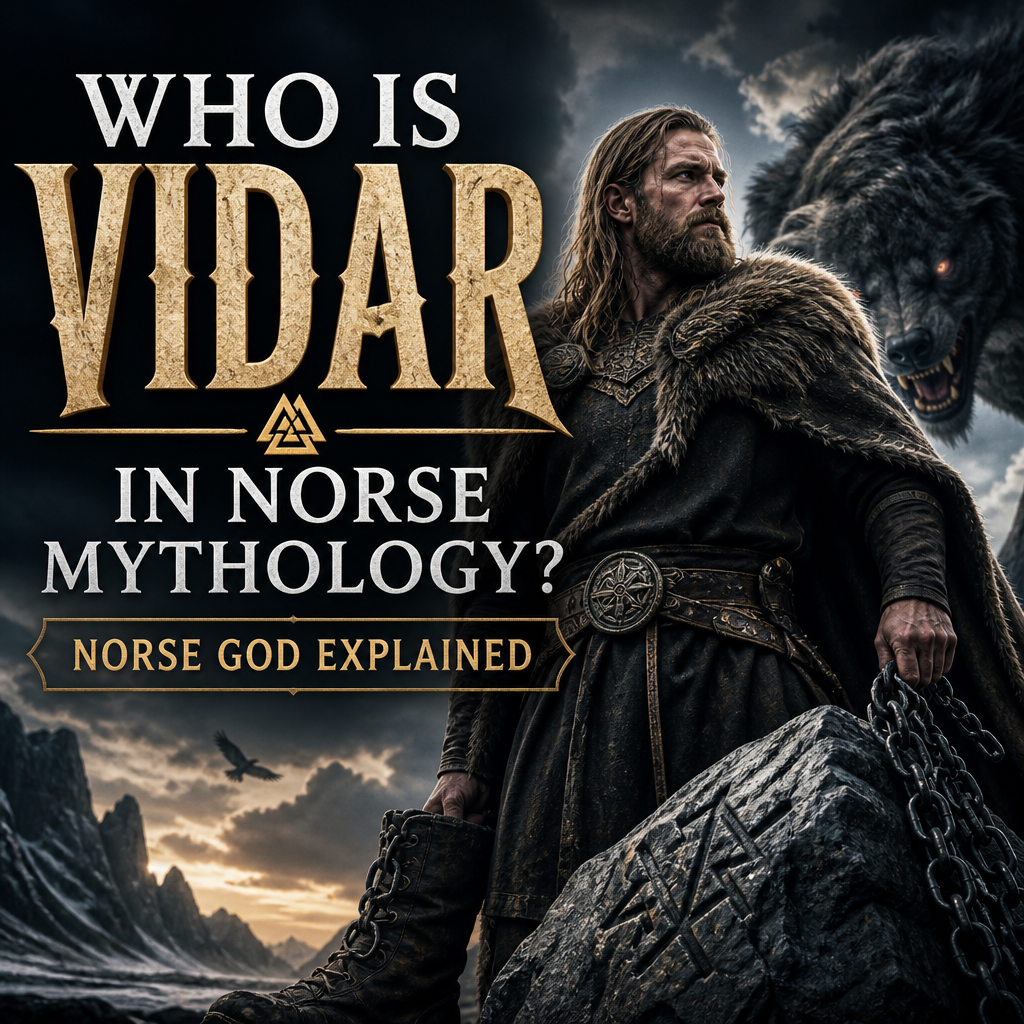
During Ragnarok, the monstrous wolf Fenrir breaks free and kills Odin. Vidar then steps forward to avenge his father. He places one foot on Fenrir’s lower jaw, using the strength and protection of his thick shoe, and tears the wolf apart.
This image is one of the most dramatic scenes in Norse mythology. It shows Vidar as a god who may remain quiet for much of the mythic cycle, but whose strength becomes decisive when the world reaches its darkest moment.
Vidar’s Role in Ragnarok
Ragnarok is the great doom of the gods, a series of catastrophic events that includes natural disasters, cosmic battles, and the deaths of many major deities. Odin is killed by Fenrir, Thor dies after slaying the serpent Jormungandr, and much of the world is destroyed by fire and flood.
Vidar’s role in Ragnarok is especially important because he avenges Odin. In Norse culture, vengeance for a slain family member was a serious duty, tied to honor and justice. Vidar fulfills this duty with terrifying force.
His killing of Fenrir is not just personal revenge. It also represents the defeat of one of the greatest chaotic threats in the cosmos. Fenrir is no ordinary wolf; he is a monster powerful enough to devour the chief god. Vidar’s victory over him marks Vidar as one of the mightiest beings in the Norse mythic world.
Vidar as a Survivor of the End
Vidar is also important because he survives Ragnarok. After the destruction of the old world, a new world rises from the sea, green and renewed. A small number of gods remain, including Vidar and his brother Vali, another son of Odin associated with vengeance.
The survival of Vidar suggests more than physical toughness. He represents endurance, continuity, and the possibility of renewal after disaster. In a mythology often marked by fate and tragedy, Vidar is one of the figures who carries the divine line forward.
The gods who survive Ragnarok help shape the next age of the world. Vidar’s presence in that renewed world gives him a quiet but hopeful significance.
Is Vidar a God of Vengeance?
Vidar is commonly understood as a god of vengeance because of his role in avenging Odin’s death. However, he is not a god of reckless anger or constant violence. Unlike Thor, who is frequently shown fighting giants, or Tyr, who is linked to war and law, Vidar’s identity is focused on a single powerful act of retribution.
This makes him a more solemn figure. His vengeance is not impulsive; it is destined. He waits until the appointed moment and then acts with unstoppable strength.
Because of this, Vidar can also be seen as a god of patience, loyalty, and duty.
Why Is Vidar Called the Silent God?
Vidar’s silence is one of his defining traits. The myths do not record long speeches from him or many adventures. His quietness may symbolize restraint and hidden strength. He does not need to boast or seek attention; his importance is revealed through action.
In a mythological world filled with clever speeches, binding oaths, riddles, and prophecies, Vidar’s silence makes him stand out. He is not a trickster like Loki or a wisdom-seeker like Odin. He is a force held in reserve until the moment he is needed most.
Why Vidar Matters in Norse Mythology
Vidar may not appear in many myths, but his role is essential. He connects several major Norse themes:
- Family loyalty, through his vengeance for Odin
- Strength and courage, through his battle with Fenrir
- Fate, through his destined role in Ragnarok
- Survival and renewal, through his life after the world’s destruction
- Silence and restraint, through his calm, reserved nature
These qualities make Vidar one of the most fascinating figures in the Norse pantheon. He proves that a god does not need many stories to be important. Sometimes one decisive moment is enough to define a mythic legacy.
Final Thoughts
Vidar in Norse mythology is the silent son of Odin, a powerful god destined to avenge his father during Ragnarok. With his thick shoe and immense strength, he kills Fenrir, the wolf who devours Odin, and becomes one of the few gods to survive into the renewed world.
Though he is less famous than Thor or Loki, Vidar holds a vital place in the Norse imagination. He represents loyalty, endurance, and the strength to act when all seems lost.

Orin Vale has spent the better part of two decades tracing the threads that connect the world’s oldest stories — from the halls of Asgard to the banks of the Nile, from Olympus to the jungles of the Maya. What began as a childhood fascination with flood myths and trickster gods grew into years of independent study across comparative mythology and ancient religion, always chasing the same question: what did these stories mean to the people who first told them? Orin writes for readers who want more than trivia — the ones looking for the beliefs, fears, and truths that myths were built to carry.