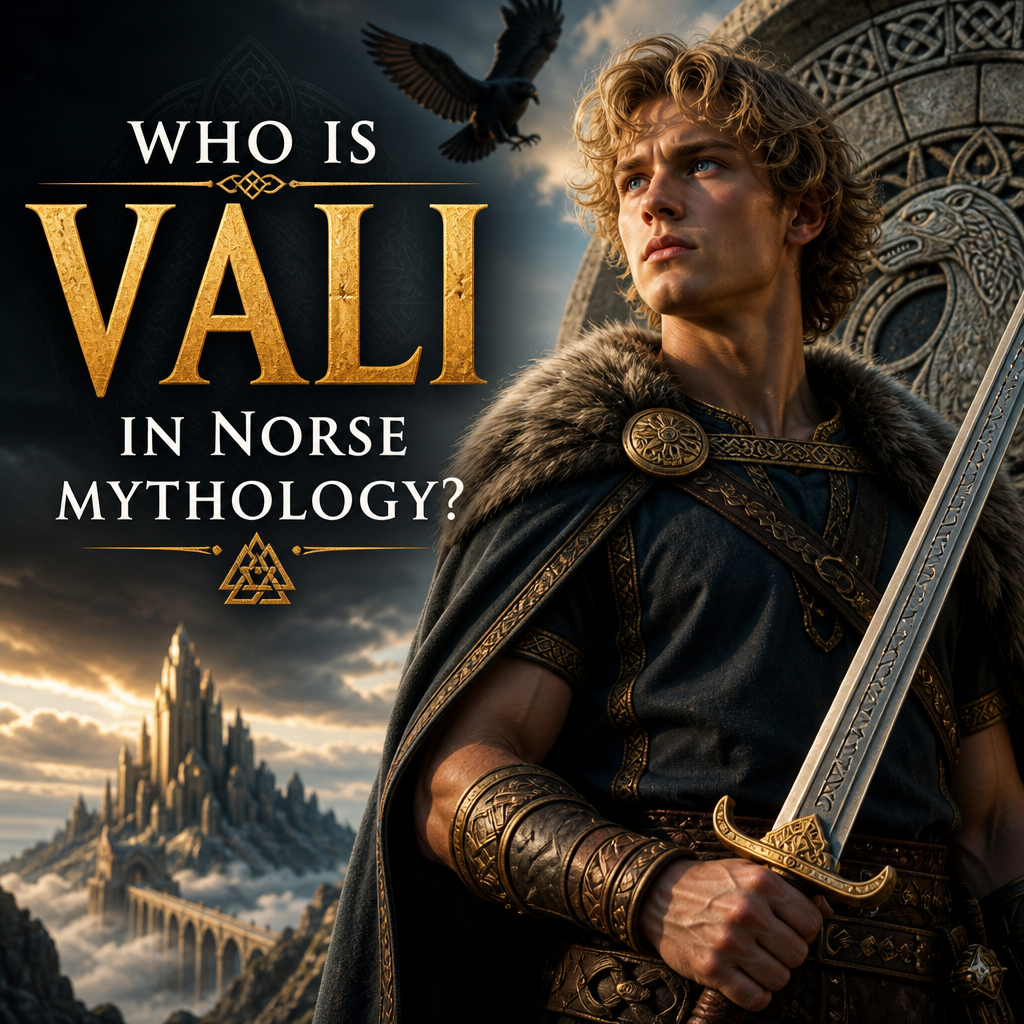
Who Is Vali in Norse Mythology?
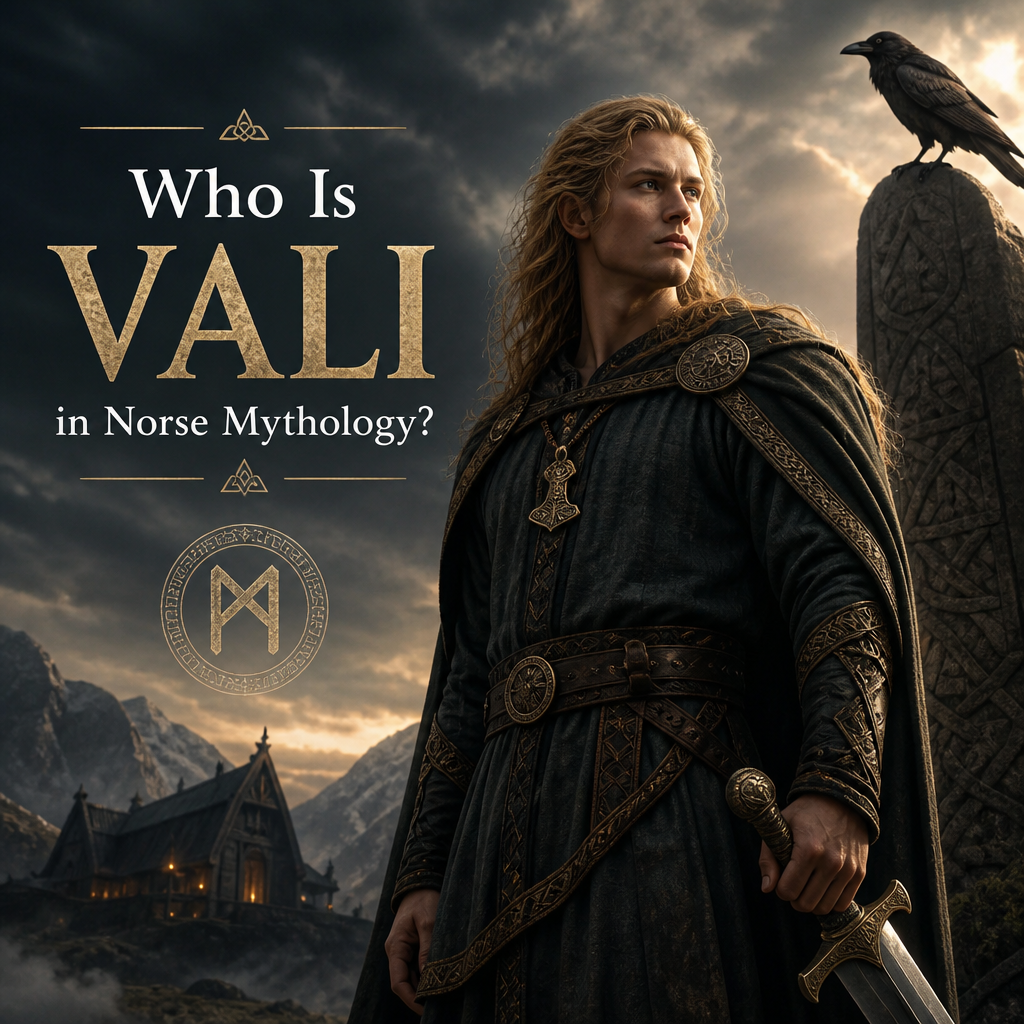
In Norse mythology, Vali is a god associated with vengeance, justice, and survival after the end of the world. Though he does not appear in as many stories as Odin, Thor, or Loki, Vali plays a crucial role in one of the most tragic events in the Norse mythological cycle: the death of Baldr.
Vali is best known as the son of Odin, the chief of the gods. He is born for a single purpose—to avenge Baldr’s death. This makes him one of the clearest examples in Norse myth of a divine figure created to fulfill fate.
Vali’s Parentage and Identity
Vali is usually described as the son of Odin and the giantess Rindr, sometimes called Rind. His birth is unusual because it is directly tied to revenge. After Baldr, Odin’s beloved son, is killed through Loki’s trickery, Odin seeks a child who can punish the one responsible.
Vali is that child.
In the old Norse sources, Vali’s name is often connected with strength and battle. He is a young god, but his youth does not make him weak. In fact, one of the most striking things about Vali is how quickly he grows and acts after birth.
The Death of Baldr
To understand who Vali is in Norse mythology, it helps to know the story that leads to his birth.
Baldr is one of the most beloved gods in Asgard. He is beautiful, wise, and gentle, and his death is considered one of the first major signs that Ragnarök—the doom of the gods—is approaching.
Baldr begins having terrible dreams about his own death. His mother, Frigg, tries to protect him by asking almost every thing in the world to swear not to harm him. Fire, water, metals, stones, animals, and diseases all make this promise.
However, Frigg overlooks mistletoe because it seems too young and harmless.
Loki discovers this weakness. He fashions a weapon from mistletoe and gives it to Baldr’s blind brother, Hodr. During a game in which the gods throw objects at Baldr for fun, knowing nothing can hurt him, Hodr throws the mistletoe. It strikes Baldr, killing him instantly.
Vali as the Avenger of Baldr
After Baldr’s death, Odin knows that the crime must be avenged. According to the myths, Vali is born for this very reason.
Vali grows to maturity with supernatural speed. In some accounts, he is only one night old when he takes vengeance. He does not wash his hands or comb his hair until he has completed his task, a detail that emphasizes his total dedication to revenge.
His target is Hodr, the blind god who threw the mistletoe. Although Hodr was manipulated by Loki, he still becomes the one punished for Baldr’s death. Vali kills Hodr, fulfilling the role for which he was born.
This act may seem harsh from a modern point of view, especially because Hodr did not fully understand what he was doing. However, Norse mythology often reflects a world where fate, honor, and vengeance are deeply connected. Vali’s role is not to judge the situation with mercy, but to restore balance through retribution.
Vali and Loki’s Punishment
Vali is sometimes confused with another figure involved in Loki’s punishment. In some sources, Loki has a son named Vali or Váli, who appears in the grim story of Loki’s binding.
After the gods finally capture Loki for his crimes, including his role in Baldr’s death, they punish him severely. Loki’s son Narfi is killed, and his entrails are used to bind Loki beneath the earth. In some versions, another son named Vali is transformed into a wolf and kills Narfi.
This can create confusion because there is both:
- Vali, son of Odin, who avenges Baldr by killing Hodr
- Vali, son of Loki, who appears in the story of Loki’s punishment in some accounts
The Vali most commonly discussed as a Norse god is Odin’s son.
Vali and Ragnarök
Vali’s story does not end with revenge. He is also important because he survives Ragnarök.
Ragnarök is the great final battle in Norse mythology, where many gods, giants, monsters, and humans die. Odin is killed by the wolf Fenrir. Thor slays the Midgard Serpent but dies from its venom. Freyr falls to the fire giant Surtr. Much of the world is destroyed by fire and flood.
Yet not all is lost.
After Ragnarök, the world is renewed. A small number of gods survive and help begin a new age. Vali is one of them. Alongside his brother Vidar, and Baldr and Hodr who return from the realm of the dead, Vali lives on in the restored world.
This survival gives Vali a deeper symbolic meaning. He is not only a god of vengeance but also a figure connected to endurance, renewal, and the continuation of divine order after destruction.
What Does Vali Symbolize?
Vali represents several important themes in Norse mythology.
Vengeance and Justice
Vali’s main role is to avenge Baldr. In the Norse worldview, vengeance was often seen as a duty, especially when a family member had been wronged. Vali embodies this principle in its purest form.
Fate
Vali is born specifically to fulfill a prophecy-like purpose. His life shows how strongly Norse mythology is shaped by fate. Even the gods cannot escape destiny; they move toward it.
Youth and Strength
Although Vali is extremely young when he takes revenge, he is powerful enough to kill Hodr. This sudden growth highlights his divine nature and the urgency of his mission.
Survival After Destruction
Because Vali survives Ragnarök, he also symbolizes what remains after catastrophe. His presence in the renewed world suggests that even after grief and violence, life continues.
Why Vali Matters in Norse Mythology
Vali may not be as famous as Thor or Odin, but he has an important place in the Norse mythological tradition. His story connects the death of Baldr, the punishment of wrongdoing, and the survival of the gods after Ragnarök.
When people ask, “who is Vali in Norse mythology,” the simplest answer is that he is the son of Odin, born to avenge Baldr’s death. But his meaning goes beyond that single act. Vali stands at the crossroads of vengeance and renewal, tragedy and survival.
He reminds us that Norse mythology is not only about heroic battles and powerful gods. It is also about fate, loss, justice, and the hope that something can endure beyond the end of the world.

Orin Vale has spent the better part of two decades tracing the threads that connect the world’s oldest stories — from the halls of Asgard to the banks of the Nile, from Olympus to the jungles of the Maya. What began as a childhood fascination with flood myths and trickster gods grew into years of independent study across comparative mythology and ancient religion, always chasing the same question: what did these stories mean to the people who first told them? Orin writes for readers who want more than trivia — the ones looking for the beliefs, fears, and truths that myths were built to carry.