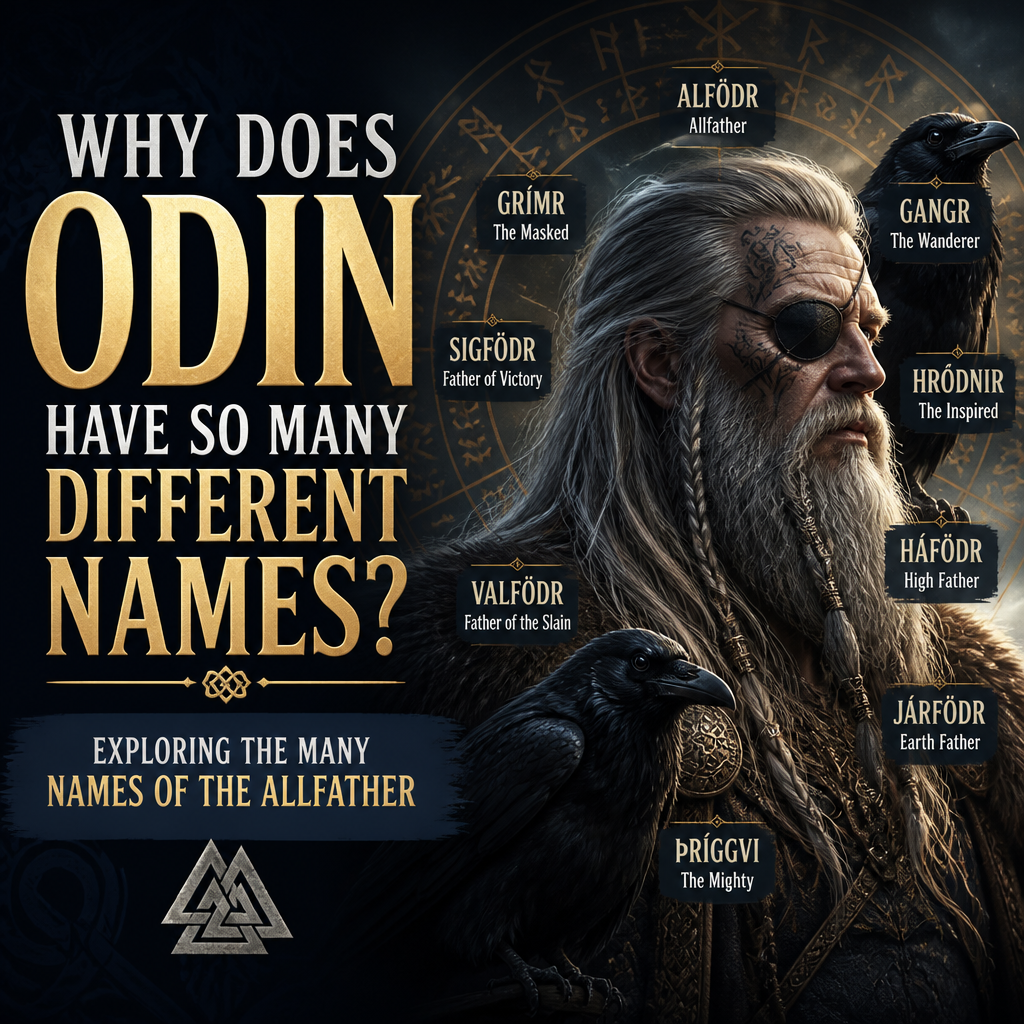
Why Does Odin Have So Many Different Names?
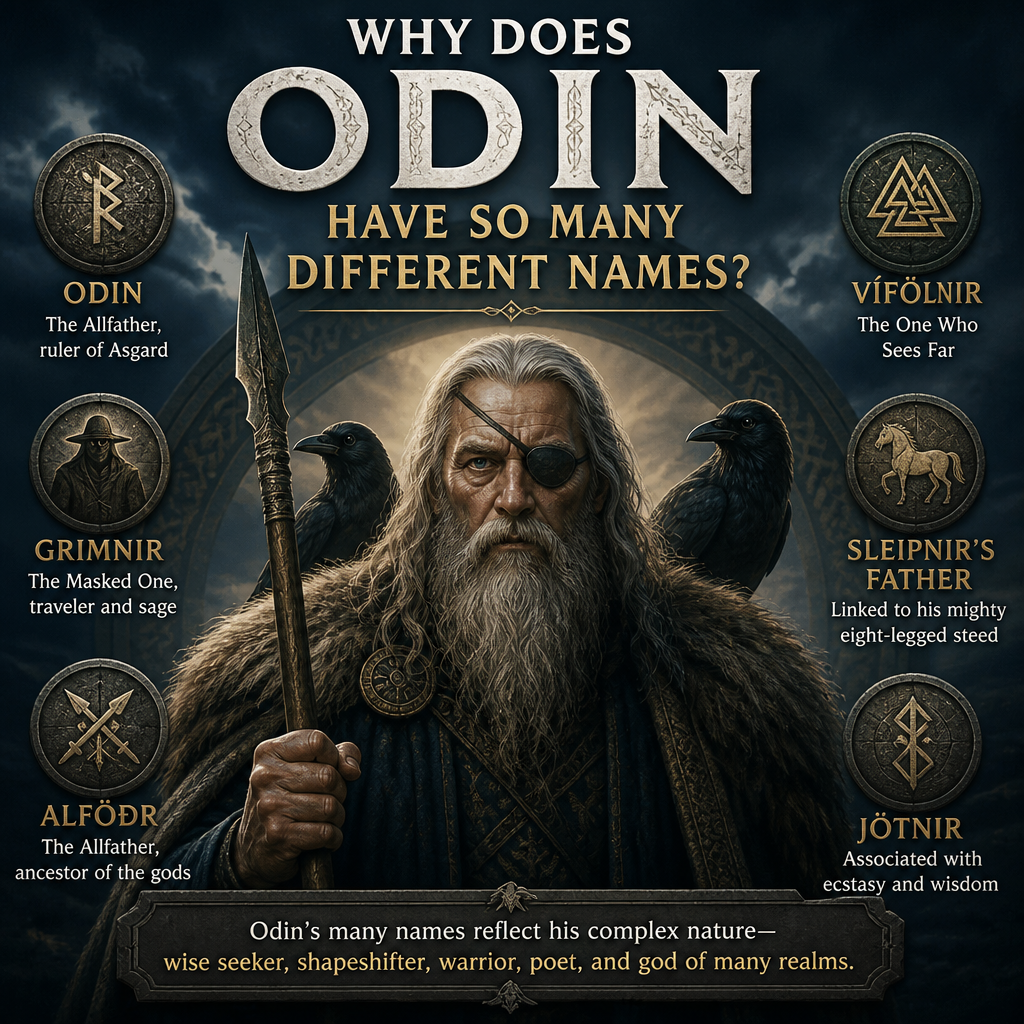
Odin is one of the most complex figures in Norse mythology. He is a god of war, wisdom, poetry, magic, death, kingship, and prophecy. Because he appears in so many roles, stories, and traditions, he is known by an extraordinary number of names. So, why does Odin have so many different names? The answer lies in his nature as a shape-shifting wanderer, a master of hidden knowledge, and a god whose identity changes depending on the story being told.
In the surviving Norse sources, Odin is given dozens—possibly hundreds—of names and titles. Some describe his appearance. Others refer to his powers, deeds, disguises, or relationships with gods and humans. Together, these names reveal how ancient Norse people understood him: not as a simple character, but as a mysterious and many-sided force.
Odin as a God of Many Roles
One reason Odin has so many names is that he is connected to many different parts of life and death. Unlike some gods who are strongly tied to a single domain, Odin crosses boundaries.
He is associated with:
- Wisdom and knowledge
- War and victory
- Poetry and inspiration
- Magic and runes
- Death and the afterlife
- Kings and rulers
- Travelers and wanderers
- Prophecy and fate
Each role gives him a different identity. As a war god, he may be called by a name linked to battle or victory. As a seeker of wisdom, he may bear a name connected to knowledge, sacrifice, or vision. As a wanderer, he may appear under a disguise with an entirely different name.
This makes Odin less like a god with one fixed personality and more like a collection of overlapping identities.
Names as Clues to His Character
In Norse poetry, names were not just labels. They often carried meaning. A name could describe a quality, a famous act, or a hidden truth about the person or god.
Many of Odin’s names function like poetic clues. For example, some names refer to his appearance, such as his missing eye. Odin sacrificed one eye at Mimir’s well in exchange for wisdom, so names connected to sight, blindness, or one-eyedness point back to that myth.
Other names describe his personality. He is cunning, restless, dangerous, and wise. He seeks knowledge at almost any cost, even when the price is pain, fear, or death. His names reflect this strange combination of wisdom and intensity.
Examples of Odin’s Names
Some of Odin’s best-known names include:
- Allfather – A title that presents him as the father or ruler of gods and humans.
- Bölverk – Often translated as “evil-doer” or “worker of misfortune,” a name linked to one of his disguises.
- Grímnir – Meaning “masked one” or “hooded one,” used when Odin appears in disguise.
- Hár – Meaning “High One,” emphasizing his power and status.
- Valföðr – Meaning “father of the slain,” connecting him to warriors who die in battle.
- Yggr – Meaning “terrible one,” showing his fearsome and awe-inspiring side.
These names are not random. Each one shows a different face of Odin.
Odin the Wanderer in Disguise
Another major reason Odin has so many different names is that he often travels in disguise. In many myths, he enters the world of gods, giants, and humans under a false identity. He may appear as an old man with a cloak, a wide-brimmed hat, and a staff. He asks questions, tests people, gives advice, or causes trouble.
Because he moves through the world in disguise, he needs many names. These names allow him to hide his true identity until the right moment. They also reflect his role as a god of mystery.
Odin’s disguises show that knowledge is not always obvious. Wisdom may come from a stranger, a wanderer, or someone who seems weak or unimportant. In this way, his many names support one of his central themes: appearances can be deceptive.
The Importance of Poetry in Norse Culture
Odin’s many names also come from the poetic traditions of the Norse world. Much of what we know about Norse mythology comes from poems, especially those preserved in the Poetic Edda and the Prose Edda.
Old Norse poets loved wordplay, variation, and layered meaning. They often used alternate names and poetic phrases called kennings. A kenning is a descriptive expression used in place of a simple word. For example, the sea might be called “the whale-road,” and battle might be called “the storm of swords.”
Gods also received many poetic names. Odin, as the god of poetry himself, naturally has an especially large number. His names gave poets more ways to refer to him while keeping rhythm, alliteration, and meaning in their verses.
In other words, Odin’s many names are partly a result of literary art. They helped storytellers create rich, memorable poetry.
Regional Traditions and Oral Storytelling
Norse mythology was not a single fixed religion with one official text. It was passed down through oral tradition across different regions and generations. Stories changed over time. Names varied from place to place. A name used in one community might emphasize Odin as a war god, while another might focus on him as a wise wanderer or magical figure.
This flexibility helped Odin grow into a layered mythological figure. His many names may preserve traces of different local traditions, rituals, and stories that were later gathered together in written sources.
A God of Hidden Knowledge
Odin’s many names also fit his obsession with hidden knowledge. He is not a straightforward god. He sacrifices himself to himself on the World Tree, Yggdrasil, to gain the runes. He gives up an eye for wisdom. He consults the dead. He seeks prophecy even when it reveals doom.
A god like this cannot be fully captured by one name. Each name reveals something, but no single name explains him completely.
His identity is intentionally mysterious. The more names he has, the more he seems to slip away from simple understanding.
What Odin’s Many Names Tell Us
So, why does Odin have so many different names? Because Odin is a god of many faces. His names reflect his roles as ruler, wanderer, magician, warrior, poet, and seeker of wisdom. They come from myths, disguises, poetic tradition, regional storytelling, and the Norse love of layered meaning.
Odin’s many names are not a confusing accident. They are part of what makes him powerful and fascinating. Each title offers a glimpse of him, but never the whole picture.
In the end, Odin has so many different names because he is not meant to be easily defined. He is the masked god, the wise god, the terrifying god, and the father of the slain—all at once. His many names remind us that in Norse mythology, wisdom often hides behind mystery.

Orin Vale has spent the better part of two decades tracing the threads that connect the world’s oldest stories — from the halls of Asgard to the banks of the Nile, from Olympus to the jungles of the Maya. What began as a childhood fascination with flood myths and trickster gods grew into years of independent study across comparative mythology and ancient religion, always chasing the same question: what did these stories mean to the people who first told them? Orin writes for readers who want more than trivia — the ones looking for the beliefs, fears, and truths that myths were built to carry.