Anyone searching for Venus in Greek mythology will run into a surprising fact almost immediately: Venus does not belong to Greek mythology at all. Venus is a Roman goddess, not a Greek one, and her presence in ancient religion comes from the mythology of Rome rather than the mythology of Greece. The confusion is understandable, since Venus and her Greek counterpart, Aphrodite, share so many traits that centuries of art, literature, and popular culture have blurred the line between them. Understanding where Venus actually comes from is the first step to understanding who she really is.
The reason Venus and Greek mythology are so often mentioned in the same breath has to do with how the Romans absorbed Greek religion into their own. When Rome expanded across the Mediterranean and came into sustained contact with Greek culture, Roman writers and priests began mapping their own gods onto the Greek pantheon, matching deities with overlapping functions. Venus, the Roman goddess of love, beauty, and desire, was matched almost perfectly with Aphrodite, the Greek goddess who governed the same domains. This process explains why Venus inherited so many of Aphrodite’s myths, symbols, and stories, even though she originated as a distinct figure within Roman religion.
This article addresses the question directly and in depth: it clarifies why Venus is Roman rather than Greek, introduces Aphrodite as her true Greek equivalent, and compares the two goddesses so that the differences and similarities are equally clear. It also explores Venus’s own mythology within ancient Rome, her symbols, her worship, and the lasting legacy she has left behind in art, language, and even astronomy.
By the end, the relationship between Venus and Greek mythology should be far less confusing and far more precise. Venus and Aphrodite are related, but they are not interchangeable, and knowing the difference matters for anyone genuinely interested in ancient mythology rather than the popular shorthand that treats every goddess of love as the same figure.
Venus Is Not a Greek Goddess: Here’s Why
The Roman Origins of Venus
Venus originated within Roman religion, not Greek mythology, and her earliest identity was more modest than the powerful goddess later celebrated across the Roman Empire. Some historians trace her roots to an old Italic deity associated with gardens, cultivated fields, and spring growth, long before she became linked to love and beauty on a cosmic scale. Rome had its own native pantheon of gods long before Greek influence intensified, and Venus was part of that earlier religious landscape, worshipped in a form quite different from the goddess described in later Roman poetry.
As Rome’s contact with Greek city-states and colonies grew, particularly through southern Italy and Sicily, Roman religion absorbed Greek deities and myths at a rapid pace. Venus was one of the figures reshaped by this contact, gradually taking on the identity, stories, and iconography of Aphrodite. By the time Roman literature reached its height, Venus and Aphrodite had become so intertwined that Roman authors treated them as the same goddess under two different names, one Roman and one Greek.
How Rome Absorbed Greek Mythology (interpretatio graeca)
This blending of Roman and Greek deities followed a broader pattern known as interpretatio graeca, the practice of interpreting foreign gods through the lens of Greek mythology, and its Roman counterpart, interpretatio romana, which worked in the opposite direction. Roman writers matched their own gods with Greek equivalents based on shared functions: Jupiter with Zeus, Mars with Ares, Neptune with Poseidon, and Venus with Aphrodite. This was not a simple renaming exercise but a genuine merging of religious traditions, in which myths, rituals, and artistic conventions moved freely between the two cultures.
Because of this process, many people today assume Venus is simply the Roman “version” of a Greek goddess, when the more accurate description is that Venus and Aphrodite are parallel deities from two related but distinct mythological systems, later fused through centuries of cultural exchange. Recognizing this distinction is essential to answering the question of who Venus is in Greek mythology: she is not part of it directly, but she is deeply connected to it through Rome’s adoption of Greek religious ideas.
Who Is Venus, Exactly?
Venus’ Role in Roman Religion and Culture
Within Roman mythology, Venus held the position of goddess of love, beauty, desire, and fertility, and she was regarded as one of the most powerful figures in the Roman pantheon. Unlike a purely decorative deity of romance, Venus carried real religious and political weight in ancient Rome. She was invoked in matters of marriage, sexuality, and procreation, but also in the founding myths that gave Rome its sense of divine destiny.
Roman religion treated Venus as an ancestral force behind the city itself, not merely a goddess of personal affection. This elevated status set her apart from a purely mythological figure and turned her into a symbol of Roman identity, invoked by poets, generals, and emperors alike. Her image appeared on coins, public monuments, and temples throughout the Roman world, reflecting how central she was to both private devotion and public life.
Family Ties: Parents, Consorts, and Children
Roman mythology gives Venus a lineage that closely mirrors the Greek tradition surrounding Aphrodite, again showing how tightly the two goddesses became linked. In some accounts, Venus is described as the daughter of Jupiter and the minor goddess Dione, following the same parentage the Greek poet Homer gives to Aphrodite. In other traditions, drawn more directly from Hesiod’s version of Aphrodite’s origin, Venus is said to have emerged from the sea foam, a myth Roman writers and later European artists frequently applied to her as well.
Venus was married to Vulcan, the Roman god of the forge, equivalent to the Greek Hephaestus, yet Roman mythology also gave her a passionate relationship with Mars, the god of war, paralleling Aphrodite’s affair with Ares in Greek myth. Their union produced Cupid, the winged god of desire, known to the Greeks as Eros. Just as significant, Venus was also the mother of Aeneas, the legendary hero whose journey from Troy to Italy formed the mythological foundation of Rome, making Venus not just a goddess of love but the divine ancestor of the Roman people themselves.
Aphrodite: The Real Greek Goddess Behind Venus
Origins of Aphrodite in Greek Mythology
Aphrodite is the actual goddess of love and beauty within Greek mythology, and she is the figure most people are truly searching for when they type a query about Venus and Greek mythology into a search engine. According to Hesiod’s Theogony, one of the oldest surviving sources on Greek myth, Aphrodite was born from the sea foam that formed after the Titan Cronus severed the genitals of the sky god Uranus and cast them into the ocean near Cyprus. This dramatic origin story marks her as one of the oldest deities in the Greek pantheon, older even than many of the Olympian gods born later to Zeus.
A second, more commonly cited tradition, found in Homer’s Iliad, presents Aphrodite instead as the daughter of Zeus and the goddess Dione, integrating her more directly into the Olympian family structure. Both traditions coexisted in ancient Greek religion, and later Roman writers drew on each version when shaping the mythology of Venus, which explains why Venus inherited two competing origin stories rather than a single, consistent one.
Key Myths: Birth from the Sea, the Judgment of Paris
Aphrodite’s mythology within ancient Greece extended well beyond her birth, shaping some of the most consequential stories in the Greek mythological tradition. She was married to Hephaestus, the god of the forge, yet she engaged in a well-known affair with Ares, the god of war, a relationship later mirrored by Venus and Mars in Roman mythology. Aphrodite was also central to the myth of the Judgment of Paris, in which the Trojan prince Paris awarded her a golden apple as the most beautiful goddess, after she promised him Helen of Sparta, an act that set the Trojan War in motion.
Aphrodite’s involvement in the Trojan War extended further through her son Aeneas, born to the mortal Anchises, whose survival of Troy’s fall and journey to Italy became the mythological bridge between Greek and Roman civilization. This connection is precisely why Venus, though a Roman goddess, carries such strong ties to Greek mythology: her own defining myth as the mother of Aeneas is inherited directly from Aphrodite’s story within the Greek tradition.
Venus vs. Aphrodite: Key Similarities and Differences
Shared Symbols and Domains
Venus and Aphrodite share an extensive set of symbols and areas of influence, a direct result of Rome’s adoption of Greek mythological material. Both goddesses are associated with doves, sparrows, roses, myrtle, and the scallop shell, all of which appear consistently in ancient Greek and Roman art. Both preside over love, beauty, desire, and fertility, and both are portrayed as irresistibly attractive figures capable of influencing gods and mortals alike through passion and persuasion.
Despite this overlap, the two goddesses are not identical copies of one another, and treating them as perfectly interchangeable oversimplifies both Greek mythology and Roman religion. The table below highlights where Venus and Aphrodite align and where their traditions diverge.
| Aspect | Venus (Roman) | Aphrodite (Greek) |
|---|---|---|
| Origin | Old Italic deity later merged with Aphrodite | Born from sea foam or daughter of Zeus and Dione |
| Cultural role | Ancestral goddess of the Roman people | Goddess of love within the Olympian pantheon |
| Key myth | Mother of Aeneas, ancestor of Rome | Judgment of Paris, Trojan War |
| Husband | Vulcan | Hephaestus |
| Lover | Mars | Ares |
| Political significance | Linked to Roman emperors, especially Julius Caesar | Primarily religious and mythological, not political |
Where the Myths Diverge
The most significant difference between Venus and Aphrodite lies not in appearance or symbolism but in cultural function. Aphrodite, within Greek mythology, is primarily a divine personality involved in the affairs of gods and heroes, shaping events like the Trojan War through desire, jealousy, and favoritism. Venus, by contrast, took on an additional political and national dimension in Roman religion that Aphrodite never carried in Greece: she became a symbolic ancestor of the Roman state itself, invoked by rulers seeking to legitimize their authority through claimed descent from a goddess.
This distinction becomes especially clear in how each goddess was used politically. Roman leaders, most notably Julius Caesar, publicly claimed descent from Venus through Aeneas’ lineage, using her mythology to reinforce their right to power. Aphrodite, in contrast, was never used in Greek city-states as a direct ancestral claim for ruling families in the same systematic way, underscoring how Roman mythology adapted a Greek goddess into a distinctly Roman institution.
Venus in Roman Mythology and Society
Venus as Ancestor of Rome
Roman mythology assigned Venus an extraordinary role as the divine ancestor of the Roman people, a status rooted in her son Aeneas and his legendary journey from the ruins of Troy to the shores of Italy. Aeneas’s descendants were said to have eventually founded the line that led to Romulus and Remus, the mythical founders of Rome, tying Venus directly to the city’s origin story. This lineage gave Venus a foundational role in Roman national identity that went far beyond her Greek counterpart’s involvement in Greek city-state religion.
This ancestral claim reached its peak under Julius Caesar, whose family, the gens Julia, asserted descent from Venus through Aeneas’s son, traditionally called Iulus or Ascanius. Caesar formalized this connection by constructing a temple to Venus Genetrix, meaning “Venus the Mother” or “Venus the Ancestor,” in the heart of the Roman Forum, cementing her position as a goddess of state as much as a goddess of love.
Temples, Festivals, and Worship
Worship of Venus extended throughout the Roman world through temples, festivals, and civic rituals that reflected her dual role as a goddess of both personal desire and public significance. The festival of Veneralia, celebrated on April 1st, honored Venus in her capacity as a protector of feminine virtue and marital harmony, drawing participation from Roman women across social classes. Other festivals, such as the Vinalia, connected Venus to wine and agricultural abundance, echoing her earlier associations with fertility and growth from the pre-Hellenized Roman tradition.
Temples dedicated to Venus appeared across the Roman Empire, from Rome itself to distant provinces, often built to commemorate military victories or political alliances tied to her mythology. This widespread devotion illustrates how thoroughly Venus had been integrated into Roman civic and religious life, extending well beyond the more limited scope of personal worship associated with Aphrodite in individual Greek city-states.
Symbols and Depictions of Venus
Common Iconography
Artistic depictions of Venus consistently rely on a recognizable set of symbols inherited largely from Aphrodite’s Greek iconography. Doves and sparrows represent her association with fertility and affection, while roses and myrtle symbolize beauty and romantic devotion. The scallop shell, closely tied to her mythological birth from the sea, remains one of the most enduring visual motifs connected to Venus in both ancient and later artistic traditions.
Mirrors also appear frequently in depictions of Venus, symbolizing vanity, self-awareness, and the power of beauty, while the cestus, a magical girdle said to inspire irresistible desire, ties directly back to Aphrodite’s mythology as described in Homeric sources. These recurring symbols reinforce the deep visual and thematic overlap between Venus and her Greek counterpart, even as their cultural roles diverged.
Venus in Roman and Renaissance Art
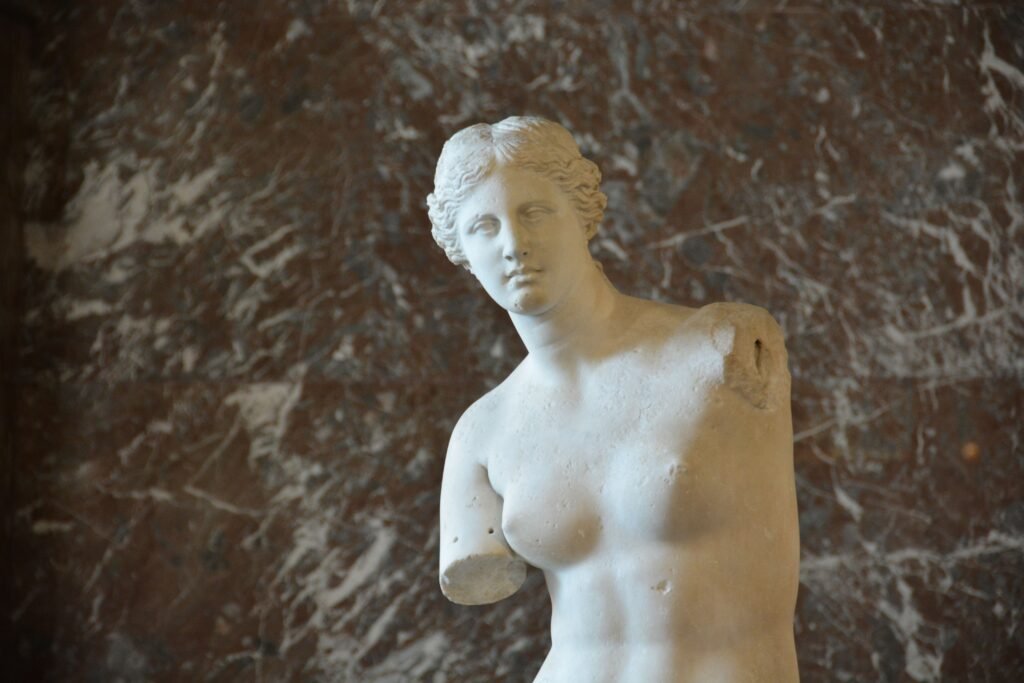
Roman sculpture frequently portrayed Venus in idealized nude or semi-nude forms, emphasizing physical beauty as a reflection of divine perfection, a tradition that directly influenced European art for centuries afterward. Renaissance artists, in particular, returned to Venus as a central subject, often blending Roman and Greek mythological elements without much concern for maintaining a strict distinction between the two traditions.
Sandro Botticelli’s famous painting, The Birth of Venus, exemplifies this blending, depicting Venus emerging from the sea in a scene mythologically rooted in Aphrodite’s own origin story rather than any distinctly Roman myth. Titian’s Venus of Urbino similarly draws on Roman ideals of beauty while echoing Greek mythological themes, demonstrating how thoroughly Venus and Aphrodite had merged in the artistic imagination long after antiquity had ended.
The Legacy of Venus Today
The Planet Venus
The planet Venus takes its name directly from the Roman goddess, chosen for its distinction as the brightest object in the night sky after the moon, a fitting tribute to a goddess associated with beauty and radiance. Ancient astronomers initially believed the planet’s appearance as a morning star and an evening star represented two separate celestial bodies, later identified as a single planet once observational astronomy advanced.
This naming convention reflects the enduring cultural weight of Roman mythology in shaping scientific and astronomical language, a legacy that Aphrodite, despite her equivalent status in Greek mythology, did not receive in the same direct way. The continued use of “Venus” for the planet keeps the goddess’s name active in modern scientific discourse, far removed from her original religious context.
Venus in Modern Pop Culture and Language
Venus remains a common reference point in modern language, art, and popular culture, often used as shorthand for beauty, romance, or desire without much attention to her specific mythological origins. Phrases, brand names, and artistic works continue to invoke Venus rather than Aphrodite, largely because Roman naming conventions became more deeply embedded in Western languages through Latin’s lasting influence on English and other European tongues.
This lingering presence explains why so many people search for Venus in the context of Greek mythology in the first place: the name feels universally tied to love and beauty, even though its true origin lies in Roman rather than Greek tradition. Recognizing this distinction allows for a more accurate appreciation of both mythologies, honoring Aphrodite’s original Greek identity while understanding how Venus developed her own distinct significance within Roman culture.
Conclusion
Venus is not a Greek goddess, but a Roman one, whose extensive connection to Greek mythology comes from Rome’s deliberate adoption and reinterpretation of Aphrodite’s identity, myths, and symbolism. This relationship explains why the two goddesses share so many traits while still representing separate figures within their respective mythological systems, each shaped by the distinct cultural and political needs of their civilizations.
Aphrodite remains the genuine goddess of love within Greek mythology, defined by her birth from the sea, her central role in the Judgment of Paris, and her involvement in the events leading to the Trojan War. Venus, meanwhile, developed her own uniquely Roman identity as an ancestral goddess linked to Aeneas, Rome’s founding, and the political legitimacy of figures like Julius Caesar, extending far beyond the more personal mythological role Aphrodite held in Greece.
Understanding this distinction enriches any exploration of ancient mythology, replacing a common misconception with a more precise picture of how Roman and Greek religious traditions intersected without ever becoming entirely identical. Venus and Aphrodite stand as two related but separate goddesses, each with a legacy that continues to shape art, language, and culture today.
For anyone drawn to the mythology of love and beauty, recognizing Venus as Roman and Aphrodite as her true Greek counterpart opens the door to a richer, more accurate understanding of both traditions, rather than a simplified merging of the two into a single, blurred mythological figure.

Orin Vale has spent the better part of two decades tracing the threads that connect the world’s oldest stories — from the halls of Asgard to the banks of the Nile, from Olympus to the jungles of the Maya. What began as a childhood fascination with flood myths and trickster gods grew into years of independent study across comparative mythology and ancient religion, always chasing the same question: what did these stories mean to the people who first told them? Orin writes for readers who want more than trivia — the ones looking for the beliefs, fears, and truths that myths were built to carry.