Anyone asking who is Nike in Greek mythology will find a consistent answer across ancient sources: Nike is the winged goddess of victory, a divine figure who accompanied triumph in every form it could take, from battlefield conquest to athletic achievement. Unlike many Olympian gods who ruled over broad, complex domains, Nike in Greek mythology represented something singular and immediate — the moment of winning itself. Understanding who is Nike in Greek mythology means recognizing her not as a distant, abstract force, but as a constant presence beside the most powerful gods, celebrated wherever victory was claimed.
Nike — The Greek Goddess of Victory
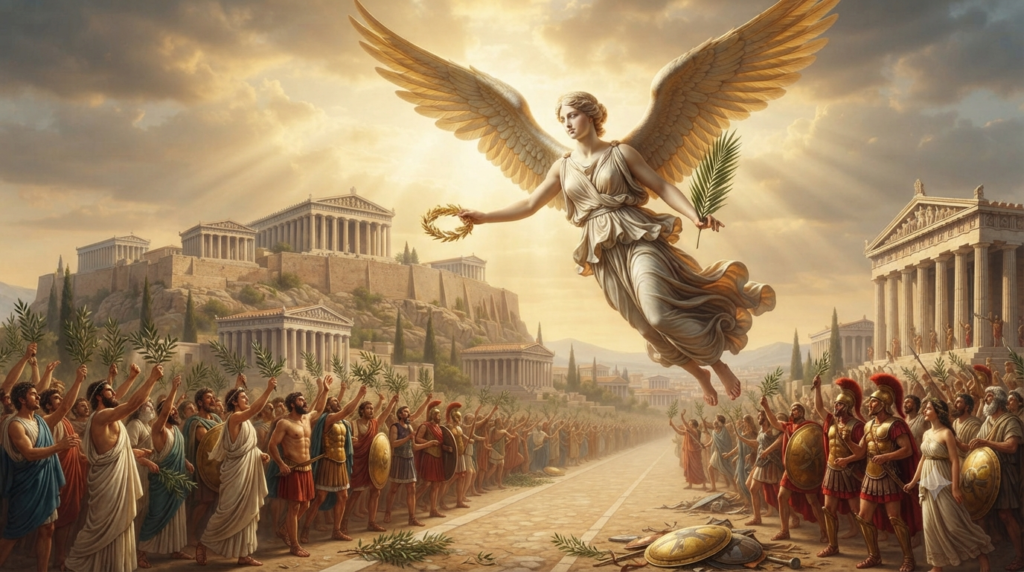
Nike occupied a distinctive position in Greek religion because she was not one of the twelve Olympians in the traditional sense, yet her importance rivaled theirs. As the Greek goddess of victory, Nike personified triumph in war, athletic competition, and any contest where one side ultimately prevailed. She was often depicted flying swiftly across battlefields and stadiums alike, delivering victory to whichever side the gods favored at that moment.
What made Nike in Greek mythology so significant was her close association with the most powerful figures on Olympus, particularly Zeus and Athena. Rather than ruling independently, Nike frequently appeared as an attendant or extension of their authority, reinforcing the idea that true victory required divine sanction. This relationship elevated her status considerably, positioning her as an essential companion to the ruling powers of the Greek pantheon.
Nike’s role also extended beyond warfare into the realm of Greek athletic competition, particularly the ancient Olympic Games. Victors in these contests were understood to have received Nike’s favor, and her image was frequently invoked, sculpted, or painted to commemorate athletic success. This dual presence in both military and athletic contexts made Nike in Greek mythology uniquely versatile compared to gods confined to a single domain.
Because Nike represented an outcome rather than a fixed territory like the sea or the harvest, her worship took a different shape than that of gods like Poseidon or Demeter. She was invoked in moments of decision — before a battle, during a competition, at the culmination of a conflict — making her presence felt at pivotal instances rather than through ongoing daily devotion. This made the Greek goddess of victory a figure of high stakes and high reverence whenever she appeared.
Origins and Family of Nike
Nike was the daughter of the Titan Pallas and the river goddess Styx, giving her origins that predate the rule of the Olympian gods entirely. This lineage connected Nike directly to the primordial forces of the Greek cosmos, as Styx in particular held enormous significance as the river by which even the gods swore their most binding oaths. Her parentage placed Nike in Greek mythology firmly within the older generation of divine powers, even though she would go on to serve the younger Olympian order.
Nike had three siblings born of the same union between Pallas and Styx: Cratos (Strength), Bia (Force), and Zelus (Zeal or Rivalry). Together, these four siblings formed a group of personified qualities essential to any conflict or contest — strength, force, rivalry, and victory itself. Ancient sources frequently paired Nike with her siblings as a unit, particularly Cratos and Bia, who appear together with her in several mythological accounts as enforcers of divine will.
The family’s most defining moment came during the Titanomachy, the great war between the Olympian gods led by Zeus and the elder Titans. Styx, recognizing the shifting balance of power, brought her four children to fight alongside Zeus rather than remain loyal to the Titans. This decision proved pivotal, as Nike and her siblings played a direct role in securing the Olympian victory, a fact that cemented Nike’s permanent alliance with Zeus and the new ruling order.
This origin story explains why Nike in Greek mythology carries such deep loyalty to Zeus specifically. Having fought alongside him during the defining conflict of the Greek cosmological order, Nike’s position as his close companion was not incidental but earned through direct participation in the war that established Olympian rule. Her family history is, in many ways, inseparable from the founding mythology of the Greek pantheon itself.
Symbols and Depictions of Nike
The most immediately recognizable symbol of Nike in Greek mythology is her set of wings, which allowed her to move swiftly between battles, competitions, and the halls of Olympus. Ancient artists consistently depicted her in flight, often captured mid-motion with wings spread wide, reinforcing her role as a goddess who arrived suddenly at the decisive moment of victory rather than lingering as a passive presence.
Nike was also closely associated with the laurel wreath and the palm branch, both of which became lasting symbols of triumph in Greek and later Western culture. Victors in athletic competitions and military campaigns were crowned with laurel wreaths specifically because of their connection to Nike, a tradition that persisted well beyond antiquity and continues to influence modern symbols of achievement and success.
Among the most celebrated depictions of Nike in ancient art is the Nike of Samothrace, a monumental sculpture that captures the goddess in dramatic flight, her wings and drapery rendered with extraordinary dynamism. Though created centuries after the earliest myths involving Nike, this sculpture remains one of the most powerful visual representations of the Greek goddess of victory, illustrating how enduring her symbolic power became across Greek history.
Nike was also frequently depicted alongside Athena, sometimes appearing as a small winged figure held in Athena’s outstretched hand, as seen in representations of the Athena Parthenos. This particular pairing, often referred to as Nike Athena, reinforced the idea that wisdom and strategy — Athena’s domains — were the forces that ultimately called victory into being, with Nike serving as the tangible outcome of Athena’s guidance.
Nike’s Role Among the Gods
Nike’s alliance with Zeus during the Titanomachy secured her a permanent and trusted position within the Olympian order, distinguishing her from deities who had to earn their standing through other means. Because she fought directly alongside Zeus at the moment his rule was established, Nike in Greek mythology carried an authority tied specifically to the legitimacy of Olympian power, making her presence a symbol of rightful, sanctioned victory rather than chaotic or contested triumph.
Her relationship with Athena further defined her role among the gods, particularly in Athens, where the two were worshipped in close connection. The Temple of Athena Nike, built on the Acropolis, reflects this pairing directly, presenting Athena in her aspect as a bringer of victory. This connection reinforced the idea that Nike rarely acted independently, instead lending her power to the gods most associated with wisdom, strategy, and rightful rule.
Unlike gods such as Ares, whose domain of war carried connotations of chaos and brutality, Nike represented the clean, decisive outcome of conflict rather than the conflict itself. This distinction mattered greatly in Greek religious thought: while other deities might preside over the struggle, Nike arrived specifically at its conclusion, embodying resolution rather than ongoing violence. Her role, therefore, carried a more universally positive reputation than many gods associated with warfare.
Nike’s position among the gods also extended into more abstract territory, as the Greeks did not always worship her as a fully independent deity with her own cult and priesthood in every city. In many contexts, victory itself — Nike as a concept — blurred with Nike as a goddess, reflecting how deeply the personification and the abstract idea had merged in Greek religious understanding. This dual nature made her simultaneously a specific mythological figure and a broader symbol invoked whenever triumph was at stake.
Key Myths and Appearances of Nike
The defining myth involving Nike centers on the Titanomachy, where she fought alongside Zeus, Cratos, Bia, and Zelus against the Titans. This war represents the most significant appearance of Nike in Greek mythology, as her participation directly shaped the outcome that established Olympian rule over the cosmos. Ancient sources treat this conflict as the foundation of her enduring alliance with Zeus and her permanent role as a bringer of sanctioned victory.
Beyond this foundational myth, Nike appears repeatedly in connection with the ancient Olympic Games, where her favor was credited for every athletic victory. Sculptures and offerings dedicated to Nike were common at sites like Olympia, where athletes and their communities sought her blessing before competition and offered thanks after triumph. This athletic association gave Nike in Greek mythology a presence in everyday civic and religious life that extended well beyond the battlefield.
Nike’s imagery also played a prominent role in commemorative monuments following military victories, with cities erecting statues and reliefs of the winged goddess to mark successful campaigns. The Nike of Samothrace, though created later in Greek history, exemplifies this tradition, having been commissioned to celebrate a naval victory. Such monuments show how thoroughly Nike’s mythology intertwined with the historical reality of Greek military and civic life.
In addition to her appearances in war and athletics, Nike is referenced in various hymns and poetic works praising victorious rulers, athletes, and city-states. These references often invoke her directly, asking for her continued favor or thanking her for triumphs already achieved. Through this pattern, Nike in Greek mythology functioned as a living, invoked presence rather than a distant figure confined to a single ancient narrative.
Nike vs. Victoria — Greek vs. Roman Goddess of Victory
When Roman culture absorbed and adapted Greek mythology, Nike found her direct counterpart in Victoria, the Roman goddess of victory. Much like her Greek predecessor, Victoria was depicted with wings, associated with laurel wreaths, and invoked at moments of military and civic triumph. This continuity demonstrates how central the concept of a winged victory goddess remained across both cultures, even as religious and political contexts shifted.
Victoria, however, took on an even more prominent civic role in Rome than Nike typically held in Greece. Roman emperors frequently associated themselves directly with Victoria, using her imagery on coins, monuments, and military standards to reinforce their legitimacy and success in conquest. This level of direct political appropriation exceeded the way Nike in Greek mythology was typically used, reflecting Rome’s more centralized and image-conscious approach to political power.
Despite these differences in cultural emphasis, the core identity of the goddess remained remarkably stable in the transition from Nike to Victoria. Both figures represented the same essential concept: victory as a divine gift, delivered by a winged messenger rather than claimed purely through mortal effort. This consistency highlights how deeply embedded the idea of Nike in Greek mythology became within the broader Greco-Roman religious tradition.
The comparison between Nike and Victoria also illustrates a broader pattern in how Rome adapted Greek deities to fit its own political needs. While Greece treated Nike largely as a companion to more prominent gods like Zeus and Athena, Rome elevated Victoria into a more independent and politically charged symbol. This shift underscores just how flexible mythological figures could become as they moved between cultures while retaining their fundamental meaning.
Why Nike Matters in Greek Mythology Today
Modern fascination with Nike in Greek mythology persists largely because the concept she represents — victory itself — remains universally relevant. Unlike deities whose domains feel distant from contemporary life, the idea of triumph, achievement, and success continues to resonate directly with modern audiences, keeping Nike’s mythology accessible and meaningful centuries after her original worship.
Nike’s visual legacy also continues to shape modern symbols of achievement, particularly through the enduring popularity of the laurel wreath as an emblem of victory in everything from academic honors to sporting events. This visual continuity demonstrates how thoroughly Nike’s iconography embedded itself into Western culture, far outlasting the specific religious practices of ancient Greece.
Perhaps most notably, Nike’s name and imagery inspired the branding of one of the most recognizable athletic companies in the modern world, a connection that has introduced her name to millions who may know little else about Greek mythology. This modern association, while commercial in nature, has nonetheless kept the question of who is Nike in Greek mythology alive in popular curiosity, prompting many to look deeper into her ancient origins.
Ultimately, Nike matters in Greek mythology today because she represents a rare mythological figure whose meaning translated cleanly across centuries without significant reinterpretation. Where many gods required cultural context to understand fully, Nike’s core identity — the arrival of victory — remains immediately intuitive, making her one of the more accessible figures for modern audiences exploring Greek mythology for the first time.
FAQ — Quick Answers About Nike in Greek Mythology
Who is Nike in Greek mythology?
Nike is the winged goddess of victory in Greek mythology, representing triumph in war, athletic competition, and any contest with a decisive outcome.
Who are Nike’s parents?
Nike is the daughter of the Titan Pallas and the river goddess Styx, giving her origins among the elder generation of Greek divine powers.
Is Nike an Olympian god?
Nike is not typically counted among the twelve Olympians, but she held a position of great importance as a close companion to Zeus and Athena.
What is the Roman equivalent of Nike?
The Roman equivalent of Nike is Victoria, a goddess who shared the same core identity but held an even more prominent civic and political role in Rome.
Why is Nike often shown with Athena?
Nike is frequently depicted alongside Athena, sometimes held in her hand, symbolizing that victory follows from Athena’s wisdom and strategic guidance.
Conclusion
Anyone who sets out to answer who is Nike in Greek mythology arrives at a goddess defined by motion, loyalty, and consequence — the daughter of Pallas and Styx who chose the winning side during the Titanomachy and never left it. Her wings, laurel wreath, and constant presence beside Zeus and Athena reflect a mythology built not around a fixed territory, but around the single, decisive moment when victory is claimed.
Nike’s story also reveals how the Greeks understood triumph itself: not as something mortals achieved alone, but as a gift delivered by a divine messenger acting on behalf of the gods who upheld the rightful order. Her contrast with Ares, the chaotic god of war, and her continuity into Rome’s Victoria further show how deliberately the Greeks separated the disorder of conflict from the clean resolution of victory.
Centuries later, Nike’s legacy endures far beyond her original myths, shaping everything from academic laurels to global branding. Few figures in Greek mythology carry a legacy so immediately recognizable, which is precisely why the question of who is Nike in Greek mythology continues to draw curiosity from anyone encountering her name for the first time.

Orin Vale has spent the better part of two decades tracing the threads that connect the world’s oldest stories — from the halls of Asgard to the banks of the Nile, from Olympus to the jungles of the Maya. What began as a childhood fascination with flood myths and trickster gods grew into years of independent study across comparative mythology and ancient religion, always chasing the same question: what did these stories mean to the people who first told them? Orin writes for readers who want more than trivia — the ones looking for the beliefs, fears, and truths that myths were built to carry.