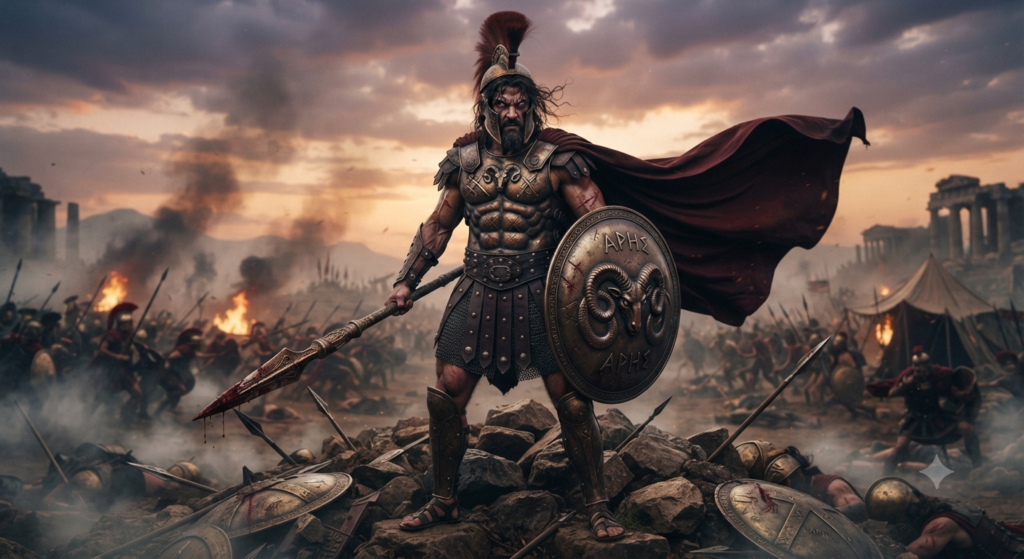
Anyone asking who is the god of war in Greek mythology will find the same answer across every ancient source: Ares. As the Greek god of war, Ares embodied the raw, chaotic, and often brutal side of armed conflict, standing in stark contrast to the disciplined, strategic warfare represented elsewhere in the Greek pantheon. Understanding who is the god of war in Greek mythology means understanding a deity who was feared more than he was loved, respected for his power but rarely admired for his character. Ares occupied a unique and uncomfortable place among the Olympians — essential to the mechanics of war, yet consistently portrayed as reckless, bloodthirsty, and unwelcome company at Olympus.
Ares — The Greek God of War
Ares was one of the twelve Olympian gods, ruling specifically over war, bloodlust, and the violent chaos of battle. Unlike some deities whose domains overlapped with civic order or wisdom, Ares represented war in its rawest form: the clash of armies, the shedding of blood, and the frenzy that accompanies combat when strategy gives way to instinct. This is precisely why so many people searching to understand who is the god of war in Greek mythology are surprised to learn that Ares was not universally celebrated for this role — quite the opposite.
The Greek god of war held a complicated position among the Olympians because his domain sat at odds with the values the Greeks associated with civilization. War, to the ancient Greeks, was sometimes necessary but rarely glorified for its own sake. Ares personified the aspect of war that served no higher purpose — destruction without discipline. This distinguishes him sharply from Athena, who also governed aspects of warfare but represented strategy, justice, and calculated defense rather than chaos.
The contrast between Ares and Athena is central to understanding the Greek god of war as a mythological figure. Athena was consistently portrayed as wise and victorious, while Ares was associated with recklessness and, on more than one occasion, outright defeat. Ancient sources frequently depict Athena besting Ares in direct confrontation, reinforcing the idea that thoughtful strategy triumphed over brute aggression in the Greek moral imagination.
Despite his unpopularity among the gods, Ares remained an indispensable figure in Greek mythology. Wars needed a god to preside over them, and Ares filled that role completely, appearing in myths, hymns, and depictions throughout the ancient Greek world. His presence in the pantheon reminds us that the Greeks did not shy away from acknowledging the darker, uncontrollable aspects of human experience — they simply assigned those qualities to a god they were not obligated to love.
Origins and Family of Ares
Ares was the son of Zeus, king of the gods, and Hera, queen of Olympus, making him a legitimate and high-ranking member of the Olympian family from birth. This parentage placed Ares firmly within the innermost circle of Greek divinity, yet his standing among the other gods rarely matched the prestige of his lineage. Even Zeus, according to ancient sources, expressed open disdain for his son’s love of violence, reportedly declaring Ares the most hateful of all his children precisely because of his affinity for strife and bloodshed.
As the son of Zeus and Hera, Ares had several notable siblings within the Olympian family, including Hebe and Eileithyia. However, it was his relationships with the wider network of gods — rather than his direct siblings — that defined much of his mythological presence. His connection to Aphrodite, the goddess of love, became one of the most significant relationships in his story, producing consequences that echoed through multiple myths.
Ares fathered several children who became mythological figures in their own right. With Aphrodite, he had Phobos (Fear) and Deimos (Dread), twin gods who accompanied their father into battle as literal personifications of the terror war inflicts. He also fathered Harmonia, goddess of harmony, an outcome many ancient audiences found ironic given that harmony emerged from the union of the god of war and the goddess of love. This paradox was not lost on Greek storytellers, who often used Harmonia’s birth to comment on the strange balance between conflict and unity.
The family of Ares, then, illustrates a broader truth about how the Greeks understood the god of war: he was neither isolated nor purely destructive in his mythology. His bloodline connected him to fear and dread, yes, but also — improbably — to harmony itself, suggesting that even the ancient Greeks recognized war’s complicated relationship with peace.
Symbols and Depictions of Ares
Visual representations of Ares in ancient Greek art relied on a consistent set of symbols that reinforced his identity as the god of war. He was typically depicted armed with a spear and wearing a helmet, standing ready for combat rather than seated in repose like many other Olympians. This martial posture distinguished Ares immediately in any depiction, signaling his domain before any inscription or context was needed.
The vulture and the dog were closely associated with Ares, both animals linked to the aftermath of battle. Vultures, scavengers drawn to the fallen on a battlefield, served as a grim but fitting emblem of the destruction Ares presided over. Dogs, meanwhile, were associated with him in both sacrificial practices and as companions befitting a god who thrived amid violence and chaos.
In ancient Greek pottery and sculpture, Ares was rarely portrayed with the serene, composed expressions given to gods like Apollo or Artemis. Instead, artists emphasized tension, readiness, and aggression in his form, often capturing him mid-motion or poised for confrontation. This artistic choice reflected the broader cultural understanding of Ares as a volatile presence rather than a stabilizing one.
Temples dedicated to Ares were notably rare compared to those honoring other major Olympians, a detail that speaks volumes about his standing in everyday religious life. While cities certainly invoked Ares before going to war, they did not build the same widespread devotional infrastructure around him that existed for gods associated with protection, wisdom, or prosperity. His symbols and depictions, therefore, tell the story of a deity respected for necessity rather than beloved for virtue.
Ares’ Role and Reputation Among the Gods
Few figures in Greek mythology carried a reputation as consistently negative as Ares did among his fellow deities. Homer’s writings, among the most influential sources on Greek religion, describe Ares as detestable even to his own father, Zeus. This is a striking detail: rather than portraying divine favoritism toward a son who governed something as significant as war, Greek mythology emphasized Zeus’s discomfort with Ares’ insatiable appetite for violence.
The rivalry between Ares and Athena stands as one of the clearest illustrations of his reputation. Athena, who also held authority over aspects of warfare, consistently outmaneuvered and outfought Ares in mythological accounts. In the Iliad, Athena wounds Ares directly during the Trojan War, a moment that ancient audiences would have understood as a clear statement: wisdom and strategy surpass brute force and recklessness, even within the god of war’s own domain.
Ares’ affair with Aphrodite added another layer to his complicated standing among the gods. Aphrodite was married to Hephaestus, the god of the forge, yet she and Ares carried on a well-known relationship that ancient sources treat with a mixture of scandal and dark humor. When Hephaestus discovered the affair, he famously trapped the couple in an unbreakable net, exposing them before the assembled gods — a humiliation that became one of the more memorable episodes involving Ares in Greek mythology.
This pattern of humiliation, rivalry, and open disdain reveals something important about how the Greeks conceived of their god of war. Ares was never framed as a heroic or admirable figure, even though his domain was essential to the world the Greeks inhabited. His reputation reflects a broader cultural instinct: war was a grim necessity, and the god who represented it most purely was treated with suspicion rather than reverence.
Key Myths Featuring Ares
Ares appears prominently in the Iliad, Homer’s account of the Trojan War, where he fights on behalf of the Trojans against the Greek forces favored by Athena and Hera. His involvement in the war is marked by volatility rather than triumph; he switches allegiances, suffers injury at the hands of mortal heroes aided by the gods, and is ultimately shown as inferior in skill to Athena. This portrayal cemented his image as a god whose power did not translate into consistent victory.
One of the most striking myths involving Ares describes his confrontation with Heracles, the legendary hero known for his superhuman strength and endurance. In several accounts, Ares seeks vengeance after Heracles kills one of his sons, leading to a direct clash between the god of war and one of Greek mythology’s greatest mortal champions. These confrontations frequently end with Ares wounded or driven off, reinforcing a recurring theme: even demigods and heroes could match or overpower the god of war under the right circumstances.
Beyond his battlefield appearances, Ares features in myths that explore his personal relationships and vulnerabilities. The story of his affair with Aphrodite and subsequent public exposure by Hephaestus is retold across multiple ancient sources, each version emphasizing the comedic and cautionary elements of divine scandal. These myths humanized Ares in an unflattering way, showing that even a god of immense martial power could be outwitted through cunning rather than force.
Ares also appears in regional myths and local traditions throughout the ancient Greek world, particularly in areas with strong martial cultures, such as Thrace and Sparta. In these contexts, Ares was sometimes treated with greater reverence, reflecting local values that placed higher esteem on martial prowess. This regional variation shows that while Panhellenic sources like Homer emphasized Ares’ flaws, his worship and cultural meaning were not uniform across the ancient Greek world.
Ares vs. Mars — Greek vs. Roman God of War
While Ares represents the god of war in Greek mythology, his Roman counterpart, Mars, occupied a strikingly different position within Roman religion and culture. Both deities governed the domain of war, yet the reverence afforded to each could not have been more different. Understanding this contrast helps clarify exactly who is the god of war in Greek mythology by comparison to the culture that borrowed and reshaped his mythology.
In Rome, Mars was regarded as one of the most important gods in the entire pantheon, second in significance only to Jupiter. Mars was closely tied to Roman identity itself, credited as the father of Romulus and Remus, the legendary founders of Rome. This connection meant that Mars was not merely tolerated as a necessary evil but actively honored as a symbol of Roman strength, discipline, and national origin.
Ares, by contrast, never achieved this level of civic importance in Greece. Greek city-states did not trace their founding myths to Ares, nor did they build their national identity around his character in the way Rome did with Mars. This fundamental difference reflects the distinct values of the two civilizations: Rome, an expansionist military power, elevated its war god to near-supreme status, while Greece, with its emphasis on philosophy, strategy, and civic wisdom, kept its god of war at a deliberate distance.
The transformation from Ares to Mars illustrates how mythology adapts to the needs of the culture that adopts it. The core domain — war — remained consistent, but the surrounding narrative, reputation, and reverence shifted dramatically. This comparison remains one of the clearest ways to understand why the Greek god of war held such an ambivalent position, especially when placed side by side with his far more celebrated Roman counterpart.
Why Ares Matters in Greek Mythology Today
Modern interest in Greek mythology continues to bring fresh attention to Ares, even though his reputation among the ancient gods was far from favorable. Contemporary literature, art, and storytelling frequently revisit Ares as a symbol of unchecked aggression, using his mythology to explore themes of violence, consequence, and the cost of glorifying conflict without restraint. This enduring relevance is precisely why so many readers continue to ask who is the god of war in Greek mythology, seeking to understand a figure whose flaws are as instructive as his powers.
Ares also serves as a valuable counterpoint within broader mythological studies, offering a clear contrast to gods associated with wisdom, order, and strategic thought. By examining why the Greeks distinguished so sharply between Ares and Athena, modern audiences gain insight into how ancient societies distinguished between different kinds of power — brute force versus calculated strength, chaos versus discipline.
The mythology surrounding Ares also offers a window into how the ancient Greeks processed the reality of war itself. Rather than presenting war as universally glorious, Greek storytelling used Ares to acknowledge its ugliness, its unpredictability, and its capacity to bring shame rather than honor. This nuanced treatment remains strikingly relevant to modern discussions about conflict and its human costs.
Finally, Ares’ complicated legacy demonstrates the depth and sophistication of Greek mythology as a whole. Few pantheons feature a war god so consistently criticized within his own stories, and this willingness to portray Ares unfavorably reflects a broader cultural confidence — a society secure enough in its values to depict even its gods as flawed. For anyone exploring Greek mythology today, Ares remains an essential figure precisely because his story is anything but simple.
FAQ — Quick Answers About the Greek God of War
Who is the god of war in Greek mythology?
Ares is the god of war in Greek mythology, ruling over the violence, bloodlust, and chaos of armed conflict as one of the twelve Olympian gods.
Is Ares the same as Mars?
Ares is the Greek god of war, while Mars is his Roman counterpart. Although they share the same domain, Mars held a far more honored position in Roman culture than Ares did in Greece.
Why did the other gods dislike Ares?
Ares was disliked, even by his father Zeus, because of his reckless love of violence and bloodshed, which contrasted with the strategic, disciplined warfare represented by gods like Athena.
Who were the children of Ares?
Ares fathered Phobos and Deimos with Aphrodite, along with Harmonia, the goddess of harmony, creating a family lineage that paradoxically connected fear, dread, and unity.
Did Ares ever lose in battle?
Yes. Ares was wounded by Athena during the Trojan War in the Iliad and was also overpowered in confrontations with mortal heroes such as Heracles, reinforcing his reputation as powerful but not invincible.
Conclusion
Anyone who sets out to answer who is the god of war in Greek mythology arrives at the same figure: Ares, son of Zeus and Hera, ruler of bloodshed, chaos, and the violent instinct that accompanies armed conflict. His story is defined less by triumph and more by tension — tension with his father, rivalry with Athena, humiliation through his affair with Aphrodite, and repeated defeat at the hands of mortal heroes like Heracles. Rather than diminishing his importance, these details give the Greek god of war a complexity that few other Olympians share.
Ares’ symbols, from the spear and helmet to the vulture and dog, reinforced his identity as a deity bound entirely to combat, while his comparison to the Roman god Mars highlights just how differently two closely related cultures could treat the same domain. Where Rome elevated its war god to near-supreme status, Greece kept Ares at arm’s length, using his myths to critique rather than celebrate unchecked violence.
Ultimately, the enduring fascination with Ares lies in what he represents: a god the Greeks needed but never fully embraced. His mythology offers a lasting lesson about the difference between strength used with purpose and strength that exists for its own sake — a distinction as relevant to modern readers as it was to the ancient audiences who first told his story.

Orin Vale has spent the better part of two decades tracing the threads that connect the world’s oldest stories — from the halls of Asgard to the banks of the Nile, from Olympus to the jungles of the Maya. What began as a childhood fascination with flood myths and trickster gods grew into years of independent study across comparative mythology and ancient religion, always chasing the same question: what did these stories mean to the people who first told them? Orin writes for readers who want more than trivia — the ones looking for the beliefs, fears, and truths that myths were built to carry.