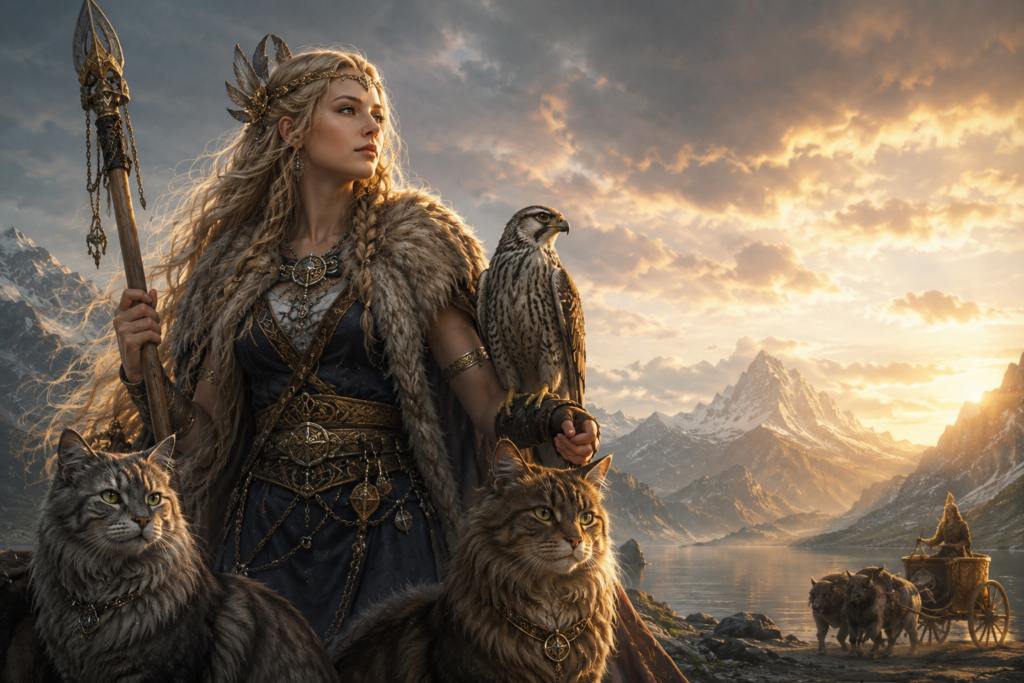
To understand who Freya was in Norse mythology is to understand one of the most complex and revered figures in the entire Norse pantheon. Freya was not a minor deity confined to a single domain; she was the goddess of love and beauty, yet also a formidable figure of war, death, and magic. Her presence spans the Poetic Edda and the Prose Edda, two of the primary sources through which Norse mythology has survived into the modern age. Unlike many goddesses in ancient pantheons who occupy a narrow role, Freya’s authority stretched across life, death, desire, and destiny, making her one of the most multifaceted figures the Vikings worshipped.
Her name alone, often rendered as Freyja in Old Norse, translates roughly to “Lady,” a title related to words still used today in Scandinavian and Germanic languages for a woman of rank. This elevated title befits her standing among both the Aesir and the Vanir, the two families of gods that populate Norse cosmology. Freya’s story is inseparable from the larger narrative of the Aesir-Vanir War, the founding conflict that shaped the structure of Asgard itself.
The Poetic Edda and Prose Edda, composed in medieval Iceland but drawing on much older oral traditions, remain the primary written sources for nearly everything known about Freya today. These texts were recorded centuries after the Viking Age itself, often by Christian scholars looking back on a fading pagan past, which means modern accounts of Freya rely on careful synthesis of sources that do not always agree with one another. Even with these limitations, the picture that emerges is remarkably consistent: a goddess of extraordinary range, power, and independence.
To answer who Freya was in Norse mythology fully, one must trace her lineage, her powers, her symbols, and the tales that made her a central figure of the Viking worldview. Few other deities in the Norse pantheon touch as many aspects of daily and spiritual life, from the harvest in the fields to the outcome of battle to the fate of the soul after death.
Who Was Freya? A Quick Overview
Freya was the Norse goddess most closely associated with love, beauty, fertility, war, and death, a combination that reflects the practical worldview of the Viking Age far better than a simple deity of romance would. She belonged to the Vanir, a tribe of gods connected to nature, prosperity, and fertility, distinct from the Aesir, the more war-focused family that included Odin and Thor. Her dual nature as both a goddess of love and a goddess of war made her uniquely suited to a culture that saw passion and conflict as two sides of the same coin.
In the surviving Norse texts, Freya commands respect not through submission but through independence. She traveled the nine realms searching for her missing husband, Óðr, wept tears of gold in his absence, and took multiple lovers without moral judgment from the sources that recorded her myths. This portrayal set her apart from many other ancient goddesses, whose narratives are often defined primarily in relation to a male counterpart. Freya’s independence, magical knowledge, and battlefield authority made her one of the most fully realized characters in the entire Norse mythology corpus.
Freya’s association with war placed her above even the Valkyries in some respects. According to the Prose Edda, she received half of those who died in battle, taking them to her hall Folkvangr, while Odin received the other half in Valhalla. This detail alone demonstrates that Freya’s role in Norse cosmology extended far beyond love and beauty into the very structure of the afterlife reserved for warriors. Her overview, therefore, cannot be reduced to a single label; she was a goddess whose authority touched nearly every aspect of Norse spiritual life.
Modern readers approaching Norse mythology for the first time often expect a goddess of love to resemble Aphrodite or Venus, figures largely defined by romantic and physical beauty. Freya defies that expectation. She is a goddess of contradictions held in balance: tender and fierce, beautiful and battle-hardened, associated with fertility yet deeply connected to death. This complexity is precisely what has kept Freya relevant across centuries of retelling, scholarship, and popular culture.
Freya’s Origins: Daughter of Njord and the Vanir Gods
Freya’s origins trace back to the Vanir, one of the two principal families of gods in Norse mythology, alongside the Aesir. She was the daughter of Njord, the Vanir god of the sea, wind, and wealth, which linked her from birth to prosperity, fertility, and the natural world. Her brother, Freyr, shared many of these same fertility associations, and the two siblings are frequently mentioned together in the surviving Norse sources as central figures of Vanir religion and worship.
The Vanir and the Aesir were not always allies. Norse mythology describes a prolonged conflict known as the Aesir-Vanir War, a struggle between the two divine families that nearly tore the cosmos apart. The war ended not through conquest but through an exchange of hostages meant to secure peace, and it was through this exchange that Freya, along with her father Njord and her brother Freyr, came to live among the Aesir in Asgard. This origin story matters because it explains why Freya, though fundamentally Vanir in nature, is so deeply embedded in Aesir mythology and often treated as a member of Odin’s court.
This transition from Vanir outsider to trusted member of Asgard also explains much of Freya’s dual character. She retained her Vanir associations with fertility, prosperity, and nature-based magic, while simultaneously absorbing the martial, political culture of the Aesir. Few other figures in Norse mythology embody this fusion of the two divine families as completely as Freya does. Her presence in Asgard was not merely tolerated; she became one of its most powerful and respected members.
Some scholars of Norse mythology have argued that Freya’s incorporation into Aesir mythology reflects a broader historical process, in which older fertility-based religious practices among Scandinavian peoples were gradually merged with the war-centered Aesir cults that came to dominate later Viking Age society. Whether or not this theory holds, the mythology itself preserves the memory of that merger in Freya’s very identity: a goddess born of the Vanir, raised into the halls of the Aesir, and never fully reducible to either tradition alone.
What Was Freya the Goddess Of?
Freya’s domains are broader than almost any other deity in the Norse pantheon, spanning love, beauty, fertility, war, death, wealth, and magic. Unlike gods confined to a single function, Freya’s authority touches nearly every major concern of Viking Age life. Her connection to love and beauty is the most commonly cited aspect of her mythology, yet it represents only one dimension of a far more complex figure whose influence extended into matters of survival, prosperity, and the afterlife itself.
As a fertility goddess inherited from her Vanir lineage, Freya was invoked in matters of crops, childbirth, and the prosperity of the land, echoing her father Njord’s own associations with wealth and abundance. This fertility role connected her directly to the everyday concerns of Norse farming communities, for whom successful harvests and healthy offspring were matters of survival rather than mere sentiment. Freya’s blessing was sought not only in matters of the heart but in the material conditions that sustained Viking society.
Freya’s role as a war goddess is equally significant and often underappreciated in popular retellings. She rode into battle, claimed half of the slain warriors for her hall of Folkvangr, and was associated with the practice of shape-shifting into a falcon using her feathered cloak, a skill she was said to have lent to other gods, including Loki. Her martial character was not incidental; it placed her alongside Odin as one of the primary deities overseeing the fate of warriors who died in combat, a role of enormous religious significance in a warrior culture like that of the Vikings.
Wealth and material prosperity round out Freya’s portfolio, tying her once again to her Vanir origins. She was closely associated with gold, famously said to weep tears of gold in longing for her absent husband, and her most iconic possession, the necklace Brísingamen, symbolizes this connection between beauty, wealth, and divine favor. This combination of love, war, wealth, fertility, and magic made Freya one of the most invoked deities in everyday Norse religious practice, relevant to nearly every major concern a Viking Age person might have.
Freya and Seidr: The Goddess of Norse Magic
Among Freya’s most distinctive attributes was her mastery of seidr, a form of Norse magic associated with prophecy, fate, and the manipulation of destiny itself. According to Norse mythological sources, Freya was the one who first taught this practice to the Aesir, including Odin himself, establishing her as the ultimate source of magical knowledge in the Norse cosmological system. This detail elevates Freya beyond a simple goddess of love into a figure of profound spiritual authority.
Seidr practitioners, often women known as völvur, were believed to enter trance states in order to perceive and even alter the threads of fate. Freya’s association with this practice connected her to the Norns, the fate-weaving beings of Norse cosmology, and positioned her as a goddess deeply concerned with destiny, prophecy, and the hidden forces shaping human and divine lives alike. Her magical authority was taken seriously within the religious framework of the Viking Age, not treated as a minor or decorative trait.
The transmission of seidr from Freya to Odin is itself a significant mythological event, illustrating the flow of knowledge between the Vanir and the Aesir following their war and reconciliation. It suggests that even Odin, the chief god of the Aesir and himself deeply associated with wisdom and prophecy, depended on Vanir knowledge, specifically Freya’s knowledge, to access some of his most powerful abilities. This detail reinforces Freya’s standing as a goddess whose influence reached the very top of the Norse divine hierarchy.
Freya’s connection to seidr also ties her to broader Norse beliefs about fate, transformation, and the boundary between life and death. Her magical practice was not separate from her roles in love, war, and the afterlife; rather, it unified them, since seidr was often used to influence outcomes in battle, love, and fortune alike. Understanding Freya as a goddess of magic is therefore essential to understanding her full mythological identity.
Freya’s Symbols and Sacred Objects
Freya’s most famous possession was the necklace Brísingamen, a piece of jewelry so central to her identity that entire myths were constructed around its acquisition and theft. According to Norse mythological accounts, Freya obtained the necklace from four dwarven smiths, and its beauty was said to rival anything else in the nine realms. Brísingamen was not merely decorative; it symbolized Freya’s connection to wealth, craftsmanship, and divine favor, and its theft by Loki in at least one surviving tale demonstrates just how coveted and significant the object was considered to be.
Freya’s cloak of falcon feathers represents another crucial symbol tied to her mythology, granting the wearer the ability to transform into a falcon and travel swiftly between the nine realms. This object was so valuable that other gods, including Loki, borrowed it for their own purposes, further cementing Freya’s role as a source of magical resources within the Norse pantheon. The falcon cloak reflects Freya’s broader association with transformation, mobility, and the boundary-crossing nature of her magical abilities.
Freya’s chariot, famously pulled by two cats, stands as one of the most recognizable images associated with her in Norse mythology. Cats held particular significance in Norse belief, often associated with fertility and domestic prosperity, reinforcing Freya’s connection to the Vanir’s agricultural and household concerns. The image of Freya traveling by cat-drawn chariot has become one of the most enduring visual symbols of her mythology, appearing repeatedly in later artistic interpretations of the Norse pantheon.
Finally, Freya was closely associated with the boar Hildisvíni, a creature linked to protection and fertility within Norse religious symbolism. Boars held sacred status across several Germanic and Norse traditions, often connected to both war and agricultural abundance, mirroring Freya’s own dual nature as a goddess of both battle and fertility. Together, these symbols, Brísingamen, the falcon cloak, the cat-drawn chariot, and the boar Hildisvíni, form a coherent visual and symbolic language through which Viking Age worshippers understood Freya’s complex divine identity.
Freya and Folkvangr: Her Role in the Afterlife
Folkvangr, meaning “field of the host” or “people’s field,” was Freya’s hall in Asgard and one of the two primary destinations for warriors who died in battle, the other being Odin’s Valhalla. According to the Prose Edda, Freya received half of all those slain in combat, choosing among the dead before Odin claimed the remainder. This division of the slain between Freya and Odin represents one of the clearest indications of Freya’s standing as a major deity of war and death, not merely a secondary goddess of romance.
The existence of Folkvangr as a distinct destination for the honored dead raises important questions about Norse beliefs regarding gender, warfare, and the afterlife. Some scholars of Norse mythology have suggested that Folkvangr may have been particularly associated with fallen warrior women, though the surviving sources are not entirely explicit on this point. What remains clear is that Freya’s authority over a portion of the slain placed her in a category of religious importance matched by very few other figures in the Norse pantheon.
Freya’s role in the afterlife also connects to her broader association with fate and destiny through seidr magic. As a goddess capable of perceiving and influencing outcomes, her authority over the fate of fallen warriors extended naturally from her magical practice into her religious function as a guide and claimant of the dead. This connection between magic, fate, and death further illustrates how deeply interconnected Freya’s various mythological roles truly were.
The image of Freya choosing among the fallen on the battlefield, much like the Valkyries who served Odin, reinforces her standing as a goddess actively engaged with the realities of Viking Age warfare. She was not a distant, passive figure of love waiting in Asgard; she was present, in mythological terms, at the moment of a warrior’s death, exercising direct authority over who would join her in Folkvangr. This active, battlefield-adjacent role remains one of the most significant yet underdiscussed aspects of Freya’s mythology.
Freya vs. Frigg: Are They the Same Goddess?
One of the most persistent points of confusion in Norse mythology concerns the relationship between Freya and Frigg, two goddesses whose names, roles, and associations overlap enough to have caused genuine debate among scholars. Frigg was Odin’s wife, the queen of Asgard, associated primarily with marriage, motherhood, and domestic foresight, while Freya was the Vanir goddess of love, war, and magic discussed throughout this article. Despite their distinct origins, several elements of their mythology bear striking similarities, fueling the theory that they may represent a single deity split into two figures over time.
Both goddesses, for instance, are associated with falcon cloaks, both are connected to prophecy and hidden knowledge, and both hold positions of considerable authority within Asgard. Some scholars of Norse mythology, drawing on linguistic and comparative religious analysis, have proposed that Frigg and Freya may descend from a common earlier goddess figure in Proto-Germanic religion, later divided into two distinct deities as Norse mythology developed across different regions and time periods. This theory remains debated rather than settled within academic circles.
Despite these similarities, the surviving Norse sources treat Freya and Frigg as clearly separate individuals with distinct genealogies, husbands, and mythological narratives. Frigg’s story centers on her marriage to Odin and her tragic foreknowledge of Baldur’s death, a tale absent from Freya’s own mythology. Freya, by contrast, is defined by her Vanir origins, her missing husband Óðr, her command over Folkvangr, and her mastery of seidr magic, a set of associations that Frigg does not share in the primary sources.
For readers seeking clarity on who Freya was in Norse mythology, the most useful distinction is functional rather than purely genealogical: Frigg represents marital and maternal authority within Asgard’s royal household, while Freya represents an independent, multifaceted goddess whose authority in love, war, magic, and death exists largely outside the marital structure that defines Frigg’s mythology. Whether or not the two figures share a distant common origin, Norse mythology as it survives treats them as two distinct and equally significant goddesses.
Freya in Norse Mythological Tales
Among the most famous myths involving Freya is the tale recorded in the Þrymskviða, a poem from the Poetic Edda in which the giant Thrym steals Thor’s hammer Mjölnir and demands Freya as his bride in exchange for its return. Freya’s furious refusal, described vividly in the source text, is one of the clearest demonstrations of her fierce independence within Norse mythology; rather than being treated as an object to be traded, her outrage becomes a central plot point that ultimately drives the gods toward a more clever solution, in which Thor disguises himself as Freya to retrieve the hammer.
The story of Brísingamen’s acquisition represents another significant myth associated with Freya, detailing how she obtained the necklace from four dwarven craftsmen in exchange for spending a night with each of them. This tale, preserved primarily in later sources rather than the core Eddic poems, has been interpreted variously by scholars of Norse mythology as reflecting themes of desire, autonomy, and the price of divine beauty. Loki’s subsequent theft of the necklace, ordered by Odin as a form of punishment or test, forms a related narrative thread that further illustrates Freya’s centrality to the broader web of Norse mythological storytelling.
Freya’s search for her missing husband Óðr represents a quieter but equally important thread within her mythology. According to the sources, Óðr departed on long journeys, leaving Freya to weep tears that turned to gold, a detail that reinforces her association with wealth while also humanizing her as a figure capable of grief and longing despite her immense power. This narrative thread stands in contrast to her more assertive appearances elsewhere, presenting a more vulnerable dimension to a goddess otherwise defined by strength and independence.
Freya also appears throughout Norse mythology as a lender of magical items and knowledge to other gods, including her falcon cloak and her mastery of seidr. These recurring appearances across multiple myths, rather than a single defining narrative, are precisely what make Freya such a richly documented figure within the Norse mythological corpus. Few deities appear in as many distinct tales, across as many different contexts, as Freya does throughout the Poetic Edda and Prose Edda.
Freya’s Legacy in Modern Culture
Freya’s influence extends well beyond the Viking Age into the modern world, most visibly through the English day of the week “Friday,” believed by many etymologists to derive from “Freya’s day,” paralleling similar naming conventions for other Norse deities such as Thursday from Thor. This linguistic legacy demonstrates just how deeply embedded Freya became within Germanic and later English-speaking culture, surviving the transition from active Norse religious practice into the linguistic fabric of everyday modern life.
Contemporary popular culture has also embraced Freya as a recurring figure across video games, television series, and fantasy literature, often drawing on her associations with love, war, and magic to construct compelling narrative characters. These modern portrayals vary considerably in accuracy, sometimes emphasizing her romantic associations while downplaying her martial and magical significance, or vice versa, reflecting the same tension between Freya’s multiple domains that scholars of Norse mythology continue to explore.
Neopagan and modern Heathen religious movements have also revived interest in Freya, incorporating her worship into contemporary practices that draw inspiration from historical Norse religion. These modern devotional practices often emphasize Freya’s role as a goddess of love, fertility, and personal empowerment, reflecting broader cultural interests in feminine divine authority and independence, themes that resonate strongly with Freya’s original Norse characterization as an assertive, self-determined goddess.
Academic interest in Freya has similarly grown alongside broader popular fascination with Norse mythology, with scholars continuing to examine her Vanir origins, her relationship to Frigg, and her role in the transmission of seidr magic to the Aesir. This sustained scholarly and popular attention ensures that Freya remains one of the most actively discussed and reinterpreted figures within Norse mythology, more than a millennium after the original sources describing her were first recorded.
Frequently Asked Questions
Is Freya a Valkyrie?
Freya is not a Valkyrie, though her role overlaps with theirs in certain respects. Valkyries served Odin directly, choosing among the slain to bring to Valhalla, while Freya operated independently as a goddess in her own right, claiming half of the fallen for her own hall, Folkvangr. Freya’s authority exceeded that of the Valkyries, who functioned more as divine attendants than as sovereign deities.
Who is Freya’s husband?
Freya’s husband in Norse mythology was Óðr, a figure who departed on long journeys, leaving Freya to search for him and weep tears of gold in his absence. Óðr remains a relatively obscure figure in the surviving sources, and some scholars have speculated that he may be connected in some way to Odin himself, though this theory remains unproven.
Is Freya related to Frigg?
Freya and Frigg are distinct goddesses within the surviving Norse sources, though their similarities have led some scholars to propose a shared origin in earlier Germanic religion. Freya belongs to the Vanir and is associated with love, war, and magic, while Frigg is Odin’s wife and is associated with marriage and foresight.
What animals are associated with Freya?
Freya is most closely associated with cats, which pulled her chariot, and falcons, reflecting her feathered cloak that granted the power of flight and transformation. She is also connected to the boar Hildisvíni, a creature tied to fertility and protection within Norse symbolism.
Conclusion
Freya stands as one of the most complex and consequential figures in Norse mythology, a goddess whose authority spanned love, war, magic, wealth, and death. Her origins among the Vanir, her incorporation into the Aesir following the Aesir-Vanir War, and her mastery of seidr magic together illustrate a deity far more intricate than the simplified image of a mere goddess of romance. Understanding who Freya was in Norse mythology requires engaging with all of these dimensions simultaneously, rather than isolating any single aspect of her character.
From her sacred symbols, including Brísingamen, her falcon cloak, and her cat-drawn chariot, to her governance over Folkvangr and her frequent confusion with Frigg, Freya’s mythology reflects the layered, multifaceted worldview of the Viking Age itself. She was a goddess capable of grief and independence, romance and warfare, generosity and fierce self-assertion, embodying contradictions that Norse religious thought did not attempt to resolve but rather held in balance.
Freya’s continued presence in modern language, popular culture, and revived religious practice confirms that her mythology has never truly faded from cultural relevance. More than a thousand years after the composition of the Poetic Edda and Prose Edda, Freya remains a figure through which contemporary audiences continue to explore themes of love, power, autonomy, and magic within the Norse mythological tradition.
Ultimately, no single label, goddess of love, goddess of war, or goddess of magic, fully captures who Freya was in Norse mythology. She was, and remains, all of these at once, a figure whose complexity is the very reason her name has endured across a thousand years of retelling.

Orin Vale has spent the better part of two decades tracing the threads that connect the world’s oldest stories — from the halls of Asgard to the banks of the Nile, from Olympus to the jungles of the Maya. What began as a childhood fascination with flood myths and trickster gods grew into years of independent study across comparative mythology and ancient religion, always chasing the same question: what did these stories mean to the people who first told them? Orin writes for readers who want more than trivia — the ones looking for the beliefs, fears, and truths that myths were built to carry.