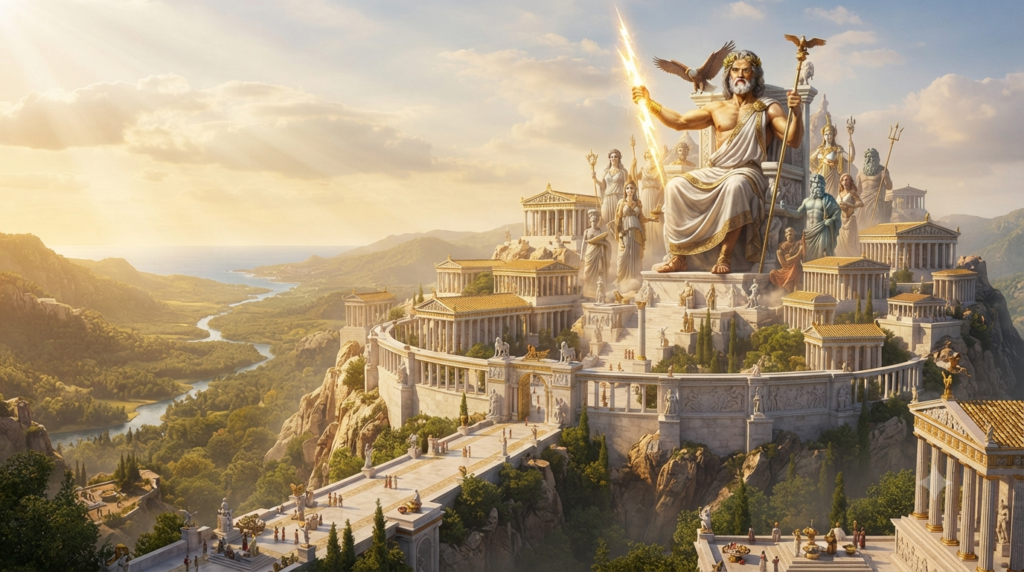
Anyone asking who is the king of the gods in Greek mythology arrives at a single, unambiguous answer: Zeus. As ruler of Mount Olympus and lord of the sky, Zeus stood at the top of the Greek pantheon, holding authority that no other deity could challenge outright. Understanding who is the king of the gods in Greek mythology means understanding a figure whose power was won through conflict, secured through strategy, and maintained through a combination of strength, judgment, and the loyalty of the gods who served beneath him.
Zeus — The King of the Greek Gods
Zeus ruled as the supreme authority among the Olympian gods, governing the sky, thunder, and the overall order of the cosmos. Where other deities presided over specific domains such as the sea, the underworld, or love, Zeus held a position above them, acting as final arbiter in disputes among gods and mortals alike. This distinction between being “a god” and being the king of the gods in Greek mythology mattered enormously in ancient Greek religious thought, since Zeus’s authority extended beyond his own domain into the affairs of every other deity.
His rule was not simply inherited or assumed by default; it was earned through a defining conflict that reshaped the structure of the entire Greek cosmos. Zeus’s position as king of the gods rested on both his personal strength and his ability to organize alliances, qualities that separated him from rulers who governed through fear alone. This combination of power and strategic judgment became a defining trait associated with Zeus throughout Greek mythology.
As king, Zeus presided over Mount Olympus, the mountain home of the principal Greek gods, where he held court, issued judgments, and maintained the balance between divine and mortal affairs. His throne on Olympus symbolized more than physical rule; it represented his role as the ultimate guarantor of cosmic order, a responsibility the Greeks took seriously given how central the concept of order versus chaos was to their worldview.
Zeus’s authority also extended into the moral and social realm, as he was regarded as the protector of oaths, guests, and the fundamental laws that governed civilized behavior among the Greeks. This aspect of his rule reinforced why the question of who is the king of the gods in Greek mythology carries weight beyond mythology alone — Zeus represented the very concept of legitimate authority within Greek culture itself.
Origins and Rise to Power
Zeus was born to the Titans Cronus and Rhea, but his early life began under threat rather than privilege. Cronus, having overthrown his own father, feared a prophecy warning that one of his children would eventually overthrow him in turn. To prevent this, Cronus swallowed each of his children immediately after birth, a brutal measure meant to eliminate any possibility of rebellion before it could begin.
Rhea, determined to save at least one of her children, hid Zeus away at birth and tricked Cronus into swallowing a stone wrapped in cloth instead. Raised in secrecy, Zeus grew to adulthood outside his father’s knowledge, eventually returning to confront Cronus directly. This act of deception and survival set the stage for the central conflict that would determine who is the king of the gods in Greek mythology for the rest of Greek religious history.
The confrontation between Zeus and Cronus escalated into the Titanomachy, a prolonged war between the younger Olympian gods, led by Zeus, and the elder generation of Titans. Zeus first forced Cronus to release his swallowed siblings — Poseidon, Hades, Hestia, Demeter, and Hera — who joined him in the fight. With allies including the Cyclopes and the Hecatoncheires, Zeus ultimately defeated the Titans, securing Olympian rule over the cosmos.
Following this victory, Zeus divided the universe among himself and his brothers Poseidon and Hades through a drawing of lots. Zeus received dominion over the sky, Poseidon the sea, and Hades the underworld, while the earth remained common ground for all three. This division formalized Zeus’s position, confirming through cosmic agreement — not force alone — that he was to be recognized as king of the gods in Greek mythology going forward.
Family of Zeus
Zeus’s principal wife was Hera, herself a powerful Olympian goddess who ruled alongside him as queen of the gods. Their marriage, however, was frequently marked by tension, largely due to Zeus’s numerous relationships outside the marriage, which produced many of the most significant figures in Greek mythology. Despite this discord, Hera remained his official consort and a central figure in the Olympian hierarchy.
As the youngest son of Cronus and Rhea, Zeus shared close familial bonds with his siblings Poseidon, Hades, Hestia, Demeter, and Hera, all of whom became major Olympian deities in their own right. This sibling group, having fought together during the Titanomachy, formed the founding generation of Olympian rule, with Zeus recognized among them as the leader by virtue of both his role in their liberation and his subsequent authority.
Zeus fathered a remarkable number of children, many of whom became prominent gods and heroes central to Greek mythology. Athena, goddess of wisdom, emerged fully formed from his head, while Apollo and Artemis were born to the Titaness Leto. Other notable offspring included Hermes, the messenger god, along with mortal heroes such as Perseus and Heracles, whose stories frequently trace back to Zeus as their divine father.
This extensive family network reinforced Zeus’s centrality within Greek mythology as a whole. As king of the gods, his bloodline connected directly to an enormous share of the pantheon’s most important figures, meaning that understanding Greek mythology broadly often requires tracing lineage back to Zeus at some point, further cementing his role as the foundational authority of the Greek divine order.
Symbols and Depictions of Zeus
The thunderbolt stands as the most recognizable symbol associated with Zeus, representing both his authority over the sky and his capacity for decisive, overwhelming power. Ancient depictions frequently show Zeus wielding this weapon, ready to strike down enemies or enforce his will, making the thunderbolt an immediate visual shorthand for his identity as king of the gods in Greek mythology.
The eagle served as Zeus’s sacred animal, chosen for its association with the sky and its reputation as a powerful, dominant bird capable of soaring above all others. This symbolism paralleled Zeus’s own position above the rest of the pantheon, and eagles frequently appeared alongside him in Greek art as a visual reinforcement of his supreme rank among the gods.
The oak tree held particular sacred significance to Zeus, especially at the ancient oracle of Dodona, where priests interpreted the rustling of oak leaves as messages from the god himself. This connection between Zeus and the oak reflected his broader association with the natural forces of sky and storm, tying his mythology directly to the physical world the Greeks observed around them.
In artistic representations, Zeus was typically portrayed as a mature, bearded figure seated on a throne, often holding a scepter alongside his thunderbolt. This imagery, most famously realized in the lost Statue of Zeus at Olympia, one of the Seven Wonders of the Ancient World, captured the gravity and authority expected of a ruler — visually reinforcing, for any observer, precisely who is the king of the gods in Greek mythology.
Zeus’ Role and Authority Among the Gods
Zeus held final authority over major decisions affecting both gods and mortals, frequently intervening in disputes to enforce order or deliver judgment. This role positioned him not merely as the strongest god physically, but as the ultimate arbiter whose decisions carried binding weight across the entire Greek cosmological system, distinguishing his authority from that of any single-domain deity.
As protector of oaths and hospitality, Zeus was invoked whenever agreements needed divine backing, reflecting his role as guarantor of social and moral order among the Greeks. Breaking an oath sworn in Zeus’s name was considered a serious offense, one that carried the risk of divine punishment, reinforcing how deeply his authority extended into the ethical framework of Greek society, not merely its mythology.
Among the other Olympians, Zeus commanded a mixture of respect and caution, given his willingness to punish gods who defied him, as seen in various myths involving rebellious deities. This dynamic reinforced the hierarchical structure of Olympus, where even powerful gods like Poseidon and Hades deferred to Zeus in matters concerning the broader cosmic order, despite ruling significant domains of their own.
Zeus’s authority also extended to matters of fate and prophecy, though ancient sources present a nuanced relationship between his will and the broader forces of destiny governed by the Fates. Even as king of the gods, Zeus operated within limits set by these deeper cosmic principles, illustrating that his rule, while supreme among the gods, was not entirely unbounded — a detail that added complexity to his role throughout Greek mythology.
Key Myths Featuring Zeus
The Titanomachy remains the defining myth establishing Zeus’s rise to power, chronicling his war against Cronus and the Titans and his subsequent claim to rulership over the cosmos. This conflict set the template for nearly every later myth involving Zeus, as it established both his capacity for decisive action and his willingness to reorganize the entire order of existence to secure legitimate rule.
Zeus also appears in the myth of Deucalion’s flood, a Greek account of a great deluge sent to cleanse the earth of a corrupt human generation. In this myth, Zeus acts as both judge and executor of divine punishment, sparing only the righteous Deucalion and his wife Pyrrha, who go on to repopulate the earth. This story reinforced Zeus’s role as a moral authority willing to intervene directly in the affairs of mortals.
Numerous myths describe Zeus’s relationships and transformations, often undertaken to interact with mortals or other beings while avoiding Hera’s notice. While these stories vary widely in detail, they consistently produced offspring who became significant figures in Greek mythology, tying Zeus’s personal narrative directly to the broader genealogy of gods and heroes across Greek tradition.
Zeus also plays a significant role in the Iliad, where he oversees the events of the Trojan War from Olympus, occasionally intervening while attempting to maintain a degree of neutrality among the gods who took sides in the conflict. His portrayal in this context reinforces his position as king of the gods in Greek mythology — powerful enough to influence outcomes decisively, yet often choosing restraint to preserve balance among competing divine interests.
Zeus vs. Jupiter — Greek vs. Roman King of the Gods
When Roman religion absorbed Greek mythology, Zeus found his direct counterpart in Jupiter, the supreme god of the Roman pantheon. Much like Zeus, Jupiter ruled the sky, wielded the thunderbolt, and held ultimate authority over the other Roman gods, demonstrating remarkable continuity between the two cultures’ conception of a king of the gods.
Jupiter, however, carried additional political significance within Roman society that exceeded the civic role typically attributed to Zeus in Greece. As the chief state god of Rome, Jupiter was directly tied to the legitimacy of Roman governance, with emperors and officials invoking his authority to reinforce their own political power in ways that had fewer direct parallels in Greek civic religion.
Despite these differences in political application, the core identity of the god remained stable across the transition from Zeus to Jupiter. Both figures represented supreme authority over an ordered cosmos, achieved through struggle against a previous generation of divine rulers, reinforcing just how foundational the concept of a sky-ruling king of the gods was to ancient Mediterranean religious thought as a whole.
The comparison between Zeus and Jupiter demonstrates how thoroughly Roman religion preserved the essential structure of Greek mythology while adapting it to fit Rome’s own political and cultural priorities. Understanding who is the king of the gods in Greek mythology, then, also provides direct insight into how the Romans understood their own supreme deity, given how closely Jupiter’s mythology mirrored that of his Greek predecessor.
Why Zeus Matters in Greek Mythology Today
Modern interest in Zeus persists largely because his story addresses timeless questions about authority, legitimacy, and the responsibilities that come with supreme power. As king of the gods in Greek mythology, Zeus offers a case study in how rule achieved through conflict can be maintained through judgment and structure rather than force alone, a theme that continues to resonate in modern discussions of leadership and governance.
Zeus’s mythology also continues to influence literature, art, and popular culture, with his image as a thunderbolt-wielding ruler remaining instantly recognizable even to audiences with limited knowledge of Greek mythology overall. This visual and narrative legacy demonstrates how deeply embedded Zeus has become within broader Western cultural memory, far beyond his original religious context.
The complexity of Zeus’s character — decisive yet bound by fate, powerful yet accountable to oaths and moral order — offers modern audiences a more nuanced figure than a simple, all-powerful ruler. This complexity is part of why the question of who is the king of the gods in Greek mythology continues to invite deeper exploration rather than a purely surface-level answer.
Ultimately, Zeus matters in Greek mythology today because he represents the foundational structure upon which the rest of the Greek pantheon depends. Nearly every major deity and hero connects back to Zeus through lineage, conflict, or direct intervention, making him not just a powerful figure individually, but the organizing center of the entire mythological system the Greeks built around him.
FAQ — Quick Answers About the King of the Gods
Who is the king of the gods in Greek mythology?
Zeus is the king of the gods in Greek mythology, ruling over the sky, thunder, and the overall order of the Olympian pantheon from Mount Olympus.
How did Zeus become king of the gods?
Zeus became king of the gods after leading the Olympians to victory over Cronus and the Titans in the Titanomachy, then dividing rule of the cosmos with his brothers Poseidon and Hades.
Who are Zeus’s parents?
Zeus is the son of the Titans Cronus and Rhea, the youngest of their children and the one who ultimately overthrew his father’s rule.
Who is the Roman equivalent of Zeus?
The Roman equivalent of Zeus is Jupiter, who similarly ruled as king of the gods, wielded the thunderbolt, and governed the sky in Roman mythology.
What are Zeus’s main symbols?
Zeus is primarily associated with the thunderbolt, the eagle, and the oak tree, each representing different aspects of his authority over the sky and cosmic order.
Conclusion
Anyone who sets out to answer who is the king of the gods in Greek mythology arrives at Zeus, a ruler whose authority was forged through rebellion, war, and the careful division of cosmic power among his brothers. From his hidden infancy to his victory in the Titanomachy, Zeus’s rise reflects a mythology deeply concerned with how legitimate power is earned rather than simply claimed.
His symbols — the thunderbolt, the eagle, and the oak — along with his vast family of gods and heroes, show just how thoroughly Zeus’s presence extends across nearly every corner of Greek mythology. His comparison to Jupiter further demonstrates how central the idea of a supreme, sky-ruling king remained across the ancient Mediterranean world, adapting to new cultures while preserving its essential meaning.
Ultimately, Zeus endures as king of the gods in Greek mythology not simply because of his power, but because of the order, judgment, and responsibility the Greeks attached to his rule. His story remains one of the clearest ancient explorations of what it truly means to hold — and justify — supreme authority.

Orin Vale has spent the better part of two decades tracing the threads that connect the world’s oldest stories — from the halls of Asgard to the banks of the Nile, from Olympus to the jungles of the Maya. What began as a childhood fascination with flood myths and trickster gods grew into years of independent study across comparative mythology and ancient religion, always chasing the same question: what did these stories mean to the people who first told them? Orin writes for readers who want more than trivia — the ones looking for the beliefs, fears, and truths that myths were built to carry.