Anyone asking who was Apollo in Greek mythology quickly discovers that no single label fully captures him. Apollo was the Greek god associated with the sun, music, prophecy, healing, and archery, making him one of the most multifaceted deities in the entire Olympian pantheon. Understanding who was Apollo in Greek mythology means accepting that his identity resists simplification — he was simultaneously a healer and a bringer of plague, a patron of the arts and a formidable archer, a source of wisdom and a figure caught in his own share of personal tragedy.
Apollo — The Greek God of Many Domains
Apollo held authority over an unusually wide range of domains compared to most other Olympian gods, whose responsibilities tended to remain more narrowly defined. As the Greek god of the sun, music, prophecy, healing, and archery, Apollo occupied a position of remarkable versatility within Greek mythology, reflecting the Greeks’ understanding of him as a deity of balance, order, and illumination in both literal and symbolic senses.
This breadth of domain is precisely why so many people researching who was Apollo in Greek mythology find him more complex than gods with a single clear function. Apollo represented the ideal of harmony between reason and inspiration, a duality the Greeks associated closely with civilization itself. His connection to music and prophecy in particular linked him to both artistic creativity and rational insight, two qualities the Greeks considered essential to a well-ordered society.
Apollo’s role as patron of the arts extended his influence into the realm of the Muses, the nine goddesses who inspired poetry, music, and other creative pursuits. As their leader, Apollo was frequently depicted presiding over artistic gatherings, reinforcing his identity not merely as a distant, abstract god but as an active guiding presence in Greek cultural life, particularly in matters of music and poetic expression.
At the same time, Apollo’s association with healing and disease introduced a layer of duality into his character that distinguished him from purely benevolent deities. Ancient sources describe Apollo both as a healer capable of curing illness and, in moments of divine anger, as a god who could send plague upon mortals with his arrows. This tension between healing and harm reflects a broader theme in Greek mythology: divine power was rarely one-dimensional, and Apollo embodied that complexity more than most.
Origins and Family of Apollo
Apollo was the son of Zeus, king of the gods, and Leto, a Titaness who endured great hardship during her pregnancy due to Hera’s jealousy. Forced to wander in search of a place to give birth, Leto eventually found refuge on the floating island of Delos, where she delivered both Apollo and his twin sister, Artemis. This difficult birth story remains a foundational element for anyone exploring who was Apollo in Greek mythology, establishing him as a figure whose arrival into the world was marked by struggle rather than ease.
Artemis, Apollo’s twin sister, became the goddess of the hunt and the wilderness, and the two siblings maintained a close, if occasionally rivalrous, relationship throughout Greek mythology. Their shared origin on Delos and their parallel roles as archer deities — Apollo associated with the sun and Artemis with the moon — created a natural symmetry that ancient audiences frequently emphasized when discussing either figure.
As the son of Zeus, Apollo held a prominent position among the Olympian gods, closely connected to figures such as Athena, Hermes, and Artemis through both kinship and shared narrative appearances. His relationship with Zeus in particular reinforced his authority, as Apollo often acted as an extension of his father’s will, particularly in matters concerning prophecy and divine justice among mortals.
Apollo’s family connections extended into numerous myths involving both gods and mortals, reflecting his broad involvement across Greek mythological narratives. Whether interacting with fellow Olympians or intervening directly in human affairs, Apollo’s lineage as the son of Zeus and Leto positioned him firmly within the highest tier of Greek divine authority, despite the humble circumstances of his birth.
Symbols and Depictions of Apollo
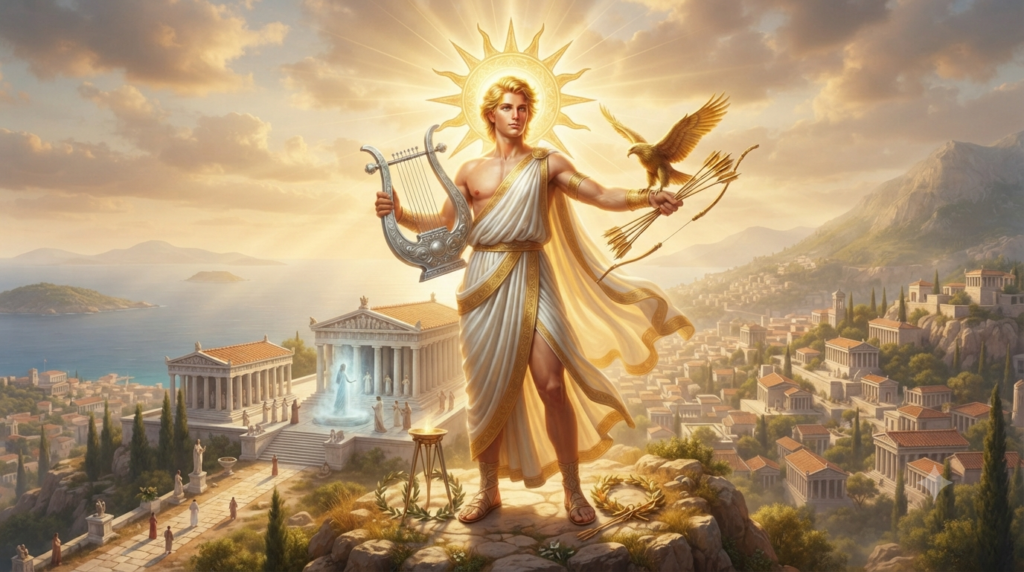
The lyre stands among the most recognizable symbols associated with Apollo, representing his role as patron of music and the arts. According to myth, Apollo received the instrument from Hermes and became so closely associated with it that the lyre came to symbolize artistic harmony and inspiration throughout Greek culture, reinforcing his identity whenever depicted in ancient art or literature.
Apollo’s bow and arrows represented his other major domain: archery, along with the dual power to heal or harm through disease. This symbolism connected directly to myths in which Apollo used his arrows to protect Delos or, alternatively, to punish mortals who offended the gods, illustrating how his weapon carried both protective and destructive potential depending on the circumstances.
The laurel tree became permanently associated with Apollo following the myth of Daphne, a nymph who transformed into a laurel tree while fleeing his pursuit. This connection made the laurel wreath a lasting symbol not only of Apollo himself but of victory and achievement more broadly, particularly in poetic and athletic contexts throughout Greek and later Western culture.
In artistic depictions, Apollo was typically portrayed as a youthful, beardless figure, embodying the Greek ideal of masculine beauty and balance. Unlike older, bearded gods such as Zeus or Poseidon, Apollo’s youthful appearance reinforced his association with vitality, clarity, and artistic perfection, making him one of the most consistently idealized figures in Greek sculpture and painting.
Apollo’s Role Among the Gods
Apollo held a particularly significant role as the god of prophecy, most famously associated with the Oracle of Delphi, where his priestess, the Pythia, delivered messages believed to come directly from him. This connection made Apollo one of the most consulted deities in Greek religious life, as individuals and city-states alike sought his guidance on matters ranging from personal decisions to major political and military choices.
As leader of the Muses, Apollo also held authority over artistic inspiration, a role that positioned him as a central figure in Greek cultural and intellectual life beyond religious practice alone. This patronage of music and poetry gave Apollo influence that extended into everyday Greek civic life, particularly during festivals and competitions celebrating artistic achievement.
Apollo’s association with healing placed him among the gods most directly invoked during times of illness or plague, though this same power carried the potential for harm when Apollo chose to punish rather than heal. This duality reinforced his standing among the other Olympians as a god whose favor was highly desirable, yet whose anger carried serious consequences, a balance that added weight to his role within the broader divine hierarchy.
Among his fellow gods, Apollo was generally respected for his wisdom and composure, qualities that aligned him with order and reason rather than the chaos associated with deities like Ares. This reputation reinforced why, when people ask who was Apollo in Greek mythology, the answer consistently includes his association with balance, insight, and the harmonious use of divine power.
Key Myths Featuring Apollo
The myth of Apollo and Daphne remains one of the most enduring stories associated with the god, describing his pursuit of the nymph Daphne, who ultimately transformed into a laurel tree to escape him. This myth not only explains the origin of Apollo’s connection to the laurel but also illustrates a more vulnerable, emotionally complex side of a god otherwise associated with order and control.
Apollo’s slaying of the serpent Python at Delphi represents another foundational myth, explaining how the god came to establish his famous oracle at that location. By defeating Python, Apollo claimed Delphi as his sacred site, transforming it into the most important center of prophecy in the ancient Greek world and reinforcing his role as the primary god of divination among the Olympians.
In the Iliad, Apollo plays a significant role during the Trojan War, siding with the Trojans and using his power to send plague upon the Greek forces in response to an insult against one of his priests. This episode demonstrates Apollo’s capacity for both protection and punishment, reinforcing the dual nature that runs throughout his mythology and further answering the question of who was Apollo in Greek mythology through direct narrative example.
The myth of Apollo and Hyacinthus describes a close relationship between the god and a young mortal companion, which ended in tragedy when Hyacinthus was accidentally killed during a discus-throwing incident. Apollo, overcome with grief, transformed Hyacinthus into a flower bearing his name, a story that reflects Apollo’s capacity for deep personal loss despite his status as an immortal and powerful deity.
Apollo in Greek vs. Roman Mythology
Apollo stands apart from many other Greek gods in that he retained the same name when adopted into Roman mythology, rather than being renamed as Zeus became Jupiter or Ares became Mars. This continuity reflects how thoroughly Roman culture embraced Apollo’s identity as originally conceived in Greek mythology, adopting his domains of music, prophecy, healing, and archery with minimal alteration.
While the core identity of Apollo remained consistent, Roman culture placed particular emphasis on his role as a god of healing and civic protection, reflecting Rome’s own religious priorities. Temples dedicated to Apollo appeared throughout Roman territory, often emphasizing his protective and healing qualities over the artistic and prophetic aspects more heavily emphasized in Greek worship.
This relatively seamless transition between Greek and Roman religion makes Apollo a particularly useful figure for understanding how mythology traveled across ancient Mediterranean cultures. Because his name and core attributes remained largely unchanged, exploring who was Apollo in Greek mythology also provides direct insight into Roman religious practice without the added complexity of reconciling differing names or significantly altered domains.
The consistency of Apollo’s identity across both cultures underscores just how fundamental his combination of reason, art, and prophecy was considered to the broader Mediterranean world. Few gods maintained such a stable identity across cultural adoption, making Apollo a rare example of mythological continuity rather than reinterpretation.
Why Apollo Matters in Greek Mythology Today
Modern fascination with Apollo persists largely due to the breadth of his influence across art, medicine, and science. His name continues to appear in contexts ranging from literature and music to space exploration, reflecting how deeply his association with light, reason, and achievement has embedded itself into modern cultural symbolism, far beyond his original religious context in ancient Greece.
Apollo’s connection to healing also left a lasting legacy in modern medical symbolism, with references to Apollo and his son Asclepius, the god of medicine, continuing to influence how healing and medical authority are symbolically represented even today. This connection demonstrates the practical, lasting relevance of Apollo’s mythology well beyond purely artistic or literary contexts.
The complexity of Apollo’s character — capable of both healing and harm, artistic inspiration and personal tragedy — offers modern audiences a more textured figure than a simple embodiment of light or reason alone. This complexity is central to why the question of who was Apollo in Greek mythology continues to invite deeper exploration rather than a single, flat answer.
Ultimately, Apollo matters in Greek mythology today because he represents an ideal the Greeks valued deeply: the balance between rational order and creative inspiration. His enduring presence across art, science, and cultural memory confirms that Apollo’s mythology continues to resonate precisely because it speaks to qualities societies have consistently admired across centuries.
FAQ — Quick Answers About Apollo in Greek Mythology
Who was Apollo in Greek mythology?
Apollo was the Greek god of the sun, music, prophecy, healing, and archery, recognized as one of the most versatile and important deities among the Olympian gods.
Who were Apollo’s parents?
Apollo was the son of Zeus and the Titaness Leto, born on the island of Delos alongside his twin sister, Artemis.
What is Apollo the god of?
Apollo governed multiple domains, including the sun, music, poetry, prophecy, healing, and archery, making him one of the most multifaceted gods in Greek mythology.
Why is Apollo associated with the Oracle of Delphi?
Apollo became associated with the Oracle of Delphi after slaying the serpent Python, claiming the site as his sacred center of prophecy and divination.
Did Apollo have a Roman equivalent?
Apollo is one of the few Greek gods who kept the same name in Roman mythology, retaining his core domains of music, prophecy, healing, and archery.
Conclusion
Anyone who sets out to answer who was Apollo in Greek mythology finds a god defined by range rather than a single fixed role — a deity of sunlight and song, prophecy and healing, order and occasional heartbreak. From his difficult birth on Delos to his founding of the Oracle at Delphi, Apollo’s mythology reflects a figure whose influence touched nearly every aspect of Greek cultural and religious life.
His symbols, from the lyre to the laurel wreath, and his myths, from Daphne to Hyacinthus, reveal a god capable of both extraordinary power and deeply personal vulnerability. This duality, paired with his rare continuity into Roman mythology under the same name, illustrates just how central Apollo remained across centuries of Mediterranean religious tradition.
Ultimately, Apollo endures in Greek mythology not because he fits neatly into one category, but because he embodies the balance between reason and inspiration that the Greeks prized most highly — a legacy that continues to shape how his story is told and remembered today.

Orin Vale has spent the better part of two decades tracing the threads that connect the world’s oldest stories — from the halls of Asgard to the banks of the Nile, from Olympus to the jungles of the Maya. What began as a childhood fascination with flood myths and trickster gods grew into years of independent study across comparative mythology and ancient religion, always chasing the same question: what did these stories mean to the people who first told them? Orin writes for readers who want more than trivia — the ones looking for the beliefs, fears, and truths that myths were built to carry.