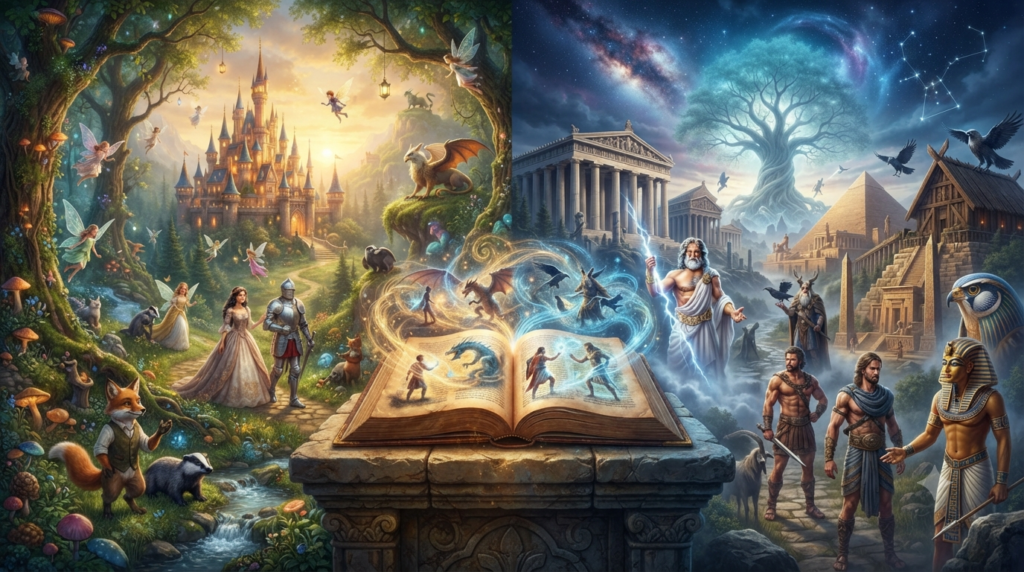
Anyone asking are fairy tales different from mythology is addressing a question that frequently causes confusion, since both storytelling traditions share magical elements, fantastical characters, and centuries of cultural transmission. Yet fairy tales and mythology represent genuinely distinct categories of narrative, separated by differences in belief, purpose, scope, and origin that go well beyond surface-level similarities. Understanding are fairy tales different from mythology requires examining what each tradition actually is, how each functioned within its originating culture, and where the boundaries between the two occasionally blur despite their fundamentally different natures.
Defining Mythology
Mythology consists of narratives deeply connected to a culture’s religious and cosmological belief system, typically explaining the origin of the world, the nature of the gods, and humanity’s place within a larger cosmic order. Unlike stories told purely for entertainment, mythology historically functioned as a genuine expression of religious belief, meaning ancient audiences generally understood these narratives as reflecting real cosmic and spiritual truths rather than fictional invention.
Mythological narratives consistently feature gods, goddesses, and other powerful cosmic forces whose actions directly shape the fate of the world and humanity within it. This connection to active religious practice distinguishes mythology significantly when addressing are fairy tales different from mythology, since mythological figures typically held genuine religious significance for the cultures that told and believed these stories, rather than existing purely as narrative devices.
Beyond explaining cosmic origin, mythology served essential cultural functions, including justifying religious rituals, reinforcing social hierarchies, and providing frameworks through which entire societies understood their relationship to the divine and the natural world. This deep cultural embedding meant that mythology operated as far more than simple storytelling, functioning instead as a foundational component of religious and social identity within its originating culture.
This combination of religious belief, cosmic scope, and deep cultural function establishes mythology as a category fundamentally different from stories told purely for entertainment or moral instruction, providing essential context for understanding precisely how are fairy tales different from mythology when the two traditions are examined side by side.
Defining Fairy Tales
Fairy tales represent a distinct folklore tradition, generally existing independently of any specific religious belief system, instead functioning as narrative entertainment often centered on moral instruction, particularly for younger audiences. Unlike mythology, fairy tales typically do not require or expect genuine belief in their events, existing instead within a clearly understood realm of imaginative fiction from the outset.
Fairy tales characteristically employ recognizable narrative formulas, including opening phrases such as “once upon a time,” along with archetypal characters like witches, princes, talking animals, and other stock figures who appear across numerous different tales within this broader storytelling tradition. This formulaic structure distinguishes fairy tales stylistically from mythology, which typically lacks this same consistent narrative framework across its various stories.
The primary cultural function of fairy tales centers on entertainment combined with moral or social instruction, frequently addressing themes such as kindness, courage, and consequence through accessible, often symbolic narrative situations. This educational and entertainment-focused purpose differs significantly from mythology’s deeper connection to religious belief and cosmic explanation, reinforcing a key distinction relevant to are fairy tales different from mythology.
Fairy tales as we recognize them today were significantly shaped by folklore collectors such as the Brothers Grimm, who gathered, recorded, and standardized oral folk traditions from various European sources during the nineteenth century. This process of compilation and preservation further distinguishes fairy tales from mythology, highlighting their more recent, identifiable path of documentation compared to the deeper antiquity typically associated with mythological tradition.
Key Differences Between Fairy Tales and Mythology
The most significant distinction when considering are fairy tales different from mythology involves belief: mythology was historically connected to genuine religious conviction within its originating culture, while fairy tales generally existed without requiring literal belief, understood instead as imaginative fiction even by the audiences who originally told and heard them.
Character composition also differs substantially between the two traditions, as mythology typically features gods, goddesses, and semi-divine heroes whose actions carry cosmic significance, while fairy tales generally center on ordinary humans or anonymous magical figures without the same explicit divine status or religious weight found within mythological narrative.
The scope of these narratives further distinguishes fairy tales from mythology, as mythological stories frequently address cosmic-scale concerns such as the origin of the universe or the ultimate fate of humanity, while fairy tales typically focus on individual journeys, personal transformation, or specific moral lessons relevant to a single protagonist’s experience rather than broader cosmological questions.
Authorship and historical origin represent another important distinction relevant to are fairy tales different from mythology, since mythological narratives are typically rooted in specific ancient cultural and religious traditions extending back many centuries or millennia, while fairy tales, though drawing on older oral folklore, are more frequently associated with identifiable collection and compilation efforts, such as those undertaken by the Brothers Grimm, occurring in relatively more recent historical periods.
Where the Lines Blur
Despite these clear distinctions, certain mythological narratives incorporate moral lessons strikingly similar to those found within fairy tales, using divine or heroic figures to illustrate consequences for particular behaviors in ways that parallel the instructive function typically associated with fairy tale tradition. This overlap demonstrates that while are fairy tales different from mythology remains a valid and important question, the two traditions are not entirely separate in every respect.
Similarly, certain fairy tales incorporate elements that closely resemble mythological material, including minor magical deities, fate-driven narrative structures, or cosmic themes that blur the otherwise clear boundary between purely secular folklore and religiously grounded mythological narrative. These overlapping elements illustrate that fairy tales and mythology, while conceptually distinct, developed within overlapping cultural environments that occasionally influenced one another.
Folklore more broadly functions as an intermediary category encompassing both fairy tales and various other traditional narrative forms, including legends and fables, some of which incorporate mythological elements while others remain firmly within secular storytelling tradition. This broader folklore category helps explain why the boundary between fairy tales and mythology can sometimes appear less distinct than a strict definitional comparison might initially suggest.
Recognizing these areas of overlap does not undermine the fundamental distinctions separating fairy tales from mythology, but rather reflects the natural complexity present whenever cultures develop rich, interconnected storytelling traditions over extended historical periods, with different narrative forms inevitably influencing one another to varying degrees.
Why This Distinction Matters
Understanding are fairy tales different from mythology carries genuine importance for approaching each tradition with appropriate historical and cultural context, ensuring that mythology receives the scholarly and cultural respect appropriate to its historical role as genuine religious belief rather than being reduced to the same category as purely fictional entertainment intended primarily for children.
This distinction similarly benefits fairy tales, allowing this tradition to be recognized and studied as a legitimate and culturally significant storytelling category in its own right, with its own distinct history, purpose, and folkloric significance, rather than being treated as a simplified or diminished version of mythology.
Maintaining this clear conceptual distinction also supports more accurate and meaningful engagement with both traditions individually, allowing readers and scholars to appreciate mythology’s deep connection to ancient religious belief while simultaneously recognizing fairy tales’ distinct value as folklore focused on moral instruction and cultural transmission through generations.
Ultimately, addressing are fairy tales different from mythology thoughtfully enriches understanding of both storytelling traditions, reinforcing that each deserves recognition on its own terms rather than being conflated simply because both involve magical or fantastical narrative elements.
FAQ — Quick Answers About Fairy Tales and Mythology
Are fairy tales different from mythology?
Yes, fairy tales and mythology are different, primarily distinguished by their connection to religious belief, with mythology historically tied to genuine religious practice and fairy tales existing as secular folklore.
Do fairy tales and mythology share any similarities?
Yes, both traditions can include magical elements and moral lessons, and certain fairy tales incorporate mythological elements, creating some overlap between the two categories.
Who collected many well-known fairy tales?
The Brothers Grimm are among the most well-known collectors of European fairy tales, compiling and preserving oral folklore traditions during the nineteenth century.
Do mythological stories require belief, while fairy tales do not?
Generally, yes. Mythology was historically connected to genuine religious belief, while fairy tales were typically understood as imaginative fiction from the outset.
Is folklore the same as mythology?
No, folklore is a broader category that includes fairy tales, legends, and fables, some of which incorporate mythological elements while others remain entirely secular.
Conclusion
Anyone who sets out to answer are fairy tales different from mythology finds two related but genuinely distinct storytelling traditions, separated by differences in belief, scope, character composition, and historical origin. Mythology’s deep connection to religious practice and cosmic explanation sets it apart from fairy tales, which function primarily as folklore centered on moral instruction and entertainment.
While certain areas of overlap exist, particularly where mythological elements appear within fairy tales or moral lessons echo across both traditions, these connections do not erase the fundamental distinctions separating the two categories. Recognizing these differences allows both traditions to be understood and appreciated according to their own distinct cultural significance.
Ultimately, fairy tales and mythology each occupy a meaningful and separate place within human storytelling history, and understanding what distinguishes them offers a richer, more accurate foundation for engaging with either tradition thoughtfully and respectfully.

Orin Vale has spent the better part of two decades tracing the threads that connect the world’s oldest stories — from the halls of Asgard to the banks of the Nile, from Olympus to the jungles of the Maya. What began as a childhood fascination with flood myths and trickster gods grew into years of independent study across comparative mythology and ancient religion, always chasing the same question: what did these stories mean to the people who first told them? Orin writes for readers who want more than trivia — the ones looking for the beliefs, fears, and truths that myths were built to carry.