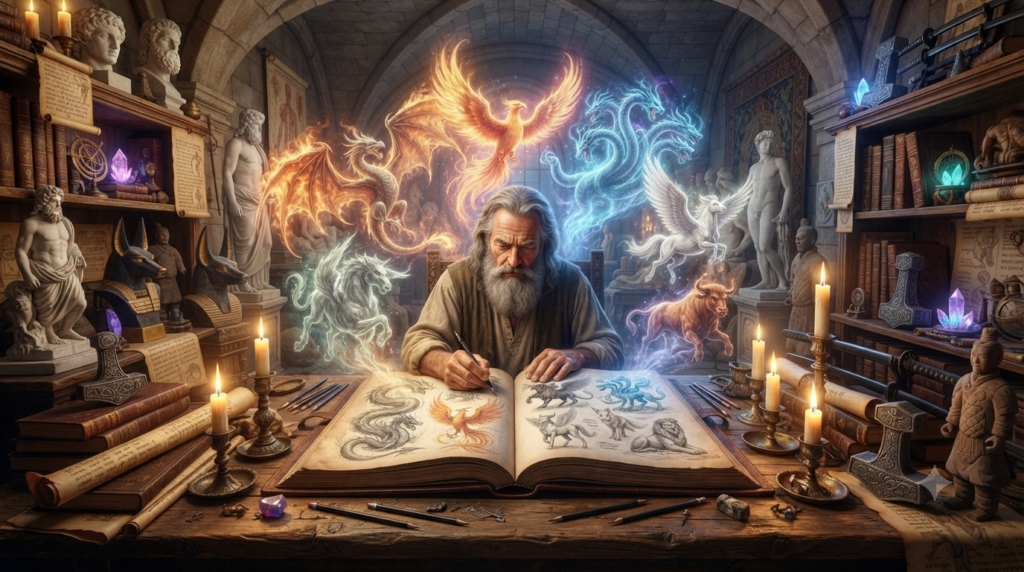
Anyone searching how to draw mythology creatures benefits far more from understanding the defining visual features and symbolic logic behind these beings than from any single generic drawing tutorial, since mythological creatures across different cultures share certain underlying design principles worth understanding before attempting to render them. This guide approaches how to draw mythology creatures as a cross-cultural reference resource, examining the specific visual attributes that define significant creatures across Greek, Norse, Egyptian, and folkloric tradition. Understanding how to draw mythology creatures convincingly starts with recognizing the shared compositional logic that ancient cultures used to visually communicate power, danger, and supernatural presence.
Why Hybrid Design Defines Most Mythological Creatures
Across nearly every mythological tradition worldwide, monstrous and supernatural creatures share a recurring compositional principle: the combination of features drawn from multiple different animals or beings into a single, visually striking hybrid form. This pattern represents one of the most essential concepts for anyone exploring how to draw mythology creatures effectively across various cultural traditions.
This hybrid approach served a clear symbolic function within ancient visual culture, immediately signaling a creature’s supernatural or dangerous nature by combining features that would never naturally coexist within a single biological organism, creating instant visual recognition of something existing outside ordinary, natural categories familiar to human observers.
Understanding this underlying principle proves considerably more valuable for anyone exploring how to draw mythology creatures than simply memorizing individual creature designs in isolation, since recognizing the broader pattern of purposeful hybridization allows artists to understand why specific creatures were designed the way they were within their originating mythological tradition.
This hybrid design logic, appearing consistently across Greek, Norse, Egyptian, and numerous other mythological traditions, provides essential conceptual grounding before examining the specific creatures and their defining attributes discussed throughout the remainder of this guide to how to draw mythology creatures effectively.
Greek Mythology Creatures — Key Visual Features
Medusa remains one of Greek mythology’s most visually distinctive creatures, defined primarily through living serpents replacing her hair and her fundamentally dangerous, petrifying gaze, both essential elements for anyone approaching how to draw mythology creatures specifically within Greek mythological tradition.
The Minotaur combines a human body with a bull’s head, creating an immediately recognizable hybrid form that has remained visually consistent throughout centuries of Greek and later Western artistic tradition, offering a particularly clear example of purposeful hybrid design within Greek mythological creature iconography.
Centaurs, combining a human torso and upper body with the full lower body of a horse, represent another significant Greek mythological creature type, illustrating a slightly different hybrid composition approach compared to the Minotaur’s head-and-body combination, worth understanding for anyone exploring how to draw mythology creatures with varied hybrid structures.
These three examples collectively demonstrate the range of hybrid compositional approaches present within Greek mythology alone, from partial transformation like Medusa’s serpentine hair to full anatomical combination as seen in both the Minotaur and centaurs, providing essential reference points for this particular mythological tradition specifically.
Norse Mythology Creatures — Key Visual Features
Jörmungandr, the Midgard Serpent, is defined primarily through its colossal scale, frequently depicted encircling the entire world and biting its own tail, an image reflecting both its immense size and its cosmic significance within Norse mythology, essential details for anyone exploring how to draw mythology creatures from this particular tradition.
Fenrir, the monstrous wolf central to Norse mythology’s apocalyptic narrative, is typically depicted with exaggerated, threatening proportions that clearly distinguish this creature from an ordinary wolf, visually reinforcing the genuine cosmic danger this figure represents within the broader Norse mythological framework surrounding Ragnarök.
Both Jörmungandr and Fenrir rely primarily on scale and proportion, rather than complex anatomical hybridization, to communicate their supernatural danger and mythological significance, offering a somewhat different visual approach compared to the more explicitly hybrid creatures found within Greek mythological tradition discussed previously.
This emphasis on overwhelming scale rather than complex hybrid anatomy provides an important additional principle for anyone exploring how to draw mythology creatures broadly, demonstrating that visual terror and mythological significance can be communicated effectively through proportion and scale alone, without requiring complex multi-species combination.
Egyptian Mythology Creatures — Key Visual Features
Ammit represents Egyptian mythology’s most significant creature relevant to how to draw mythology creatures within this specific tradition, combining the head of a crocodile, the body of a leopard, and the hindquarters of a hippopotamus into a single, deliberately composite hybrid form reflecting her role in judging and consuming unworthy souls.
This specific three-part combination reflects deliberate symbolic choices within ancient Egyptian visual tradition, drawing on animals the ancient Egyptians themselves recognized as genuinely dangerous within their own natural environment, reinforcing Ammit’s fearsome nature through culturally specific animal associations rather than arbitrary creature combination.
Ancient Egyptian artistic tradition also relied heavily on specific color and proportion conventions to communicate divine or monstrous nature, using consistent stylistic approaches that anyone exploring how to draw mythology creatures within Egyptian tradition specifically should study directly through surviving historical artwork and tomb decoration.
Understanding Ammit’s deliberate three-animal composition provides valuable insight into how ancient Egyptian visual culture approached hybrid creature design, offering a particularly clear example of purposeful, culturally specific animal selection relevant to anyone exploring how to draw mythology creatures within this distinctive mythological tradition.
Creatures From Folklore and Maritime Tradition
The Kraken, drawn primarily from Scandinavian maritime folklore, relies heavily on overwhelming scale and tentacled anatomy to communicate its terrifying nature, typically depicted attacking ships with massive tentacles emerging from otherwise calm ocean waters, an important reference point for anyone exploring how to draw mythology creatures connected to maritime fear and the unknown depths of the sea.
This creature’s design emphasizes scale and unfamiliar anatomy over strict biological hybridization, drawing primarily on octopus or squid-like features exaggerated to an overwhelming, ship-destroying scale, offering yet another distinct approach within the broader landscape of how to draw mythology creatures across different cultural and folkloric traditions.
Various other maritime and folkloric creatures across different cultural traditions similarly rely on exaggerated scale, unfamiliar anatomy, or partial visibility, often depicted only partially emerging from water or darkness, to generate a similar sense of overwhelming, unknown danger relevant to artists exploring this broader creature category.
These maritime and folkloric examples reinforce that how to draw mythology creatures effectively does not always require complex multi-species hybridization, sometimes instead relying on scale, unfamiliar anatomy, or strategic partial concealment to communicate a creature’s genuinely threatening, supernatural nature.
Where to Find Authentic Visual References
Ancient Greek pottery, particularly black-figure and red-figure vase painting, provides extensive historical reference material showing exactly how ancient Greek artists themselves depicted creatures like Medusa, the Minotaur, and centaurs, offering invaluable primary source material for anyone seriously exploring how to draw mythology creatures with historical accuracy.
Norse carved stones and surviving manuscript illustrations provide similarly valuable historical reference for creatures like Jörmungandr and Fenrir, demonstrating how medieval Scandinavian artists visually interpreted these significant mythological figures within their own specific artistic tradition and historical period.
Egyptian tomb decoration and funerary art offer extensive, well-preserved visual references for creatures like Ammit, illustrating precisely how ancient Egyptian artists rendered this figure’s specific hybrid composition within religious and funerary contexts throughout ancient Egyptian history.
Consulting these authentic historical sources directly, rather than relying solely on modern reinterpretations, provides far richer and more historically grounded creative reference for anyone genuinely committed to how to draw mythology creatures in a manner that respects and reflects their original cultural and artistic origins.
FAQ — Quick Answers About Drawing Mythological Creatures
What is the most common design principle in mythological creatures?
Hybrid design, combining features from multiple different animals or beings, represents the most common and recognizable principle across mythological creatures worldwide.
What defines Ammit’s appearance in Egyptian mythology?
Ammit combines a crocodile’s head, a leopard’s body, and a hippopotamus’s hindquarters, reflecting animals ancient Egyptians considered genuinely dangerous.
How is Jörmungandr typically depicted?
Jörmungandr is typically shown as an enormous serpent encircling the entire world, biting its own tail, emphasizing its colossal scale and cosmic significance.
Do all mythological creatures rely on animal hybridization?
No, some creatures like the Kraken rely primarily on exaggerated scale and unfamiliar anatomy rather than combining multiple distinct animal features.
Where can I find authentic references for mythological creatures?
Ancient Greek pottery, Norse carved stones, and Egyptian tomb art all provide authentic historical visual references for specific mythological creatures.
Conclusion
Anyone exploring how to draw mythology creatures benefits significantly from understanding the underlying compositional principles, whether hybrid anatomy, exaggerated scale, or culturally specific animal symbolism, that define creatures like Medusa, Jörmungandr, Ammit, and the Kraken across their respective mythological traditions.
Recognizing that different cultures relied on different visual strategies, from Greek hybrid anatomy to Norse emphasis on overwhelming scale to Egyptian deliberate animal symbolism, provides far richer creative grounding than treating mythological creature design as a single, universal formula applicable across every tradition equally.
Ultimately, mastering how to draw mythology creatures means building genuine familiarity with these varied cultural and symbolic design traditions first, ensuring that any resulting artwork remains meaningfully connected to the rich, historically specific mythological heritage each creature actually represents.

Orin Vale has spent the better part of two decades tracing the threads that connect the world’s oldest stories — from the halls of Asgard to the banks of the Nile, from Olympus to the jungles of the Maya. What began as a childhood fascination with flood myths and trickster gods grew into years of independent study across comparative mythology and ancient religion, always chasing the same question: what did these stories mean to the people who first told them? Orin writes for readers who want more than trivia — the ones looking for the beliefs, fears, and truths that myths were built to carry.