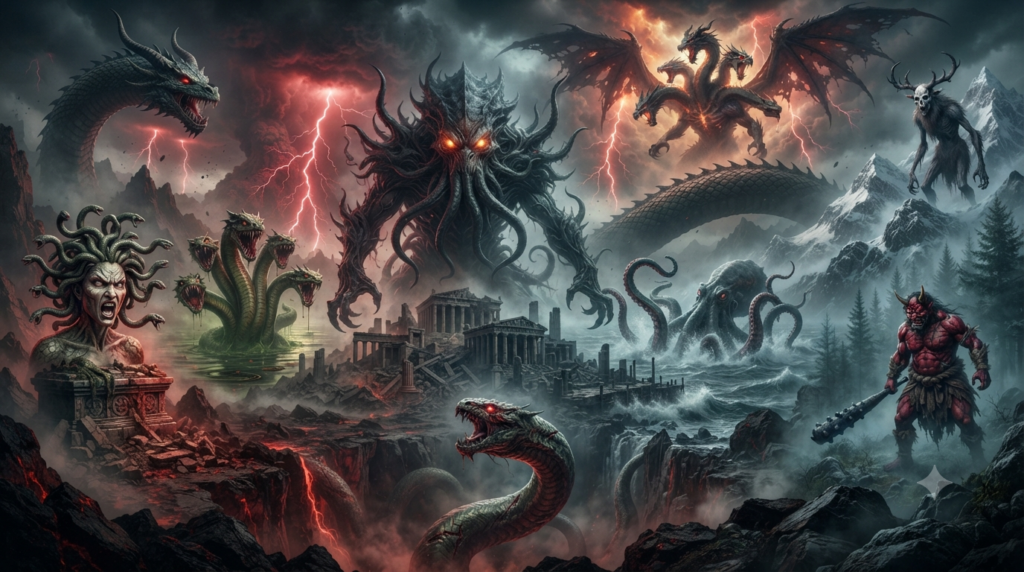
Anyone asking what is the scariest monster in mythology quickly discovers that this question admits no single, universally agreed-upon answer, since fear itself takes many different forms across the world’s mythological traditions. Rather than declaring one definitive winner, meaningfully addressing what is the scariest monster in mythology requires examining several strong contenders across different mythological traditions, evaluating each according to consistent criteria that capture what actually makes a mythological creature genuinely terrifying rather than simply powerful or dangerous.
What Makes a Mythological Monster Truly Scary
Determining what is the scariest monster in mythology benefits from clear evaluative criteria rather than pure subjective impression alone. One useful distinction separates monsters posing existential, cosmic-scale threats from those representing more localized, immediate physical danger, since these two categories of fear operate quite differently within mythological narrative and symbolic meaning.
Beyond scale of threat, the specific symbolism a monster represents significantly affects its capacity to genuinely frighten, with creatures symbolizing complete annihilation, irreversible transformation, or total loss of identity often proving more psychologically unsettling than monsters representing straightforward physical danger alone, however powerful that physical threat might be.
Importantly, raw power alone does not necessarily determine what is the scariest monster in mythology, since a monster’s ability to genuinely terrify often depends more on the specific nature of the threat it poses rather than simple strength or size. A creature capable of ending existence entirely may prove considerably more frightening than one merely capable of causing injury or death through conventional means.
These criteria, examining scale, symbolic meaning, and the specific nature of the threat posed, provide a meaningful framework for comparing genuinely strong contenders when addressing what is the scariest monster in mythology, allowing for thoughtful comparison across dramatically different mythological traditions and cultural contexts.
Medusa — Greek Mythology’s Petrifying Gaze
Medusa represents one of Greek mythology’s most enduringly frightening figures, possessing the ability to turn any living being who meets her gaze directly to stone, an immediate and utterly irreversible transformation representing complete loss of life and agency in a single, inescapable moment.
This specific form of threat, activated through something as fundamental and unavoidable as sight itself, makes Medusa a particularly compelling candidate for what is the scariest monster in mythology, since her power transforms an ordinary, involuntary human action into a potentially fatal encounter beyond the victim’s conscious control.
The psychological horror underlying Medusa’s myth extends beyond simple physical danger into deeper fears surrounding loss of bodily autonomy and control, as victims become frozen, permanently transformed objects rather than experiencing a more conventional form of death, reinforcing why her particular brand of terror has remained culturally resonant for millennia.
Medusa’s continued cultural prominence within discussions of what is the scariest monster in mythology reflects this specific, deeply unsettling combination of inevitability and irreversible transformation, distinguishing her from monsters whose threat, however severe, remains more conventionally physical in nature.
Jörmungandr and Fenrir — Norse Mythology’s Apocalyptic Beasts
Jörmungandr, the Midgard Serpent, and Fenrir, the monstrous wolf, represent Norse mythology’s strongest contenders for what is the scariest monster in mythology, given their direct role in Ragnarök, the prophesied apocalyptic battle resulting in the destruction of the gods themselves and the broader cosmic order they maintained.
These creatures embody existential, world-ending threat rather than localized danger, with Jörmungandr’s venom ultimately killing Thor even after his own defeat of the serpent, while Fenrir’s role in killing Odin himself during Ragnarök demonstrates a scale of threat extending far beyond individual mortal danger into genuine cosmic catastrophe.
This cosmic scale of threat significantly strengthens their claim regarding what is the scariest monster in mythology, since Jörmungandr and Fenrir represent forces capable of ending not just individual lives, but the entire established divine and cosmic order maintained by the Aesir gods throughout Norse mythological tradition.
Their fated, unavoidable role within Ragnarök further amplifies this terror, as Norse mythology presents their eventual, catastrophic confrontation with the gods as an inevitable certainty rather than merely a possible danger, reinforcing a particular kind of existential dread distinct from more immediate, avoidable mythological threats.
Ammit — Egyptian Mythology’s Devourer of Souls
Ammit represents a fundamentally different category of mythological terror relevant to what is the scariest monster in mythology, since her threat involves not physical death, already an inevitable mortal experience, but complete spiritual annihilation through the consumption of a soul that fails judgment within the Egyptian afterlife system.
This distinction matters significantly when evaluating what is the scariest monster in mythology, as Ammit’s power represents the permanent erasure of identity and existence itself, extending beyond death into the complete elimination of any continued afterlife presence, a considerably more absolute form of ending than physical death alone typically represents.
Unlike monsters whose threat remains confined to the physical world of the living, Ammit’s role specifically within the judgment process of the Duat connects her terror directly to fundamental questions of morality, consequence, and ultimate accountability, adding a distinctly psychological and existential dimension to her particular brand of mythological horror.
This combination of complete annihilation and direct connection to moral judgment makes Ammit a genuinely compelling answer to what is the scariest monster in mythology, representing a form of ultimate consequence distinct from the more conventional physical or cosmic threats posed by other major mythological monsters.
Other Notable Contenders Across Mythologies
The Kraken, drawn from Scandinavian maritime folklore, represents another significant contender when considering what is the scariest monster in mythology, embodying deep-seated human fear of the vast, unknown depths of the ocean and the genuine helplessness sailors historically faced when confronting this unpredictable natural environment.
Numerous smaller, hybrid mythological creatures across various world traditions similarly evoke genuine terror through their combination of familiar and unfamiliar physical characteristics, often triggering deep-rooted psychological discomfort associated with beings that violate expected, natural biological categories and boundaries.
These additional contenders demonstrate that what is the scariest monster in mythology varies considerably depending on which specific type of fear, whether of the unknown depths, biological violation, or other deep psychological triggers, resonates most strongly with any particular audience evaluating these mythological figures.
This broader range of contenders reinforces that mythological terror takes many legitimate forms across different cultural traditions, each reflecting specific fears and anxieties significant to the particular society and environment that originally produced these enduring mythological monsters.
So, What Is the Scariest Monster in Mythology?
Based on this comparison, several strong contenders emerge for what is the scariest monster in mythology, each representing a genuinely distinct category of fear: Medusa’s inescapable, transformative gaze, Jörmungandr and Fenrir’s cosmic, world-ending destruction, and Ammit’s complete spiritual annihilation beyond physical death itself.
Rather than declaring one absolute winner, this comparison reveals that the answer depends significantly on which specific criterion matters most to the individual evaluating these figures, whether immediate physical horror, existential cosmic dread, or the deeper psychological fear of complete identity annihilation beyond death.
This variation in what genuinely terrifies reflects the broader diversity present across world mythological traditions, each developing monsters specifically calibrated to represent the particular fears, values, and cosmological concerns most significant to their originating culture and historical context.
Ultimately, what is the scariest monster in mythology finds its most honest answer not in a single definitive figure, but in recognizing that Medusa, Jörmungandr, Fenrir, and Ammit each represent legitimate, powerful answers depending on which specific dimension of fear resonates most strongly with the person considering this genuinely subjective question.
FAQ — Quick Answers About Mythology’s Scariest Monsters
What is the scariest monster in mythology?
There is no single definitive answer, though strong contenders include Medusa, Jörmungandr, Fenrir, and Ammit, each representing a different type of mythological terror.
Why is Medusa considered so frightening?
Medusa’s ability to turn victims to stone through her gaze alone represents an inescapable, irreversible transformation triggered by involuntary human sight.
What makes Jörmungandr and Fenrir scary?
Jörmungandr and Fenrir pose existential, cosmic-scale threats, directly causing the deaths of major gods during Ragnarök, Norse mythology’s apocalyptic final battle.
Why is Ammit different from other mythological monsters?
Ammit threatens complete spiritual annihilation rather than physical death, consuming the souls of those who fail judgment within Egyptian afterlife belief.
Is fear in mythology always about physical danger?
No, mythological fear often extends beyond physical danger into existential, psychological, or spiritual threats, as seen with monsters like Ammit and Medusa.
Conclusion
Anyone who sets out to answer what is the scariest monster in mythology discovers that genuine mythological terror takes many distinct forms, from Medusa’s inescapable petrifying gaze to Jörmungandr and Fenrir’s world-ending destruction and Ammit’s complete spiritual annihilation beyond death itself. Each represents a legitimate, powerful answer depending on which specific fear resonates most strongly.
Rather than diminishing the question, this diversity of contenders reveals something significant about mythology itself: different cultures developed monsters specifically calibrated to embody their particular anxieties, whether cosmic destruction, bodily transformation, or ultimate moral consequence beyond physical death.
Ultimately, what is the scariest monster in mythology remains genuinely open precisely because fear itself is not singular, ensuring that Medusa, Jörmungandr, Fenrir, and Ammit will each continue holding legitimate claim to this title depending on what kind of terror truly resonates most deeply with each individual reader.

Orin Vale has spent the better part of two decades tracing the threads that connect the world’s oldest stories — from the halls of Asgard to the banks of the Nile, from Olympus to the jungles of the Maya. What began as a childhood fascination with flood myths and trickster gods grew into years of independent study across comparative mythology and ancient religion, always chasing the same question: what did these stories mean to the people who first told them? Orin writes for readers who want more than trivia — the ones looking for the beliefs, fears, and truths that myths were built to carry.