Anyone asking where is the Statue of Zeus today confronts a somewhat sobering answer: the statue no longer physically exists anywhere in the world, having been lost to history well over a thousand years ago. Originally housed within the Temple of Zeus at Olympia in ancient Greece, this monumental sculpture stood as one of the Seven Wonders of the Ancient World before ultimately disappearing under historically uncertain circumstances. Understanding where is the Statue of Zeus requires tracing its full history, from its creation by the renowned sculptor Phidias through its eventual, historically debated destruction, since no complete physical version of this once-legendary statue remains anywhere today.
The Statue of Zeus at Olympia — Origins
The Statue of Zeus was created by Phidias, one of ancient Greece’s most celebrated sculptors, who was also responsible for the equally famous statue of Athena Parthenos housed within the Parthenon in Athens, establishing Phidias as one of the preeminent artistic figures relevant to understanding where is the Statue of Zeus originally created and displayed.
This statue was originally housed within the Temple of Zeus at Olympia, a site of enormous religious and cultural significance within ancient Greece, serving as the location of the ancient Olympic Games and functioning as one of the most important religious centers dedicated to Zeus worship throughout the broader ancient Greek world.
Historical evidence suggests the statue was created around the fifth century BCE, during a particularly significant period of Greek artistic and architectural achievement, reflecting the broader flourishing of classical Greek sculpture and religious architecture that also produced other significant monuments throughout ancient Greece during this general historical period.
Understanding this origin at Olympia provides essential context for where is the Statue of Zeus historically located, establishing this specific religious and athletic site as the statue’s original, defining home for many centuries before its eventual disappearance from the historical record entirely.
What the Statue Looked Like
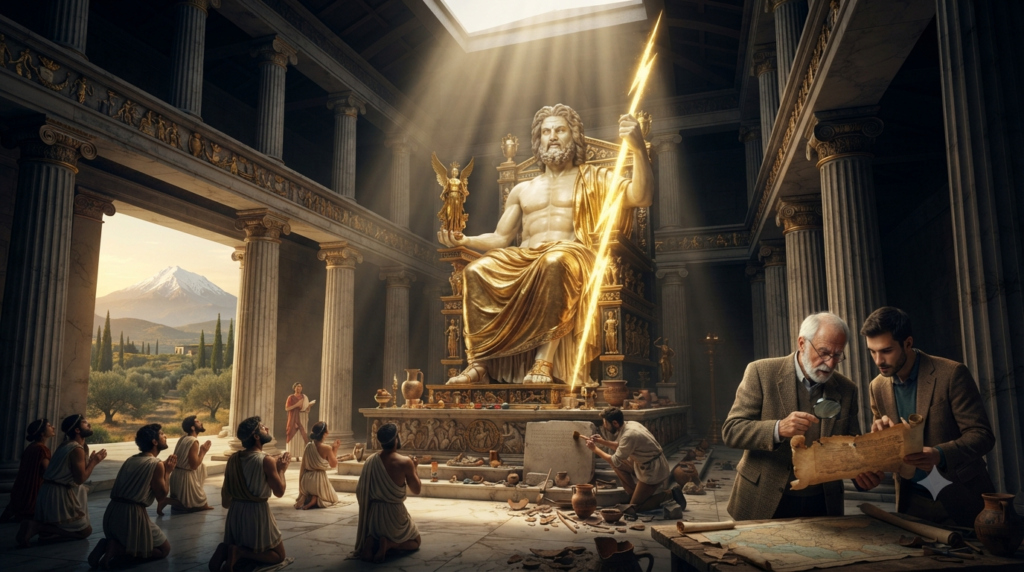
The Statue of Zeus employed a chryselephantine technique, combining ivory for exposed skin surfaces with gold for clothing and other decorative elements, all constructed over an underlying wooden framework, representing one of ancient Greece’s most technically sophisticated and materially valuable sculptural achievements.
This statue reached a truly monumental scale, standing approximately twelve meters tall, nearly touching the ceiling of the temple that housed it, creating an overwhelming physical presence that ancient visitors consistently described as genuinely awe-inspiring upon first encountering this massive representation of Zeus within the temple’s interior space.
The statue depicted Zeus seated upon an elaborately decorated throne, holding a small statue of Nike, the goddess of victory, in one hand while grasping a scepter in the other, creating a composition that visually reinforced Zeus’s supreme authority alongside his connection to triumph and victorious outcomes throughout Greek mythology.
This detailed physical description helps modern audiences understand where is the Statue of Zeus conceptually, even in its physical absence, allowing us to reconstruct through historical description what this genuinely remarkable ancient sculpture actually looked like during the many centuries it remained standing within its original temple setting.
Why the Statue of Zeus Was Considered a Wonder
The Statue of Zeus earned inclusion among the Seven Wonders of the Ancient World, a designation reflecting its extraordinary scale, technical sophistication, and profound cultural significance within the broader ancient Mediterranean world, placing it alongside other legendary structures such as the Great Pyramid of Giza and the Hanging Gardens of Babylon.
Ancient visitors and writers consistently described the overwhelming visual and emotional impact this statue produced, with historical accounts suggesting that encountering the statue in person left a lasting, genuinely profound impression on those who traveled to Olympia specifically to witness this remarkable sculptural achievement firsthand.
This reputation for producing genuine emotional and religious impact reinforces why where is the Statue of Zeus remains such a compelling historical question today, since this level of ancient reverence and admiration makes its eventual, uncertain disappearance feel like a genuinely significant cultural loss extending well beyond simple physical destruction.
Understanding this historical reputation helps explain why the statue’s ultimate fate continues generating serious scholarly and popular interest, reflecting genuine appreciation for what ancient sources consistently describe as one of the most impressive artistic and religious achievements of the ancient Greek world.
What Happened to the Statue
As Christianity gradually became the dominant religion throughout the Roman Empire, the Temple of Zeus at Olympia eventually closed, reflecting the broader decline of traditional Greek religious practice as imperial religious policy shifted significantly during Late Antiquity, directly affecting the statue’s continued preservation and religious function.
Historical accounts suggest that the Statue of Zeus was eventually transported to Constantinople, the capital of the Eastern Roman Empire, though the specific details and circumstances surrounding this relocation remain somewhat historically uncertain based on surviving ancient sources addressing where is the Statue of Zeus during this particular transitional historical period.
Most historical accounts point to a significant fire in Constantinople during the fifth century CE as the likely event that ultimately destroyed the statue, though ancient sources do not provide complete, entirely consistent documentation regarding this final destruction, leaving some genuine historical uncertainty surrounding the statue’s precise final fate.
This combination of relocation and probable destruction by fire represents the most historically supported answer to where is the Statue of Zeus today, though the remaining uncertainty in ancient sources means historians continue treating this specific historical account with appropriate scholarly caution rather than complete certainty.
So, Where Is the Statue of Zeus Today?
Based on available historical evidence, the honest answer to where is the Statue of Zeus today is that it no longer exists anywhere in physical form, having likely been destroyed by fire in Constantinople during the fifth century CE, following its earlier relocation from its original home at Olympia.
What remains today includes the ruins of the Temple of Zeus itself at Olympia, Greece, which visitors can still explore as an archaeological site, providing tangible physical connection to the statue’s original location even though the statue itself has been lost for well over a thousand years of subsequent history.
Ancient coins depicting the statue, along with detailed written descriptions from ancient historians and travelers, provide our only remaining visual and descriptive evidence of the statue’s actual appearance, allowing modern scholars and enthusiasts to understand where is the Statue of Zeus conceptually despite its complete physical absence today.
This combination of archaeological ruins, ancient coinage, and historical written description represents the complete extent of what survives regarding this once-legendary statue, confirming its status as one of the Seven Wonders of the Ancient World that no longer exists in any physical form accessible to modern visitors.
FAQ — Quick Answers About the Statue of Zeus
Where is the Statue of Zeus today?
The Statue of Zeus no longer exists; it was likely destroyed by fire in Constantinople during the fifth century CE after being relocated from its original home in Olympia.
Who created the Statue of Zeus?
The Statue of Zeus was created by Phidias, the renowned Greek sculptor also responsible for the statue of Athena Parthenos in Athens.
Where was the Statue of Zeus originally located?
The statue was originally housed within the Temple of Zeus at Olympia, Greece, the site of the ancient Olympic Games.
How big was the Statue of Zeus?
The statue stood approximately twelve meters tall, nearly reaching the ceiling of the temple that housed it at Olympia.
Can you visit the Statue of Zeus today?
No, but visitors can explore the ruins of the Temple of Zeus at Olympia, the statue’s original historical location.
Conclusion
Anyone who sets out to answer where is the Statue of Zeus today ultimately discovers a story of loss rather than location, tracing this legendary sculpture from its creation by Phidias at Olympia through its eventual relocation to Constantinople and likely destruction by fire during the fifth century CE. No physical trace of the statue itself remains anywhere today.
What survives instead includes the ruins of its original temple at Olympia, ancient coins bearing its image, and written descriptions from ancient historians, together allowing modern audiences to understand this remarkable statue’s scale and significance despite its complete physical absence from the modern world.
Ultimately, where is the Statue of Zeus finds its answer not in any surviving location, but in historical memory itself, confirming its place among the Seven Wonders of the Ancient World that, despite their legendary status, did not survive into the present day.

Orin Vale has spent the better part of two decades tracing the threads that connect the world’s oldest stories — from the halls of Asgard to the banks of the Nile, from Olympus to the jungles of the Maya. What began as a childhood fascination with flood myths and trickster gods grew into years of independent study across comparative mythology and ancient religion, always chasing the same question: what did these stories mean to the people who first told them? Orin writes for readers who want more than trivia — the ones looking for the beliefs, fears, and truths that myths were built to carry.