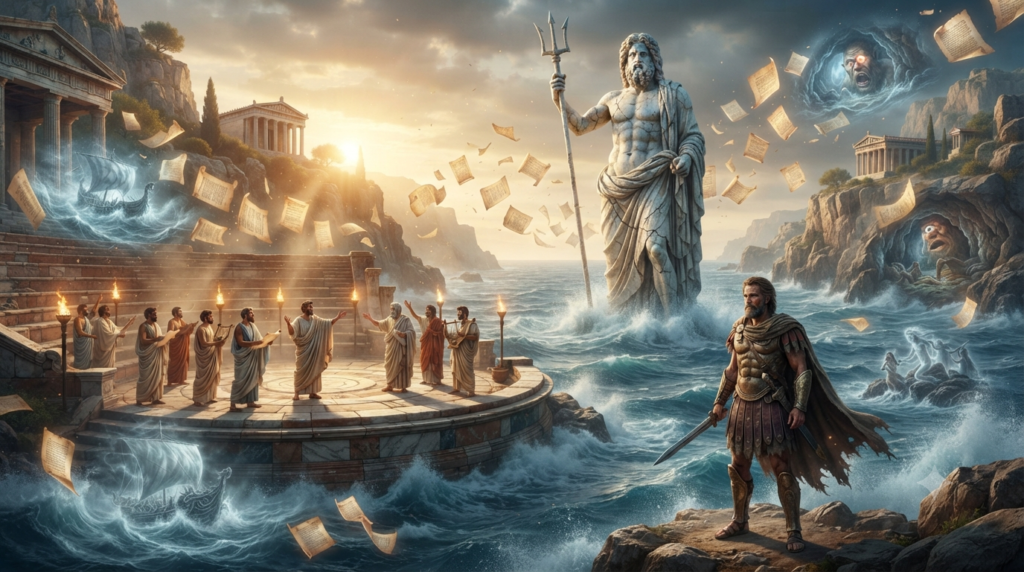
The question of whether Odysseus killed Poseidon has a clear and immediate answer: no, Odysseus never killed Poseidon, and no version of Greek mythology describes such an event taking place. The premise itself runs directly against one of the most fundamental rules governing the Greek pantheon, since Olympian gods like Poseidon are immortal by nature, incapable of being killed by mortal hands regardless of a hero’s strength, cunning, or divine favor. Understanding why this question has an impossible premise is the first step toward understanding what actually happened between Odysseus and Poseidon.
Rather than a story of a mortal defeating a god, the true relationship between Odysseus and Poseidon in Homer’s Odyssey is one of prolonged, one-sided pursuit, in which the god relentlessly hunts the hero across the seas while Odysseus struggles simply to survive. This dynamic makes far more narrative and mythological sense than any confrontation ending in Poseidon’s death, since it preserves the god’s authority while still allowing for a compelling story of endurance and escape.
Clarifying this distinction matters because it reshapes the entire framework through which readers should approach the Odyssey’s central conflict. Rather than searching for a moment when Odysseus kills Poseidon, the more accurate and rewarding question becomes how Odysseus managed to survive a god who actively sought his destruction, using intelligence, patience, and divine assistance rather than brute confrontation.
What follows examines exactly why the idea of Odysseus killing Poseidon is mythologically impossible, where this misconception likely originates, and what genuinely transpired between the hero and the god throughout one of literature’s most enduring epics.
Why Odysseus Could Never Kill Poseidon
The immortality of the Olympian gods stands as one of the defining principles of Greek mythology, separating deities like Poseidon entirely from the mortal characters who populate epics such as the Odyssey. Poseidon, as god of the sea, exists outside the boundaries of death that govern human life, meaning no weapon, trick, or act of heroism available to a mortal like Odysseus could ever end his existence. This structural rule alone makes the premise behind did Odysseus kill Poseidon impossible from the outset.
Ancient Greek religious and literary tradition consistently reinforces this boundary between gods and mortals, with no surviving source, whether Homeric epic, Hesiod’s writings, or later classical literature, ever depicting an Olympian deity being slain by human action. Even the most powerful mortal heroes in Greek myth, figures who battle monsters and defy fate itself, never come close to killing a god outright, since doing so would violate the fundamental order the gods themselves maintain over the cosmos.
Odysseus, despite his renowned cunning and resourcefulness, operates within this same limitation throughout his journey home. His conflict with Poseidon is defined not by any attempt to kill the god, which would have been narratively and theologically unthinkable to an ancient audience, but by his efforts to endure, evade, and eventually outlast the god’s anger long enough to reach Ithaca alive.
This immortal status is precisely why questions like did Odysseus kill Poseidon require reframing rather than a simple yes-or-no answer. The real story lies not in the impossible defeat of a god, but in the very real and dramatic struggle of a mortal man attempting to survive one, a distinction that shapes every subsequent event in Odysseus’s long and dangerous voyage.
Where This Misconception Comes From
Confusion around whether Odysseus killed Poseidon likely stems from a few overlapping sources, the most common being a misunderstanding of what it means for a hero to “beat” or “defeat” a god within the context of ancient mythology. In everyday language, defeating an opponent often implies eliminating them entirely, but in Greek myth, a mortal defeating a god typically means surviving their wrath or outmaneuvering their pursuit rather than ending their life.
Modern media has also contributed significantly to this kind of confusion, particularly video games and films that reimagine Greek mythology with far looser rules than the original sources. Franchises depicting gods being killed by mortal protagonists have introduced generations of audiences to a version of Greek mythology where divine death is not only possible but common, making it easy to mistakenly assume similar events occur in the original Homeric texts.
This same pattern of confusion appears elsewhere in mythology-focused searches, such as questions asking whether Thor killed Zeus, which similarly stem from blending unrelated pantheons or applying modern storytelling conventions to ancient source material. In both cases, the underlying issue is the same: contemporary reinterpretations of mythology often abandon the strict rules that governed how ancient audiences understood gods and their relationship to mortality.
Recognizing this origin helps clarify why the question did Odysseus kill Poseidon persists despite having no basis in any classical source. The confusion reflects a broader modern tendency to import assumptions from popular culture into stories that originally operated under very different rules regarding divine power and mortal limitation.
What Actually Happened: Odysseus’s Real Conflict with Poseidon
The genuine conflict between Odysseus and Poseidon begins not with any attack on the god, but with an injury inflicted on Poseidon’s son, the Cyclops Polyphemus, during Odysseus’s escape from his island cave. After Odysseus blinds him and reveals his own name while sailing away, Polyphemus prays to his father, asking Poseidon to curse Odysseus’s journey home, ensuring it becomes as long, painful, and costly as possible.
This curse, rather than any direct confrontation, becomes the true engine driving the conflict between the two throughout the remainder of the epic. Poseidon, bound by the same fate that guarantees Odysseus will eventually reach Ithaca, cannot kill him outright, but channels his fury into obstacles, storms, and prolonged suffering, fulfilling his son’s request as closely as divine law allows.
From this point forward, every setback Odysseus experiences at sea traces back to Poseidon’s anger, including shipwrecks, lost companions, and years of delay before finally reaching home. This sustained pursuit, rather than a single decisive battle, defines the relationship between hero and god throughout the Odyssey, making the conflict a war of attrition rather than a contest ending in anyone’s death.
Understanding this origin makes clear why the question did Odysseus kill Poseidon misunderstands the fundamental nature of their relationship. The true story is one of a wounded god’s lasting anger and a mortal man’s determination to survive it, not a battle for supremacy that could ever end with Poseidon’s defeat or death.
How Odysseus Actually Survived Poseidon’s Wrath
Given that direct confrontation with Poseidon was never an option, Odysseus’s survival depends almost entirely on intelligence, patience, and the intervention of other gods sympathetic to his plight. Athena, his most consistent divine ally throughout the epic, repeatedly works to counterbalance Poseidon’s fury, calming storms, guiding his path, and advocating on his behalf before the assembled gods of Olympus.
Other divine figures also play crucial roles at key moments, such as the sea goddess Ino, who rescues Odysseus during the storm that nearly drowns him in Book Five, offering him a magical veil that keeps him afloat long enough to reach the shores of Scheria. These interventions illustrate that Odysseus’s survival was never purely a matter of personal strength, but a combination of his own resilience and the protection extended by gods willing to shield him from Poseidon’s full wrath.
Odysseus’s own resourcefulness remains essential throughout these trials as well, since even with divine assistance, he must navigate treacherous situations using judgment, patience, and physical endurance. His survival strategy consistently favors evasion and endurance over confrontation, a pattern entirely consistent with the impossibility of ever answering did Odysseus kill Poseidon in the affirmative.
This combination of mortal cunning and divine support allowed Odysseus to endure a decade of hardship without ever needing to defeat Poseidon directly. His survival stands as a testament to resilience under divine persecution rather than a triumph over the god himself, reinforcing the true nature of their conflict throughout the epic.
Did Poseidon Ever Try to Kill Odysseus?
While Odysseus never attempts to kill Poseidon, the reverse is genuinely true: Poseidon actively seeks to kill Odysseus at multiple points throughout the epic, most dramatically during the storm depicted in Book Five. Upon spotting Odysseus’s raft nearing the shores of Scheria, Poseidon summons a massive storm, calling on opposing winds simultaneously in a deliberate attempt to destroy the vessel and drown the hero before he can reach safety.
This asymmetry lies at the heart of their entire relationship, with Poseidon possessing both the motive and the divine power to end Odysseus’s life, held back only by the boundaries of fate rather than any lack of intent. The god’s fury throughout the poem is neither symbolic nor restrained, representing a genuine, sustained effort to harm Odysseus as severely as divine law permits.
This reality further clarifies why did Odysseus kill Poseidon fundamentally misreads the balance of power between the two figures. Odysseus spends the entire epic on the defensive, reacting to a god’s aggression rather than initiating any attack of his own, a dynamic that makes the idea of him killing Poseidon not just false, but a complete inversion of their actual roles in the story.
Recognizing this one-directional hostility helps readers appreciate the true stakes of Odysseus’s journey. He is not a conqueror seeking to overpower a deity, but a survivor navigating the wrath of a god who possesses every advantage except the ability to override the fate guaranteeing his eventual return home.
Why the Conflict Ends Without Death on Either Side
The rivalry between Odysseus and Poseidon reaches its conclusion not through any climactic battle, but through the natural limits placed on divine power by fate itself. Since it has already been determined that Odysseus will return to Ithaca, Poseidon’s fury, however intense, can only delay and complicate that outcome rather than prevent it entirely, ensuring the conflict never escalates into a confrontation that could end in death.
By the time Odysseus finally reaches home, Poseidon’s active pursuit of him fades from the narrative, having exhausted the extent of harm the god was permitted to inflict under the terms of Polyphemus’s original curse. This resolution reflects the broader structure of Greek mythology, where even the most powerful gods operate within limits set by fate, preventing conflicts between gods and mortals from ending in outcomes as absolute as death on either side.
This ending reinforces why did Odysseus kill Poseidon remains an impossible outcome from beginning to end. The story never moves toward a confrontation capable of producing that result, instead resolving through endurance, divine restraint, and the eventual exhaustion of Poseidon’s sanctioned vengeance rather than any dramatic reversal of power between hero and god.
The absence of death on either side ultimately reflects the true nature of Greek mythological storytelling, where mortal heroism is measured by survival and cleverness rather than by the ability to overpower the gods themselves. Odysseus’s story ends not in triumph over Poseidon, but in successful endurance of him, a distinction that defines the entire arc of his journey home.
Frequently Asked Questions
Can gods die in Greek mythology?
No, Olympian gods like Poseidon are immortal by nature and cannot be killed by mortals under any circumstances described in classical sources.
Did Odysseus ever fight Poseidon directly?
No, the two never engage in direct physical combat; their conflict unfolds through storms, delays, and divine intervention rather than confrontation.
What did Poseidon do to Odysseus instead of being killed by him?
Poseidon pursued Odysseus with storms, shipwrecks, and prolonged hardship throughout his journey home, fulfilling the curse requested by his son Polyphemus.
Conclusion
The premise behind did Odysseus kill Poseidon collapses under the basic rules of Greek mythology, since gods like Poseidon exist beyond the reach of mortal death entirely. What unfolds instead is a far more compelling story: a god’s relentless, personal pursuit of a single mortal, and that mortal’s extraordinary endurance in surviving it through intelligence, patience, and the support of allies like Athena and Ino, rather than through any confrontation that could ever end in Poseidon’s defeat.

Orin Vale has spent the better part of two decades tracing the threads that connect the world’s oldest stories — from the halls of Asgard to the banks of the Nile, from Olympus to the jungles of the Maya. What began as a childhood fascination with flood myths and trickster gods grew into years of independent study across comparative mythology and ancient religion, always chasing the same question: what did these stories mean to the people who first told them? Orin writes for readers who want more than trivia — the ones looking for the beliefs, fears, and truths that myths were built to carry.