In the rich and complex world of Greek mythology, where gods and goddesses often embodied powerful and capricious forces, Eleos stood as a gentle but essential presence. Who is Eleos, the Greek personification of mercy? She is the divine spirit or personification of mercy, pity, compassion, and clemency. Unlike the thunderous Olympians who governed the sky and sea, Eleos was a daimona, a spirit whose power was felt in the quiet, profound acts of human empathy. Her very name, derived from the Greek word ἔλεος (eleos), translates directly to “mercy,” “compassion,” or “pity”. Eleos was more than just an abstract concept; she was a worshipped deity whose altar in Athens served as a powerful symbol of the city’s humanity and its role as a refuge for the desperate.
Origins and Family
The genealogical origins of Eleos are somewhat sparse, as is common with personified spirits in Greek mythology who often personify abstract concepts rather than having elaborate myths. According to the Latin author Hyginus, Eleos was the daughter of two primordial and powerful deities: Erebus, the personification of darkness, and Nyx, the goddess of the night. This lineage, connecting a spirit of mercy to the deepest and most ancient forces of the cosmos, suggests that compassion was seen as a fundamental aspect of existence. In this framework, Eleos was the antithesis of her opposite number, Anaideia, the spirit of ruthlessness, cruelty, and shamelessness. The struggle between Eleos and Anaideia represented the eternal human conflict between empathy and indifference.
The Altar of Mercy at Athens
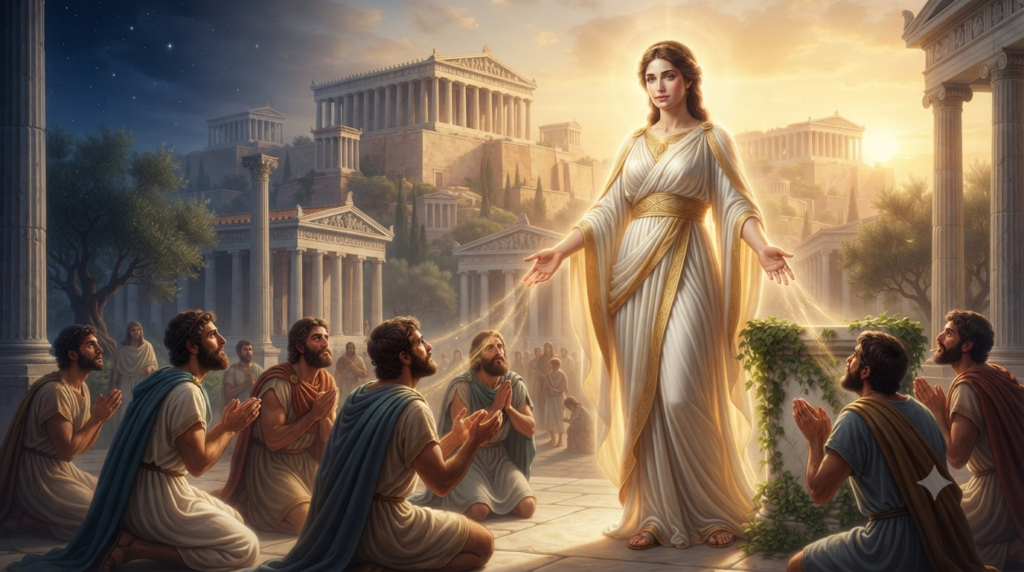
The most significant and defining aspect of Eleos’s worship was her unique altar, which stood in the agora, the bustling civic and commercial heart of ancient Athens. The location was no accident, as placing the altar for mercy in the center of public life highlighted its importance to Athenian identity. According to the traveler and geographer Pausanias, who wrote in the 2nd century CE, the Athenians were unique among the Greeks in their worship of this divine being. The altar served as a place of sanctuary, a testament to the city’s willingness to hear the pleas of the desperate. It was famously said that at the altar of Eleos, all supplicants were heard, day and night, regardless of the severity of their crimes. This created a powerful and enduring image of Athens as a compassionate and civilized city, a safe haven for those who had nowhere else to turn.
The Suppliants at Her Altar
The altar of Eleos was not merely a symbolic structure; it was central to the mythology of Athenian mercy through famous literary and historical supplications. The most prominent myths associated with Eleos involve the children of Heracles and the hero Adrastus. When the children of the great hero Heracles were being relentlessly pursued by King Eurystheus, they sought refuge at the altar of Eleos in Athens. Similarly, Adrastus, the king of Argos and leader of the failed expedition of the Seven against Thebes, came to this same altar to plead for permission to bury the fallen warriors who had died in the disastrous campaign. The act of the Athenians granting such supplicants their request was a source of immense civic pride, showcasing their adherence to the divine principles of mercy even in the face of political pressure or the risk of war.
Roman Equivalents and Legacy
The concept of Eleos did not remain confined to the Greek world but was adopted and adapted by the Romans, who saw her value in their own civic and philosophical traditions. In Roman mythology, Eleos was equated with Clementia, the goddess of clemency and forgiveness, and also with Misericordia, the personification of pity and compassion. The Roman historian and poet Statius, writing in the 1st century CE, described an altar to “gentle Clementia” in Athens, referencing the same compassionate spirit that Pausanias had documented. The legacy of Eleos continues to the modern day, as the Greek word eleos is a prominent term in the New Testament, used to describe God’s mercy and compassion toward humanity. This enduring legacy ensures that Eleos remains a powerful symbol of the importance of mercy and human kindness.
Frequently Asked Questions About Who is Eleos, the Greek personification of mercy?
Who were the parents of Eleos in Greek mythology?
According to the Latin author Hyginus, Eleos was the daughter of Erebus, the primordial god of darkness, and Nyx, the goddess of night.
Where was the altar of Eleos located?
The altar of Eleos was located in the agora, which was the central public square and marketplace of ancient Athens.
What was unique about the worship of Eleos in ancient Greece?
The Athenians were unique among the Greeks in their worship of Eleos. The altar was considered a place of sanctuary where all supplicants were heard.
Who sought refuge at the altar of Eleos?
The children of the hero Heracles sought refuge from King Eurystheus at the altar of Eleos. Also, the hero Adrastus came to the altar to plead for the burial of fallen warriors after the battle of the Seven against Thebes.
What is the Roman equivalent of Eleos?
The Roman goddesses who are seen as equivalents to Eleos are Clementia, the goddess of clemency and forgiveness, and Misericordia, the personification of pity.
Conclusion
Who is Eleos, the Greek personification of mercy? She is the embodiment of one of humanity’s most fundamental virtues: compassion. As a daimona born from the primordial forces of darkness and night, Eleos represented the profound choice to extend kindness and forgiveness. Her most lasting legacy is her unique altar in the heart of Athens, a symbol of a city that prided itself on its humanity and its willingness to act as a sanctuary for the desperate. The stories of supplicants like the Heracleidae and Adrastus are testaments to the power and importance of the principle Eleos represented. Her name, living on in texts like the New Testament, serves as an enduring reminder that mercy is not a sign of weakness but a profound strength that elevates and defines civilization itself.

Orin Vale has spent the better part of two decades tracing the threads that connect the world’s oldest stories — from the halls of Asgard to the banks of the Nile, from Olympus to the jungles of the Maya. What began as a childhood fascination with flood myths and trickster gods grew into years of independent study across comparative mythology and ancient religion, always chasing the same question: what did these stories mean to the people who first told them? Orin writes for readers who want more than trivia — the ones looking for the beliefs, fears, and truths that myths were built to carry.