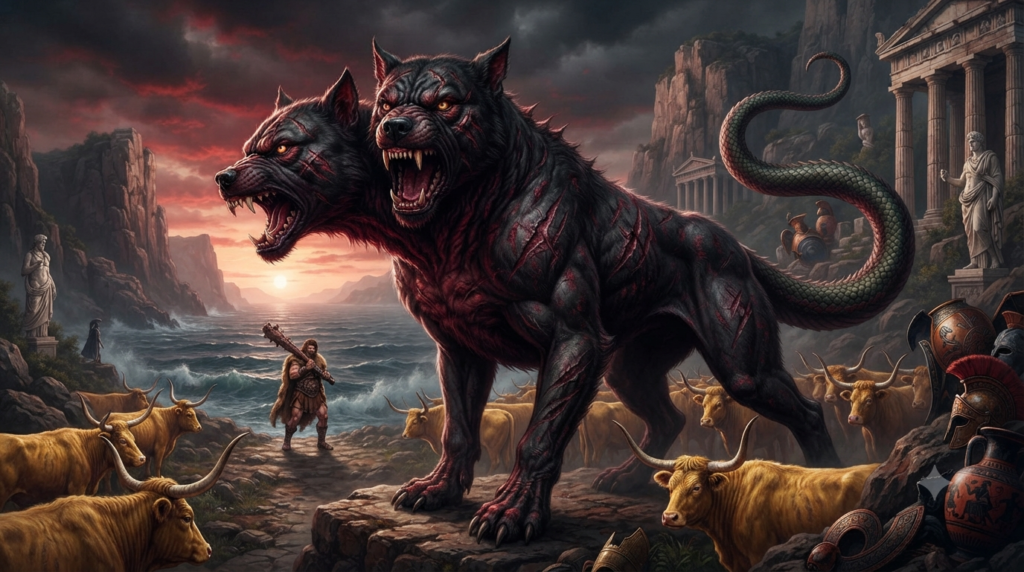
In the terrifying menagerie of Greek mythology, where monstrous creatures guard forbidden realms and challenge the greatest heroes, Orthros stands as one of the most fearsome and formidable guardians. Who is Orthros, the two-headed dog of Greek mythology? He is the monstrous, multi-headed canine who served as the loyal watchdog of the giant Geryon, tasked with protecting the fabulous cattle that grazed on the mythical island of Erytheia. As the brother of Cerberus, the infamous three-headed hound of Hades, Orthros represents the untamed, primordial forces that heroes must overcome in their quests, embodying the ferocity and loyalty of the canine spirit in its most terrifying form.
Origins and Genealogy
Orthros was born from the union of two of the most powerful and ancient monsters in Greek mythology. His parents were Typhon, the terrifying storm-giant who was considered the most fearsome creature in all of Greek myth, and Echidna, the monstrous she-dragon who was known as the “Mother of All Monsters.” This fearsome lineage ensured that Orthros would be a creature of immense power and savagery. His siblings included some of the most infamous monsters of Greek legend, including Cerberus, the three-headed guardian of the underworld; the Lernaean Hydra, the multi-headed serpent; the Chimera, the fire-breathing hybrid; the Nemean Lion, whose hide was impervious to weapons; and the Sphinx, the riddle-posing guardian of Thebes.
This monstrous family tree firmly establishes Orthros as part of a divine and terrifying dynasty that was often in direct opposition to the Olympian gods and the heroes they championed. His nature as a guardian creature is reflected in the roles of his siblings, who were all tasked with protecting some of the most important or sacred sites in the mythological world, from the gates of Hades to the hidden lairs of the gods.
The Two-Headed Monster
Orthros is consistently described in ancient sources as a two-headed dog, a physical characteristic that made him a formidable opponent. This duality is sometimes interpreted as representing a heightened sense of vigilance, as he could always have one head awake while the other rested. The poet Hesiod, in his Theogony, famously describes him as “Orthros, a dog with two heads, an irresistible monster, whose death was destined to be at the hands of Heracles.”
Some later traditions and artistic depictions have portrayed Orthros with more than two heads, sometimes with fifty heads or even a serpent’s tail, but the canonical and most widely accepted representation is that of a powerful dog with two heads. This number of heads, while less than his more famous brother Cerberus, is symbolic of the immense destructive power that Orthros possessed. Regardless of the exact number of heads, Orthros was described as an “irresistible” and “unspeakable” monster, a creature whose very appearance struck terror into the hearts of mortals and gods alike.
The Cattle of Geryon
The primary mythological role of Orthros was to serve as the vigilant guardian of the magnificent cattle owned by the giant Geryon. According to the myth, Geryon was a monstrous being with three bodies, who lived on the island of Erytheia, far to the west, near the edge of the world. His cattle were of exceptional beauty and value, and they were protected by the two-headed dog Orthros and the herdsman Eurytion.
The tenth and final labor of the great hero Heracles (Hercules) was to retrieve these cattle. This was considered one of his most difficult and dangerous tasks, as it required him to travel to the far edge of the world. Upon his arrival at Erytheia, Heracles was immediately confronted by the guardian Orthros. The hero wasted no time, drawing his mighty club and striking the two-headed dog. Some versions of the myth also describe Heracles using his strength to wrestle the beast or even killing Orthros with a single, powerful blow from his club.
The Killing of Orthros and Eurytion
The slaying of Orthros was a swift but crucial moment in Heracles’s labor. The two-headed dog, for all his ferocity, was no match for the demigod’s immense strength. Immediately after killing Orthros, Heracles also dispatched the herdsman Eurytion, who attempted to defend the cattle. This act of swift and decisive violence, however, was not without consequence. The noise of the commotion alerted the giant Geryon, who came to investigate his missing guardians. This led to a dramatic confrontation where Heracles, after some difficulty, shot and killed the three-bodied giant with one of his poisoned arrows. The removal of Orthros was essential for Heracles to complete his labor and return the cattle to King Eurystheus.
Artistic Representations and Legacy
Orthros is a figure who appears in various forms of ancient Greek art, though his depictions are less frequent than his brother Cerberus. On the François Vase, a famous Attic black-figure volute krater dating to around 570 BC, Orthros is depicted with two heads and a serpent’s tail, demonstrating the fluidity of his iconography. He is also depicted on the chest of Cypselus, an early Archaic period masterpiece, where he is shown fighting Heracles. In art, Orthros is often portrayed as a fierce, powerful dog, emphasizing his role as a guardian and his monstrous nature.
The legacy of Orthros is somewhat overshadowed by that of his more famous brother, Cerberus. However, his role in the Heracles myth is crucial, establishing the hero’s ability to overcome even the most terrifying guardians. His name has also endured in modern popular culture, appearing in various forms of fantasy literature, games, and films, typically as a fearsome beast or guardian creature. Orthros remains a potent symbol of the monstrous guardians that heroes must overcome in their journeys and the untamed forces of nature that civilization must tame.
Frequently Asked Questions About Who is Orthros, the two-headed dog of Greek mythology?
How many heads did Orthros have?
Orthros is most famously described as having two heads. Some later sources and artistic depictions show him with more heads or a serpent’s tail, but the two-headed version is the most prevalent and canonical.
Who were the parents of Orthros?
Orthros was the offspring of Typhon, the monstrous storm-giant, and Echidna, the she-dragon known as the “Mother of All Monsters.” This lineage placed him among the most fearsome creatures in Greek mythology.
What was the role of Orthros in Greek mythology?
Orthros served as the loyal guardian of the cattle of Geryon. He was tasked with protecting the giant’s herd on the island of Erytheia, a role that brought him into conflict with the hero Heracles.
How did Heracles kill Orthros?
Heracles killed Orthros during his tenth labor, which was to retrieve the cattle of Geryon. The hero struck the two-headed dog with his club, slaying him quickly before also killing the herdsman Eurytion.
Are Orthros and Cerberus brothers?
Yes, Orthros and Cerberus were brothers. Both were born to Typhon and Echidna, making them part of a family of legendary monsters, including the Lernaean Hydra and the Chimera.
What is the significance of Orthros’s name?
The name “Orthros” is sometimes interpreted as meaning “the one who stands guard” or “the watcher,” reflecting his role as a guardian figure. His name also appears to be related to the word for “mountaintop” in some contexts.
Conclusion
Who is Orthros, the two-headed dog of Greek mythology? He is the formidable, multi-headed canine guardian whose loyalty and ferocity made him a worthy opponent for the greatest of all Greek heroes. As the brother of the infamous Cerberus, he stands as a symbol of the monstrous threats that heroes must overcome in their journeys to prove their worth and achieve their goals. His swift and decisive defeat at the hands of Heracles underscores the hero’s unparalleled strength and the importance of courage in the face of overwhelming odds. Although his role in the narrative is brief, his presence is essential to the drama of the twelfth labor, ensuring that the cattle of Geryon were not surrendered without a fight. Orthros endures as a powerful symbol of the untamed forces of nature and the tireless guardianship that stands between mortals and their greatest prizes.

Orin Vale has spent the better part of two decades tracing the threads that connect the world’s oldest stories — from the halls of Asgard to the banks of the Nile, from Olympus to the jungles of the Maya. What began as a childhood fascination with flood myths and trickster gods grew into years of independent study across comparative mythology and ancient religion, always chasing the same question: what did these stories mean to the people who first told them? Orin writes for readers who want more than trivia — the ones looking for the beliefs, fears, and truths that myths were built to carry.