In the vast and luminous tapestry of Greek mythology, few figures shine as brightly—both literally and figuratively—as the giant hunter who was placed among the stars. Who is Orion in Greek mythology? He is the mighty hunter, a giant of extraordinary beauty and strength, whose adventures and tragic death captivated the ancient Greeks and whose image remains one of the most recognizable constellations in the night sky . His story is a patchwork of contradictory tales, a collection of episodes that vary wildly across ancient sources, yet all agree that he was the greatest of hunters, a figure whose very existence embodied the relationship between humanity, the gods, and the natural world .
Origins and Genealogy
The origins of Orion are as varied and complex as the myths that surround him, with ancient sources offering several competing genealogies. The most common tradition, recorded by the poet Hesiod, states that Orion was the son of the sea god Poseidon and Euryale, a daughter of King Minos of Crete . This divine parentage granted him the remarkable ability to walk on the waves of the sea, a skill that would play a significant role in his later adventures .
A more unusual and earth-bound version of his birth was popular in Boeotia. According to this tradition, the gods Zeus, Hermes, and Poseidon visited the poor farmer Hyrieus, who offered them a feast. In return, the gods granted him a son. They took the hide of a sacrificed bull, urinated into it, and buried it in the earth. When Hyrieus dug it up ten months later, he found Orion, explaining why he was considered “earthborn” . His name, derived from the Greek word ourion, meaning “urine,” is a direct reference to this peculiar birth story . Regardless of his parentage, Orion was consistently described as a giant of immense stature and the most handsome of all earth-born men .
The Hunter’s Adventures
The core of Orion’s legend is a tragic tale of love, betrayal, and the restoration of sight. According to the most complete version of the story, Orion traveled to the island of Chios, where he fell in love with Merope, the daughter of King Oenopion . To win her hand, he cleared the island of its wild beasts, but the king, who disapproved of the match, continually deferred the marriage. In a drunken rage, Orion raped Merope . In retaliation, Oenopion called upon his father Dionysus, who made Orion fall into a deep sleep, during which Oenopion blinded him and cast him out of the kingdom .
Blinded and helpless, Orion wandered to the island of Lemnos, where he found the forge of the god Hephaestus. The smith-god took pity on him and gave him his servant Cedalion to guide him. Orion carried Cedalion on his shoulders as they journeyed to the east, to the land of the sun god Helios. The rays of the rising sun healed Orion’s eyes and restored his vision . Enraged, Orion returned to Chios to exact his revenge on Oenopion, but the king had hidden underground in a bronze chamber and escaped his wrath . Orion then traveled to Crete, where he became a hunter and companion to the virgin goddess Artemis .
The Death of Orion
The death of Orion is the most inconsistent part of his myth, with several distinct and competing versions recorded in ancient literature. One of the most famous stories involves Artemis and her twin brother Apollo. In this version, Apollo grew jealous of Orion’s friendship and closeness to his sister. He challenged her archery skills, pointing to a tiny black dot far out in the sea and claiming she could not hit it. Eager to prove her prowess, Artemis shot an arrow and struck the target perfectly—only to discover that the dot was Orion’s head, swimming far from shore .
Another prominent tradition, recounted by Hesiod, shifts the blame to Gaia, the goddess of the Earth. In this version, Orion boasted to Artemis that he would kill every beast on the planet . Enraged by this hubris, Gaia sent a giant scorpion to kill him. The creature stung and killed Orion, and after his death, both he and the scorpion were placed among the stars, where they are forever separated in the sky . The Roman mythographer Hyginus adds another layer to this story, stating that after Orion’s death, the healer-god Asclepius attempted to bring him back to life but was struck down by Zeus’s thunderbolt for doing so . Several other, less common versions attribute his death to his assault on the goddess herself, or to a quarrel with Artemis .
Orion in the Heavens
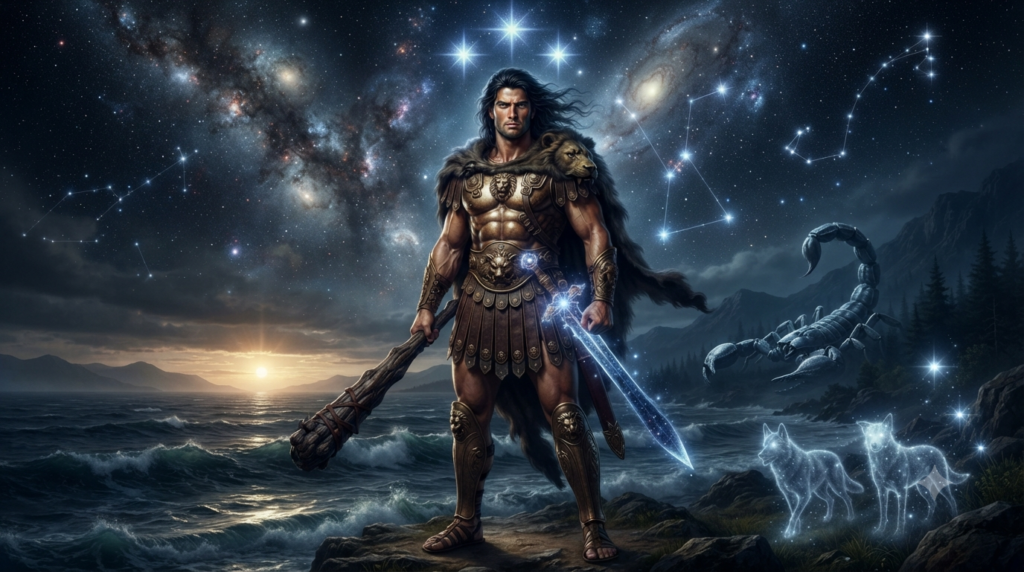
Following his death, Orion was placed among the stars, becoming the constellation that bears his name . In the sky, he is depicted as a giant hunter, often shown with a club, a lion’s skin, a belt of three bright stars, and a sword hanging from it . His two hunting dogs, represented by the constellations Canis Major and Canis Minor, follow him across the heavens . He is also shown pursuing the Pleiades, the seven sisters whom he once chased on earth .
The astronomical arrangement of Orion and Scorpius is one of the most famous and evocative celestial phenomena. As the myth states, the two constellations are never visible in the sky at the same time. When Scorpius rises, Orion sets, and vice versa . This eternal separation serves as a memorial to their legendary conflict, a powerful and enduring visual representation of a myth that has captivated humanity for millennia. Today, the constellation of Orion remains one of the most recognizable and beloved features of the night sky .
Frequently Asked Questions About Who is Orion in Greek mythology?
Who were the parents of Orion in Greek mythology?
The parentage of Orion varies in different sources. The most common tradition states that he was the son of Poseidon and Euryale. Another version describes him as earthborn, the son of the farmer Hyrieus, born from a bull hide after it was urinated on by three gods .
Why was Orion blinded and how did he regain his sight?
Orion was blinded by King Oenopion of Chios as punishment for raping his daughter, Merope. He regained his sight by traveling to the east and exposing his eyes to the rays of the rising sun, guided by the servant Cedalion on the island of Lemnos .
How did Orion die in Greek mythology?
There are several accounts of Orion’s death. One popular version states that he was killed by Artemis, who accidentally shot him at the challenge of her brother Apollo. Another well-known story says that Gaia sent a giant scorpion to kill him after he boasted he would kill every animal on earth .
What is the relationship between Orion and the constellations?
After his death, Orion was placed among the stars as the constellation of his name. He is depicted in the sky as a giant hunter pursuing the Pleiades and being pursued by the constellation Scorpius, which were arranged so they are never visible in the sky together .
Did Orion have any children?
In some accounts, Orion had several children. A Boeotian poet named Corinna says he fathered fifty sons with the nymphs of the river Cephisus. Another source, Antoninus Liberalis, states that his daughters were the Coronides .
Conclusion
Who is Orion in Greek mythology? He is the archetypal hunter, a giant of immense strength and tragic destiny whose story has been told and retold across the millennia. His myth, a rich tapestry of contradictory tales, embodies the ancient Greek fascination with the relationship between humanity and the divine, the ephemeral nature of life, and the eternal order of the cosmos. From his strange birth, his blinding and subsequent healing, to his tragic death at the hands of a goddess or a scorpion, his legend is a testament to the power of myth to explain the world around us. His elevation to the heavens, where he continues his celestial hunt across the night sky, ensures his immortality, making him one of the most enduring and beloved figures in all of mythology.

Orin Vale has spent the better part of two decades tracing the threads that connect the world’s oldest stories — from the halls of Asgard to the banks of the Nile, from Olympus to the jungles of the Maya. What began as a childhood fascination with flood myths and trickster gods grew into years of independent study across comparative mythology and ancient religion, always chasing the same question: what did these stories mean to the people who first told them? Orin writes for readers who want more than trivia — the ones looking for the beliefs, fears, and truths that myths were built to carry.