In the shadowy and enigmatic realm of Greek mythology, few figures are as complex, multifaceted, and enduringly fascinating as the goddess who presides over magic, crossroads, and the night. Who is Hecate in Greek mythology? She is the ancient and powerful goddess of witchcraft, necromancy, ghosts, and the moon, a figure of immense authority who could bestow both great blessings and terrible curses upon mortals and gods alike . As the sole child of the Titans Perses and Asteria, she was a deity of liminal spaces, worshipped at crossroads and doorways, and her very name, meaning “Worker from Afar,” speaks to her mysterious and far-reaching influence over the natural and supernatural worlds .
Origins and Family
The origins of Hecate are deeply rooted in the ancient world, with evidence suggesting that her cult may have originated among the Carians of Asia Minor before being adopted into Greek religion at an early date . In the canonical Greek tradition, her parentage is most famously recorded by Hesiod in the Theogony, where she is described as the only daughter of the Titans Perses and Asteria . This genealogy made her the granddaughter of the Titans Phoebe and Coeus, and the first cousin of Apollo and Artemis . However, as with many ancient deities, alternative parentage exists in different sources; some claim she was the daughter of Zeus and Demeter, or of the primordial goddess Nyx (Night) herself, reflecting the diverse and evolving nature of her cult .
The Hesiodic Hymn to Hecate
A passage of singular importance in understanding the nature of Hecate is the extensive and remarkable hymn dedicated to her in Hesiod’s Theogony. In this passage, Hesiod praises Hecate as a goddess of great honour, a daughter of Perses who was favoured above all by Zeus . He describes how she was given a share of the earth, the sea, and the starry heavens, a dominion that set her apart from many other deities . According to Hesiod, she was a goddess who could bestow wealth, victory in battle and athletic contests, good fortune for fishermen and hunters, and prosperity for flocks and herds, but could also withhold these blessings if she chose . This early portrayal of Hecate is not one of a sinister witch, but of a powerful and generous universal goddess who sat beside kings in judgment and was the nurse of the young (kourotrophos) .
The Goddess of the Crossroads and Boundaries
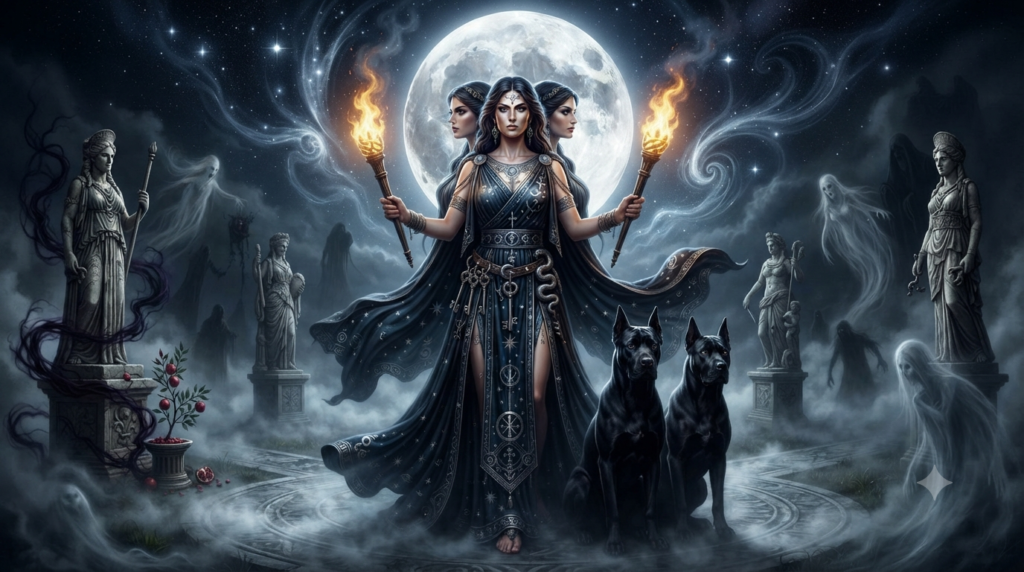
One of Hecate’s most defining attributes is her role as the goddess of the crossroads, a position that earned her the epithets Trioditis or Trivia, meaning “of the three ways” . Crossroads were considered potent and dangerous liminal spaces, points of transition where the boundaries between worlds were thin. It was at these junctions that Hecate was believed to dwell, appearing in her triple-formed aspect, with three bodies or faces looking in three different directions, so she could guard all paths at once . This threefold iconography was a powerful symbol of her dominion over all realms—earth, sea, and sky—and her ability to see past, present, and future. Household shrines called Hekataia were often placed at the entrances of homes and at these road junctions to invoke her protective power and ward off evil spirits .
Hecate and the Mysteries
Hecate played a pivotal role in the most important of all Greek mystery cults: the Eleusinian Mysteries. According to the Homeric Hymn to Demeter, Hecate was the only other deity besides Helios who witnessed the abduction of Persephone by Hades . When Demeter, the grieving mother, searched for her lost daughter, Hecate met her with a torch in hand and guided her on her quest . After Persephone was restored to her mother, Hecate became her attendant and companion in the underworld, solidifying her connection to the chthonic realm and the souls of the dead . In this capacity, she was a guide for the dead, a queen of ghosts, and a figure of immense power in the world of the spirits, often depicted accompanied by a pack of barking hell-hounds .
The Dark Goddess of Magic and Witchcraft
By the 5th century BCE, Hecate’s character began to take on a darker and more sinister dimension, becoming the supreme goddess of magic, witchcraft, and sorcery. From her position as a benevolent and universal Titan, she evolved into a terrifying nocturnal figure who ruled over ghosts, demons, and the dark arts . Her name became central to the magical invocations of witches and necromancers, who sought her aid in casting spells, drawing down the moon, and controlling the forces of the night . She was often called Brimo, the “Angry One,” and was propitiated with strange offerings such as black female lambs and, infamously, puppies . Her manifestations were fearsome: she appeared at night, surrounded by ghostly spirits and the sound of howling dogs, her approach heralding terror and the presence of the supernatural .
Frequently Asked Questions About Who is Hecate in Greek mythology?
What are Hecate’s symbols?
Hecate is most often associated with a pair of torches, which she used to guide Demeter in her search for Persephone. Other symbols include keys (as the gatekeeper of the underworld), snakes, daggers, and dogs, all of which represent her dominion over boundaries, the underworld, and magic .
Why is Hecate sometimes depicted as having three heads?
Hecate’s triple form, with three faces or bodies looking in three different directions, was a later development in her iconography. This powerful imagery reflects her role as the guardian of crossroads, allowing her to see in all directions at once and symbolize her dominion over the realms of heaven, earth, and the underworld .
Was Hecate a good or evil goddess?
Hecate was a profoundly ambivalent deity, capable of both great good and great evil. In early traditions, she was a generous goddess who could bestow wealth, victory, and protection. However, in later periods, she became associated with the darker arts of necromancy and witchcraft, ruling over ghosts and sending demons to haunt the night .
How was Hecate worshipped in ancient Greece?
Hecate was worshipped with household shrines called Hekataia, often placed at entrances to protect against evil. Offerings were frequently left for her at crossroads, particularly on the night of the new moon. Her cult centers included the sanctuary at Lagina in Caria, as well as in Athens, Eleusis, and Aegina, where mysteries were performed in her honour .
Who are Hecate’s parents?
According to the most canonical account in Hesiod’s Theogony, Hecate is the daughter of the Titans Perses and Asteria. However, other sources attribute a variety of parents to her, including Zeus and Demeter, or the primordial goddess Nyx (Night) .
Conclusion
Who is Hecate in Greek mythology? She is a deity of profound complexity, a goddess whose very nature defies easy categorization. From her origins as a powerful universal Titan, honoured by Zeus and revered for her boundless generosity, she evolved into the quintessential goddess of the night, magic, and the underworld. As the guardian of liminal spaces and the companion of the dead, she straddled the boundaries of life and death, good and evil, the known and the unknown. Her role in the Eleusinian Mysteries cemented her connection to the cycle of life and rebirth, while her fearsome appearance and association with witchcraft made her a figure to be both respected and feared. Hecate’s enduring legacy is a testament to the ancient Greek fascination with the mysterious, the powerful, and the untamed forces that exist just beyond the reach of the everyday world. She remains a powerful and evocative symbol of female power, the occult, and the enduring allure of the night.

Orin Vale has spent the better part of two decades tracing the threads that connect the world’s oldest stories — from the halls of Asgard to the banks of the Nile, from Olympus to the jungles of the Maya. What began as a childhood fascination with flood myths and trickster gods grew into years of independent study across comparative mythology and ancient religion, always chasing the same question: what did these stories mean to the people who first told them? Orin writes for readers who want more than trivia — the ones looking for the beliefs, fears, and truths that myths were built to carry.