In the vast and intricate tapestry of Greek mythology, where gods and monsters clash and heroes embark on impossible quests, few figures capture the imagination quite like the divine horse, Arion. While the winged stallion Pegasus often gallops into modern consciousness as the archetypal mythological horse, Arion stands as an equally fascinating figure, distinguished by his incredible speed, intelligence, and profound connections to the highest echelons of the Greek pantheon. Who is Arion, the divine horse of Greek mythology? He is more than a simple steed; he is a creature born from the union of the sea god Poseidon and the earth goddess Demeter, a being of immense power whose story is woven into the fabric of epic battles, royal lineages, and the very foundations of Arcadian religious cults. Known for saving the life of the Argive king Adrastus during the catastrophic war of the Seven against Thebes, Arion’s narrative offers a unique window into the ancient Greek understanding of divine intervention, the importance of horses in their culture, and the complex, often contentious, relationships among the gods themselves. This article will explore the origins, legendary deeds, and enduring cultural legacy of Arion, establishing his rightful place among the most celebrated creatures of antiquity. From his unusual birth to his role in literature and art, we will uncover the layers of myth that make Arion a truly magnificent and enduring symbol of divine power and natural wonder. Understanding Who is Arion, the divine horse of Greek mythology? requires delving into ancient texts and unraveling the traditions that kept his memory alive for millennia.
The Mythological Origins of Arion
The Union of Poseidon and Demeter
The most celebrated and widely accepted origin story of Arion is a tale of divine pursuit, shape-shifting, and the expression of powerful, primal forces. According to this tradition, most notably preserved by the geographer Pausanias in his Description of Greece, Arion was the offspring of the god of the sea, Poseidon, and the goddess of the harvest, Demeter . This lineage alone marks Arion as a creature of extraordinary significance, bridging the chthonic power of the earth and the capricious might of the sea.
The story unfolds during Demeter’s desperate search for her abducted daughter, Persephone. In her grief and rage, she wandered the earth, and during this time, she was pursued by her brother, Poseidon, who was filled with lust for her . This was not a welcome advance, and Demeter, in a clever attempt to evade him, transformed herself into a mare. She then blended in with the herds of horses belonging to Oncius, a local king in Thelpusa, a city in the region of Arcadia . Poseidon, however, was not so easily deceived. Known for his mastery over horses—he was, after all, the god who created them—he saw through the disguise. He then transformed himself into a magnificent stallion and mated with Demeter . This forced union resulted in the birth of a daughter and the divine horse, Arion .
This myth is rich with symbolic meaning. The Thelpusians, who were the keepers of this tradition, had a local cult for Demeter which gave her the epithet “Fury” (Erinys) . This title directly relates to her “avenging anger” at Poseidon following this deception . The birth of Arion is thus not just a divine origin story but an aetiological myth, one that explains the origins of a local religious practice and name. The horse, therefore, is born from an act of cosmic conflict and divine violation, embodying the powerful and often conflicting emotions of the gods involved. This narrative firmly answers the question of “Who is Arion?” by establishing his parentage as the very foundation of his power and status.
Alternative Origins in Ancient Sources
While the story of Poseidon and Demeter is the dominant narrative, ancient sources, as they often do with myths, offered alternative accounts. This polyphony of traditions highlights how myths evolved across different regions and time periods. These alternative origins do not necessarily contradict the main story but rather enrich the figure of Arion with different symbolic dimensions.
One significant alternative was presented by the poet Antimachus of Colophon, who claimed that Arion and his swift companion, Caerus, were not the children of the gods but were instead offspring of Gaia (Earth) . This version roots Arion in an even older and more primordial tradition, making him a direct child of the earth itself. This version is not without precedent; Pausanias notes that this was a tradition held by the people of Thelpusa in Arcadia, who considered Arion a native of their region . This grounding in the earth connects Arion to the chthonic forces of nature, separate from, but related to, the Greek pantheon.
Other traditions were more obscure. For instance, a scholiast (an ancient commentator) on Homer’s Iliad provides a different genealogy, stating that Arion was the offspring of Poseidon and a Fury (Erinys) . This version, linking the horse to one of the terrifying underworld avengers, adds a darker, more fearsome quality to his character. Yet another account, found in the works of Quintus Smyrnaeus, suggests that Arion was the offspring of Zephyrus, the god of the west wind, and a Harpy, a winged spirit of storm winds . This version emphasizes his incredible swiftness, a trait he shared with the wind, and links him to the realm of wild, untamed nature.
These varied traditions—from the sea and harvest gods to the earth itself, the furies, and the wind—demonstrate that Who is Arion, the divine horse of Greek mythology? was a question answered in different ways by different communities. Each version emphasizes a particular quality: his speed (wind), his power (earth), or his divine lineage (Poseidon). The multiplicity of traditions testifies to the widespread fame of the horse and the deep resonance of his myth across the Greek world.
Historical Context and Cultural Significance
The Horse in Mycenaean and Archaic Greece
To fully appreciate the myth of Arion, it is essential to place him within the broader historical context of ancient Greek culture. For the ancient Greeks, the horse was far more than a mere mode of transport or a beast of burden; it was a symbol of immense status, wealth, and martial prowess. This cultural valuation predates the classical era, reaching back to the Bronze Age, as evidenced by Mycenaean iconography and the significant role of horses in Homeric epic.
In the Homeric world, depicted in the Iliad and the Odyssey, horses were inextricably linked to the heroic ideal. A great warrior needed a great chariot team. The wealth and power of a king were reflected in the quality of his horses and the grandeur of his chariot. The epic poems are filled with named horses of divine descent, such as Achilles’ immortal horses, Balius and Xanthus, who were the offspring of the west wind Zephyrus . This literary context is crucial for understanding the figure of Arion. He is mentioned in a line from the Iliad itself, a testament to his early and enduring fame, long before the more detailed myths of later authors. Homer refers to him as the “swift horse of Adrastus, that was of heavenly stock” . This singular line establishes Arion’s ancient pedigree and his association with one of the most prominent heroes of the generation before the Trojan War.
The historical significance of horses in warfare and ceremony cannot be overstated. The introduction of the chariot revolutionized warfare in the ancient Near East and Greece, and the horse became synonymous with aristocracy. Kings and nobles would go to great lengths to acquire the best horses, as they were essential for victory in battle and in the prestigious chariot races at the ancient Olympic and other Panhellenic Games. Thus, the myth of Arion, a horse of unrivaled speed and supernatural origin, represents the absolute pinnacle of this cultural ideal. He is the horse that all others are measured against, a gift from the gods themselves, designed to bestow victory and ensure survival. Understanding this cultural milieu helps answer the question of “Who is Arion?” by showing that he was the ultimate symbol of a value system that prized the horse above almost all other animals.
Arion and the Arcadian Connection
The geographical focus of Arion’s myth, particularly his birth story, lies in Thelpusa, Arcadia. This region, located in the mountainous heart of the Peloponnese, was known for its rustic, ancient, and sometimes “backwards” culture, making it a fitting setting for myths involving chthonic and transformative events. The local traditions in Thelpusa are crucial for understanding a specific aspect of Arion’s identity.
As mentioned earlier, the Thelpusians associated Arion with a cult of Demeter Erinys (the “Fury”). Pausanias, in his travels, records that the inhabitants showed him a sanctuary of Demeter Erinys, near the river Ladon . The local myth was that Demeter had received her epithet of “Fury” because of her avenging anger at Poseidon for his deception that led to the birth of Arion . This potent and almost violent origin story was a central part of their local identity and religious observance. The horse Arion was, in a sense, a living piece of their sacred history, a symbol of the tumultuous divine encounter that shaped their land and worship.
Furthermore, the role of Oncius, the king whose mares Demeter hid among, is also tied to this landscape. Oncius was a local hero in Thelpusa, and his association with the myth cements the story firmly within this specific Arcadian context. The later geographer Strabo also mentions Arion in relation to Adrastus’ escape from Thebes . This illustrates how a local Arcadian myth became integrated into the broader, pan-Hellenic epic cycle of the Seven against Thebes. The “historical” reality for the Greeks was that this divine horse was born in their land, and by his incredible deeds, he secured a place in the wider, shared cultural memory of the Greek people. To comprehend “Who is Arion?”, one must see him as a unique product of the Arcadian landscape, a symbol of its ancient and powerful religious traditions that eventually gained national fame.
The Legendary Deeds of Arion
Arion and Heracles
The life of Arion, like many mythical figures, was defined by a succession of owners, each of whom played a role in his legendary career. According to the myth, after his divine birth, the horse did not go immediately to his most famous master, Adrastus. Instead, he first passed through the hands of several notable figures, serving as a prize and a weapon before his ultimate role as a king’s savior. This chain of ownership is detailed by Pausanias, who says the horse was given to Copreus, a king of Haliartus in Boeotia, by Poseidon himself . He then became the property of Oncus, the Arcadian king involved in his birth, before being passed on to the greatest hero of them all: Heracles .
Heracles’ acquisition of Arion is a testament to the horse’s unmatched value. During his campaign against Elis, Heracles demanded Arion from Oncus, who obliged . Heracles then rode the divine horse into battle, a pairing of two of the most powerful figures in Greek mythology. The Hesiodic Shield of Heracles, a poem from the 6th or early 5th century BC, vividly portrays this partnership. In the poem’s climactic battle, Heracles is described as being mounted on “the great horse, black-maned Arion” as he fights the defiant Cycnus, son of the god Ares . This image of the hero on the divine horse is one of supreme power and invincibility. Heracles, who also rode horses such as the mares of Diomedes, found in Arion a mount truly worthy of his god-like strength.
This episode was also used to explain a local athletic tradition. A scholiast on the Iliad mentions that Heracles used Arion to win a horse race at the shrine of Pagasaean Apollo near Troezen . This win and the subsequent dedication of Arion to a local hero demonstrate how mythology was used to explain the origins of real-world practices and the stories behind cultural landmarks. The association with Heracles firmly establishes Arion as a horse of heroic status, a creature whose power could only be matched by the strongest and most famous hero of antiquity.
The Rescue of Adrastus
The most famous and pivotal episode in the life of Arion was his role in the Theban war, specifically his rescue of King Adrastus of Argos. After Heracles had completed his tasks with the horse, he gave Arion to Adrastus . This transfer ultimately defined Arion’s place in myth and literature. Adrastus was the leader of the doomed expedition of the Seven against Thebes, an attack on the city that had been usurped by his brother-in-law, Polyneices.
The war was a complete disaster for the Argive coalition. All the other champions—including Polyneices, Tydeus, Capaneus, Hippomedon, Parthenopaeus, and Amphiaraus—were slain in the brutal conflict outside the walls of Thebes. As the battle was lost and the Argive army routed, Adrastus alone survived the slaughter, thanks to his divinely-bred horse, Arion . The ancient sources, from Homer to the later mythographers, all agree on this point. Apollodorus, a mythographer of the 1st or 2nd century AD, states that while all the other leaders were killed, “Adrastus alone was saved by his horse Arion” .
The details of the rescue are mentioned by Strabo, who notes that Adrastus’ chariot was wrecked, but he managed to escape on Arion’s back . This detail highlights the horse’s incredible intelligence and speed. In the chaos of a lost battle, with enemy forces closing in, Arion was able to swiftly spirit his master away from the battlefield and back to the safety of Argos. This act of salvation was the ultimate demonstration of the bond between a hero and his divine mount. It is the reason Arion’s name is forever etched in myth. To understand Who is Arion, the divine horse of Greek mythology?, one must acknowledge him first and foremost as the savior of Adrastus, a loyal and powerful companion who represented the thin line between life and death for a heroic king. This action is even referenced in the Iliad by Nestor, who uses the speed of “the swift horse of Adrastus” as a benchmark for the gods’ horses, demonstrating the enduring fame of this event .
Arion and the Nemean Games
Beyond his martial prowess, Arion also has a fascinating connection to the world of Greek athletics. According to tradition, the Nemean Games, one of the great Panhellenic festivals, were established to commemorate the death of the infant Opheltes, and they included a chariot race. In many versions of this founding story, Arion is the victor of the first-ever Nemean Games .
This event occurs during the Argive army’s march to Thebes. While passing through Nemea, the army stops to quench its thirst, and the infant prince Opheltes is tragically killed by a serpent. In his honor, the soldiers establish funeral games. A scholiast on the Iliad notes that in the chariot race of these games, Arion, ridden by Adrastus, finished first . This victory adds a layer of prestige to the horse’s resume. He was not only a peerless warhorse but also a champion of the most prestigious athletic competitions.
This link also further intertwines the myth of Arion with the history and religious practices of a specific Greek region. The Nemean Games were held in the Argolid, Adrastus’s home territory. Thus, Arion’s victory not only saved his master’s life in the immediate future but also played a role in the establishment of a major pan-Hellenic institution. It demonstrates how the ancient Greeks used myth to invest their cultural institutions with a deep history and divine sanction. A victory in the Nemean Games by a horse of divine origin would have been the ultimate validation of the games’ significance and the city’s importance.
Symbols, Characteristics, and Powers of Arion
The Physical Appearance and Attributes of a Divine Steed
While the myths focus on Arion’s deeds and lineage, they also provide vivid descriptions of his physical appearance, which cemented his status as a being of awe and wonder. He was not merely a mortal horse; his divine nature was evident in his magnificent and supernatural form. The sources consistently depict him as a creature of immense size, incredible speed, and striking beauty.
Arion is frequently described as “fabulously fast” and “swift,” qualities that were essential to his role as a savior and a warrior’s mount . His speed was his primary tactical advantage, allowing him to outrun any foe and rescue his master from certain death. According to some accounts, this speed was so otherworldly that it made him “lightning fast,” a natural trait befitting his lineage from gods of the sea and earth . He was, in essence, the embodiment of speed itself, a force of nature that could alter the course of battle and destiny.
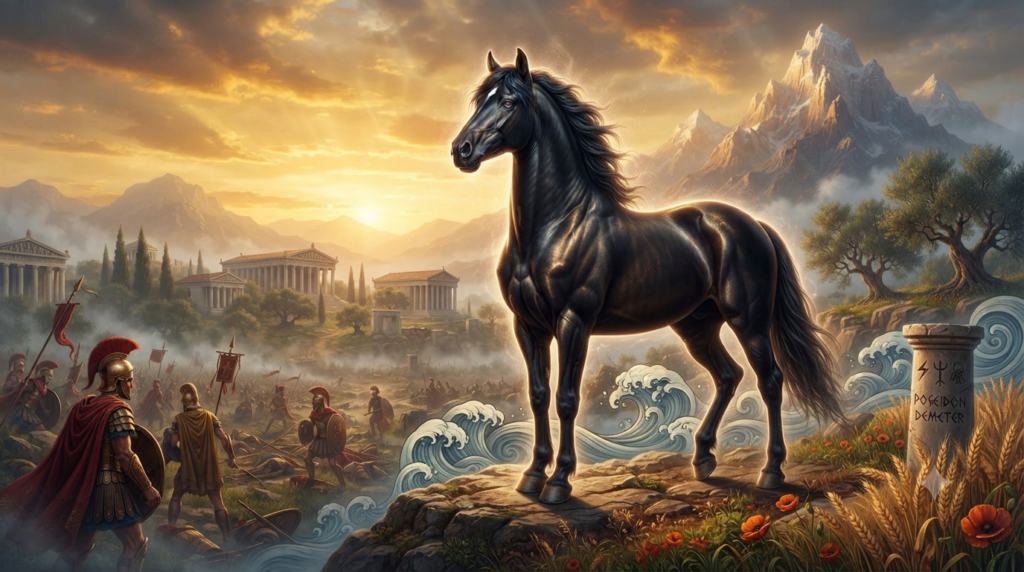
In terms of appearance, the Hesiodic Shield of Heracles provides a key detail: Arion was a “black-maned” horse . His mane was as dark as the depths of the sea from which his father ruled, or perhaps as dark as the fertile, life-giving earth of his mother. This detail gives him a distinctive, powerful appearance. He is also described as a “great horse,” suggesting he was of colossal size, much larger and more powerful than any mortal steed . Some traditions endowed him with an almost human-like intelligence. He was said to be “super intelligent” and even able to speak . This ability elevates him beyond a mere animal into the realm of a fully sentient being, capable of understanding complex commands and perhaps even forming a bond of true companionship with his masters. All these characteristics—his speed, size, majestic coloring, and intelligence—compose a picture of a horse that was the absolute pinnacle of equine perfection.
Symbolic Interpretations of Arion
The figure of Arion transcends a simple narrative of a miraculous horse; he is a potent symbol freighted with deep cultural and religious meaning. His story and attributes allow for multiple symbolic interpretations, reflecting the values and beliefs of ancient Greek society.
First and foremost, Arion is a symbol of salvation. His most famous act, rescuing Adrastus from the slaughter at Thebes, inextricably ties his identity to the concept of being saved from hopeless peril. In a society that placed a high value on heroic achievement and fate, a divine force that could cheat death for a king was of immense importance. He represents the deus ex machina on the battlefield, the unexpected intervention of the divine that can alter a predetermined tragic course.
Secondly, Arion is a symbol of divine power and legitimacy. A horse of his stature could only be owned by the most powerful heroes and kings. For Heracles, he was a tool of martial dominance. For Adrastus, he was a symbol of his royal authority and his divine favor. Possessing a creature with such a prestigious genealogy—directly from the gods themselves—would have elevated the status of any mortal who had the honor of riding him. It served as a validation of their own heroic or royal lineage.
Finally, Arion is a symbol of the untamed and fertile natural world. His birth from the forced union of the sea-god and the earth-goddess encapsulates the raw, creative, and often violent power of nature. His association with Gaia in some traditions and his Arcadian origins root him in the earth’s oldest and wildest places. He represents the connection between the divine, human, and natural worlds, a being that exists at the nexus of these different spheres. The answer to “Who is Arion?” becomes more complex when he is viewed not just as a horse, but as a powerful symbol of these fundamental cultural and philosophical concepts.
Arion in Ancient Sources and Artistic Representations
Primary Literary Sources
The figure of Arion is remarkably well-attested in the literary record of antiquity, appearing in some of the most foundational works of Greek literature. This broad coverage across different genres and time periods testifies to his enduring fame. The earliest mention of Arion is in the Iliad of Homer, the epic that formed the bedrock of Greek education and culture. In Book 23, Nestor advises his son Antilochus on how to win a chariot race, saying that it is better to be cunning than fast, “not even if you were to drive the colt Areion in front of you” . This offhand reference shows that by the time of Homer (usually dated to the 8th century BC), Arion was already a well-known benchmark for supreme speed. His name had become a byword for equine excellence.
Following Homer, Arion appears in the Hesiodic Shield of Heracles, an epic poem likely composed a century or two later . Here, he is a major player in the narrative, serving as Heracles’ magnificent and powerful mount in his battle against Cycnus. This more detailed depiction fleshes out his physical description and presents his role in a heroic conflict. The poem’s depiction of the “great horse, black-maned Arion” is a vital source for understanding his imagery in early Greek art and literature.
Several other key texts preserve crucial information about Arion. The mythographer Pausanias, writing in the 2nd century AD, is our most important source for the Arcadian birth myth of Arion . He records the local traditions of Thelpusa, preserving the story of Demeter and Poseidon’s transformation and its connection to the local cult of Demeter Erinys. Similarly, Apollodorus’ Library, a comprehensive and systematic compilation of Greek myths from the 1st or 2nd century AD, confirms Arion’s parentage and his role in saving Adrastus . The works of other authors, such as the scholiasts on Homer, the epic poet Quintus Smyrnaeus, the poet Antimachus, and the geographer Strabo, all contribute pieces to the puzzle, either confirming, supplementing, or offering alternative versions of Arion’s myth . This rich and diverse textual tradition makes Arion one of the best-documented divine horses in all of Greek mythology.
Depictions in Art and Culture
While the literary attestations are plentiful, the archaeological and artistic evidence for Arion is less abundant but still significant. Unlike his more famous half-brother Pegasus, who was a staple of vase painting and sculpture, Arion’s iconography is more limited. However, his presence on ancient artifacts provides tangible evidence of his cultural impact.
Arion is most frequently identified on the “Hesiodic Shield of Heracles” itself, which is a description of a magnificent shield, not an actual preserved artifact. However, the poem’s popularity may have inspired actual artistic creations. In general, the most likely place to find Arion in ancient art would be in scenes depicting the Seven against Thebes. Some vase paintings show the departure of the doomed champions or the funeral games of Opheltes, where Arion’s victory could have been a subject. He might also appear in scenes showing the battle itself, with Adrastus fleeing the mayhem on the back of his divine horse.
His association with Heracles also provided artistic opportunities. Pausanias mentions that the people of Thelpusa had a cult and presumably some form of representation of Demeter Erinys and her offspring, Arion . In ancient Arcadia, the horse may have been a local symbol, appearing in the region’s coinage or votive offerings. He may also have been a decorative motif in sanctuaries and civic buildings dedicated to Poseidon, Demeter, or Heracles. The fact that he was a subject of interest for Pausanias, who meticulously documented art and architecture throughout Greece, suggests that statues or significant paintings of Arion were known to exist in his time. While his artistic footprint is more limited than some other major mythological figures, his appearance on coins, pottery, and in local cultic art confirms that he was a figure of lasting visual and religious significance in the ancient world. These representations help answer the question of “Who is Arion?” by giving him a concrete, visual presence in the ancient world.
The Enduring Legacy of Arion
Influence on Later Literature and Thought
The story of Arion did not end with the fall of ancient Greece. His myth, preserved in the works of Homer, Hesiod, and countless others, continued to resonate through the Roman period and into the Byzantine and modern eras. He served as a touchstone for writers, poets, and scholars who sought to evoke the grandeur, tragedy, and wonder of the classical world.
In the Roman period, Arion’s name appears in the works of poets and encyclopedists who were eager to catalog the treasures of Greek mythology. Roman authors, like their Greek counterparts, used the image of the swift horse as a simile for speed and nobility. The Dictionary of Greek and Roman Biography and Mythology compiled by William Smith in the 19th century drew directly from these ancient sources, ensuring that Arion was not forgotten in the modern era . This scholarly tradition preserved the complex threads of his myth for future generations.
As a figure of immense speed, power, and loyalty, Arion represents the ideal of the heroic steed. This archetype has proven remarkably durable, reappearing in countless forms in fantasy literature and folklore. From the mighty steeds of ancient epics to the loyal animal companions of modern fantasy protagonists, the shadow of Arion’s divine and unbreakable bond with his master can still be seen. He is a literary ancestor of all great horses in fiction, a symbol of the unique and powerful relationship that can exist between a person and their mount.
Arion in Modern Popular Culture
Even in the 21st century, Arion maintains a subtle but notable presence in popular culture. While he may not have achieved the universal fame of his flying half-brother, Pegasus, his name and legend remain a source of inspiration, especially in the realms of fantasy, gaming, and literature.
Arion’s name is frequently borrowed for characters in video games, fantasy novels, and tabletop role-playing games. He often appears as a powerful horse, a notable deity, or an important figure in a pantheon-like system. His story, involving divine parentage and heroic rescue, provides rich narrative material for character backgrounds and quests. This use of his name in gaming ensures that a new generation becomes familiar with it.
Furthermore, the myth of a supremely intelligent and loyal horse with divine origins continues to be a compelling theme. While the direct myths are often adapted or reimagined, the underlying archetype of Arion persists. This endurance speaks to the universal appeal of his story: a noble creature, born of the gods, who uses his extraordinary gift to save his master from an impossible fate. His legacy lives on not just as a footnote in a mythology textbook, but as a living part of a cultural language that continues to create and reinterpret stories of heroism and divine animals. To understand Who is Arion, the divine horse of Greek mythology? in a modern context is to see how a figure from an ancient world can still find new life in the imagination of contemporary culture.
Frequently Asked Questions About Who is Arion, the divine horse of Greek mythology?
What makes Arion different from other divine horses like Pegasus?
Arion and Pegasus are often compared as the two most famous divine horses of Greek mythology, yet they are distinct figures. Pegasus is known for his ability to fly, being a winged horse born from the blood of Medusa, while Arion is celebrated for his incredible speed, intelligence, and strength as an earthly horse. Arion could run faster than any mortal or immortal being and was a loyal companion in battle, whereas Pegasus served as a mount for heroes like Bellerophon and was later a celestial constellation. While Pegasus’s story is often one of taming and service to different masters, Arion’s narrative is more unified, centering on his birth from Poseidon and Demeter and his pivotal role in saving King Adrastus. In essence, Pegasus is a creature of the sky and the cosmos, and Arion is a creature of the earth and the battlefield.
Who were the parents of Arion?
The most widely accepted and detailed origin story for Arion names his parents as two of the most powerful Olympian gods: his father was Poseidon, the god of the sea and earthquakes, and his mother was Demeter, the goddess of agriculture and the harvest. This union occurred when Demeter, in the shape of a mare, tried to hide from Poseidon’s advances, and he, taking the form of a stallion, mated with her. However, there were also alternative traditions. Some sources, like the poet Antimachus, claimed Arion was the offspring of Gaia (Earth) herself. Other, less common accounts, stated that his father was Zephyrus, the god of the west wind, and his mother was a Harpy.
What is the most famous event in the life of Arion?
Arion’s most famous and defining deed is his rescue of King Adrastus during the War of the Seven against Thebes. The Argive expedition was a catastrophic failure; all the other leaders were killed, and the army was routed. In the chaos of the battle, as the enemy forces closed in, Adrastus was able to escape only because of his divine horse. Arion’s incredible speed and intelligence allowed him to carry his master away from the battlefield and back to safety in Argos, making him the sole survivor of the ill-fated campaign. This act of salvation immortalized Arion and solidified his bond with Adrastus.
Was Arion associated with any specific athletic events?
Yes, according to myth, Arion was the victor in the chariot race of the first Nemean Games. The Nemean Games were one of the four great Panhellenic festivals of ancient Greece, and their founding is associated with the death of the infant Opheltes. As the army of the Seven against Thebes was passing through Nemea, the funeral games were held for Opheltes, and Adrastus, riding Arion, is said to have won the very first horse race held there. This victory linked Arion’s legend to the prestigious athletic and religious traditions of the Greek world.
Why did Demeter have the title “Fury” (Erinys)?
The title “Fury” (Erinys) associated with Demeter is directly linked to the story of Arion’s birth. The Thelpusians in Arcadia, who told the story of Demeter’s transformation into a mare, explained that she acquired this epithet because of her “avenging anger” at Poseidon for his deception . After she transformed herself to escape his pursuit, he tricked her by turning into a stallion and mating with her. Her fury at being violated and deceived in such a manner was so great that it became a defining aspect of her local cult. Thus, the cult of Demeter Erinys was intrinsically connected to the myth of her son, Arion.
Who owned Arion before Adrastus?
Before being given to King Adrastus of Argos, the divine horse Arion passed through the ownership of several notable figures. The chain of ownership began with Poseidon, who gave Arion to Copreus, a king in Boeotia. The horse then became the property of Oncus, the Arcadian king who was involved in the myth of his birth. After Oncus, Arion was acquired by the greatest hero of Greek myth, Heracles, who rode the horse during his expedition against Elis and during his combat with the god Ares’ son, Cycnus. It was Heracles who eventually gave the horse to Adrastus, establishing the bond that would make Arion famous.
What did Arion look like?
Ancient sources provide a vivid, if somewhat broad, depiction of Arion’s physical appearance. He was described as a “great horse,” implying a massive and powerful stature far surpassing that of any mortal horse. His most distinctive feature was his “black-maned” appearance, with a mane as dark as the sea or the earth from which his divine nature sprang. He is consistently described as “fabulously fast” and “swift,” and some traditions endowed him with intelligence and the ability to speak. This combination of size, speed, intelligence, and striking coloring made him the ideal and archetypal image of a divine steed.
What is the significance of the alternative origins of Arion?
The existence of alternative origins for Arion, such as being the son of Gaia (Earth) or Zephyrus and a Harpy, reflects the dynamic and localized nature of Greek mythology. Myths were not static but evolved over time and across different regions, with communities often emphasizing the genealogy that best suited their local traditions and worldview. The “Earth” origin, for instance, powerfully connects Arion to a specific place, making him a primordial symbol of the region . The “wind and Harpy” origin emphasizes his incredible speed, while the Poseidon and Demeter story provides a dramatic narrative and explains a local religious cult. The multiplicity of traditions does not weaken the myth but enriches it.
Conclusion
In the grand pantheon of mythical creatures, Arion stands as a testament to the ancient Greek fascination with divine power, heroic endeavor, and the profound bond between humans and animals. We have explored the various facets that define Who is Arion, the divine horse of Greek mythology?, revealing him to be a figure of immense complexity and enduring significance. From his extraordinary birth—the result of a shape-shifting encounter between the gods Poseidon and Demeter—to his legendary deeds, his story is a microcosm of the Greek mythic imagination. He is the swift horse that was the envy of the gods, the savior of the king of Argos, and the champion of the first Nemean Games.
His legacy is woven into the very fabric of Greek culture, appearing in the foundational poems of Homer and Hesiod, referenced by historians and mythographers, and celebrated in local cults and athletic games. He is more than a simple beast of burden; he is a symbol of salvation, a divine intermediary, and a representation of the untamed, creative forces of nature. His alternative origins and varied traditions only serve to highlight the richness of the mythological landscape from which he emerged. While Pegasus may dominate modern pop culture, Arion’s story remains a vital and captivating part of the ancient world’s enduring legacy.
Who is Arion, the divine horse of Greek mythology? He is the ultimate steed, a creature born of gods and kings, whose speed and loyalty snatched a hero from the jaws of death. He is a figure who embodies the power and grace that the ancient Greeks projected onto the horses they so deeply valued. In answering this question, we not only learn about a fascinating mythical horse but also gain a deeper appreciation for the culture that created him—a culture that found in the image of a magnificent, divine horse a powerful expression of its own ideals of heroism, divine favor, and the eternal struggle between fate and salvation.

Orin Vale has spent the better part of two decades tracing the threads that connect the world’s oldest stories — from the halls of Asgard to the banks of the Nile, from Olympus to the jungles of the Maya. What began as a childhood fascination with flood myths and trickster gods grew into years of independent study across comparative mythology and ancient religion, always chasing the same question: what did these stories mean to the people who first told them? Orin writes for readers who want more than trivia — the ones looking for the beliefs, fears, and truths that myths were built to carry.