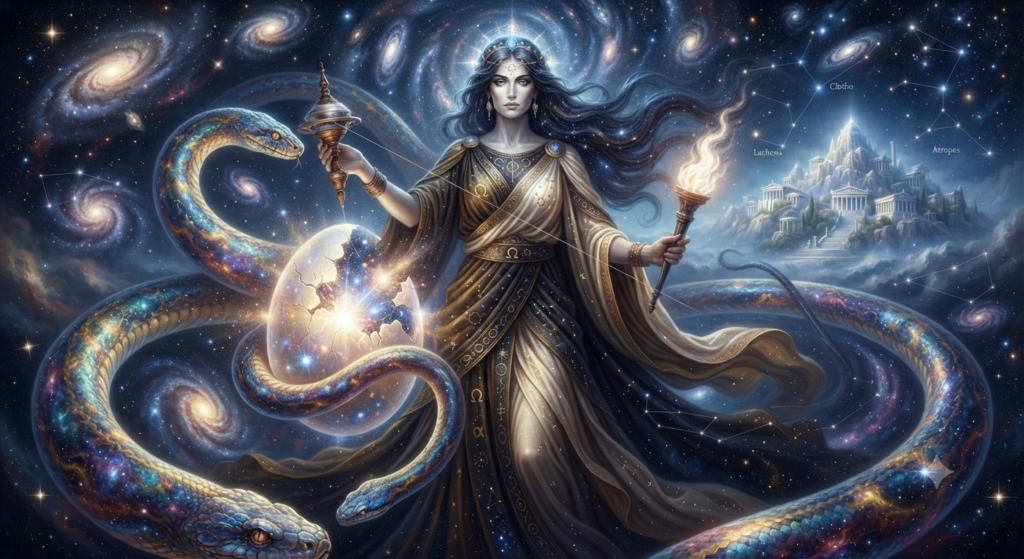
In the vast and intricate tapestry of Greek mythology, where gods vie for power and heroes struggle against fate, one primordial deity stands apart as the ultimate embodiment of inescapable force. Who is Ananke, the Greek goddess of necessity? She is the personification of inevitability, compulsion, and destiny—a power so profound that even the Olympian gods must bow to her will. Unlike the anthropomorphic deities of Mount Olympus who possess human-like passions and flaws, Ananke represents an abstract, cosmic principle that existed before creation itself. Her name, derived from the ancient Greek word for “force” or “constraint,” speaks to her fundamental nature: she is the inescapable current that drives all existence, the unyielding law that governs both mortal lives and divine actions .
To understand Ananke is to understand the ancient Greek conception of fate and the limits of power. She emerges at the very dawn of creation in the Orphic cosmogony, coiling with her consort Chronos (Time) around the primal egg of the universe, crushing it into the ordered cosmos we know . She is the mother of the Moirai, the three Fates who spin, measure, and cut the thread of human life, and even Zeus himself is said to be subject to her decrees . Unlike the more familiar figures of Greek myth, Ananke was rarely worshipped in temples or celebrated in festivals; her power was felt more than adored, acknowledged in proverbs and philosophical treatises rather than in hymns and sacrifices. Yet her influence permeates Greek literature, philosophy, and theology, from the tragedies of Aeschylus to the dialogues of Plato. This article will explore the origins, mythology, symbolism, and enduring legacy of Ananke, revealing why this ancient goddess of necessity remains a powerful and relevant concept in modern thought.
The Origins of Ananke: A Primordial Force
Cosmogony and the Orphic Tradition
To understand the origins of Ananke, one must look to the Orphic tradition, a mystical religious movement that offered an alternative to the more familiar Olympian mythology of Hesiod and Homer. In the Orphic cosmogony, the story of creation begins not with Chaos, but with the emergence of Ananke and Chronos (Time) as self-formed, primordial beings . These two entities, depicted as incorporeal serpents with their arms and bodies entwined, represent the first principles of cosmic order—the inevitable force of necessity and the infinite passage of time .
According to this myth, Ananke and Chronos emerged at the dawn of creation when the universe was still an undifferentiated mass of divine matter. They immediately began their work of cosmic organization, coiling around a massive cosmic egg—a primordial substance containing all the elements of existence . As they constricted their serpentine coils around this egg, their combined pressure split it into three fundamental parts: the lightest atoms rose to form the heavens, the heaviest sank to become the earth and waters, and the remainder floated between as the chaotic winds . This act of creation marked the division between the formless era of Chaos and the beginning of the ordered universe .
The figure of Phanes, a radiant deity of procreation and light, emerged from the fractured egg, inheriting the scepter of creation and establishing the cycles of birth, death, and rebirth that govern all existence . Ananke and Chronos, however, did not vanish after this act; they continued to encircle the cosmos, driving the rotation of the heavens and the eternal passage of time, ensuring that the order they had established remained immutable . This serpentine imagery is crucial to understanding Ananke’s nature—her form itself is a symbol of eternal recurrence and the inescapable binding force of cosmic law.
Genealogical Variations
The traditions concerning Ananke’s genealogy are as varied as they are fascinating. Unlike the Olympian gods with their well-defined family trees, Ananke’s parentage is described differently across various sources, reflecting her status as a being that transcends simple genealogical classification. In some accounts, particularly within Orphic texts, Ananke is described as self-formed or self-born, emerging from the primal void without parents or progenitors . This quality of being self-created reinforces her status as a primordial force that predates all other beings and exists independently of divine will.
Other traditions offer more specific genealogies. According to one Orphic fragment, Ananke was the daughter of Hydros (the primordial waters) and Gaia (Earth), suggesting a connection to the elemental forces that preceded creation . In yet another version, she is identified as one of the three aspects of the night goddess Nyx (Night), along with Adrasteia and Heimarmene . This identification links her to the chthonic, mysterious forces that existed in the darkness before light and order.
Perhaps the most significant genealogical tradition, however, is the one that names Ananke as the mother of the Moirai, or the three Fates. In Book X of Plato’s Republic, the philosopher explicitly names Clotho, Lachesis, and Atropos as the daughters of Ananke . This connection is crucial because it establishes Ananke as the supreme authority over destiny itself—even the Fates, who determine the lifespan and fortune of every mortal, are subject to the will of their mother. Aeschylus further develops this idea in his tragedy Prometheus Bound, where the three Fates are described as the “helmsmen” of Ananke, guiding the ship of cosmic destiny according to her dictates .
Mythological Role and Significance
The Goddess of Inevitability
Ananke’s central mythological role is that of the goddess of inevitability—the personification of those forces that cannot be escaped, altered, or avoided. The ancient Greek word anankê itself carries connotations of force, constraint, and necessity, and the goddess embodied these concepts in their most absolute form . In this role, Ananke represents the fundamental principle that certain things must be, regardless of the desires or actions of gods and mortals alike. She is the cosmic law that governs all existence, the unalterable current of destiny that flows through every moment of time.
The power of Ananke is perhaps best expressed in the ancient proverb, recorded by the poet Simonides: “Even the gods don’t fight against Ananke” . This saying captures the essence of her dominion—not even the mightiest of the Olympian deities, not even Zeus himself, can escape or overturn the decrees of necessity. This concept appears repeatedly in Greek literature and philosophy. In Aeschylus’s Prometheus Bound, the bound Titan tells the chorus that “Skill is weaker by far than Ananke,” acknowledging that even his divine craft and cunning are powerless against her force . When the chorus asks who is the helmsman of Ananke, Prometheus replies, “The three-shaped Moirai and mindful Erinyes,” confirming that the Fates and the Furies serve as her agents .
This understanding of Ananke establishes a clear hierarchy in the divine order. While Zeus rules as the king of the gods, he is not the ultimate power in the cosmos—above him stands the impersonal force of necessity, the primordial law that even he must obey. Aeschylus even hints at a prophecy, rendered ineluctable by Ananke, that any son born of Zeus and the sea nymph Thetis would depose him, demonstrating that even the king of the gods is subject to the decrees of fate . This concept offers a profound theological insight: the ancient Greeks recognized that the universe operates according to immutable laws that even the divine cannot contravene.
Ananke and the Moirai: The Fates
The relationship between Ananke and the Moirai, or the three Fates, is one of the most significant aspects of her mythology. In Plato’s Republic, the philosopher describes the Moirai—Clotho, Lachesis, and Atropos—as the daughters of Ananke, seated on thrones around the spindle of Necessity, singing in unison with the music of the Sirens . Lachesis sings of the past, Clotho of the present, and Atropos of the future, their harmonious voices weaving the fabric of destiny according to their mother’s will .
This imagery is remarkably rich in symbolic meaning. The spindle of Necessity, around which the Fates work, represents the axis of the cosmos, the central point around which all existence revolves. Ananke, as the mother and mistress of the Fates, is the force that sets this spindle in motion and determines the direction of its turning. Her daughters serve as her agents, spinning, measuring, and cutting the threads of human life according to the eternal law she embodies. Even Zeus, in this scheme, is depicted as subordinate to the Fates, though some accounts suggest he may occasionally serve as their father .
The specific functions of the three Fates reflect the comprehensive nature of Ananke’s dominion. Clotho, the Spinner, initiates the thread of life, determining the moment of birth. Lachesis, the Allotter, measures the length of the thread, assigning the span of each mortal’s existence and the fortune they will experience. Atropos, the Cutter, brings the thread to its end, determining the moment of death . Together, these three daughters of Ananke ensure that every life follows the path ordained by necessity, leaving no room for chance or escape. This conception of destiny, ruled over by Ananke and her daughters, established a framework of cosmic law that influenced Greek thought for centuries.
Symbols, Characteristics, and Depictions
The Spindle and the Torch
Ananke is customarily depicted with symbols that reflect her nature as the goddess of necessity and fate. The most common symbol associated with her is the spindle, which represents her control over the thread of destiny . This spindle is the same one described in Plato’s Republic, around which the Moirai sit and perform their work of spinning, measuring, and cutting the threads of human life . The spindle is not merely an attribute but a manifestation of Ananke’s power—it is the instrument through which fate is woven into existence, the tool that connects her dominion to the lives of every mortal and immortal being.
The spindle image is deeply symbolic of the Greek conception of destiny. In ancient Greek culture, spinning and weaving were feminine arts associated with the creation and maintenance of order—the warp and weft of fabric mirror the intertwined threads of human lives and the intricate patterns of fate. By holding the spindle, Ananke asserts her role as the ultimate weaver of destiny, the force that determines the pattern that the Fates must follow. This image also connects her to other goddesses associated with weaving, such as Athena and the Moirai themselves, though Ananke’s power far exceeds theirs.
Another symbol sometimes associated with Ananke is the torch . This attribute may seem paradoxical for a goddess of necessity, but it likely represents the illumination of truth and the revelation of what must be. The torch sheds light on the inescapable facts of existence, revealing the necessity that governs all things. It suggests that Ananke’s power is not merely a blind or arbitrary force but a principle that can be understood, even if it cannot be overcome. In representations where she is depicted with wings, the torch and the wings together suggest her swift and all-encompassing nature, moving through the cosmos with relentless purpose .
Serpentine Form and Cosmic Embrace
Perhaps the most striking characteristic of Ananke is her serpentine form. In the Orphic tradition, Ananke is described as an incorporeal, serpentine being whose outstretched arms encompass the breadth of the cosmos . This image appears in various sources, all emphasizing her coiling, constricting nature—she and Chronos are mates, mingling together in serpent form as a tie around the universe, their bodies entwined in an eternal embrace that binds all of existence . This serpentine quality is not accidental but deeply meaningful, drawing on ancient associations between snakes and the chthonic, eternal forces of nature.
The serpent was a powerful symbol in ancient Greek religion, representing a range of concepts from chthonic power and rebirth to eternity and the cycle of life. Snakes shed their skins, symbolizing renewal and the passage of time, and they coil in circles, suggesting the circular nature of existence and the eternal recurrence of cosmic cycles. Ananke’s serpentine form embodies these qualities perfectly—she is the force of necessity that winds through all of time, binding past, present, and future in an unbreakable chain. Her coils are not merely physical but metaphorical, representing the inescapable grip of fate that holds all beings in its grasp.
The description of Ananke’s embrace as “encompassing the cosmos” reinforces her role as a cosmic principle rather than a personal deity . She is not a goddess who intervenes in human affairs through emotion or caprice but a fundamental law of nature, as unchanging and all-encompassing as gravity or the passage of time. This cosmic, incorporeal quality sets her apart from the Olympian gods and aligns her more closely with the primordial forces of creation. Ananke does not have a human-like personality or a defined mythology of interpersonal relationships; she simply IS the necessity that governs all existence, a concept both terrifying and awe-inspiring.
Worship and Religious Significance
The Temple at Corinth
Although Ananke was primarily a philosophical and theological concept rather than a popular cult figure, she did receive worship in at least one significant location. The ancient Greek traveler and geographer Pausanias, writing in the 2nd century AD, records the existence of a temple in ancient Corinth where Ananke was worshipped alongside Bia, the goddess of force, violence, and power . This temple, situated on the Acrocorinth—the acropolis of the city—was a shrine that no one was permitted to enter, indicating its sacred and perhaps fearsome nature .
The pairing of Ananke with Bia is significant. Bia represents the physical force and violent compulsion that often accompanies necessity, reinforcing the idea that Ananke is not a gentle or benevolent goddess but a harsh and unyielding force. Together, these two deities embody the coercive power that governs existence—the force that compels action, enforces fate, and ensures that the cosmic order remains intact . The fact that their temple was off-limits to visitors suggests that their worship was reserved for specific religious officials and not part of the general civic cult. This exclusivity aligns with the impersonal and awe-inspiring nature of Ananke—she is not a deity to be approached lightly or petitioned for favors.
The historical record does not provide extensive details about the rituals or festivals associated with Ananke at Corinth. It is likely that, given her nature, worship focused more on acknowledging her power and placating her force rather than seeking her favor or intervention. The ancient Greek proverb, “Nothing is stronger than dread Necessity,” suggests that the primary religious attitude toward Ananke was one of respect and submission rather than devotion or love . Unlike Demeter, who received heartfelt prayers for fertility, or Athena, who was honored for wisdom and protection, Ananke was acknowledged because she could not be ignored—her power was simply a fact of existence.
Philosophical and Literary Worship
Beyond the limited cult practice at Corinth, Ananke’s true “worship” occurred in the realm of Greek philosophy and literature. She was a frequent subject of speculation and reflection for some of the greatest minds of antiquity, who sought to understand the nature of necessity and its role in human life. The works of Plato, Aristotle, and the tragedians are filled with references to Ananke and the concept of necessity, demonstrating her profound influence on Greek thought.
Plato, in his Timaeus, discusses necessity (not personified) as the brute facts of nature—the material world that can be persuaded by reason but never annihilated . This conception of Ananke as the underlying substance of reality, the “stuff” from which all things are made, connects her to the physical laws of the universe. In the Republic, as discussed, Ananke appears as the mother of the Fates, the cosmic principle that governs the cycle of souls and the justice of the afterlife. For Plato, Ananke was not a figure to be worshipped but a concept to be understood, a fundamental truth about the nature of reality.
The tragic poets, particularly Aeschylus, similarly engaged with Ananke as a dramatic force. In Prometheus Bound, the concept of necessity is central to the plot—Prometheus is bound because he defied Zeus, but even his suffering is governed by an unalterable fate that Zeus himself cannot escape. This dramatic use of Ananke underscores the Greek tragic vision: the most noble and powerful beings are still subject to the inescapable forces of destiny. In Roman literature, Ananke appears as Necessitas, the personification of necessity, in the works of poets like Horace, who associates her with death and fortune in purely literary terms . The philosophical and literary “worship” of Ananke ensured her survival far beyond the end of classical antiquity, establishing her as a timeless concept that continues to resonate.
Artistic Representations and Cultural Influence
Visual Representations in Antiquity
The visual representation of Ananke in ancient Greek art is relatively rare compared to the Olympian gods, reflecting her abstract and impersonal nature. However, the evidence that does exist offers valuable insights into how the ancient Greeks envisioned this powerful primordial force. The most definitive example is a vase painting where a torch-bearing, winged figure is labeled with her name, suggesting that she had a recognizable iconography in at least some contexts . This depiction shows her as a winged being, with a torch in her hand, poised as if to illuminate or perhaps enforce the cosmic order.
The wings in this representation are significant. They suggest speed, ubiquity, and the swift, all-encompassing nature of necessity. Ananke moves not through physical space but through the fabric of existence itself, and her wings represent the rapid, inescapable approach of fate. The torch, as mentioned, may symbolize illumination, revealing the truth of what must be, or it might represent the consuming, relentless power of necessity that burns through all obstacles. This winged, torch-bearing image aligns with other personifications of abstract concepts in Greek art, where such attributes were used to convey symbolic meaning through visual shorthand.
It is likely that Ananke also appeared in sculptural form, particularly in the temple at Corinth where she was worshipped with Bia. Pausanias, who meticulously described the art and architecture of Greece, might have seen such representations, though his works do not preserve a detailed description . The reliefs and statues that may have adorned this temple would have provided a visual focus for the worship of necessity, rendering the abstract concept into a more concrete form. The rarity of Ananke’s artistic representations, however, serves as a testament to her unique status—she is a force that can be felt and understood more than seen, a presence that is recognized more in the mind and the soul than in the physical world.
Influence on Ancient Philosophy
Ananke’s most profound cultural influence lies in the realm of philosophy, where the concept of necessity became central to Greek thought. The pre-Socratic philosophers grappled with the nature of the universe, seeking to understand the fundamental principles that govern existence. Ananke, in these early philosophical systems, represented the inescapable laws that shape reality, the impersonal forces that determine the course of nature and the lives of mortals and gods alike. Her influence can be seen in the works of the atomists, particularly Democritus and Leucippus, who argued that the universe operates according to mechanical necessity—every event follows from prior causes in an unbreakable chain .
Plato’s engagement with Ananke is among the most sophisticated. In his dialogue Timaeus, he distinguishes between the rational order of the cosmos (the work of the divine craftsman, the Demiurge) and the material necessity that resists perfect order. Ananke, in this context, represents the recalcitrant nature of matter itself, the brute facts of existence that cannot be wholly transformed by reason or will. This dialectic between the ideal and the necessary, the realm of perfect forms and the imperfect world of matter, became a foundational theme of Western philosophy . Aristotle, too, contributed to the understanding of necessity, distinguishing between “absolute necessity” and “hypothetical necessity,” concepts that echo the distinction between Ananke as a primordial force and the practical necessities of human life.
The Stoic philosophers, who emerged in the Hellenistic period, developed the concept of necessity even further. For the Stoics, the universe is governed by an all-encompassing divine reason (Logos), which operates according to a chain of cause and effect that is absolutely determined—this is, in essence, the philosophical equivalent of Ananke’s dominion. The Stoic emphasis on accepting fate and living in accordance with nature reflects an implicit acknowledgment of Ananke’s power, even if they did not always use her name. Throughout its various iterations in Greek philosophy, the concept of Ananke provided a framework for understanding order, determinism, and the limits of human agency.
Ananke’s Legacy in Modern Culture
Linguistic and Conceptual Legacy
The legacy of Ananke extends well beyond the ancient world, permeating modern language and thought. The most direct inheritance is linguistic—the English word “necessity” traces its roots through the Latin necessitas to Ananke’s Greek original . More than just a word, Ananke’s legacy is the very concept of necessity itself, the recognition that certain things must be and cannot be otherwise. This concept underlies numerous modern disciplines, from physics and philosophy to law and ethics. The laws of nature, the constraints of logic, the requirements of justice—all of these are modern manifestations of the ancient principle of Ananke.
Ananke’s influence on modern philosophical thought is particularly significant. The concept of necessity is central to discussions of determinism versus free will, causality, and the nature of reality. Philosophers from the early modern period to the present have grappled with questions that Ananke embodies: Is everything predetermined, or do humans have genuine choice? What is the relationship between necessity and contingency? These questions are direct descendants of the ancient Greek fascination with fate and necessity, with Ananke standing as their first and most powerful personification.
The goddess also appears in modern poetry and literature, often as a symbol of inescapable fate or the harsh realities of existence. The 20th-century existentialist and absurdist traditions, while rejecting the idea of a predetermined fate, nevertheless grapple with the constraints of existence—the “necessity” of death, the limitations of human agency, the brute facts of the physical world. In this sense, Ananke remains a living concept, a way of naming and understanding the forces that shape and limit human life.
Popular Culture and Astronomy
Ananke has found new life in modern popular culture, appearing in various forms in literature, music, and art. Her name and attributes are often borrowed by creators seeking to evoke themes of destiny, inevitability, and cosmic power. In fantasy and science fiction, characters named Ananke frequently appear as powerful beings associated with fate and time, drawing directly on the mythological tradition. While her presence is often subtle and her story less known than the Olympian gods, the concept of Ananke—the inescapable force—continues to resonate.
Perhaps the most prominent modern manifestation of Ananke is in the field of astronomy. Ananke is the name of one of Jupiter’s irregular moons, discovered in 1951 at the Mount Wilson Observatory . This moon, designated Jupiter XII, is a retrograde satellite that orbits Jupiter in the opposite direction to the planet’s rotation, a fitting tribute to a goddess who moves in cosmic circles and enforces inescapable laws. The naming of the moon after Ananke reflects the enduring power of Greek mythology to inspire and inform modern science, as well as the goddess’s association with the cosmic order that astronomers seek to understand.
The naming of this moon also highlights Ananke’s status as a figure of both ancient myth and modern reality. Just as she embodies the inescapable forces that govern the cosmos, the moon that bears her name is bound to Jupiter by the inescapable force of gravity, the physical manifestation of necessity in the universe. The Ananke moon group, a family of satellites that share similar orbital characteristics, further enforces this connection, suggesting that the goddess’s influence extends even to the farthest reaches of our solar system.
Frequently Asked Questions About Who is Ananke, the Greek goddess of necessity?
What is Ananke the goddess of?
Ananke is the Greek goddess of necessity, compulsion, and inevitability . She represents the inescapable forces of fate and destiny that even the gods must obey. She is a primordial deity who personifies the fundamental principle that certain things must happen regardless of divine or mortal will, and she is often associated with the unalterable laws of the universe .
Who are Ananke’s children?
According to Plato’s Republic, Ananke is the mother of the Moirai, or the three Fates: Clotho, Lachesis, and Atropos . In some traditions, she is also considered the mother or another identity of Adrasteia, the distributor of rewards and punishments . She is also said to be the mother of Chaos, Aither, and Erebus through Chronos in the Orphic tradition .
Is Ananke more powerful than Zeus?
Yes, in Greek mythology, Ananke is considered more powerful than Zeus. While Zeus is the king of the Olympian gods, Ananke is a primordial force of nature that even he cannot escape or overcome . The ancient saying that “even the gods don’t fight against Ananke” confirms her supremacy over all divine beings, including Zeus himself. According to Aeschylus, there is a prophecy that Zeus must obey due to Ananke’s decrees .
What is the relationship between Ananke and Chronos?
Ananke and Chronos are consorts, often depicted as serpentine beings whose coils are entwined around the cosmos . Together, they crushed the cosmic egg of creation, bringing order to the universe. Chronos represents time, while Ananke represents necessity, and together they are the cosmic-circling forces of fate and time that drive the rotation of the heavens and the eternal passage of time .
What does Ananke mean in Greek?
In Greek, the word anankê (ἀνάγκη) means “force,” “constraint,” or “necessity” . It is a common noun in ancient Greek that was used to describe compulsion or inevitable fate. The goddess Ananke takes her name from this word, embodying its meaning as the personification of unavoidable force. The English words “necessity” and “necessitate” ultimately derive from Ananke through the Latin necessitas .
Where was Ananke worshipped in ancient Greece?
The only known temple to Ananke in ancient Greece was located on the Acrocorinth in the city of Corinth, where she was worshipped alongside Bia, the goddess of force . This temple was reportedly off-limits to visitors. While Ananke was a significant philosophical and theological concept, her actual cult worship was quite limited, reflecting her nature as an impersonal and awe-inspiring force .
What are Ananke’s symbols?
Ananke is customarily depicted holding a spindle, which represents her control over the thread of destiny and her connection to the Moirai . She may also be shown holding a torch, which symbolizes illumination and the revelation of what must be. In the Orphic tradition, she is described as a serpentine being whose arms encompass the cosmos, and in some representations she is depicted with wings .
How is Ananke different from the Moirai?
Ananke is the primordial goddess of necessity and the mother of the Moirai, while the Moirai are her daughters and serve as her agents. Ananke represents the supreme, inescapable principle of necessity itself, whereas the Moirai—Clotho, Lachesis, and Atropos—are the personifications of the specific aspects of fate, spinning, measuring, and cutting the threads of life . Ananke is the source of all fate, and even the Fates themselves are subject to her will.
Conclusion
Who is Ananke, the Greek goddess of necessity? She is the embodiment of the inescapable, the personification of fate that governs both gods and mortals. Emerging at the dawn of creation in the Orphic cosmogony as a self-formed serpentine being, Ananke and her consort Chronos crushed the cosmic egg, bringing order to the universe and establishing the eternal cycles of time and destiny. She stands as the mother of the Moirai, the three Fates who spin, measure, and cut the threads of human life, and she is the ultimate authority over all existence—a power before which even Zeus himself must bow.
Her legacy is woven into the fabric of Western thought. From the tragic plays of Aeschylus, who depicted her as the force that even Prometheus must acknowledge, to the dialogues of Plato, who placed her at the center of the cosmic order, Ananke has shaped our understanding of necessity, fate, and the limits of power. The ancient Greek proverb that “even the gods don’t fight against Ananke” captures her essential meaning—some forces cannot be overcome, and the recognition of this truth is both a source of wisdom and a form of submission to the order of existence.
In the modern world, Ananke continues to inspire and inform. Her name is preserved in the heavens, attached to a moon of Jupiter that moves in an inescapable orbit. Her concept persists in philosophy, physics, and everyday language, a reminder that necessity is a fundamental principle of existence. While we may not build temples to her as the ancients did at Corinth, we still acknowledge her power every time we speak of the laws of nature, the constraints of logic, or the inescapable facts of life. Ananke, the goddess of necessity, remains a vital and relevant figure, a testament to the enduring power of Greek mythology to explain the forces that shape our world and our lives.

Orin Vale has spent the better part of two decades tracing the threads that connect the world’s oldest stories — from the halls of Asgard to the banks of the Nile, from Olympus to the jungles of the Maya. What began as a childhood fascination with flood myths and trickster gods grew into years of independent study across comparative mythology and ancient religion, always chasing the same question: what did these stories mean to the people who first told them? Orin writes for readers who want more than trivia — the ones looking for the beliefs, fears, and truths that myths were built to carry.