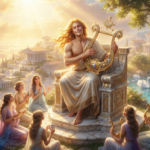
In the glittering pantheon of Greek mythology, where divine beings embody the forces of nature and human experience, Aglaia shines as a figure of luminous grace and splendor. Who is Aglaia, one of the Charites in Greek mythology? She is the goddess of beauty, glory, and adornment, the youngest of the three Charites—also known as the Graces—who personify charm, creativity, and the joyous abundance of life. Her very name, derived from the ancient Greek word for “splendor” or “brilliance,” speaks to her essence: she is the radiant light that adorns festivals, the elegance that graces the divine court, and the beauty that brings harmony to both gods and mortals . As the wife of the smith god Hephaestus and the mother of a generation of benevolent goddesses, Aglaia occupies a unique position in the mythological hierarchy—one that connects the raw power of divine craftsmanship with the refined beauty of grace and charm. This article will explore the origins, mythology, family relationships, cultural significance, and enduring legacy of Aglaia, providing a comprehensive guide to this often-overlooked but deeply significant goddess. From her birth among the Olympian elite to her role in the Homeric epics and her continued presence in art and astronomy, we will uncover the many layers of meaning woven into the figure of Aglaia.
The Origins and Genealogy of Aglaia
The Divine Parentage of the Graces
The origins of Aglaia are rooted in the highest echelons of the Greek pantheon. According to the most authoritative ancient sources, she is the daughter of Zeus, the king of the gods, and Eurynome, an Oceanid—one of the three thousand daughters of the Titans Oceanus and Tethys . This genealogy, most famously recorded in Hesiod’s Theogony, places Aglaia within the second generation of the Olympian divine order, born after the establishment of Zeus’s supreme rule . Her mother, Eurynome, is herself a figure of considerable importance, a goddess of meadows and pastures who, according to some traditions, was one of the earliest occupants of Olympus before the rise of the Olympian gods.
Hesiod provides the most complete and influential account of the Graces’ parentage, naming Aglaia, Euphrosyne, and Thalia as the daughters of Zeus and Eurynome . This lineage is confirmed by other major sources, including the mythographer Apollodorus, who repeats the same genealogy in his Library . The Orphic tradition, however, offers a slightly different account, presenting the Charites as the daughters of Zeus and Eunomia, the goddess of good order and lawful conduct . This variation reflects the broader fluidity of Greek mythology, where local traditions and different poetic schools often offered alternative genealogies for the same deities. Regardless of the specific mother named, the consistent element across all traditions is the divine paternity of Zeus, which ensures that Aglaia and her sisters occupy a position of supreme honor among the Olympian goddesses. The connection to Zeus also explains their role as bestowers of grace and charm—qualities that the king of the gods himself might wish to distribute among his divine court and favored mortals.
Aglaia’s Role Among the Charites
Within the triad of the Charites, Aglaia holds a distinct and significant position. She is consistently identified as the youngest of the three sisters, a detail that Hesiod explicitly notes in his Theogony . Her sisters are Euphrosyne, whose name means “joy” or “mirth,” and Thalia, whose name signifies “abundance” or “blooming” . Together, these three goddesses represent the complete spectrum of grace and beauty: Aglaia embodies the radiant splendor and physical beauty, Euphrosyne represents the inner joy and happiness that beauty inspires, and Thalia personifies the flourishing abundance and creative vitality that grace brings to the world .
The dynamic among the three Charites is one of harmonious complementarity. Aglaia provides the external brilliance, the dazzling appearance that captures the eye; Euphrosyne provides the emotional response, the delight and contentment that such brilliance evokes; and Thalia ensures that this beauty is fertile and productive, bringing about growth and abundance in nature and in human endeavors. This triad is sometimes presented with alternative names in different regional traditions—for instance, the Spartans worshipped two Graces named Cleta and Phaenna, while other sources mention Pasithea, Peitho, or Kale as alternative Charites . However, the canonical grouping established by Hesiod—Aglaia, Euphrosyne, and Thalia—became the definitive and most widely recognized trio in Greek and Roman culture . This grouping also reflects a philosophical principle: that true beauty consists of outer radiance (Aglaia), inner joy (Euphrosyne), and abundant flourishing (Thalia), a conception that would profoundly influence later Greek and Roman aesthetic philosophy.
Mythological Role and Divine Functions
The Goddess of Beauty, Splendor, and Adornment
Aglaia’s primary domain is the bestowal of beauty, splendor, and adornment . Her name itself, derived from the Greek word aglaia, encapsulates this function—it signifies not merely physical attractiveness but a radiant, almost blinding brilliance that commands admiration and reverence. As the goddess of beauty, Aglaia is responsible for the grace and charm that make the divine court of Olympus so magnificent, and she bestows similar qualities upon favored mortals, particularly heroes and heroines of exceptional virtue or divine favor.
In her role as a goddess of adornment, Aglaia presides over the arts of beautification and refinement. This includes not only personal adornment—jewelry, cosmetics, and fine clothing—but also the broader cultural arts that bring elegance and sophistication to human life, such as music, dance, and poetry . The Charites as a group are closely associated with these arts, often appearing in the retinue of Apollo and the Muses, dancing and singing at divine festivals . Aglaia, as the leader of the Graces, personifies the aesthetic ideal that these arts seek to achieve: the harmonious and beautiful order that delights the senses and elevates the soul.
Furthermore, Aglaia’s association with “glory” connects her to the concept of heroic achievement. In Greek culture, aglaia could refer to the brilliant glory won through heroic deeds—the honor and renown that make a hero’s name shine across the ages. This dimension of Aglaia’s character aligns her with the broader Greek ethical ideal that beauty and virtue are intrinsically connected, and that the splendor of a great deed is a form of grace that deserves divine acknowledgment. The goddess thus bridges the aesthetic and the ethical, embodying the conviction that what is beautiful is also good, and what is good should be beautiful in expression.
The Divine Attendant of Aphrodite
One of Aglaia’s most prominent mythological roles is as a devoted attendant and handmaiden to Aphrodite, the goddess of love and desire . This association is natural, given that both goddesses preside over beauty and charm—Aphrodite represents love’s power, while Aglaia represents the physical and aesthetic appeal that love often inspires. In this capacity, Aglaia and her sisters perform essential services for the love goddess, participating in her toilette and enhancing her allure.
According to the sources, the Charites bathe and anoint Aphrodite, preparing her for her seductions and amorous adventures . They weave her garments and dye her sacred peplos, the shimmering robe that makes her irresistible to gods and mortals alike . In the epic Dionysiaca of Nonnus, Aglaia is shown actively assisting Aphrodite in her weaving competition against Athena, passing the yarn as the goddess of love attempts to outdo the goddess of craftsmanship . This episode reveals Aglaia’s dual nature: she is both a goddess of craftsmanship and adornment, but also a subordinate whose loyalty is to Aphrodite’s designs. When Aphrodite grows jealous of Athena’s weaving, Aglaia supports her mistress’s ambition, even if it leads to conflict with another powerful Olympian.
Perhaps most significantly, Aglaia serves as Aphrodite’s messenger. In one episode from Nonnus’s Dionysiaca, Aglaia is sent to find Eros (Love) and deliver a message from his mother . The god of love, however, is able to fly back to Aphrodite much faster than Aglaia can travel on foot, a detail that emphasizes her human-like limitations despite her divine status. This episode humanizes Aglaia, showing her as a loyal and diligent servant who, despite her beauty and grace, does not possess the supernatural speed or mobility of some other divine beings. It also reinforces her connection to the love goddess’s court, positioning her as a bridge between Aphrodite’s desires and the actions required to fulfill them. In classical art, this association with Aphrodite is frequently depicted, with Aglaia and her sisters appearing in paintings and reliefs as part of the goddess’s retinue, dancing in celebration of love’s triumphs or attending to her needs.
Family Relationships and Connections
The Marriage to Hephaestus
One of the most significant aspects of Aglaia’s mythology is her marriage to Hephaestus, the god of fire, metalworking, and craftsmanship . This union, first recorded by Hesiod, represents a fascinating conjunction of opposites: the divine smith, characterized by his physical deformity and association with brute labor, marries the goddess of radiant splendor and grace . The contrast between the homely, lame Hephaestus and the supremely beautiful Aglaia is striking, and it has been interpreted by scholars as a symbolic reconciliation between the ugliness of toil and the beauty of its products—through his craft, Hephaestus creates objects of transcendent beauty, and in his wife, he possesses that beauty personified.
The marriage between Aglaia and Hephaestus is often understood to occur after the smith god’s bitter divorce from Aphrodite, who had been caught in adultery with Ares . This sequence of events is not always explicitly stated in the ancient sources, but it is a plausible reading of the mythological chronology. After being publicly humiliated and abandoned by the goddess of love, Hephaestus finds a more faithful and appropriate spouse in Aglaia, whose domain of adornment and beauty complements his domain of craftsmanship. Unlike Aphrodite, whose association with passion and desire might lead her to seek gratification outside marriage, Aglaia represents a more stable and harmonious form of beauty—the splendor that results from skill, order, and proper craftsmanship. Some scholars have interpreted Aglaia’s role as Hephaestus’s wife as the natural outcome of the myth’s symbolic logic: the artist produces beautiful objects, so he is appropriately paired with the goddess of beauty .
This marriage also underscores the social and theological dynamics of the Olympian court. Aglaia, despite her relative obscurity compared to some other goddesses, secures a prominent position through her union with a major Olympian deity. Her role as Hephaestus’s consort gives her a place in the inner circle of the Olympian gods and highlights her importance as a divine figure. In the Iliad, the wife of Hephaestus is called Charis (Grace), and she welcomes Thetis into her home on Olympus so that the sea goddess can ask Hephaestus to forge armor for Achilles . This episode shows Aglaia in a domestic setting, performing the duties of a hospitable hostess and acting as an intermediary between her husband and the other gods. Her home is described as a place of beauty and warmth, reflecting her own nature and the skill of her husband. The use of the name “Charis” in this passage instead of “Aglaia” indicates the fluidity of identity among the Charites in Homeric and later literature . It suggests that Aglaia, as the primary Charis, could be referred to by the collective singular name of her group.
The Mother of the Younger Graces
Aglaia’s role as a mother is a significant extension of her mythological functions. According to the Neoplatonist philosopher Proclus, drawing on earlier Orphic traditions, Aglaia bore Hephaestus four daughters, known collectively as the younger Charites: Eucleia (Good Repute), Eupheme (Acclaim or Eloquence), Euthenia (Prosperity), and Philophrosyne (Welcome or Friendliness) . These goddesses personify specific aspects of civilized life and social harmony, continuing the tradition of the Charites as bringers of grace and blessing to human society.
The names of these daughters are themselves revealing. Eucleia represents the good reputation and honor that come from virtuous actions and gracious conduct—the recognition that one has earned through proper behavior. Eupheme embodies the power of well-chosen words, the eloquence and praise that grace social interactions and public gatherings. Euthenia signifies the prosperity and abundance that result from the harmonious flow of resources and goodwill. Philophrosyne personifies the welcome and friendliness that characterize gracious hospitality and the bonds of social community . Together, these four goddesses represent the complete spectrum of social and personal goods that flow from grace: honor, eloquence, prosperity, and friendship.
This generative role further solidifies Aglaia’s importance in the Greek mythological tradition. She is not merely a passive figure of beauty but an active creator of the virtues and qualities that make human life civilized and harmonious. Her daughters serve as the divine patrons of the social graces, ensuring that honor is bestowed where it is due, that communication is eloquent and persuasive, that abundance is shared fairly, and that hospitality is warm and generous. Through her children, Aglaia’s influence extends from the divine court to the human community, making her a bridge between the ideal beauty of Olympus and the practical virtues that sustain human society. The genealogical connection also reinforces the philosophical principle that grace, properly understood, is not merely an aesthetic quality but a moral and social one—it is the source of all that is good in human interactions.
Worship and Religious Significance
The Cult of the Charites in Ancient Greece
The worship of the Charites, including Aglaia, was an ancient and deeply rooted practice in Greek religion . Their cult predated the classical Olympian religion and appears to have originated in the Pre-Greek or Pelasgian period, suggesting that the concept of grace as a divine power was fundamental to the earliest Greek societies . The Charites were primarily associated with fertility, nature, and the creative force of life, and their worship was closely tied to springs, rivers, and the agricultural abundance of the land. This connection to fertility and growth explains why they were often offered a portion of the produce, especially in Boeotian cult centers like Orchomenus .
The most important center of Charite worship was in Orchomenus, a city in Boeotia, where the cult was believed to have originated . According to tradition, the first temple dedicated to the Charites was founded by King Eteocles, who established the number of the goddesses as three and honored them for the graces he received from them . The cult at Orchomenus was strikingly ancient, centered on a trio of stones—a form of aniconic worship that predates the later development of anthropomorphic sculpture. This archaic form of veneration suggests that the Charites were originally worshipped as elemental forces of nature, more akin to nymphs than to the later fully personified goddesses.
At Orchomenus, the Charites were worshipped in connection with the local river Cephisus and the spring of Argaphia, which were considered sacred to them . The agricultural prosperity of the Kopaic plain, where Orchomenus was located, was attributed to their beneficence, and they received offerings of the produce as a sign of gratitude. The cult was also marked by a distinctive festival called the Charisia, during which dances were held throughout the night, and at the end, a special cake was given to those who had remained awake . This nocturnal celebration suggests that the Charites were associated with ecstatic and communal worship, similar to the cults of Dionysus and Artemis.
Regional Variations and Ritual Practices
The worship of the Charites was not uniform across Greece; it varied significantly from region to region in terms of the number of goddesses worshipped, their names, and the specific rituals associated with them . In Sparta, for instance, only two Graces were worshipped: Cleta (Renowned or Sound) and Phaenna (Bright or Light). The Lacedaemonians claimed that these names had been given by King Lacedaemon himself, who had established the cult . This Spartan tradition, which reduces the number of Graces from three to two, is an example of local adaptation of a pan-Hellenic cult, emphasizing the qualities—renown and brightness—that were particularly valued in Spartan warrior culture.
In Athens, the Charites were also worshipped, and the tradition there was similarly distinctive. The Athenians originally worshipped two Graces, Auxo (Increase or Growth) and Hegemone (Leader or Queen), until the poet Hermesianax added Peitho (Persuasion) as a third . This association with Peitho, the goddess of persuasion, reflects the Athenian emphasis on rhetoric and the arts of persuasion, central to their democratic political culture. The Graces in Athens were worshipped near the entrance to the Acropolis, a prominent location that underscored their importance to the city’s religious life, and their mysteries were celebrated with rituals not divulged to the many .
These regional variations demonstrate that Aglaia and her sisters were not merely abstract literary figures but lived deities whose worship was adapted to the specific values and needs of different Greek communities. The flexibility of their cult is also reflected in their artistic representations. The sculptor Praxiteles was renowned for his statue group of the Charites, which set the canon for later depictions . In art, the Graces were typically shown as three graceful young women, linked in a dance-like pose, an image that has become iconic in Western art . This convention originated in Greek sculpture of the 2nd century BC and was widely copied in Roman times, becoming a standard motif in everything from mirrors to sarcophagi . The prevalence of this image attests to the enduring appeal of the Graces and their association with harmony, beauty, and the joy of life.
Artistic Representations and Cultural Influence
The Iconography of the Three Graces
The Three Graces—Aglaia, Euphrosyne, and Thalia—are among the most recognizable figures in classical art, their image enduring from antiquity through the Renaissance to the present day. The canonical representation of the Graces, established in the Hellenistic period and widely adopted in Roman art, depicts three young, nude or semi-nude women standing in a line, facing forward, with their arms intertwined in a dance-like embrace . The middle figure typically stands with her back to the viewer, while the two outer figures face inward, creating a harmonious composition that emphasizes balance, symmetry, and mutual connection.
This arrangement is not merely decorative but symbolic. The intertwined arms and the circular, flowing movement of the figures represent the interconnectedness of grace, beauty, and joy—the qualities personified by Aglaia and her sisters. The alternating front-and-back poses suggest that grace is not a static quality but a dynamic, multifaceted force that reveals itself differently from different perspectives. The nudity of the figures emphasizes their association with natural beauty and the ideal human form, while their graceful poses and harmonious grouping embody the aesthetic perfection that the Charites were believed to bestow upon art and nature.
The Graces were frequently depicted in a variety of artistic media, from large-scale marble statuary to small decorative objects . They appeared on the pediments of temples, on the reliefs of sarcophagi, on painted vases, and as motifs on jewelry, mirrors, and furniture. This ubiquity testifies to their importance as symbols of beauty, harmony, and good fortune in both public and private contexts. The sculptural group at the Metropolitan Museum of Art, a Roman copy of a Greek original from the 2nd century BC, exemplifies this tradition, showing the Graces in their canonical pose, their bodies young and graceful, their expressions serene and welcoming . This statue group, measuring over four feet in height, would have been a significant and impressive public or private display, reminding viewers of the divine blessings of grace and beauty.
Aglaia in Literature and Philosophy
Beyond the visual arts, Aglaia and the Charites played a significant role in Greek literature and philosophy. The poets of the Archaic and Classical periods frequently invoked the Graces as sources of inspiration and patrons of the arts. Pindar, the great lyric poet of the 5th century BC, wrote an entire ode, the Olympian 14, in honor of the Charites, calling them the “queens of Orchomenus” and the guardians of the ancient Minyans, and praying for their blessings . This hymn is a testament to the Charites’ importance as cultural figures and their association with poetic inspiration. Pindar’s request for their favor reflects the belief that grace and charm are essential qualities for a poet—that the ability to delight and enchant an audience is itself a divine gift.
In philosophical thought, the concept of charis (grace) became central to discussions of ethics, aesthetics, and theology. Plato, in his dialogues, often refers to the importance of grace and harmony in education and the arts, and the Charites are implicitly invoked as the personification of these ideals. The Neoplatonist philosophers of late antiquity developed a complex allegorical interpretation of the Charites, seeing them as representations of the threefold nature of grace: the descent of divine beauty into the material world, the ascent of the soul towards the divine, and the harmonious circle that unites all creation. Proclus, the 5th-century Neoplatonist, provides a detailed account of Aglaia’s role as Hephaestus’s wife and the mother of the younger Graces, interpreting these relationships in terms of the emanation of divine qualities .
The influence of Aglaia and the Charites extends well beyond antiquity. The image of the Three Graces has remained a staple of Western art, appearing in paintings by Botticelli, Raphael, Rubens, and many others. The Graces have been interpreted as symbols of love, friendship, and the arts, and they continue to inspire artists and thinkers to the present day. In astronomy, the asteroid 47 Aglaja, discovered in 1857, is named for Aglaia, extending her presence even to the heavens . This legacy demonstrates the enduring power of the concept of grace—the recognition that beauty, charm, and joy are not merely superficial qualities but fundamental aspects of human experience that deserve divine acknowledgment.
Frequently Asked Questions About Who is Aglaia, one of the Charites in Greek mythology?
What does the name Aglaia mean?
The name Aglaia (Ἀγλαΐα in ancient Greek) means “splendor,” “beauty,” “brilliance,” or “radiance” . It is derived from the Greek word aglaos, which means “shining” or “splendid.” Her name directly reflects her role as the goddess of beauty, glory, and adornment, representing the shining quality of grace that she bestows upon gods and mortals.
Who are the parents of Aglaia?
According to the most authoritative sources, including Hesiod’s Theogony and Apollodorus’s Library, Aglaia is the daughter of Zeus, the king of the gods, and Eurynome, a daughter of the Titans Oceanus and Tethys . The Orphic tradition offers an alternative genealogy, naming her mother as Eunomia, the goddess of good order . In both traditions, however, Zeus is consistently identified as her father, confirming her status as a deity of high Olympian lineage.
Who is Aglaia’s husband?
Aglaia is the wife of Hephaestus, the god of fire, metalworking, and craftsmanship . Hesiod first records this union in the Theogony, and it is widely referenced in later sources. Her marriage to Hephaestus is often interpreted as occurring after the smith god’s divorce from Aphrodite, and it represents a harmony between the beauty of craftsmanship and the splendor of adornment. In the Iliad, she is referred to as “Charis,” the Grace, when welcoming Thetis into her home on Olympus .
What is the relationship between Aglaia and the other Charites?
Aglaia is one of the three Charites, along with her sisters Euphrosyne (Joy) and Thalia (Abundance/Blooming) . They are goddesses of grace, charm, beauty, and creativity, and they appear together as a harmonious triad. Aglaia is consistently described as the youngest of the three . Together, they personify the full spectrum of grace: Aglaia embodies its radiant splendor, Euphrosyne its inner joy, and Thalia its fertile, abundant flourishing.
What does Aglaia do in Greek mythology?
Aglaia serves as a goddess of beauty, splendor, and adornment . She is a faithful attendant of Aphrodite, bathing and anointing the love goddess, weaving her garments, and serving as her messenger . She is also a loyal wife to Hephaestus, presiding over a gracious and beautiful home on Olympus. Through her marriage to Hephaestus, she is the mother of Eucleia, Eupheme, Euthenia, and Philophrosyne, goddesses of good repute, acclamation, prosperity, and friendliness .
Did Aglaia have any children?
Yes, according to later sources, particularly the Neoplatonist Proclus, Aglaia had four daughters by Hephaestus: Eucleia (Good Repute), Eupheme (Acclaim or Eloquence), Euthenia (Prosperity), and Philophrosyne (Welcome or Friendliness) . These goddesses are sometimes called the younger Charites, and they represent the specific virtues and blessings that flow from grace in human society.
Where was Aglaia worshipped in ancient Greece?
Aglaia, as one of the Charites, was worshipped throughout Greece, particularly in Orchomenus in Boeotia, which was the most important center of her cult . The Charites were also worshipped in other cities, including Sparta (where only two Graces were recognized), Athens (with a different set of names), and elsewhere. The cult of the Charites was ancient, dating to the Pre-Greek period, and was closely associated with fertility, springs, and agricultural abundance.
How is Aglaia depicted in ancient art?
Aglaia is most commonly depicted as one of the Three Graces, shown as a beautiful, graceful young woman in a harmonious dance-like pose with her sisters . The canonical composition, established in the Hellenistic period, shows three nude or semi-nude women with their arms intertwined, the central figure facing backward and the outer figures facing inward. This image was widely used in Roman art and became a standard motif in Western art for centuries . In earlier Greek art, she sometimes appears as a solitary figure, often with wings and a torch, but the triad representation is the most iconic and enduring.
Conclusion
Who is Aglaia, one of the Charites in Greek mythology? She is the goddess of beauty, splendor, and adornment, a figure of radiant grace whose influence extends from the divine court of Olympus to the lives of mortals. As the youngest of the three Charites, the daughter of Zeus and Eurynome, the wife of Hephaestus, and the mother of a generation of benevolent goddesses, Aglaia stands at the intersection of divine beauty and human creativity. Her name, meaning “splendor” or “brilliance,” encapsulates her essence: she is the shining quality of grace that elevates the ordinary to the sublime, the charm that delights the gods, and the inspiration that drives the arts.
Her mythology reveals a goddess of complexity and depth. She is both a devoted attendant of Aphrodite and a loyal wife to Hephaestus, embodying the reconciliation of love’s passion with the enduring beauty of craft. She serves as a messenger and helper, but also as a generative figure whose children personify the social virtues that sustain civilized life. Through her association with the Charites, she represents the complete spectrum of grace—outer radiance, inner joy, and abundant flourishing—and her image has become an enduring symbol of harmony, beauty, and the pleasures of civilized existence.
Her worship, though varied across the Greek world, was ancient and widespread, reflecting the deep human need to acknowledge and honor the forces that bring joy, charm, and abundance into life. Her presence in art, from Hellenistic sculptures to Renaissance paintings to contemporary works, attests to the timeless appeal of grace and beauty. Even in the modern world, her name endures on a distant asteroid, a reminder that the splendor of the ancient gods can still inspire wonder and awe. To know Aglaia is to understand the profound importance that the Greeks placed on grace—not as a superficial quality, but as a divine force that makes life worth living, a gift from the gods that we would all do well to cultivate and cherish.

Orin Vale has spent the better part of two decades tracing the threads that connect the world’s oldest stories — from the halls of Asgard to the banks of the Nile, from Olympus to the jungles of the Maya. What began as a childhood fascination with flood myths and trickster gods grew into years of independent study across comparative mythology and ancient religion, always chasing the same question: what did these stories mean to the people who first told them? Orin writes for readers who want more than trivia — the ones looking for the beliefs, fears, and truths that myths were built to carry.