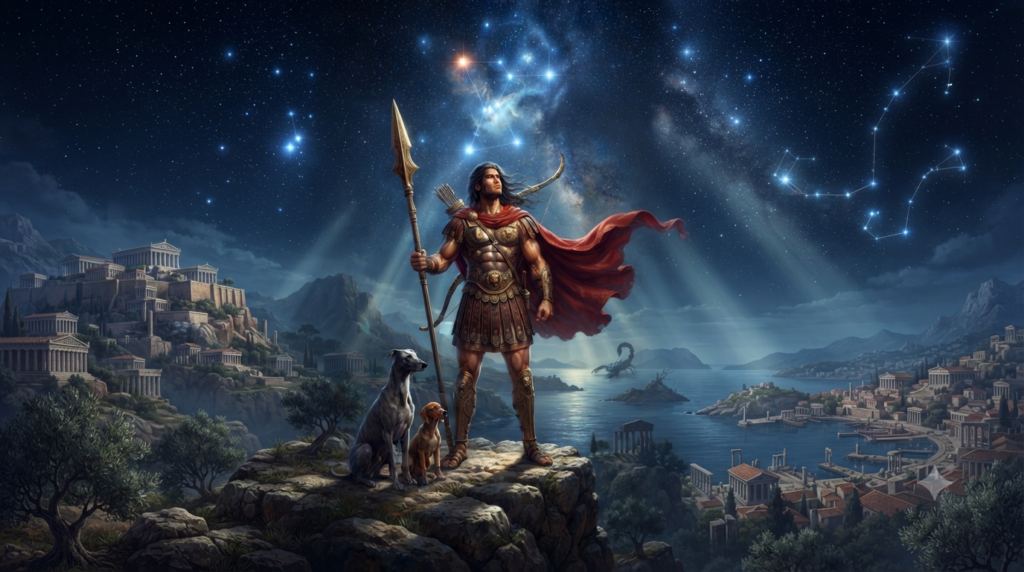
In the vast and star-filled tapestry of Greek mythology, few figures bridge the realms of mortal heroism and celestial wonder quite like Orion the Hunter. Who is Orion in Greek mythology? He is the giant huntsman of unparalleled beauty and strength, a figure whose dramatic life and tragic death were etched permanently into the night sky as one of the most recognizable constellations. Orion is a complex and often contradictory character; he is a son of the sea god Poseidon, yet also a being born from the earth; a beloved companion of the virgin goddess Artemis, yet also her victim; a mortal who fell in love with the goddess Dawn, yet was ultimately brought low by a scorpion sent by Gaia. His myths, recorded in fragments by poets, historians, and mythographers from Homer’s time to the Roman era, are a rich tapestry of local traditions and astronomical observations. This article will delve into the many stories of Orion, exploring his origins, his legendary adventures, his tragic death, and his ultimate ascension to the stars. From his miraculous birth to his role as a navigation guide in ancient literature, we will explore all facets of this fascinating figure to provide a definitive answer to Who is Orion in Greek mythology?
The Origins and Birth of Orion
The origins of Orion are as varied and fascinating as the tales of his life, with ancient sources offering two major, distinct traditions. One presents him as a mortal giant of divine lineage, while the other tells a story of an earth-born child created through a miraculous, and somewhat peculiar, act of the gods.
The Divine Son of Poseidon
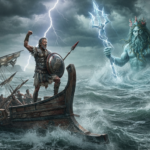
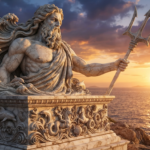
The most common and widely cited version of Orion’s parentage establishes him as the son of Poseidon, the god of the sea, earthquakes, and horses . In this tradition, Orion’s mother is usually identified as Euryale, a daughter of the legendary King Minos of Crete . This divine lineage is a key factor in understanding Orion’s character. As a son of a powerful Olympian god, Orion was no mere mortal. He was a giant of immense stature and possessed supernatural abilities, most notably the power to walk on the surface of the water as if it were land . This gift from his father would prove crucial in his later travels and adventures. Accounts from Hesiod and the mythographer Apollodorus support this version, solidifying Poseidon and Euryale as the parents of the great hunter . Homer, in the Odyssey, also refers to Orion as the “most handsome of the earthborn,” a descriptor that aligns with his stature as a demigod .
The Earth-Born Son of Hyrieus
An alternative, yet equally celebrated, version of Orion’s birth grounds him in the Boeotian region of Greece, specifically Hyria . This story involves Hyrieus, a poor and pious farmer. According to the myth, Hyrieus once offered hospitality to three gods—Zeus, Poseidon, and Hermes—who were traveling in disguise. As a reward for his generosity, the gods offered to grant him any wish. Hyrieus, who was childless, expressed his deepest desire for a son . Following a rather bizarre divine instruction, the gods took the hide of a sacrificed bull, urinated upon it, and buried it in the earth. From this fertilized patch of ground, after a gestation period of several months, the infant Orion was born . This version of the myth provides a fascinating etymology for Orion’s name. His name, Ōríōn, was thought by some ancients to be derived from ourion, meaning “urine,” linking him directly to the peculiar method of his conception . This autochthonous birth, where he sprang directly from the earth, is why he is often described as “earth-born” in ancient texts .
Historical Context and Cultural Significance
Orion in the Mycenaean and Archaic Periods
Orion is one of the most ancient figures in Greek mythology, with his story and astronomical associations predating the classical period. His name appears in some of the earliest works of Greek literature, including the epics of Homer . In the Iliad, Orion is already a well-established constellation on the shield of Achilles, and his dog, Sirius, is mentioned . This early reference indicates that Orion was a familiar figure in Mycenaean and Archaic Greek culture. More than a mere story, Orion served as a practical tool for ancient peoples. Hesiod’s Works and Days describes how the rising and setting of the constellation Orion were used by farmers to signal the changing seasons and guide agricultural tasks, such as the time for plowing and harvesting . The myths surrounding Orion may have been used to explain these celestial movements, with his birth legends, for instance, being connected to seasonal rains that followed the rising and setting of the constellation .
The Boeotian Hero
Orion’s connection to the region of Boeotia, particularly the city of Tanagra, was of immense local importance . He was venerated as a hero in this area, suggesting that his cult was an integral part of the region’s identity. Pausanias, the 2nd-century CE travel writer, mentions visiting a tomb in Tanagra that was said to belong to Orion . The story of his birth in Hyria and his local epithet, “Candaon,” further cement his status as a regional hero . The Boeotians were responsible for preserving the unique earth-born version of his myth, which highlighted their own land’s divine favor and ancient history. This local hero worship contrasts with Orion’s more pan-Hellenic fame as a constellation, demonstrating how a local figure could achieve national and even international renown through his connection to the celestial sphere.
The Legendary Life and Loves of Orion
The Adventures on Chios
One of the most detailed and dramatic episodes in Orion’s life takes place on the island of Chios. It is here that his prowess as a hunter and his passionate, often violent, nature come to the forefront. According to the myth, Orion was invited by King Oenopion of Chios to clear the island of the wild beasts that plagued its inhabitants . The king promised his daughter, Merope (or Aero in some accounts), as a reward for this service . Orion successfully completed the task, but Oenopion, loath to part with his daughter, continually delayed the marriage .
One night, intoxicated, Orion broke into Merope’s chambers and raped her . Upon discovering this transgression, an enraged Oenopion sought the help of the god Dionysus. Dionysus either sent satyrs to put Orion into a deep sleep or plied him with wine. While Orion was incapacitated, Oenopion blinded him, taking his sight and banishing him from Chios . This tale adds a layer of tragedy to Orion’s story. The great hunter, famed for his strength and skill, is rendered helpless through intoxication and guile, punished for his inability to control his own desires.
The Journey to Lemnos and the Restoration of Sight
Orion’s story does not end in darkness. An oracle informed him that his sight could be restored if he traveled east and exposed his eyes to the first rays of the rising sun . Following the sound of a Cyclops’ hammer, he traveled to the island of Lemnos, the legendary home of the smith god Hephaestus . Hephaestus, taking pity on the blind giant, gave him his servant and guide, Cedalion, to lead him further east . Orion placed the small figure of Cedalion on his shoulders, and the servant guided him to the very edge of the world, where Helios, the sun god, rises each day . The brilliant rays of the rising sun restored Orion’s vision . Having regained his sight and strength, Orion immediately set out to return to Chios to take his revenge on Oenopion. However, the king was warned of his arrival and hid himself in an underground, bronze chamber, safe from Orion’s wrath . Frustrated but undeterred, Orion left Chios and traveled to Crete, marking the next phase of his legendary career.
Orion and the Goddess Artemis
In Crete, Orion became a hunting companion to the goddess Artemis and her mother Leto . As a fellow hunter of immense skill, Orion was a natural companion for Artemis, the virgin goddess of the hunt. This association, however, would lead to his ultimate demise. While hunting with Artemis on Crete, Orion committed a grave act of hubris. According to the most common tradition, he boasted that he would kill every wild beast on the face of the earth . This arrogant claim incensed Gaia (Earth), the primordial mother of all life, who saw this as a threat to her children. To protect the animals, she sent a giant scorpion to punish the hunter . The scorpion attacked Orion, and despite his immense strength, it stung him to death with its venomous tail . This story, more than any other, explains the astronomical relationship between Orion and Scorpius. The scorpion was also placed in the sky as a constellation, and to this day, the two constellations are set on opposite sides of the heavens; as Scorpio rises, Orion sets, and he is forever seen to be fleeing from the creature that killed him .
Death, Apotheosis, and Celestial Legacy
The Varied Accounts of Orion’s Death
While the scorpion myth is the most famous, ancient sources record several other versions of Orion’s death, each adding a unique layer to his myth. One tradition, found in Homer, relates that Eos, the goddess of Dawn, fell in love with Orion and carried him away. The gods, particularly Artemis, grew jealous of this affair, and the goddess slew Orion with her arrows on the island of Ortygia . In another account, Orion met his end at the hands of his own companion. A common version, told by Hyginus, presents his death as a tragic accident. Apollo, Artemis’s brother, grew jealous of the close relationship between the goddess and the hunter. While Orion was swimming far out at sea, Apollo pointed to a distant black spot—Orion’s head—and challenged his sister to prove her archery skill by hitting it. Artemis, unaware of the target’s identity, shot her arrow with unerring aim, killing Orion instantly . When his body washed up on the shore, Artemis was overcome with grief. Another tale speaks of Orion attempting to violate the goddess Artemis herself or one of her attendants, Opis, and being killed for his transgression . In a final, distinct variant, the god Asclepius attempted to resurrect Orion, but Zeus, fearing the healer was overstepping his mortal bounds, struck him dead with a thunderbolt before he could succeed .
The Constellation Orion and His Celestial Companions
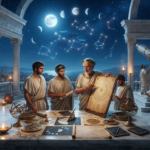
Following his death, Orion was placed among the stars by Zeus, and he became the great constellation that bears his name . In the sky, the constellation of Orion takes the form of a hunter, complete with a club, a lion’s skin, and a sword hanging from his belt . He is depicted as a giant of immense stature, forever pursuing his prey across the celestial dome. The most recognizable feature of the constellation is his “belt,” formed by three bright stars in a straight line . This star pattern has been recognized by cultures around the world for millennia. The ancient Egyptians, for instance, saw the belt as the resting place of the soul of the god Osiris, while the Arabs saw the figure of a giant . Orion is not alone in the heavens. His hunting dogs are immortalized as the constellations Canis Major and Canis Minor, which follow him across the sky . Canis Major, in particular, is home to the brightest star in the night sky, Sirius, which Homer described as “the dog of Orion” . A more complex astronomical myth involves Orion and the Pleiades. According to one story, Orion pursued the seven sisters, the Pleiades, for seven years before Zeus intervened and transformed them all into constellations to protect them. This is reflected in the night sky, where the hunter seems to eternally pursue them .
Ancient Sources and Artistic Representations
Literary References
Orion is remarkably well-attested in surviving ancient literature. Homer mentions him in both the Iliad and the Odyssey . In the Odyssey, the hero Odysseus encounters the ghost of Orion in the Underworld, where he is depicted as herding the animals he had killed in life across the asphodel meadows, wielding an indestructible bronze club . Hesiod, in his Works and Days, uses the heliacal rising and setting of Orion to mark the agricultural calendar . The mythographers Apollodorus, Hyginus, and Pausanias also provide detailed accounts of his various myths, including the story of his blinding on Chios and the different versions of his death . The 1st-century CE poet Ovid also mentions Orion and his wife, Side, in his Art of Love .
Visual Representations
In ancient art, Orion is a relatively rare subject, but he does appear in some works. The most famous artistic depiction of the myth is the story of Orion’s birth, where the gods urinate on the hide. This unusual scene appears in the Fasti of Ovid and is likely derived from local Boeotian legends . A more notable representation is in the Hesiodic Shield of Heracles, where the shield’s description includes a detailed astronomical scene featuring Orion as a constellation, alongside the Pleiades . However, most depictions of Orion in antiquity were likely astronomical rather than narrative, showing the constellation on ancient star maps. In modern times, the constellation’s distinctive shape has made it a staple of art and popular culture. The Renaissance era saw numerous representations of the hunter in celestial cartography, with artists like Albrecht Dürer depicting him as a heroic, classical figure. Today, Orion remains one of the most photographed and recognized constellations in the night sky.
The Enduring Legacy of Orion
Modern Astronomy and Science
Orion’s most significant legacy is the constellation that bears his name, which remains one of the most prominent and scientifically important features of the night sky. Visible from nearly every inhabited region of the world, the Orion constellation is a treasure trove for astronomers. It contains Betelgeuse, a red supergiant star nearing the end of its life, and Rigel, a blue supergiant . Below his belt lies the Orion Nebula, a stellar nursery where new stars are being born, making it a prime target for both amateur and professional astronomers . The “Orion correlation theory” has also sparked debate among Egyptologists, suggesting that the layout of the Giza pyramids aligns with the belt of Orion, demonstrating the profound cultural impact of this constellation even in the ancient world. The constellation is also a valuable navigation tool; its position on the celestial equator makes it visible all over the planet .
Influence on Culture and Language
The myth of Orion has influenced various aspects of modern culture and language. His name is frequently used for military operations, space exploration missions, and products seeking to evoke strength and adventure. The Orion spacecraft, for instance, is NASA’s deep-space exploration vehicle intended to carry astronauts beyond Earth’s orbit, a fitting tribute to the celestial hunter’s exploration of the cosmos. The myth has also been a subject of fascination for writers and artists, serving as the inspiration for numerous poems, paintings, and musical compositions. The story of Orion’s blindness and the restoration of his sight by the sun is a powerful motif of loss and rebirth. The constellation’s distinct appearance has also led to its incorporation into pop culture, from films and television shows to video games and corporate logos. In all these ways, the legacy of Orion continues to thrive, demonstrating the enduring power of a story that bridges the realms of myth, astronomy, and human imagination.
Frequently Asked Questions About Who is Orion in Greek mythology?
What is Orion the god of?
In Greek mythology, Orion is not a god but a giant huntsman of immense strength and beauty . He is a mortal hero, although some versions of the myth make him a demigod as the son of Poseidon. He was considered a hero and was venerated as such in the Boeotian region . After his death, he was placed among the stars as a constellation, becoming a celestial figure rather than a chthonic or Olympian god.
Who killed Orion and why?
There are several different versions of Orion’s death. The most famous myth is that he was killed by a giant scorpion sent by Gaia (Earth) after he boasted he would kill every animal on the planet . Other accounts say he was killed by the goddess Artemis, either by accident after being tricked by her brother Apollo, or in anger for attempting to rape her or one of her attendants .
Why is Orion in the sky?
After his death, Orion was placed among the stars as a constellation by Zeus (or by Artemis, in some versions) . This was a way to honor him and grant him immortality for his deeds and his tragic fate. He is depicted in the sky as a hunter with his belt, sword, and club, forever pursuing the Pleiades and fleeing the Scorpion .
Was Orion the son of Poseidon?
Yes, many ancient sources, including Hesiod and Apollodorus, name Orion as the son of Poseidon and Euryale, the daughter of King Minos . This divine parentage is what granted Orion the ability to walk on water and his immense stature. However, an alternative tradition says he was the earth-born son of the farmer Hyrieus in Boeotia .
Did Artemis love Orion?
The relationship between Artemis and Orion is complex and contradictory. Some myths state that Artemis fell in love with Orion, and they became hunting companions on Crete . This is often the motivation for Apollo’s trickery, as he was jealous of the relationship. Other versions portray Artemis as the one who killed him, either accidentally or because he committed a transgression against her .
What is the myth of Orion and the Pleiades?
In one story, Orion, the great hunter, pursued the seven sisters known as the Pleiades across the land for seven years . To save them from his relentless chase, Zeus transformed the sisters into a cluster of stars, placing them in the night sky. The constellation Orion is still depicted as pursuing them across the heavens, which is an astronomical reflection of their rising and setting cycles .
Why is Orion called a giant?
Orion is consistently described as a giant in Greek mythology, a being of enormous stature and strength . This is either a result of his lineage as a son of Poseidon or from the nature of his earth-born creation in Boeotia. The description of him as a “giant” helps to explain his heroic feats and his larger-than-life presence in the myths and the sky.
What is the story of Orion’s blindness?
During his stay on the island of Chios, Orion was blinded by King Oenopion. The king was enraged after Orion, intoxicated, raped his daughter Merope . Oenopion, with the help of Dionysus, put Orion into a deep sleep, during which his eyes were gouged out. An oracle then told Orion that his sight could only be restored by the rays of the sun, which led him on a journey to the far east .
Conclusion
The figure of Orion stands as one of the most enduring and multi-layered figures in Greek mythology. Who is Orion in Greek mythology? He is a paradox: a demigod and an earth-born man, a beloved companion and a feared aggressor, a mortal who died a tragic death and a celestial hero who lives forever in the stars. His story, preserved in fragmented accounts, paints a picture of a figure of immense power and equally immense flaws. He was a man of hubris, boasting to the gods, and a victim of passion, both his own and that of others. As a hunter, he was peerless; as a lover, he was relentless and, at times, violent. His ultimate transformation from a mortal giant into the most recognizable constellation in the night sky is a powerful testament to the ancient Greek desire to explain the world around them. Orion is not just a constellation; he is a character, a story, and a lesson in the relationships between gods, mortals, and the cosmos. From his miraculous birth to his death, his adventures were woven into the very fabric of the natural world. He is a figure to be both admired and pitied, a timeless tale of strength, passion, tragedy, and eternal glory. His presence in our skies continues to inspire wonder, connecting us to the ancient world and its profound understanding of the universe through the power of myth.

Orin Vale has spent the better part of two decades tracing the threads that connect the world’s oldest stories — from the halls of Asgard to the banks of the Nile, from Olympus to the jungles of the Maya. What began as a childhood fascination with flood myths and trickster gods grew into years of independent study across comparative mythology and ancient religion, always chasing the same question: what did these stories mean to the people who first told them? Orin writes for readers who want more than trivia — the ones looking for the beliefs, fears, and truths that myths were built to carry.