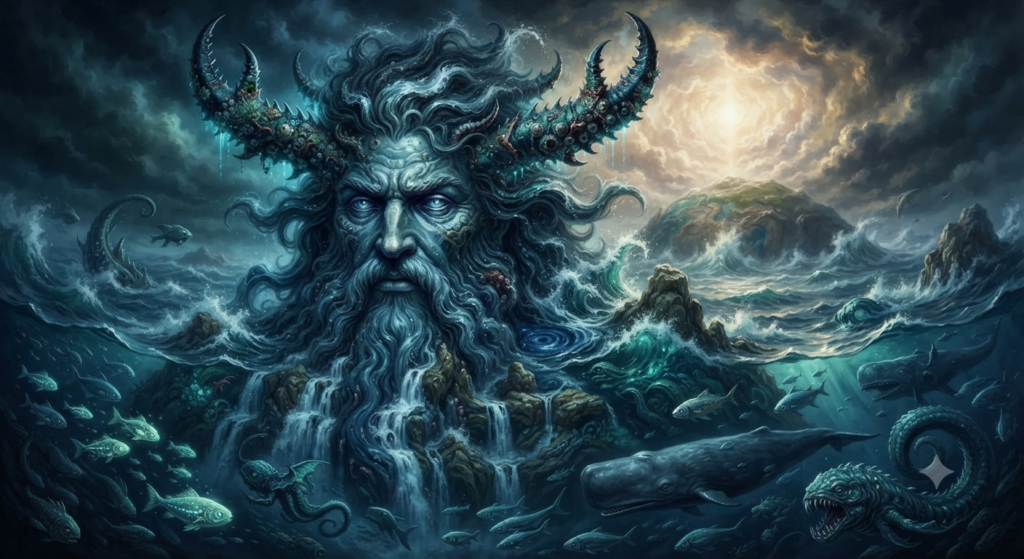
In the vast and ancient cosmology of Greek mythology, before the reign of the Olympian gods, there existed a generation of primeval beings who personified the very foundations of the universe. Among these primordial powers, one figure stands as the embodiment of the sea itself. To answer the question of who is Pontus, the Greek primordial god of the sea? is to delve into the deepest layers of Greek cosmogony, exploring a deity who is not merely a god of the sea, but the sea personified. Pontus (Greek: Πόντος, translit. Póntos) represents the raw, untamed essence of the marine world, a fundamental force born at the dawn of creation. Unlike the more familiar and anthropomorphic sea god Poseidon, Pontus is a passive, ancient power whose significance lies not in dramatic myths or personal agency, but in his role as the progenitor of an entire lineage of sea deities who would come to populate and govern the oceans of Greek myth. This article will serve as a definitive guide to Pontus, exploring his origins, his family, his symbolic meaning, and his enduring legacy in the ancient world.
Origins and Historical Background of Pontus
The origins of Pontus are rooted in the very earliest Greek thoughts about the creation of the cosmos. He belongs to the class of beings known as the Protogenoi, the primordial deities who came into existence at the beginning of time. These were not gods with human-like personalities and complex myths, but rather the physical manifestations of fundamental aspects of the universe, such as the Earth, the Sky, and the Sea.
The primary source for Pontus’s origin is Hesiod’s Theogony, composed around the 8th century BCE. In this foundational work of Greek cosmogony, Hesiod describes the emergence of the first beings from Chaos, the great void. He writes that Gaia (Earth) “bore also the fruitless deep with his raging swell, Pontus, without sweet union of love”. This passage is crucial for understanding his nature. He was not the child of any other deity; he was generated by Gaia alone. This makes him a direct and pure emanation from the Earth itself, a brother to Uranus (the Sky) and the Ourea (the Mountains). In this cosmogony, the sea is not a separate or later creation, but a primary feature of the world that emerged alongside the land and the heavens.
This understanding of the sea as a primordial entity reflects the ancient Greek perception of their world. Surrounded by the sea and dependent upon it for travel, trade, and sustenance, the Greeks recognized its immense and fundamental power. The sea was not just a place; it was a living entity. Other ancient sources offer slightly different genealogies. For instance, the Roman author Hyginus, in his Fabulae, lists Pontus as a son of Aether (the upper atmosphere or light) and Gaia. This alternative parentage suggests a different cosmological model where the sea is born from the mingling of the bright sky and the earth. However, it is the Hesiodic version, with its stark simplicity and emphasis on Gaia as the sole parent, that remains the most influential and widely recognized account of the being who is Pontus, the Greek primordial god of the sea?
The Mythological Role of Pontus
Pontus’s role in Greek mythology is unique and somewhat passive. He is not a character who engages in adventures, loves, or battles like the Olympian gods. Instead, his primary mythological function is as a progenitor—the father of a race of important sea deities. He is the sea itself, an element, not a personality. The myth does not narrate his actions; it simply acknowledges his existence and his generative power.
In this sense, he represents the fertile, creative potential of the sea. Hesiod’s Theogony states that Pontus mated with his mother, Gaia, to produce the first generation of sea gods. This incestuous union, common among the primordial deities, served to populate the seas with divine beings. The children of Pontus and Gaia are the “Old Men of the Sea,” ancient and wise figures who personify different, often more manageable, aspects of the ocean.
Pontus’s name itself, simply meaning “sea,” was often used synonymously with the ocean or the open waters in ancient Greek literature and thought. He represents the sea in a geological and literal sense, not just its emotional or metaphorical meaning. While Oceanus, the Titan, was often imagined as a great river encircling the world, Pontus was the more immediate and tangible sea, the “fruitless deep” that the Greeks sailed upon and feared. His presence in the cosmogony establishes the sea as a primary, eternal force, a concept that has been noted as comparable to other ancient Near Eastern mythologies where the sea (like Tiamat in the Babylonian Enuma Elish) is a primordial power at the beginning of creation.
Family and Relationships
The family of Pontus is where his true mythological importance lies. His relationships, though few, are generative and define the structure of the marine world in Greek myth.
Pontus and Gaia
Gaia, the personification of the Earth, is both the mother and the consort of Pontus. This dual role is a common motif in creation myths, emphasizing the interconnectedness of the earth and the sea. The sea rises from the earth’s depths, and its basin is a part of the earth’s form. Their union produced a powerful and numerous progeny who would fill the oceans.
Offspring of Pontus and Gaia
The primary offspring of this union are the elder sea gods and goddesses. They are:
- Nereus: Often called the “Old Man of the Sea,” Nereus is a wise, gentle, and truthful god of the sea’s bounty. He is best known as the father of the Nereids, the fifty beautiful sea nymphs, including Amphitrite, the wife of Poseidon.
- Thaumas: Thaumas represents the “wonder” of the sea. He is a minor god but is famous as the father of Iris, the rainbow goddess, and the Harpies, the swift wind-spirits.
- Phorcys and Ceto: These two are the most fearsome of the children. They represent the dangers and hidden terrors of the deep. They married each other and produced a host of monsters, including the Graeae (Grey Sisters), the Gorgons (including Medusa), and the serpent-like creature Echidna.
- Eurybia: A sea goddess who represents the force and power of the sea. She married the Titan Crius and became the mother of important figures like Astraeus and Pallas.
Consort of Thalassa
In some traditions, Pontus is also paired with Thalassa, the female personification of the sea’s surface. From this union, it was said, were born the various tribes of fish and other sea creatures. While not as prominent as his lineage with Gaia, this connection reinforces his role as the father of all marine life. Some sources also list the Telchines, ancient sea-dwelling craftsmen and magicians, as his children.
Symbols and Meaning
Pontus’s symbolism is deeply linked to his nature as a primordial personification.
- The Sea Itself: His primary symbol is the sea in its most fundamental and literal sense. He is not a ruler of the sea but the sea itself. This makes his symbol the vast, often chaotic, and mysterious body of water that surrounded the ancient Greek world.
- The “Fruitless Deep”: Hesiod’s description of him as the “fruitless deep” (ἄκαρπος) is a powerful symbol of the sea’s nature. It signifies the sea’s inability to be cultivated like the earth and its reputation as a treacherous, unyielding, and ultimately “fruitless” environment for human survival.
- Crab-Claw Horns and Watery Beard: In a surviving Greco-Roman mosaic from the 2nd century AD, Pontus is depicted in a distinctive way: as a giant, bearded head rising from the sea, with crab-claw horns and a watery-gray beard. These symbols are telling. The crab-claws connect him directly to the marine world and perhaps to the monstrous and ancient aspects of the sea. The watery beard reinforces his identity as a being of water, a personification so complete that even his physical form is made of the element he represents. This image stands in contrast to the more youthful and heroic depictions of Poseidon.
- The Ocean: While often conflated with the Titan Oceanus, Pontus symbolizes the known and navigated sea, rather than the great, river-like body of water that the Greeks believed encircled the world.
Powers and Characteristics
Pontus’s “powers” are not those of a god who hurls thunderbolts or shapes the weather. His power is inherent in his existence.
- Personification of the Sea: His primary power is to be the sea. He embodies its totality—its depth, its power, its mysteries, and its dangers. He is not a figure who actively uses power, but a cosmic force whose existence defines the world.
- Primordial Generation: His defining power is his ability to generate and father an entire race of gods and monsters. Through his consorts, he populates the world with powerful beings, thereby shaping the pantheon and establishing the hierarchy of the marine world.
- Lack of Individual Agency: Unlike the Olympian gods, Pontus does not have myths with personal triumphs or failures. His characteristic, in a sense, is his passivity. He is a foundational stone of the universe, not a dramatic actor within it. While later writings occasionally mention a “titan staff which can strike lightning,” this is a far later and less authentic attribution and is not a part of his classical characterization.
Worship and Religious Importance
As a primordial deity who is the sea itself, Pontus did not have temples, a formal cult, or priests dedicated to his worship in the same way as the Olympian gods. The Greeks worshipped gods like Poseidon because they could interact with them—pray for safe voyages, offer sacrifices, and hope for their favor. A passive, elemental force like Pontus could not be placated or bargained with in the same manner.
His religious importance lies in his status as a cosmogonic figure. The early Greeks believed in a pantheon that reflected the natural world, and by naming and acknowledging these primal forces—Chaos, Gaia, Uranus, and Pontus—they were establishing a sacred and meaningful order to the universe. In the ancient Greek mind, the sea was a powerful and mysterious entity, and by personifying it as Pontus, they paid homage to its presence in their world. This recognition of the sea’s fundamental nature is the primary form of his religious significance.
Ancient Sources
Our knowledge of Pontus comes almost entirely from a few key literary sources that recorded the Greek cosmogonies.
- Hesiod’s Theogony (c. 8th century BCE): This is the most important source. It is the text that firmly establishes Pontus’s birth from Gaia without a father and lists his primary children.
- Hyginus’s Fabulae (1st century CE): This Roman text offers an alternative genealogy, naming Aether and Gaia as Pontus’s parents. It also mentions his children.
- Apollodorus’s Bibliotheca (c. 1st-2nd centuries CE): This later compilation of Greek myths provides a summary that aligns with Hesiod’s account, confirming Pontus’s role as the son of Gaia and father of the sea gods.
- Scholia and Lexica: Later commentators and encyclopedists like the Suda also make references to Pontus, but all ultimately derive their information from the earlier sources.
Artistic Representations
Pontus is rarely depicted in surviving ancient art. The fact that he is not a dramatic figure with a personality meant he was not a popular subject for vase painters or sculptors. However, his image does exist.
- The Constantine Mosaic: A Roman mosaic from the 2nd century AD, now in the Constanţa Museum of National History in Romania, is the most famous depiction. It portrays a stern, bearded male figure with crab-claw horns rising from the sea, surrounded by fish and a fisherman. This late representation shows that he was still recognized in the Roman period, but it also suggests that by this time, his attributes were being conflated with other sea gods, such as Oceanus.
- Rare Depictions: Beyond this mosaic, there are very few identifiable images of Pontus in the ancient world. His legacy in art is not as a major icon, but as a figure who, in later antiquity, was sometimes subsumed into the more famous and visually spectacular deities of the sea.
Cultural Influence and Historical Legacy
The influence of Pontus is more in his role as a concept than as a character. His legacy is found in the very structure of Greek mythology and in the way ancient peoples understood their world.
In the philosophical tradition, the primacy of water as a fundamental element was explored by pre-Socratic thinkers like Thales of Miletus, who posited that water was the arche, or first principle, of all things. This concept has a direct parallel in the idea of Pontus, the personification of the sea, as a primordial being. The myth provided a poetic and religious framework for an idea that would later be debated by philosophers.
In the Roman world, his name was generally known, but he was largely overshadowed by Neptune (the Roman equivalent of Poseidon). The mosaic from Constanța testifies to this cultural transmission, showing that the Romans, who adopted so much of Greek mythology, also adopted the figure of Pontus, even if he was not a central figure in their state religion.
The name “Pontus” also appears in other contexts, most notably in the ancient kingdom of Pontus in Anatolia. While this region’s name is derived from the Greek word for sea, it shows the deep linguistic and cultural footprint of the concept.
Legacy
The legacy of Pontus is that he is the silent, foundational source of all the drama and stories of the Greek sea. He is the father of the wise Nereus, the monstrous Phorcys, and the beautiful Nereids. Without this initial generation, the sea would be a barren void. He establishes the hierarchy: the primordial sea gives birth to the elder sea gods, who in turn give birth to the nymphs and monsters, and finally, the Olympian Poseidon comes to rule over them all.
He represents a fundamental truth about Greek mythology: that the gods of the pantheon did not appear from nowhere. They are part of a long, complex genealogy that reaches back to the very origins of existence, into the chaotic and formless forces of the cosmos. By trying to answer the question who is Pontus, the Greek primordial god of the sea? one realizes that the answer is not a simple story, but a key that unlocks the door to the earliest Greek theological thought, a world where the sea itself was a living, breathing ancestor.
Frequently Asked Questions About Who is Pontus, the Greek primordial god of the sea?
How was Pontus created in Greek mythology?
According to the most famous account, found in Hesiod’s Theogony, Pontus was born from Gaia, the Earth, without a father. He was generated spontaneously by the Earth at the beginning of creation, making him a primordial, or protogenos, deity. Some later sources, like Hyginus, offer an alternative genealogy where he is the son of Aether (Light) and Gaia.
What is the difference between Pontus and Poseidon?
The primary difference is their generation and their role. Pontus is a primordial, pre-Olympian deity who is the literal personification of the sea itself. He is a passive, generative force with few personal myths. Poseidon, by contrast, is an Olympian god with a distinct personality. He is the ruler of the sea, a powerful figure who causes earthquakes, storms, and has a vast array of myths and lovers.
Who were the children of Pontus?
With his mother Gaia, Pontus fathered Nereus (the Old Man of the Sea), Thaumas, Phorcys, Ceto, and Eurybia. In some traditions, he also fathered the Telchines. With Thalassa, the sea’s surface, he is sometimes credited with fathering all the fish and sea creatures.
What does the name “Pontus” mean?
The name “Pontus” is directly derived from the ancient Greek word pontos (Πόντος), which simply means “sea”. As his name suggests, he was the sea itself, not just a god with power over it.
Is Oceanus the same as Pontus?
No, they are distinct figures. Oceanus was a Titan, a son of Uranus and Gaia, and was often depicted as a great, world-encircling river, considered the source of all fresh water. Pontus was a Protogenos, a son of Gaia alone, and represented the more familiar, saltwater sea of the Mediterranean.
What is Pontus’s role in Greek mythology?
His primary role is as a progenitor. He is the father of the first generation of sea deities, effectively populating the oceans with gods, nymphs, and monsters. He is a foundational figure in Greek cosmogony, representing the sea as a fundamental, primordial element of the universe.
Conclusion
Pontus stands as a silent, ancient monument in the landscape of Greek mythology. He is the answer to the question of what the sea was before it was ruled by a god—it was a god itself. He is a being of immense significance, not for the myths he stars in, but for the myths he enables. As the father of Nereus, Thaumas, Phorcys, Ceto, and Eurybia, he is the ultimate ancestor of all the magical, terrible, and beautiful creatures that inhabit the Greek marine world. His historical importance lies in his role in Hesiod’s cosmogony, establishing the sea as a primary, earth-born force. Mythologically, he is a symbol of the passive, generative power of nature, the source from which all other sea deities flow. His legacy is a quiet but foundational one, a reminder that before the heroics and the drama, there was the simple, powerful fact of the deep sea.

Orin Vale has spent the better part of two decades tracing the threads that connect the world’s oldest stories — from the halls of Asgard to the banks of the Nile, from Olympus to the jungles of the Maya. What began as a childhood fascination with flood myths and trickster gods grew into years of independent study across comparative mythology and ancient religion, always chasing the same question: what did these stories mean to the people who first told them? Orin writes for readers who want more than trivia — the ones looking for the beliefs, fears, and truths that myths were built to carry.